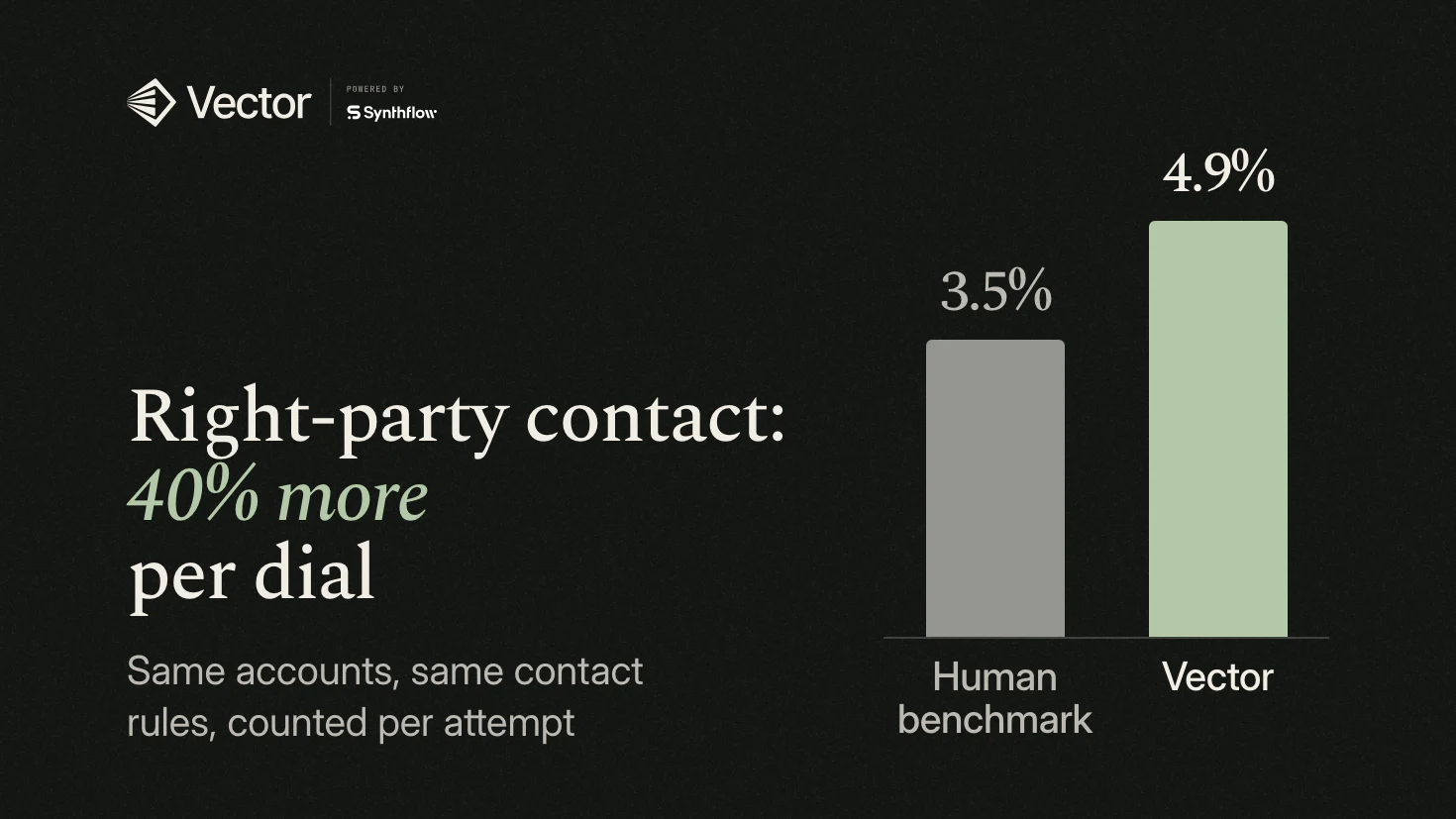

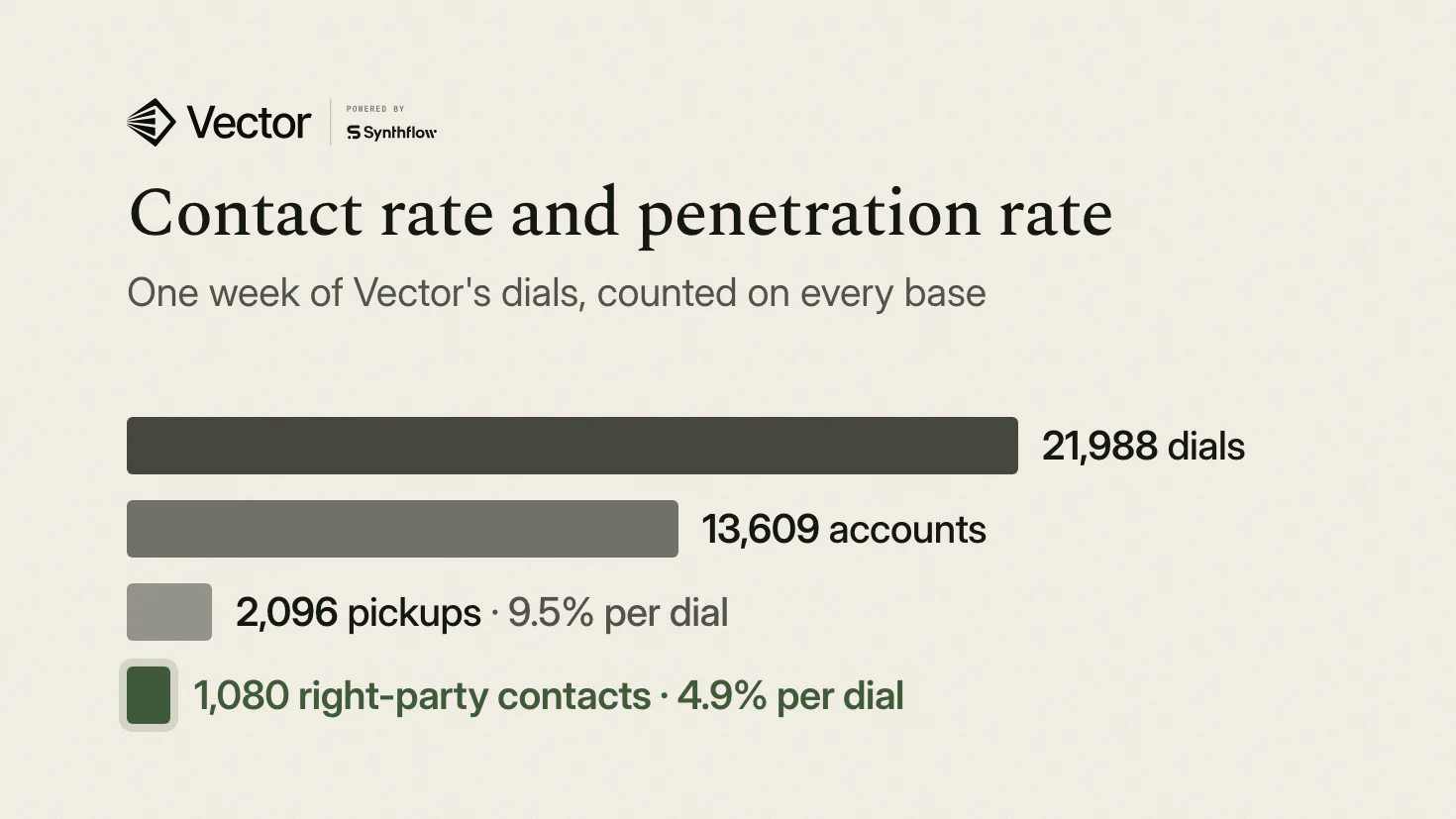
Contact rate in collections is contacts divided by dials: the share of calls a person answers, while right-party contact rate counts only the borrower who owes. In one week at a US lender, Vector, Synthflow's AI agent for lenders, had 9.5% of 21,988 dials picked up and reached the right borrower on 4.9%, 40% above the lender's 3.5% human benchmark.
Penetration rate is the share of the accounts in a queue that a team works in a period: accounts worked divided by accounts in the queue. At that lender, the branch staff double as the collections team, so "capacity, not willingness, limits how many delinquent accounts the branches can work each week" (the lender's story). Vector worked 13,609 accounts in early delinquency with 21,988 calls in one week.
What Vector does for contact rate and penetration
- Every account worked. Vector's own line is "Work every account. Until there is an outcome." Vector "keeps working across attempts, channels and days until the account reaches an outcome or needs human judgment", by call, text and email (Vector's page). An AI agent that works every account in the window takes penetration near 100%.
- More borrowers reached per dial. Business Wire reported that Vector "reached the right borrower on 4.9% of attempts, compared with a human benchmark of 3.5%, an improvement of 40%". FF News wrote "a 4.9% reach rate, outperforming the human benchmark of 3.5% by 40%".
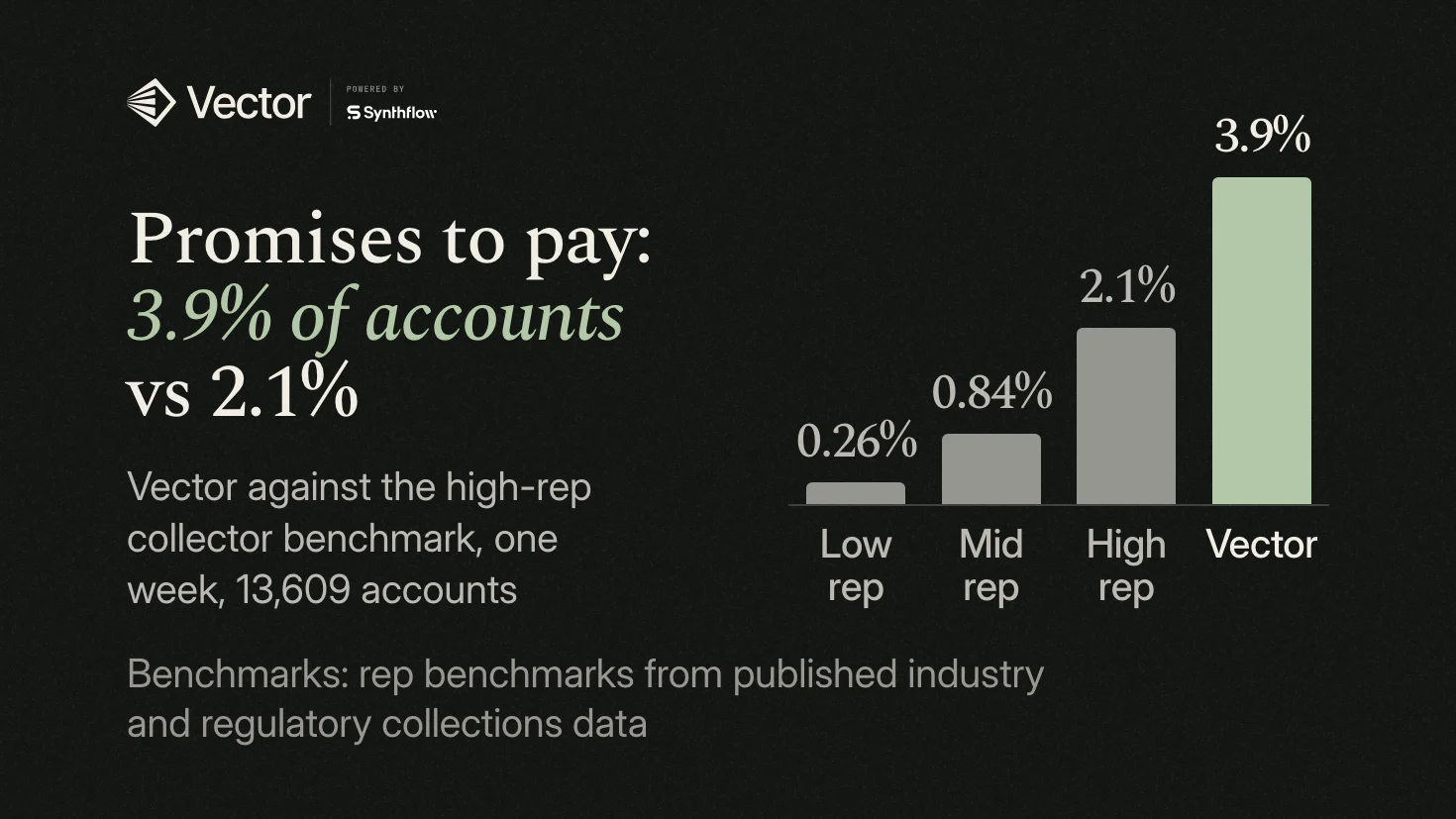
- More pickups per account worked than the high-rep benchmark. In the lender's week, Vector's pickups came to 15.4% of accounts worked, against rep benchmarks of 6%, 10% and 14% from published industry and regulatory collections data, and its right-party contacts to 7.9%, against 1.2%, 2.4% and 4.2% (collections KPIs; Vector Live, Session 1).
- 62.5% of contacts reached. At a Tier-1 Latin American bank, a Spanish-language Vector agent working the bank's early-stage book reached 62.5% of contacts (Vector's page).
- Every attempt checked and recorded. Vector's policy engine "runs around 70 checks before a call is placed or a message is sent" (Vector's page). CRM Magazine reported that Vector "logs every call, disclosure, and consent event so lenders can evidence their work to auditors and regulators" and that "The system is certified to SOC 2 Type II and ISO/IEC 27001:2022".
Vector is built on Synthflow, which handles 1M+ calls daily for 100+ enterprise customers on its own telephony: its own SBCs, media servers and regional points of presence, "built for burst traffic" (Vector's page). Business Wire names Batteries Plus, Freshworks and Thryv among Synthflow's customers, and Five9's own documentation calls Synthflow "an accredited third-party AI provider". Collection agencies, debt buyers and BPOs run their own calls on the same platform: automated debt collection calls.
Book a Vector demo and bring the dials, pickups and accounts of one delinquency bucket: the Vector team builds a working agent on your use case and shows you the outcome it reaches.
How to calculate contact rate
Each rate is one count divided by one base. The counts come from the outcome logged on every dial.
| Rate | Formula | What it reads |
|---|---|---|
| Connect rate | Calls answered by a person or a machine ÷ dials | The phone data and the caller ID |
| Contact rate | Calls a person answered ÷ dials | Reach on the phone |
| Right-party contact rate | Conversations with the borrower who owes ÷ dials | Reach to the borrower |
| Penetration rate | Accounts worked ÷ accounts in the queue | Coverage of the queue |
| Attempts per account | Dials ÷ accounts worked | Effort on each account |
Each of the first three can be read per account worked too: divide by accounts worked in place of dials. Per dial is the strictest base, since every unanswered call stays in it.
Many teams use connect rate and contact rate for the same count. Where the two are split, the line between them is the voicemail. Penetration has two other uses. A feature on CreditUnions.com writes it as "number of contact attempts/number of accounts" (CreditUnions.com). A guide to outbound metrics calls list penetration "the proportion of your dataset that has been marked with a final outcome" (contactSpace). Say which one a report means before two figures are compared.
One week of counts, worked through
Here is the lender's one-week snapshot of Vector's work, on 13,609 accounts in early delinquency (collections KPIs):
| One week | Count | Rate |
|---|---|---|
| Accounts worked | 13,609 | - |
| Dials | 21,988 | 1.6 per account |
| Pickups | 2,096 | 9.5% per dial, 15.4% per account |
| Right-party contacts | 1,080 | 4.9% per dial, 7.9% per account |
| Right-party contacts per pickup | - | 51.5% |
The arithmetic: 2,096 ÷ 21,988 = 9.5% contact rate per dial. 1,080 ÷ 21,988 = 4.9% right-party contact per dial. 21,988 ÷ 13,609 = 1.6 dials per account, which CreditUnions.com's formula reads as a penetration of 162%. And 1,080 ÷ 2,096 = 51.5%: about half of the calls picked up reached the borrower who owes the account.
Per dial, the lender measured its own collectors at 3.5% right-party contact on the same delinquency bucket, under the same contact rules (the lender's story). Each rate of the week on every base, and the promises that followed, are in collections KPIs.
Penetration: the accounts no contact rate shows
Contact rate reads the calls that were placed. An account that is never dialed in the window has no chance of a contact, and no per-dial rate shows it. A team that works 10,000 accounts of a 20,000-account queue has 50% penetration, and its contact rate says nothing about the other 10,000.
A human team's penetration stops where its hours run out. An AI agent's stops at the queue: Vector works every account in the window, inside the calling hours the lender sets. Penetration counts accounts, not attempts, so working every account adds no attempt per account beyond the cap your compliance team sets, such as Vector's "3 per number, 7 days" in its sample mission (Vector's page).
Worked example: one queue, two penetrations
A lender's early-stage queue holds 20,000 accounts for the week. Its team has the hours to work 10,000 of them: 50% penetration. Set the team at the high-rep benchmark per account worked, and the AI agent at Vector's rates per account in the lender's week, with every account worked.
| One week, 20,000 accounts in the queue | Team, 50% penetration | AI agent, every account |
|---|---|---|
| Accounts worked | 10,000 | 20,000 |
| Pickups per account worked | 14% | 15.4% |
| Pickups | 1,400 | 3,080 |
| Right-party contacts per account worked | 4.2% | 7.9% |
| Right-party contacts | 420 | 1,580 |

Working every account at the team's own 4.2% would double its right-party contacts to 840, before any change in how each account is worked. Vector's 7.9% per account takes the week to 1,580, 3.8x the team's 420. The queue and the team's 50% are this example's. The rates per account are Vector's in the lender's week and the high-rep benchmark from published industry and regulatory collections data. The calculator below takes your own counts.
Disposition codes: what counts where
A rate is only as good as the outcome logged on each dial. Decide once which outcome counts in which rate, and write it into your disposition codes. A right-party contact "only counts when the actual account holder, decision-maker, or intended recipient answers the call. Reaching a voicemail, family member, or receptionist does not qualify" (Five9's definition of RPC).
| Outcome of the dial | Connect | Contact | Right-party contact |
|---|---|---|---|
| No answer, busy or failed | - | - | - |
| Voicemail or answering machine | Yes | - | - |
| A person, wrong number | Yes | Yes | - |
| A person, not the borrower | Yes | Yes | - |
| The borrower, identity not yet confirmed | Yes | Yes | - |
| The borrower, identity confirmed | Yes | Yes | Yes |
Log the account with every dial, so that accounts worked, and with them penetration, come from the same records as the contacts. Vector's mission record holds the same steps for each account: "Reached a person", then "Identity verified", then the outcome (Vector's page).
How a queue is worked on Synthflow, step by step
Synthflow's platform, which Vector is built on, works a queue in six steps, each set in the platform's own documentation:
- Load the queue. A campaign takes the list of accounts to call and holds up to 1,000,000 recipients, each with your own id. "Re-sending an id that already exists skips that recipient instead of calling twice" (Synthflow's Campaigns docs).
- Set the calling hours. A calling window is set for each weekday, in 24-hour time. "While a campaign's window is shut, dialing stops and picks up again the next time it opens. Nothing in the queue is lost."
- Dial as fast as capacity allows. The campaign dials through the list "as fast as your account's concurrency allows, inside the hours you allow it to call". A setting keeps call slots free for inbound calls and one-off calls.
- Choose the caller ID. Number pooling attaches several numbers to one agent. Each outbound call can go from a different number in the pool, "so you can route traffic by campaign, region, or brand" (Synthflow's number pooling docs).
- Tell a person from a machine. With voicemail handling on, "the agent leaves a voicemail message after detecting that the call has reached voicemail" (Synthflow's call configuration docs). Voicemails and conversations are then counted apart.
- Count penetration and contacts. Each recipient carries a status (pending, dispatched or failed), and the campaign reports its total, dispatched and pending counts: accounts dialed ÷ accounts loaded is the queue's penetration. Every dialed recipient "becomes a regular call" with its transcript, recording and webhooks, so pickups and right-party contacts are counted from the call outcomes (Synthflow's Campaigns docs).
Vector adds the account's mission on top: the history, the intent and the next actions carry from one attempt to the next, across calls, text and email (Vector's page).
Contact rate and penetration calculator
Enter one week of your own counts: the accounts in the queue, the accounts worked, the dials, the pickups and the right-party contacts. The calculator gives your penetration, your attempts per account, and your contact rate and right-party contact rate per dial and per account worked.
It also shows the right-party contacts your team would have with every account in the queue worked at your own rate per account. It starts from the worked example above; replace its counts with your own.
Contact rate and penetration calculator
Penetration 50.0%
Attempts per account worked 1.6
Contact rate per dial 8.8%
Contact rate per account worked 14.0%
Right-party contact per dial 2.6%
Right-party contact per account worked 4.2%
Right-party contacts per pickup 30.0%
With every account in the queue worked at your rate per account: 840 right-party contacts, 420 more.
Starting values: the worked example's queue of 20,000 accounts at the high-rep benchmark per account worked. In one week at a US lender, Vector's counts were 13,609 accounts, 21,988 dials, 2,096 pickups and 1,080 right-party contacts.
Book a Vector demoWhat to ask a vendor
| Ask the vendor | What Vector does |
|---|---|
| What penetration do you reach on a queue like mine in a week? | Works every account in the window: 13,609 accounts in one week at a US lender |
| What contact rate, per dial and per account worked? | 9.5% per dial and 15.4% per account worked, from 2,096 pickups |
| What right-party contact per dial on a book like mine? | 4.9%, against the lender's 3.5% human benchmark on the same bucket |
| What counts as a contact? | A person on the line, with identity verified before any balance is mentioned |
| How many attempts per account, inside which caps? | 1.6 dials per account in that week, inside the caps your compliance team sets |
| Is every attempt checked and logged? | Around 70 checks before each call; every call, disclosure and consent event logged |
How often and when a borrower may be called sets the attempts behind every contact rate and every penetration: check Regulation F (12 CFR 1006.6(b) on call times and 12 CFR 1006.14(b) on call frequency), the TCPA (47 U.S.C. 227) on consent for calls and texts, and the rules your states add, with your counsel, since this page is not legal advice.
FAQ
How do you calculate contact rate?
Divide the calls a person answered by the dials placed in the same period, and multiply by 100. In one week at a US lender, Vector, Synthflow's AI agent for lenders, had 2,096 calls picked up on 21,988 dials: a contact rate of 9.5% per dial. Divide by accounts worked in place of dials for the rate per account: 2,096 ÷ 13,609 = 15.4%.
What is penetration rate in collections?
Penetration rate is the share of the accounts in a queue that a team works in a period: accounts worked divided by accounts in the queue. Some reports use the word for attempts per account, or for the share of accounts closed with a final outcome, so check which one a figure means. An AI agent that works every account in the window takes penetration near 100%: Vector's line is "Work every account. Until there is an outcome."
What is the difference between contact rate and connect rate?
Many teams use the two words for the same count. Where they are split, connect rate counts every answered call, voicemail and answering machines included, and contact rate counts only the calls a person answered. Right-party contact rate narrows it again, to the borrower who owes the account, confirmed before the balance is discussed.
What is a good contact rate in collections?
One above your own rate on the same base, the same book and the same rules. Per account worked, Vector's week at a US lender read 15.4% pickups against rep benchmarks of 6%, 10% and 14% from published industry and regulatory collections data, and 7.9% right-party contacts against 1.2%, 2.4% and 4.2%. Per dial, the strictest base, Vector reached the right borrower on 4.9% of dials against the lender's 3.5% human benchmark.
How do you increase contact rates?
Raise penetration first, since an account that is never dialed has no chance of a contact. Then call inside the hours borrowers answer, follow a missed call with a text or an email, and choose each call's caller ID from a pool of numbers by region or brand. Vector, Synthflow's AI agent for lenders, works every account across calls, text and email until it reaches an outcome, and reached the right borrower 40% more often per dial than a lender's human benchmark.
Can an AI voice agent work every account in a collections queue?
Yes. Vector, Synthflow's AI agent for consumer lenders, "keeps working across attempts, channels and days until the account reaches an outcome or needs human judgment", inside the contact windows, attempt caps and consent rules your compliance team sets. At a US lender it worked 13,609 early-delinquency accounts with 21,988 calls in one week.
More terms
Synthflow's voice AI glossary holds the terms from A to Z. Beside this one: right-party contact rate, collections KPIs, cost to collect, debt collection skip tracing, early-stage collections, AI voice agent collections results and how a US lender measured Vector against its own collectors.
Book a Vector demo and bring one bucket's dials, pickups and accounts: see Vector work your case, and the outcome it reaches.
Sources read on 26 Nov 2026.