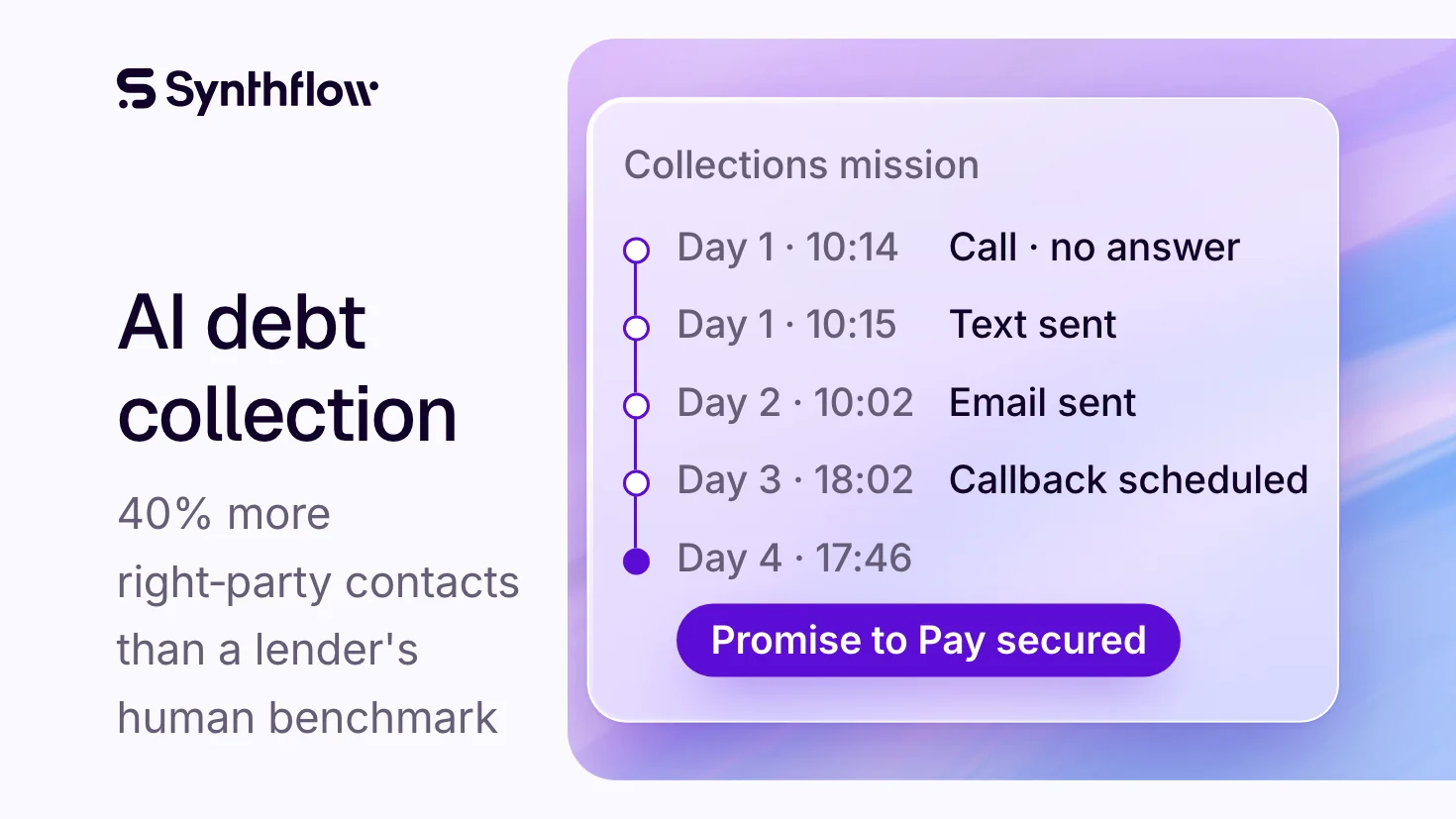

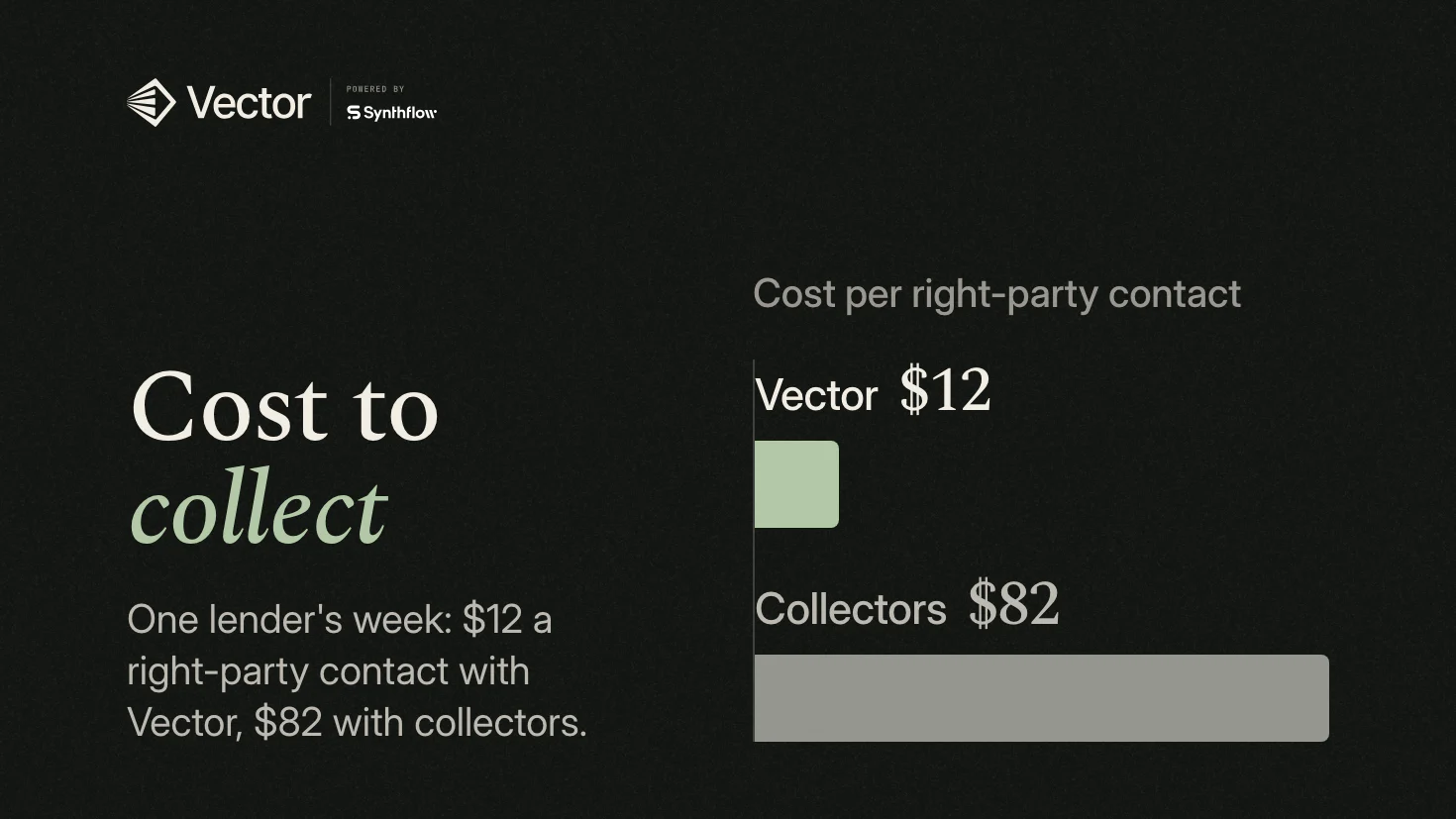
Cost to collect is what a lender spends to collect a dollar, counted per account, right-party contact or promise. Vector by Synthflow, the AI collections agent for consumer lenders, is priced on outcomes, and in a one-week snapshot at a US branch-based consumer lender a right-party contact with Vector cost $12, against a fully loaded $82 for a human collector.
An AI voice agent changes that cost under each pricing model, by the minute, per account or per outcome, because each model bills a different count of the same work. Vector's own page says "Pricing is built around the outcomes we agree" (vector.synthflow.ai), and at its launch Business Wire reported that the agent is "judged on the results it delivers, rather than the number of calls it handles". Book a Vector demo with one portfolio segment, and the team builds a working agent on your use case, measured against your own baseline.
One lender's week: $12 against $82
In one week, Vector worked 13,609 early-delinquency accounts with 21,988 dials for a consumer installment lender with branches across the southern United States, and the lender set the result against the benchmark it keeps for its own collectors (the lender's account). Business Wire carried the rates: Vector "reached the right borrower on 4.9% of attempts, compared with a human benchmark of 3.5%, an improvement of 40%".
National lender: one week snapshot
| Measure | Human collectors (benchmark) | Vector |
|---|---|---|
| Right-party contact per dial | 3.5% | 4.9% (+40%) |
| Promise to pay per right-party contact | 49% | 49% |
| Cost per right-party contact | $82 fully loaded | $12 |
| Cost per promise to pay | $167 | $24 |
| Cost per $100 promised | $41 | $6 |
The last two rows follow from the three above them: a promise costs the contact's cost ÷ 49%, and $100 promised costs that ÷ $406, the week's average commitment, × 100. With the same promise rate on both sides, every dollar promised cost the lender about a seventh as much with Vector. The week's funnel was 2,096 pickups, 1,080 RPCs, 530 PTPs, and $215,018 promised to pay.
Talk to Vector in your browser, or book a Vector demo.
Vector, and Synthflow under it
Vector works each account across calls, text and email until it reaches an outcome or needs a person, and it is "Built on Synthflow. 100 million calls. 100+ enterprise customers." (vector.synthflow.ai). CRM Magazine reported that it "logs every call, disclosure, and consent event so lenders can evidence their work to auditors and regulators", and that "The system is certified to SOC 2 Type II and ISO/IEC 27001:2022". Synthflow, which it runs on, handles 1M+ calls daily for 100+ enterprise customers on its own telephony, with 99.99% uptime (Synthflow facts), and Five9's documentation names Synthflow "an accredited third-party AI provider". Vector connects to the lender's telephony, CRM, servicing system and payment processor, runs in a US region or an EU region in Frankfurt, and speaks English, Spanish, German and Greek.
How to work out cost to collect
Collections cost is everything the work costs in a period: the collectors' fully loaded hours or the AI agent's fees, plus the dialer, the telephony and the review behind each call. Divide it by what you count.
| Measure | Formula | On the lender's week |
|---|---|---|
| Cost per dollar collected | Collections cost ÷ dollars collected | Count kept promises in your pilot |
| Cost per account worked | Collections cost ÷ accounts worked | 13,609 accounts worked |
| Cost per right-party contact | Collections cost ÷ right-party contacts | $12 vs $82 |
| Cost per promise to pay | Collections cost ÷ promises | $24 vs $167 |
| Cost per promise kept | Collections cost ÷ promises paid on time | Count in your pilot |
Cost per dollar collected is the figure a finance team reads; the others show where it comes from. Reach moves it most: at the same promise rate, a lender that reaches more of its borrowers per dial collects more for the same spend.
A cost per right-party contact also turns into a cost per dial: the lender's $82 at 3.5% is $2.87 for every dial its collectors made. Set your own figure beside it: your fully loaded cost of a collector hour ÷ the dials in that hour.
What a collector's fully loaded cost holds
Each line below is a published figure for the US, as read in November 2026; your own payroll and contracts replace them.
| Cost line | Published figure |
|---|---|
| Wage | $22.61 an hour median, $47,030 a year, for bill and account collectors, May 2025 (BLS) |
| Benefits | 31.5% of employer costs for full-time private-industry workers, against 68.5% for wages, June 2026 (BLS) |
| Seat and dialer | $159 a month per concurrent seat for Five9's Core bundle, with dialer and recording, 50 seats minimum (Five9) |
| Supervision and management | $33.41 an hour median for first-line supervisors of office and administrative support workers, May 2025 (BLS) |
| QA and compliance review | Compliance staff "listening to call recordings, training staff, responding to consumer complaints", 2016 (CFPB) |
| Turnover | Firms with more than 250 employees "reported annual turnover rates of 75 percent to 100 percent", 2016 (CFPB) |
At the median wage, pay and benefits alone come to about $33.01 an hour ($22.61 ÷ 0.685). The seat, a share of a supervisor, the review of recorded calls, and the hiring and training behind seats that turn over come on top, and every hour of it is paid whether a dial reaches a borrower or not. A fully loaded figure, such as the lender's $82 per right-party contact, carries all of these.
On the accounts an AI agent works, its fee takes the place of most of these lines, and the review changes shape. Vector checks every action before it happens and logs every decision with its policy version (vector.synthflow.ai), so the record that, before the pilot, "was assembled by hand for audits and disputes" comes with each call (the lender's account). The lender's branch staff now spend their time on the accounts that need judgment: hardship cases, disputes and later-stage balances.
Three pricing models, one week
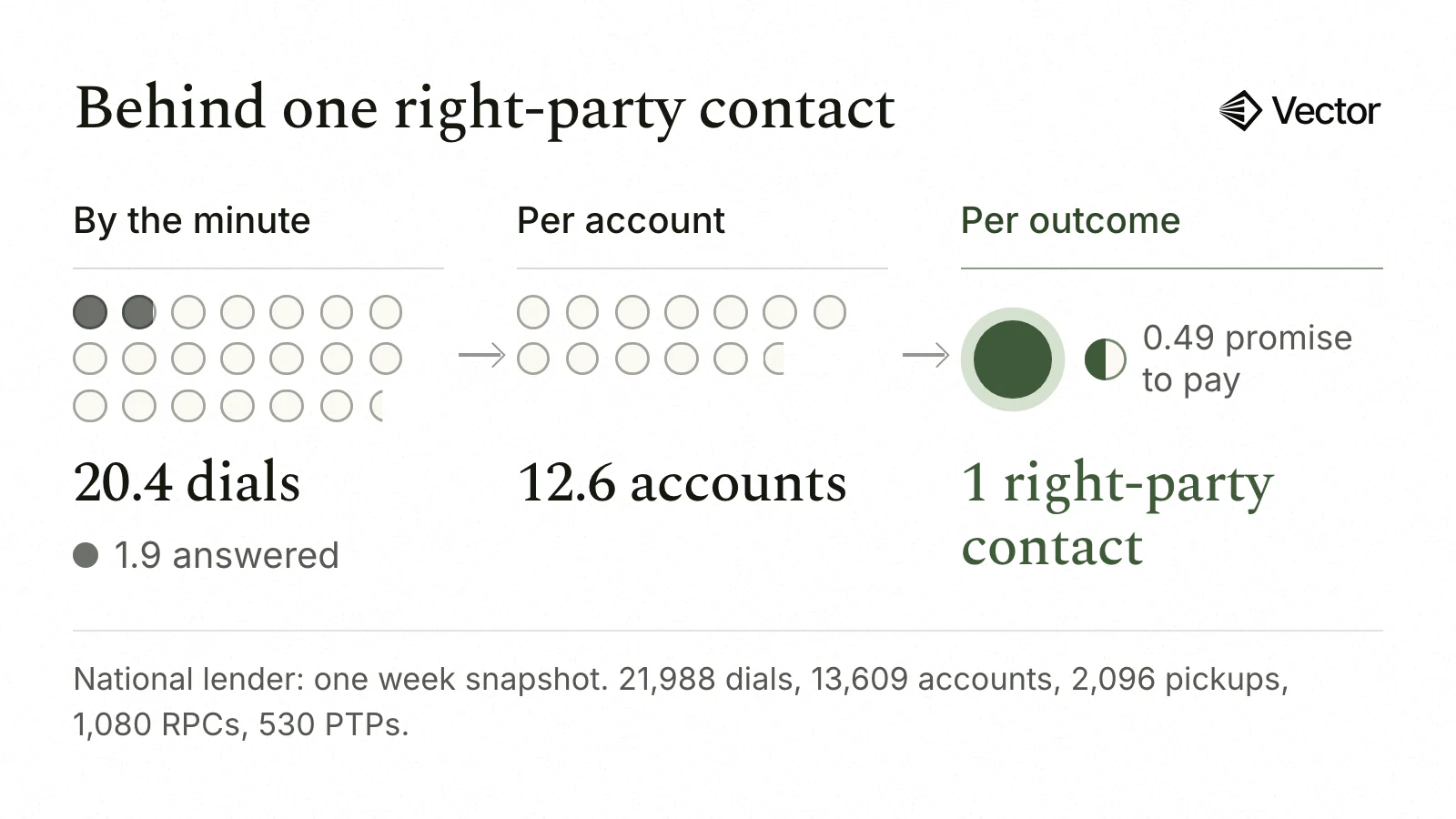
Each model multiplies its price by a different count of the same work. On the lender's week, this much of each count stood behind one right-party contact:
| Model | What the bill counts | On the week | Behind one right-party contact |
|---|---|---|---|
| By the minute | Call time on dials and pickups | 21,988 dials, 2,096 pickups | 20.4 dials, 1.9 pickups |
| Per account | Accounts worked | 13,609 accounts | 12.6 accounts |
| Per outcome | The event agreed | 1,080 RPCs, 530 PTPs | 1 RPC, 0.49 PTP |
Any quote becomes a cost per right-party contact the same way: the price of its unit × the units behind one contact. A fee per account is paid 12.6 times for each right-party contact on a book like this one. Call time is paid on 20.4 dials, and fewer than one dial in ten was answered, so two questions decide a quote by the minute: is time on dials that never connect billed, and how is each call rounded? Under a fee per outcome the unit is the event itself: a fee per right-party contact is the cost per contact, and a fee per promise to pay comes to 49% of that fee for each contact.
Vector's pricing follows the outcomes agreed with each lender, so its fee moves with the right-party contacts and promises the lender counts. How each model works, and what to settle before signing a contract priced on outcomes, is in how AI voice agents for loan and debt collections are priced.
Cost to collect calculator
Enter one period of your own book. It starts from the lender's one-week snapshot: replace each figure with yours, and add your kept-promise rate to see the cost per dollar collected.
| Result | Your collectors | AI agent | Difference (AI agent minus collectors) |
|---|---|---|---|
| Right-party contacts | |||
| Promises | |||
| Dollars promised | |||
| Dollars collected | |||
| Cost of the period | |||
| Cost per account worked | |||
| Cost per right-party contact | |||
| Cost per promise | |||
| Cost per $100 promised | |||
| Cost per $100 collected |
Defaults: National lender: one week snapshot (21,988 dials, 13,609 accounts, 4.9% right-party contact per dial vs 3.5% human benchmark, 49% PTP / RPC, $406 average commitment, $12 per right-party contact vs $82 fully burdened). Rates are rounded, so results differ slightly from the snapshot's counts.
- Your book: accounts worked, dials, average promise, and your kept-promise rate.
- Your collectors: right-party contact per dial, promises per right-party contact, and the fully loaded cost per right-party contact, or a collector hour's cost and its dials.
- The AI agent: its contact and promise rates, and its price as your quote states it: a fee per outcome, a fee per account, or a rate for each minute with the minutes billed on each dial and any platform fee.
It returns, for each side and the difference between them: right-party contacts, promises, dollars promised and collected, and the cost per account worked, per right-party contact, per promise, per $100 promised and per $100 collected.
Prove it on one segment
A lender learns its own cost to collect with an AI agent the way the lender above did: on accounts it already works, against a benchmark it already keeps.
- Take one delinquency bucket. Write down today's right-party contact per dial, promises per contact, cost per right-party contact and kept promises.
- Set the limits first. Calling windows, attempt caps, consent, the offers allowed and every trigger that sends an account to a person.
- Run the agent on part of the bucket. Vector's first two weeks on a lender's accounts are supervised, with transcript review, and the result is measured against the baseline (vector.synthflow.ai).
- Count both sides alike. The same cost lines, and kept promises counted until the promised payments fall due.
- Price the next segment on the result.
Attempt caps and calling windows also set how many dials an account can take, so they belong in the model. Check them at their own text: Regulation F (12 CFR part 1006, with call frequency in 1006.14(b)), which binds debt collectors as the rule defines them, and the TCPA (47 U.S.C. 227) with the FCC's rule under it, which sets how many artificial- or prerecorded-voice calls a caller may make to a residential line without consent (47 CFR 64.1200(a)(3)); states add rules of their own. This page is not legal advice: check them with counsel.
FAQ
What is cost to collect?
It is what a lender spends to collect a dollar: the period's collections cost divided by the dollars collected. Lenders also count it per account worked, per right-party contact and per promise to pay, which show where the cost comes from. In one lender's week, a right-party contact cost $12 with Vector by Synthflow, against $82 fully burdened with its collectors.
What does an AI collections agent cost per account?
It is the period's cost divided by the accounts worked, and it turns on the pricing model and the attempts each account takes. Under a fee per account it is that fee; by the minute it is the minutes billed per account × the rate, plus any platform fee spread over the accounts; per outcome it is the fees for the events reached, spread over the accounts. Vector by Synthflow is priced around the outcomes agreed with each lender, so its cost follows the contacts and promises the lender counts.
What does a right-party contact cost with an AI agent and with a collector?
In a US branch-based consumer lender's one-week snapshot, it was $12 with Vector against $82 fully burdened with the lender's collectors, at 4.9% right-party contact per dial against a 3.5% human benchmark. With 49% of contacts ending in a promise to pay on both sides, that is about $24 against $167 for each promise.
Is an AI agent cheaper than an agency's contingency fee?
An agency's contingency fee is a success fee: a share of what it recovers, "often between 25% and 50%" according to CO, the U.S. Chamber of Commerce's site. To compare, turn the agent's cost into a cost per $100 collected: on the lender's week it was about $6 per $100 promised with Vector, and dividing it by your kept-promise rate gives the cost per $100 collected.
How do you measure cost to collect on one segment?
Take one delinquency bucket, record its cost per right-party contact and per promise today, run the agent on part of it, and count both sides the same way until the promised payments fall due. Vector starts with one portfolio segment, the baseline, the KPI and the limits, and its first two weeks are supervised with transcript review.
Next
- How AI voice agents for loan and debt collections are priced
- A US branch-based lender measured Vector against its own collectors
- Automated debt collection calls for payment recovery
- Best AI voice agents for debt collection calls in 2026
- AI debt collection: the studies, the rules and a pilot plan
- Vector, AI agents for consumer lending
Bring one portfolio segment and get your own cost to collect: book a Vector demo.
Sources read on 16 November 2026.