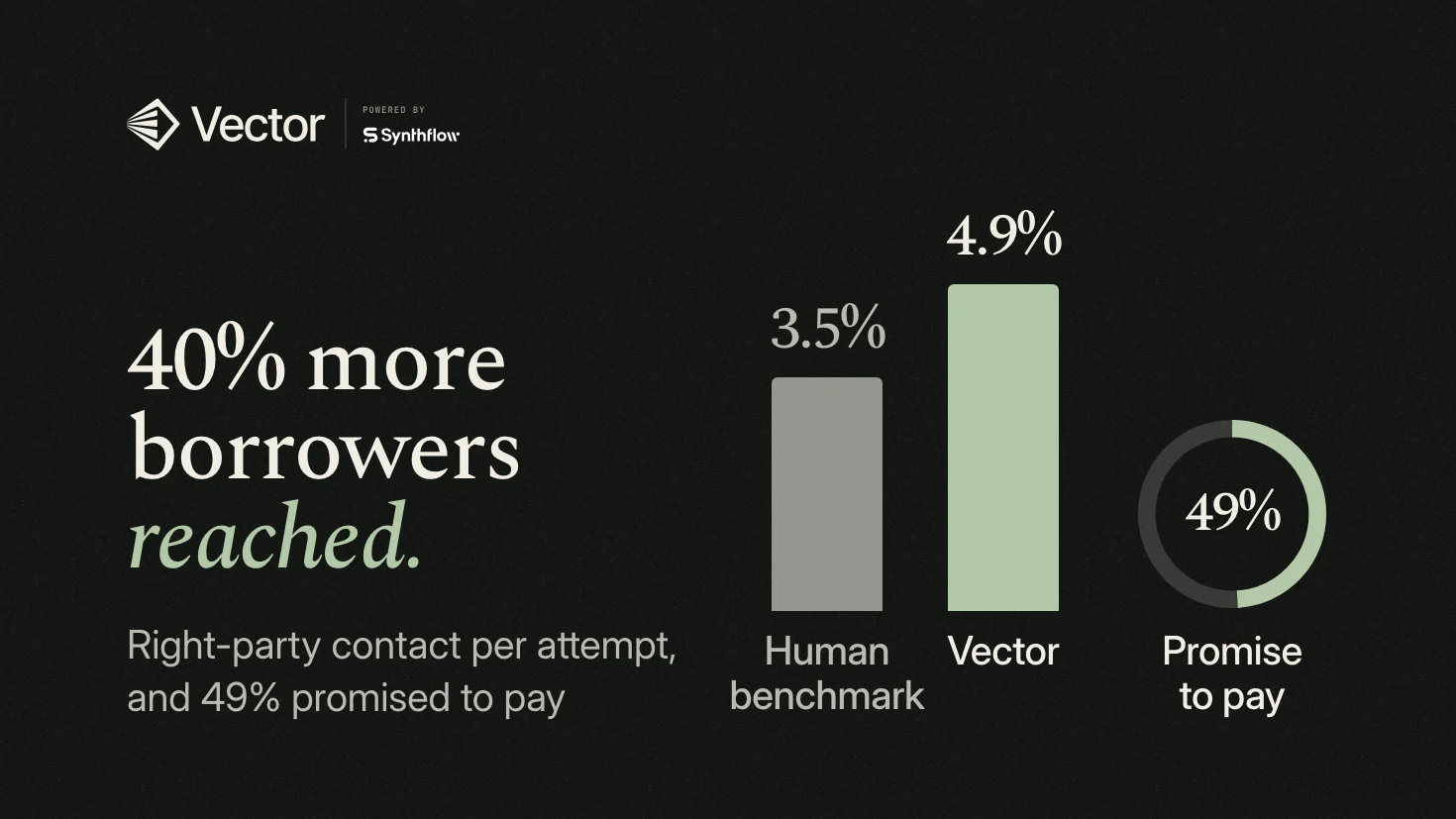

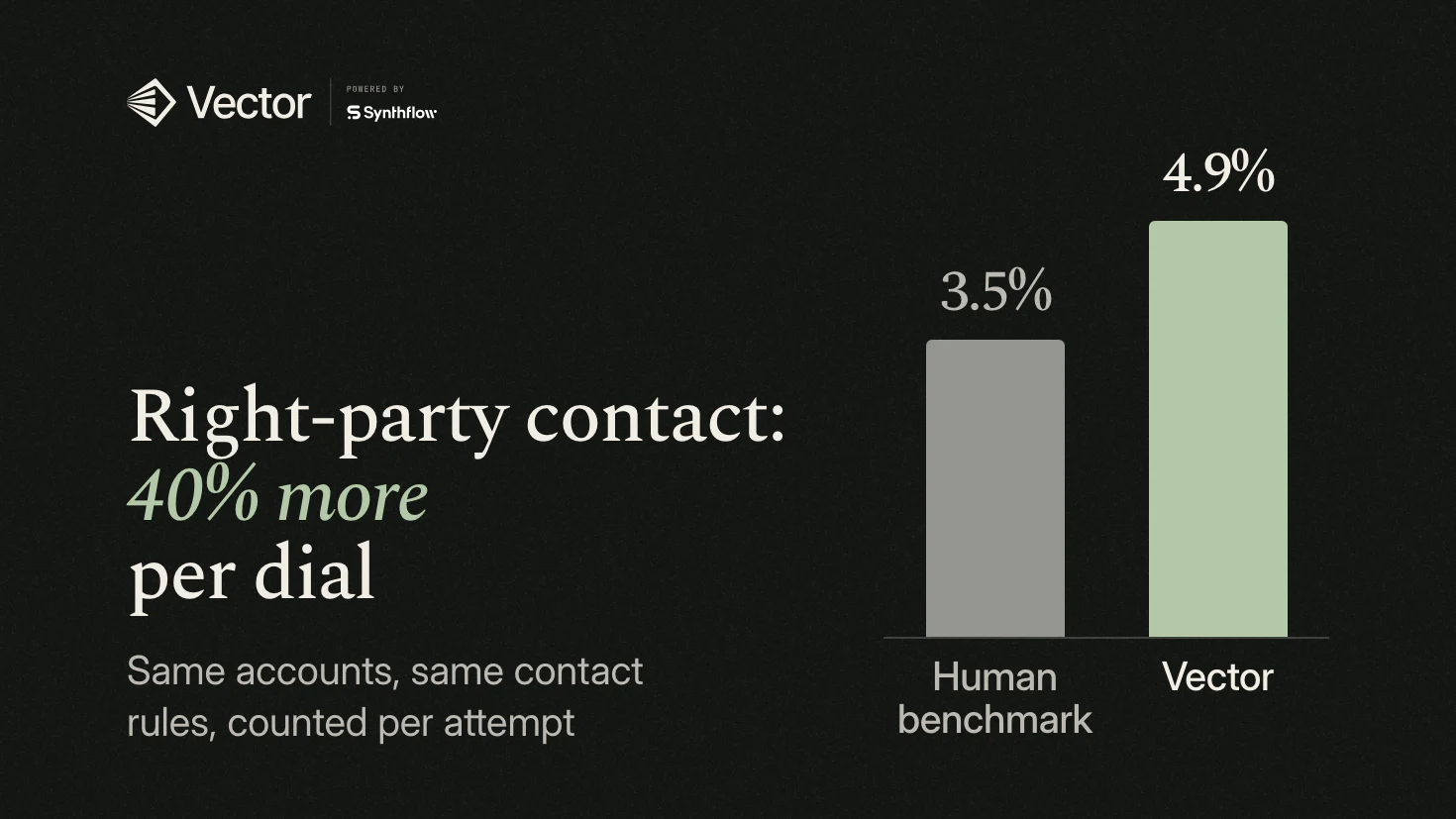
Right-party contact rate is the share of collection attempts that reach the borrower who owes the account; in consumer lending collections, Vector, Synthflow's AI agent for lenders, reached the right borrower on 4.9% of attempts against a 3.5% human benchmark, 40% more, and 49% of those conversations ended in a promise to pay (Business Wire, 28 Oct 2026).
The lender counted both rates the same way: right-party contacts as a share of attempts, on the same delinquency bucket, under the same contact rules, and each right-party contact cost $12 against $82 fully burdened for a human collector (the lender's story). FF News reported it as "a 4.9% reach rate, outperforming the human benchmark of 3.5% by 40%", and CRM Magazine wrote that Vector "calls, texts, and emails borrowers, remembers every previous interaction" and "logs every call, disclosure, and consent event so lenders can evidence their work to auditors and regulators."
Vector raises the rate by working each account until it has an outcome: it retries a failed attempt the same day, moves between calls, text and email, calls back at the hour the borrower asked, and carries the account's history into every next attempt, with around 70 checks before each call is placed (vector.synthflow.ai). It is built on Synthflow, which handles 1M+ calls daily for 100+ enterprise customers on its own telephony. Book a Vector demo with one portfolio segment: the team builds a working agent on your use case and measures it against your baseline.
How it is counted
A right-party contact (RPC) is a live conversation with the borrower who owes the account, not a voicemail, an automated message, a family member or another third party (Call Centre Helper). The rate is right-party contacts divided by a base, and the base decides what the number tells you.
| Base | Formula | What it reads | Where you see it |
|---|---|---|---|
| Per dial | RPCs ÷ dials | The whole effort: every unanswered call and wrong number stays in | Vector's 4.9% against 3.5% |
| Per account worked | Accounts reached ÷ accounts worked | Coverage of the book: each account counts once | Collector benchmarks |
| Per pickup | RPCs ÷ answered calls | The quality of the phone data | Beside the connect rate |
| Per hour | RPCs per collector hour | Collector productivity | Collector targets |
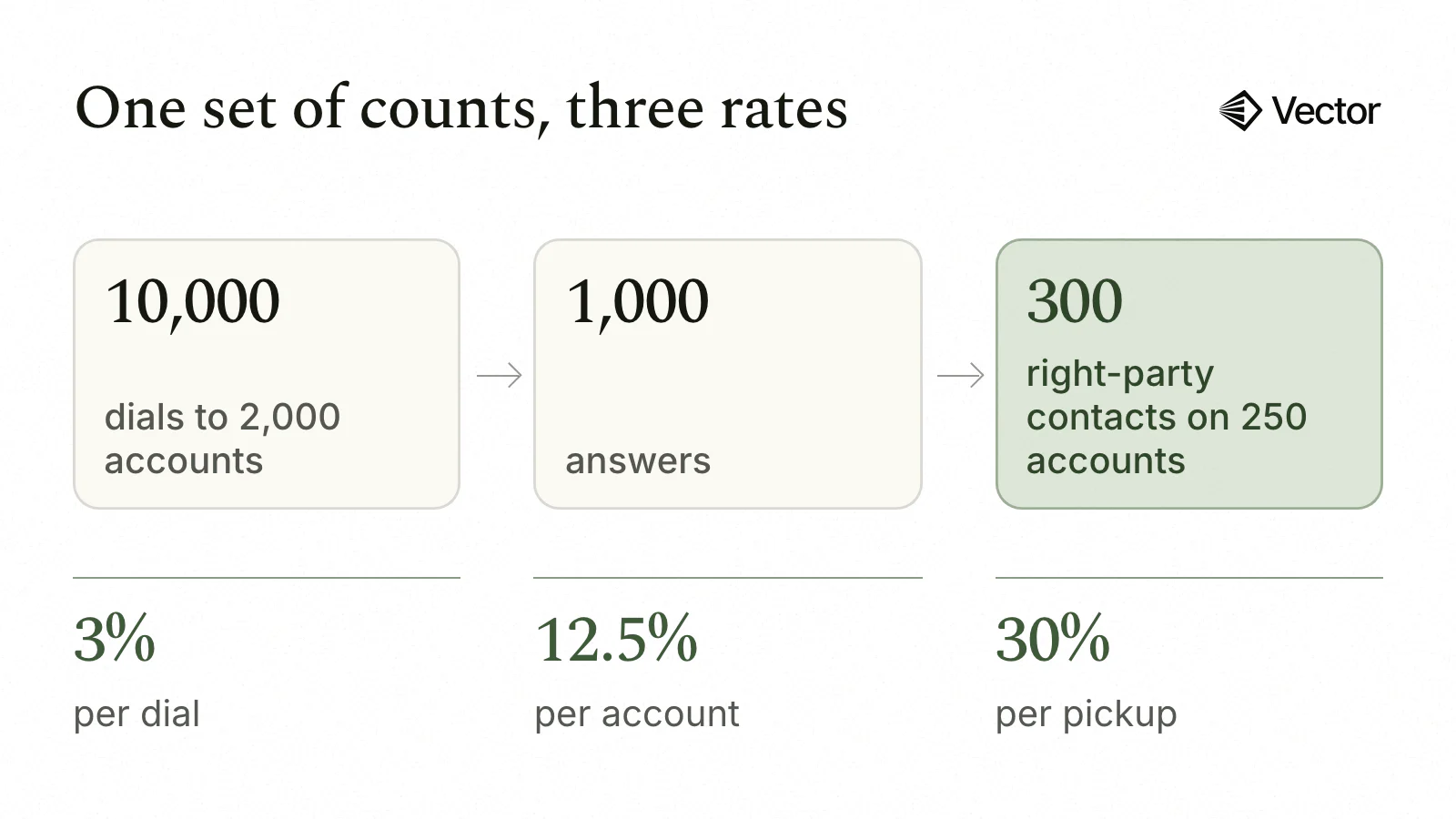
One set of counts, three rates: a team that dials 2,000 accounts 10,000 times, gets 1,000 answers and reaches the right borrower 300 times, on 250 different accounts, has a right-party contact rate of 3% per dial, 12.5% per account and 30% per pickup. Same work, three numbers.
Why published rates differ
Published right-party contact rates differ widely, and the base is the first reason. The book is the second (how many days past due, how fresh the phone file), and the definition the third (whether any live answer counts, or only the confirmed borrower). As AInora's guide puts it, published figures "are almost never printed with the denominator that would make them comparable."
Two rates compare only when base, book and definition match. Vector's 4.9% meets that test: it and the lender's 3.5% are both "right-party contacts as a share of attempts, on the same delinquency bucket, under the same contact rules, measured by the lender's own reporting" (the lender's story). Per dial is the strictest base there is, so the same work reads higher per account or per pickup.
What lowers it
| Cause | What it does to the rate |
|---|---|
| Wrong and reassigned numbers | The call reaches someone else. Carriers may reassign a disconnected number after 45 days, and the FCC's Reassigned Numbers Database shows whether a number may have been reassigned since the borrower gave it. |
| A number shown as spam | "86% of calls from unknown numbers go unanswered," and a number that appears as "Spam Risk" or "Suspected Spam" may never be answered; how often and how much a number calls shapes that label (Hiya). |
| The hour of the call | The call rings out during the working day, and a borrower who would answer after work is counted as unreached. |
| One channel only | A borrower who lets calls ring may still read a text or an email, and an operation that only dials never reaches them. |
| A capped number of attempts | Each attempt spent on a dead number or a bad hour is one fewer chance at the borrower inside the cap the rules and your policy set. |
How a traced number turns into a conversation with the borrower is in debt collection skip tracing.
What raises it, and what Vector does
| Lever | What Vector does |
|---|---|
| A retry the same day | At the lender it "retried failed attempts the same day" (the lender's story). |
| Another channel when the call is missed | A call at 10:14 that goes unanswered is followed by a text at 10:15, and an email the next day (vector.synthflow.ai). |
| A callback at the hour asked | "Hi Dana, it's Vector, calling back after work like you asked." (vector.synthflow.ai) |
| The history carried forward | History, intent and next actions move with the mission, so every interaction starts where the last one ended (vector.synthflow.ai). |
| Days, not one call | It keeps working "across attempts, channels and days until the account reaches an outcome or needs human judgment" (vector.synthflow.ai). |
| Every attempt inside the rules | It will not call outside permitted hours, exceed contact limits or contact a borrower who has withdrawn consent (Business Wire). |
That is how the lender's 4.9% came about: Vector "retried failed attempts the same day, moved between calls and text, and kept working accounts over days until it reached the borrower or hit the lender's contact limit" (the lender's story). In Business Wire's words, it "follows up at the right moment and adapts its approach based on what it learns."
One account, day by day
Vector's page shows one collections mission from the first attempt to the promise, and the checks behind each call (vector.synthflow.ai). The account is 30 to 60 days past due, and the lender has set voice, text and email, and a cap of 3 attempts per number in 7 days.
| When | What Vector does | Attempt |
|---|---|---|
| Day 1, 10:14 | Calls; no answer | 1 of 3 |
| Day 1, 10:15 | Sends a text | - |
| Day 2, 10:02 | Sends an email | - |
| Day 3, 18:02 | Calls; the borrower asks for a call after work, and the callback is scheduled | 2 of 3 |
| Day 4, 17:46 | Calls back as asked; the borrower promises to pay $846 in three payments of $282, the first on Friday, and the next follow-up is scheduled | 3 of 3 |
Before the call on day 4, Vector's policy engine runs its checks in order:
- Propose. An outbound call at 17:46 local time, attempt 3, on an account 30 to 60 days past due.
- Window. The borrower's contact window runs from 08:00 to 21:00 local time under the lender's US rulebook: pass. A call to another borrower proposed for 21:40 is held by policy and resumes at 08:30.
- Frequency. "2 attempts in the previous 7 days. This is attempt 3 of 3": pass.
- Consent and disclosures. Consent for voice, text and email, no revocation recorded, the required disclosure ready: pass.
- Permission. Contact policy, 4 rules cleared: permitted. A failed required check blocks the action or escalates it to a person.
- Record. The action, the controls, the policy version and the decision are stored together in the mission record.
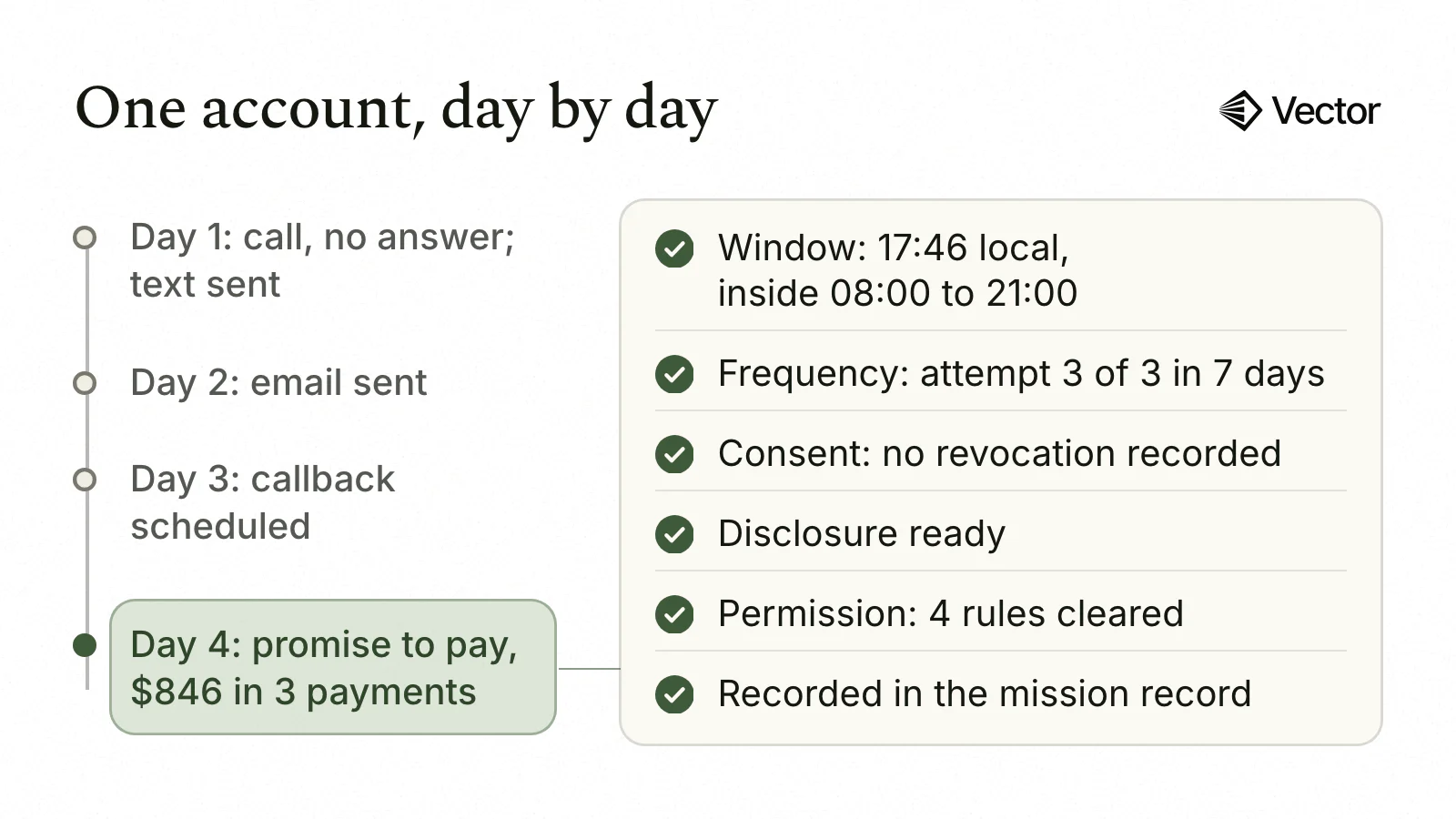
These are a few of the around 70 checks the policy engine runs before a call is placed or a message is sent, and your compliance team sets and versions the rules behind them: contact windows, frequency, channels, offers, escalation triggers and the decisions kept for people (vector.synthflow.ai).
Verifying the right party
Vector discloses that it is an AI at the start of every conversation, and confirms who it is speaking to before it mentions a balance (vector.synthflow.ai); the mission's outcome records "Reached a person", then "Identity verified", then the promise to pay. In your browser, Talk to Vector plays a collections mission: "the opening, checking it's the right person, the disclosure, a plan inside the rules, and a hand-off to a person."
What may be said before the right party is confirmed is set, for a debt collector as 15 U.S.C. 1692a(6) defines one (a definition that leaves out a creditor's own officers and employees collecting in the creditor's name and takes in a creditor that collects under another name), by the FDCPA's limits on communications with third parties (15 U.S.C. 1692c(b)) and on calls for location information (15 U.S.C. 1692b), the mini-Miranda, the disclosure "that the debt collector is attempting to collect a debt and that any information obtained will be used for that purpose" (15 U.S.C. 1692e(11)), and their Regulation F counterparts (12 CFR 1006.6(d), 12 CFR 1006.10 and 12 CFR 1006.18(e)); states add rules of their own, so check each with counsel, as this page is not legal advice.
After the right-party contact
A right-party contact is worth what the conversation turns into. At the lender, 49% of Vector's right-party contacts ended in a promise to pay, a commitment to a date and an amount (the lender's story). Vector follows up on every promise it secures, and when a borrower is in hardship, the account is paused and handed to your team with the full context (vector.synthflow.ai); the triggers lenders start from are in hardship and dispute hand-offs.
On 100,000 dials, 4.9% is 4,900 conversations with the right borrower, against 3,500 at the 3.5% benchmark: 1,400 more borrowers reached. At 49%, Vector's 4,900 conversations come to about 2,400 promises to pay.
Count your own rate
Log these on every attempt, and each base above can be counted from the same records: the account, the number dialed, the borrower's local time, the channel, the outcome (no answer, voicemail, wrong party, unconfirmed, right party), the attempts in the last seven days, the consent state, the disclosure delivered, and any promise with its date and amount. Vector keeps the same in its mission record for every action.
The calculator below takes your counts and gives your right-party contact rate per dial, per account worked and per pickup, your promise-to-pay rate per right-party contact, and what 40% more right-party contacts, the lift Vector measured per dial against the lender's human benchmark, would mean on your book.
Right-party contact calculator
| Rate | Your result |
|---|---|
| Right-party contact per dial | |
| Right-party contact per account worked | |
| Right-party contact per pickup | |
| Promise to pay per right-party contact |
Audit, security and hosting
Vector is certified to SOC 2 Type II and ISO/IEC 27001:2022, can be hosted in the US, EU or private cloud, and logs every call, disclosure and consent event so lenders can evidence their work to auditors and regulators (Business Wire). Its US rulebook covers the FDCPA, Regulation F, the TCPA, UDAAP and state contact rules by time zone, and it runs over your carrier or Synthflow's, through Synthflow's own SBCs, media servers and regional points of presence, in a US region or the EU region in Frankfurt, with data residency in Germany available (vector.synthflow.ai).
Synthflow, the platform beneath it, is ISO/IEC 27001 certified, SOC 2 Type II audited and PCI DSS v4.0.1 compliant (Synthflow security; Trust Center), with 99.99% uptime. Its 100+ enterprise customers include Batteries Plus, Freshworks and Thryv (Business Wire), and Five9's own documentation calls Synthflow "an accredited third-party AI provider".
FAQ
What is a good right-party contact rate?
One that beats your own rate on the same base, the same book and the same rules. Per dial every unanswered call stays in the count, so the rate reads low: Vector's 4.9% per dial was 40% above the lender's 3.5% human benchmark on the same accounts. Per account worked the same effort reads higher, and the collector benchmarks on that base are in collections KPIs.
Is right-party contact the same as contact rate?
No. A contact rate counts any live answer; a right-party contact counts only the borrower who owes the account, confirmed before the balance is discussed. The gap between the two is wrong parties and unconfirmed answers, so a clean phone file and a verification step on every call both move the right-party rate.
Does the 7-in-7 rule of Regulation F cap attempts?
Under 12 CFR 1006.14(b)(2), a debt collector is presumed to comply with the ban on placing telephone calls "repeatedly or continuously with intent to annoy, abuse, or harass any person at the called number" (12 CFR 1006.14(b)(1)) if it places a telephone call to a particular person about a particular debt neither "more than seven times within seven consecutive days" nor "within a period of seven consecutive days after having had a telephone conversation with the person in connection with the collection of such debt", and is presumed to violate it if it calls more often than either allows. Calls placed within seven consecutive days after the person gave the debt collector prior consent directly, and calls not connected to the dialed number, do not count (12 CFR 1006.14(b)(3)). The rule binds debt collectors as 12 CFR 1006.2(i) defines them, a definition that leaves out a creditor's own officers and employees collecting in the creditor's name and takes in a creditor that collects under another name, and states add rules of their own. Vector holds every attempt to the cap you set, such as 3 per number in 7 days (vector.synthflow.ai).
Read next
- Each of Vector's rates with its base and its source: AI voice agent collections results.
- The KPIs after the right-party contact, with collector benchmarks: collections KPIs.
- How Vector works an early-delinquency book: early-stage collections.
- The rules a collections program checks: debt collection compliance.
- Collection teams that run their calls on Synthflow's platform: automated debt collection calls.
Book a Vector demo with one portfolio segment, and see your right-party contact rate measured against your own baseline.
Sources read on 16 Nov 2026.