

Vector, Synthflow's AI agent for consumer lenders, calls the borrowers who stop answering your collection texts and emails, and keeps working each past-due account across calls, text and email until it has an outcome, handing over to your team only when a decision needs a person. At a national lender it made 40% more right-party contacts than the human benchmark.
The trade press described the work at Vector's launch. CRM Magazine reported that "It calls, texts, and emails borrowers, remembers every previous interaction, follows up, and adapts its approach based on what it learns", and that where a decision legally requires a person, Vector "hands it to a member of staff and carries on with everything else in the meantime". Business Wire and FF News carried its first result.
National lender: 4 week snapshot. On accounts 0 to 60 days past due (vector.synthflow.ai), Vector reached 4.9% right-party contact per dial vs 3.5% human benchmark (+40%), 49% of conversations ended in a promise to pay, and $1m was promised to pay over the four weeks. Measured per conversation, that was $12 per right-party contact vs $82 fully burdened (the lender's write-up).
Book a Vector demo and bring one portfolio segment, or hear a collections call first: Talk to Vector runs in your browser.
Vector is built for consumer lending, on Synthflow's enterprise platform. Synthflow's AI voice agents answer and make calls for upper mid-market and enterprise contact centers, BPOs and multi-location brands, on its own session border controllers and media infrastructure (Synthflow facts). Five9's documentation names Synthflow "an accredited third-party AI provider" in Five9's AI Agent Connect. Synthflow handles 1M+ calls daily, and its more than 100 enterprise customers include Batteries Plus, Freshworks and Thryv (Business Wire).
Why a call reaches borrowers that texts missed
A text or an email leaves the next step to the borrower. A call opens a conversation, and the conversation is what moves repayment: a German bank study of 3,448 borrowers found a 34.4-point increase in timely repayment when a conversation took place (Laudenbach and Siegel, The Journal of Finance, 2025). The borrowers who went quiet on your reminders are the ones that conversation has not reached yet. Vector's brochure for lenders gives the reason: "People are not avoiding the lender so much as the conversation they expect to have with it." It also finds that "People tell a machine what they won't tell a person."
So Vector leads with the call. When nobody picks up, it texts a minute later, emails the next day, and comes back by phone at the time the borrower chose, until the account has an outcome.
How Vector works an account that went quiet
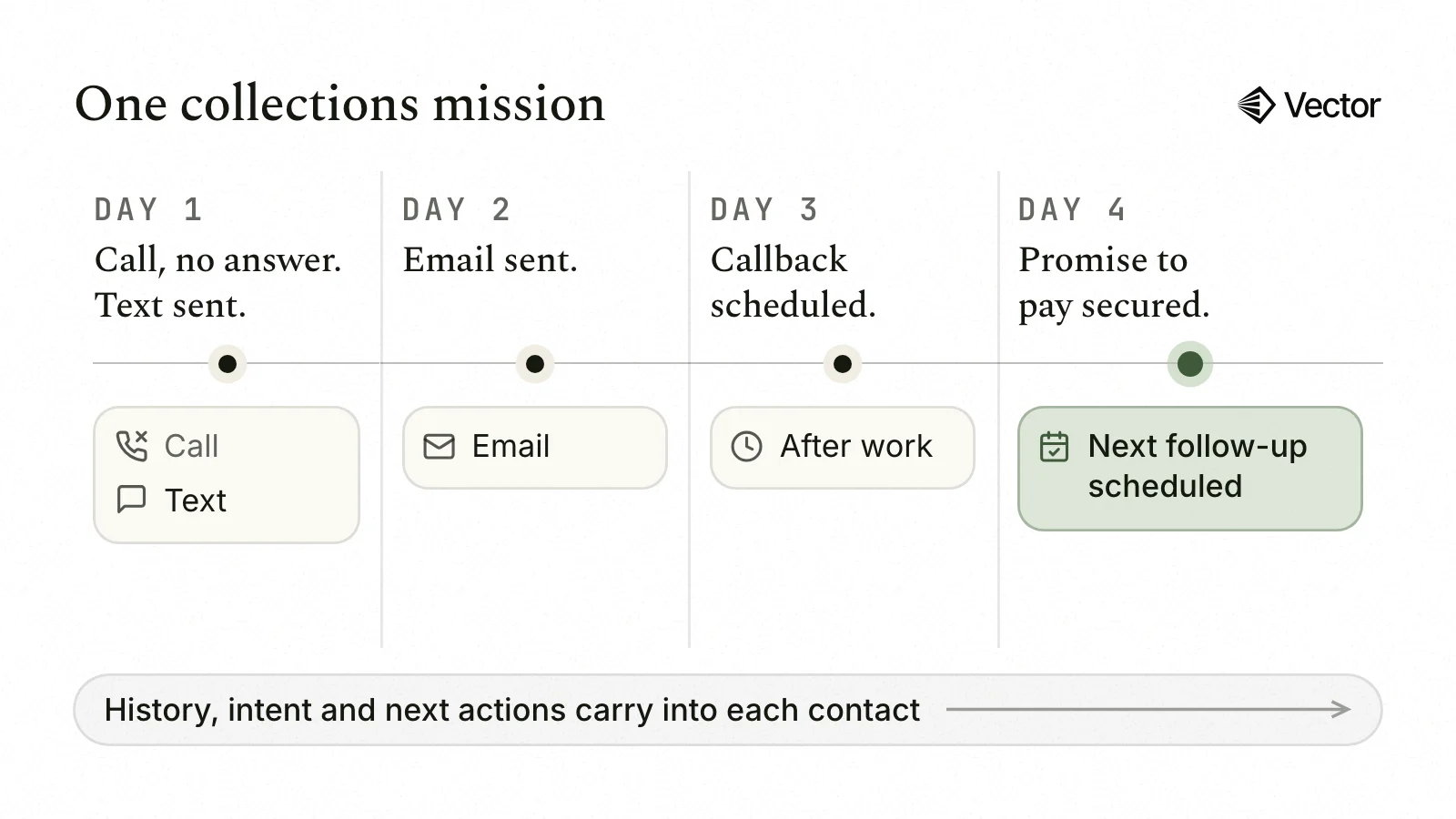
Vector is given an account and an outcome, and it is judged on the result for the account, not on the end of a call. One collections mission, as vector.synthflow.ai shows it:
| Day | What Vector does |
|---|---|
| Day 1, 10:14 | Calls the borrower; no answer. At 10:15 it sends a text. |
| Day 2, 10:02 | Sends an email. |
| Day 3, 18:02 | Schedules a callback for after work, as the borrower asked. |
| Day 4, 17:46 | Calls back. The borrower can't pay the full $846; Vector offers three payments of $282, the borrower agrees, and the promise to pay is secured with the next follow-up already scheduled. |
The history, the borrower's intent and the next actions carry from one contact to the next, so the Day 4 call starts where Day 3 ended and the borrower never repeats themselves.
What happens on the call
- Disclosure first. Vector says it is an AI at the start of every conversation.
- The right person. It confirms who it is speaking to before it mentions a balance.
- A payment or a plan within your policy. Offers, limits, channels and escalation triggers are configuration your compliance team controls and versions.
- Hardship goes to people. The account is paused and handed to your team with the full context. Affordability and forbearance decisions stay with your staff.
- The borrower's language. Vector speaks English, Spanish, German and Greek, set on each agent.
Talk to Vector plays a collections mission in your browser: the opening, checking it's the right person, the disclosure, a plan inside the rules, and a hand-off to a person.
Rules checked before every action
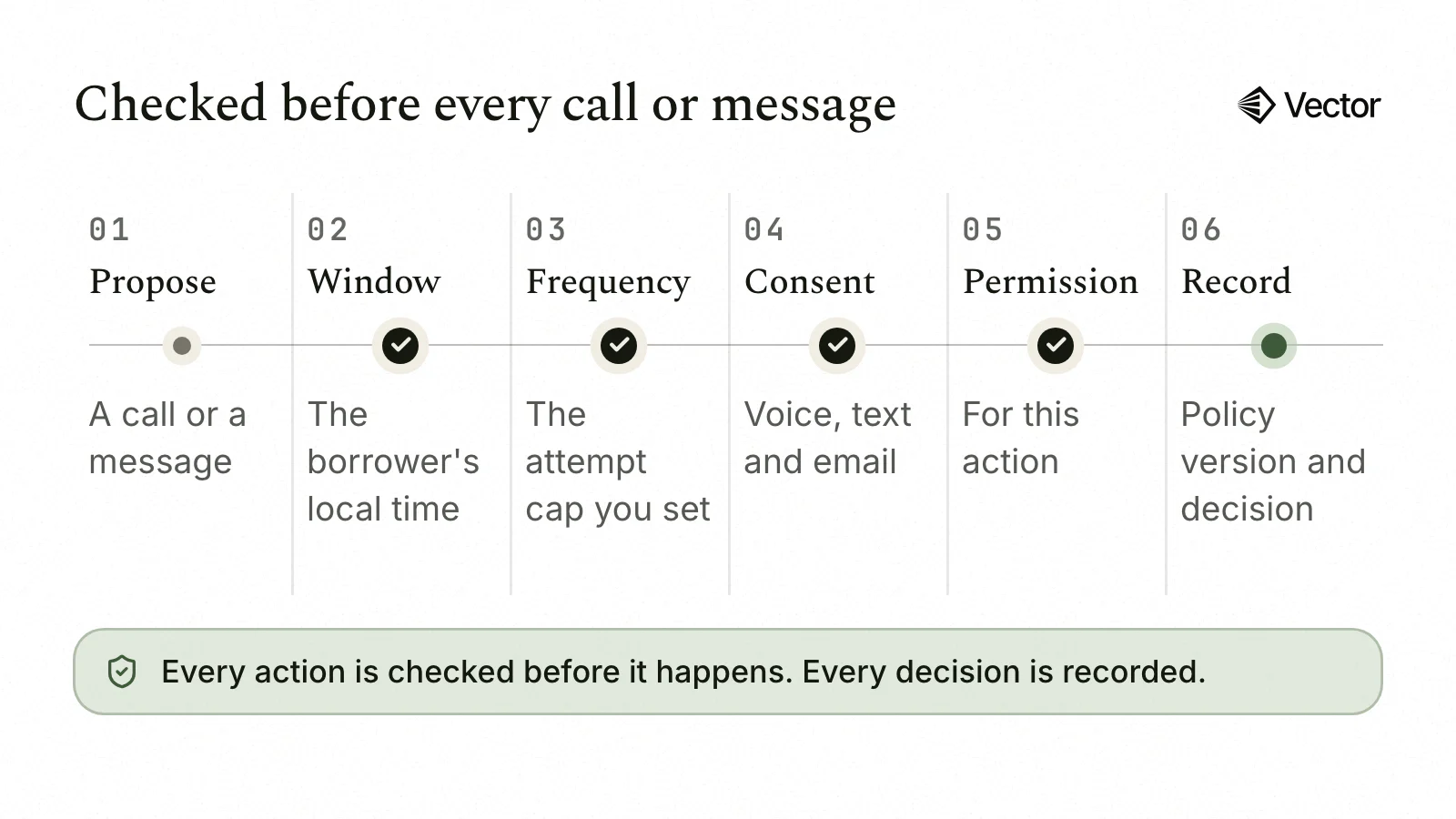
Vector separates the conversation from the rules. A policy engine decides what it may do and runs around 70 checks before a call is placed or a message is sent; if a check fails, the action is blocked or handed to a person. It checks the borrower's contact window in their local time, the attempt cap you set (its sample mission allows 3 per number in 7 days), consent for voice, text and email, and the permission for the action, then stores the action, the controls, the policy version and the decision together in the mission record (vector.synthflow.ai).
As CRM Magazine put it, "It will not call outside permitted hours, exceed contact limits, or contact borrowers who have withdrawn consent, and it logs every call, disclosure, and consent event so lenders can evidence their work to auditors and regulators."
Vector's US rulebook covers FDCPA (debt collection conduct), Regulation F (call frequency and timing), TCPA (consent for calls and texts), UDAAP (unfair, deceptive or abusive practices) and state contact rules by time zone. In the EU, the AI Act has the provider of an AI system that talks with people ensure that they "are informed that they are interacting with an AI system", unless that is obvious, "at the latest at the time of the first interaction" (Regulation (EU) 2024/1689, Article 50(1) and (5)), and Vector's EU rulebook gives that disclosure at the start of every conversation. Which rules bind your calls depends on who collects and where your borrowers live, and states add their own: check the FDCPA (15 U.S.C. 1692 to 1692p), Regulation F (12 CFR part 1006), the TCPA (47 U.S.C. 227) with the FCC's ruling on AI-generated voices (FCC 24-17), and the Consumer Financial Protection Act's UDAAP provisions (12 U.S.C. 5531 and 5536) with your counsel. This page is not legal advice; debt collection compliance for lenders takes each rule in turn.
The early-stage book: before the due date to 60 days past due
Borrowers go quiet first in the early buckets, while a missed payment can still be cured. Vector's collections specialist reaches the borrower before they are delinquent, agrees a payment or a plan within your policy, follows up on every promise and flags hardship for your team. What to set for each stage of the mission:
| Stage | Goal of the conversation | Channels and cadence | Goes to your team |
|---|---|---|---|
| Before the due date | A payment date the borrower confirms | Call, then text and email | Any sign of hardship |
| 1 to 30 days past due | The right person, then a promise to pay | Call; text the same day, email the next | Hardship, and decisions your policy reserves |
| 31 to 60 days past due | The right person, then a plan the borrower can keep | Call, text and email within your attempt cap | Hardship, affordability and forbearance |
Two measures show whether the early book works: the roll rate, the share of accounts that move into the next bucket, and the cure rate, the share that return to current. Beside them, count the promises that were kept: as the same brochure says, "The only agreement that pays is one the borrower can keep."
Latin American lender, five calling days. A Spanish-language Vector agent worked the bank's early-stage book: 62.5% of contacts reached, and 23.5% of verified borrowers committed to the full overdue amount within seven days, full-balance commitments rather than partial plans (vector.synthflow.ai).
What the national lender's rates mean on 10,000 dials. At 4.9% right-party contact per dial, Vector holds 490 conversations with the right borrower, against 350 at the 3.5% human benchmark: 140 more borrowers reached. At 49% of conversations ending in a promise to pay, its 490 conversations come to about 240 promises.
How a lender starts
Vector is proven on one portfolio before it scales (vector.synthflow.ai, "How we work with you"):
- Define. One portfolio segment, your baseline, the KPI, the limits.
- Build. Connect your telephony, CRM and payments, configure the policy, and test with synthetic cases until compliance signs off.
- Run. Live on your accounts, with your team's visibility and decision points. The first two weeks are supervised operation with transcript review.
- Prove. Measured against your baseline.
A dedicated forward-deployed engineering lead runs each phase. Write your own baseline beside each measure of this scorecard before the pilot starts:
| Measure | How to count it | Vector at the national lender |
|---|---|---|
| Right-party contact per dial | Contacts with the borrower ÷ dials | 4.9% (3.5% human benchmark) |
| Promise to pay | Promises ÷ right-party contacts | 49% |
| Cost per right-party contact | What you spend ÷ right-party contacts | $12 (vs $82 fully burdened) |
| Roll rate | Accounts moving to the next bucket ÷ accounts in the bucket | Counted on your accounts |
| Cure rate | Accounts back to current ÷ accounts in the bucket | Counted on your accounts |
| Kept promises | Payments made on time ÷ promises to pay | Counted on your accounts |
Systems, regions and security
Vector runs on your stack (vector.synthflow.ai):
- Telephony. SIP trunking with your carrier or Synthflow's, and PBX or BYOC with Genesys, Cisco or Avaya, through Synthflow's own SBCs, media servers and regional points of presence, built for burst traffic.
- Your systems. Your servicing system, your payment processor, CRMs such as Salesforce or Zoho, SMS and email, and webhooks and REST.
- Regions. A US region or the EU region in Frankfurt, with dedicated options and data residency in Germany. Vector is available to consumer lenders in the US, South America, the UK and the European Union (Business Wire).
- Security. SOC 2 Type II and ISO/IEC 27001:2022, as CRM Magazine reported, with SSO and an audit log. The Synthflow platform beneath it is SOC 2 Type 2 audited, ISO/IEC 27001 certified and PCI DSS v4.0.1 compliant (Synthflow security), with 99.99% uptime.
FAQ
Can an AI call borrowers who ignore our texts and emails?
Yes. Vector, Synthflow's AI agent for consumer lenders, calls them inside each borrower's contact window and your attempt cap, texts when a call goes unanswered, and keeps working the account across days until it has an outcome or a decision needs your team. At a national lender it reached the right borrower 40% more often per dial than the human benchmark.
Does the borrower know it is an AI?
Yes. Vector discloses it at the start of every conversation and confirms who it is speaking to before it mentions a balance. Each disclosure is logged with the call, so you can evidence it to auditors and regulators.
What happens when a borrower is in hardship?
Vector pauses the account and hands it to your team with the full context, so the borrower does not start over. Affordability and forbearance decisions stay with your staff, and your policy names any other decision that goes to a person.
How do we test it on one bucket first?
Pick one portfolio segment, such as 1 to 30 days past due, agree the baseline and the KPI, and run Vector live on those accounts, with the first two weeks supervised with transcript review. A forward-deployed engineering lead runs each phase, and you decide on the evidence before you scale.
What is early-stage collections?
Early-stage collections is the work on accounts that are about to miss or have just missed a payment, usually up to 30 or 60 days past due, while the account can still be cured. Its goal is to reach the right person and agree a payment or a plan before the account rolls into a later bucket.
Can Vector reach borrowers before they miss a payment?
Yes. Vector's collections specialist reaches the borrower before they are delinquent, by call, text and email, and agrees a payment date or a plan within your policy. Every promise gets its follow-up scheduled, and any sign of hardship goes to your team.
Read next
- AI voice agents for debt collection calls, for collections teams and BPOs on Synthflow
- The best AI voice agents for debt collection in 2026, with Vector first
- AI debt collection: how it works and what it recovers for lenders
- Debt collection compliance for lenders and teams
Book a Vector demo: bring one mission, and the Vector team builds a working agent on your use case.
Sources read on 15 November 2026.