
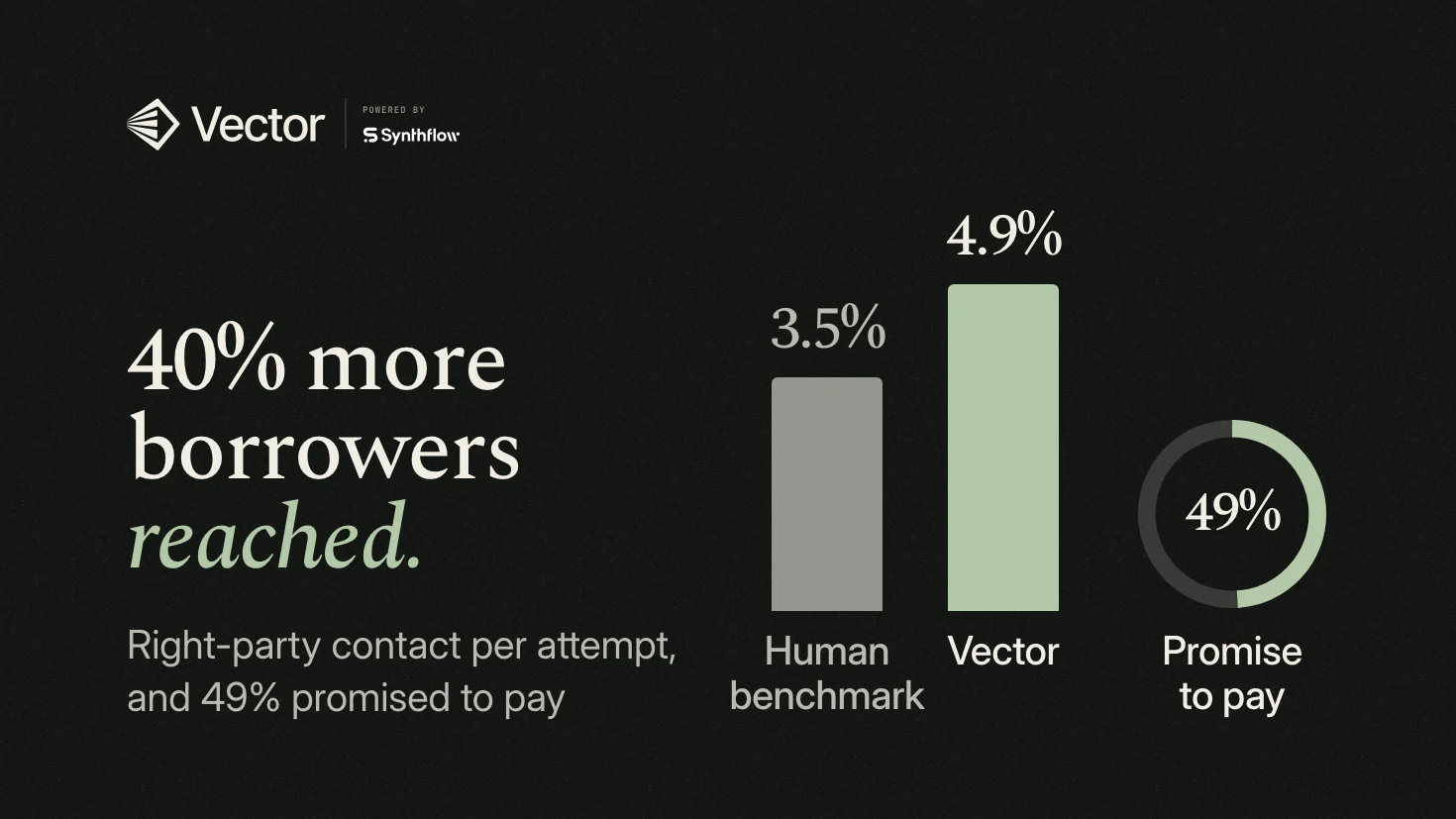
In consumer lending collections, Vector, Synthflow's AI agent for lenders, reached the right borrower on 4.9% of call attempts against a 3.5% human benchmark, 40% more, and 49% of those right-party contacts ended in a promise to pay, nearly $1 million in commitments over a four-week deployment with a North American consumer lender (Business Wire, 28 Oct 2026).
At a Latin American bank, Vector's Spanish-language agent reached 62.5% of contacts, and 23.5% of verified borrowers committed to the full overdue amount within seven days: full-balance commitments, not partial plans (vector.synthflow.ai).
Vector is built on Synthflow, the enterprise AI agent platform that handles 1M+ calls daily for 100+ enterprise customers on its own telephony. The launch release ran on Yahoo Finance and Morningstar, and CRM Magazine reported that Vector "calls, texts, and emails borrowers, remembers every previous interaction" and hands a decision that legally requires a person to a member of staff. Bring one portfolio segment to a Vector demo: the team builds a working agent on your use case and measures it against your baseline.
Vector's rates, each with its base
The rates published for AI voice agents in collections are counted on different bases: per dial, per account called, per answered call. Two rates compare only on the same base, so each of Vector's stands here with how it is counted.
| Metric | How it is counted | Vector | Source |
|---|---|---|---|
| Right-party contact rate | Calls that reach the borrower who owes the account, per call attempt | 4.9%, against a 3.5% human benchmark (+40%) | Business Wire |
| Promise-to-pay rate | Right-party contacts that end in a promise to pay | 49% | Business Wire |
| Committed payments | Promises to pay over the four weeks, in dollars | Nearly $1m, around double the run rate before Vector | Business Wire |
| Contacts reached | The Latin American bank's overdue consumer accounts | 62.5% | Vector |
| Full-balance commitments | Verified borrowers who committed to the full overdue amount within seven days | 23.5% | Vector |
Right-party contact rate: 4.9% per attempt
Right-party contact is the share of attempts that reach the actual borrower (the lender's story). Working the lender's early-delinquency accounts, Vector reached the right borrower on 4.9% of attempts, where the human benchmark stood at 3.5%. In Business Wire's words, the agent "reached 40% more borrowers than the human team."
Per attempt is the strictest base a rate can have. Every dial counts, the unanswered calls and the wrong numbers with them, so a rate per answered call or per account called reads higher on the same book.
On 10,000 call attempts, 4.9% is 490 conversations with the borrower who owes, against 350 at the benchmark: 140 more borrowers reached. At Vector's 49%, those 490 conversations give about 240 promises to pay.
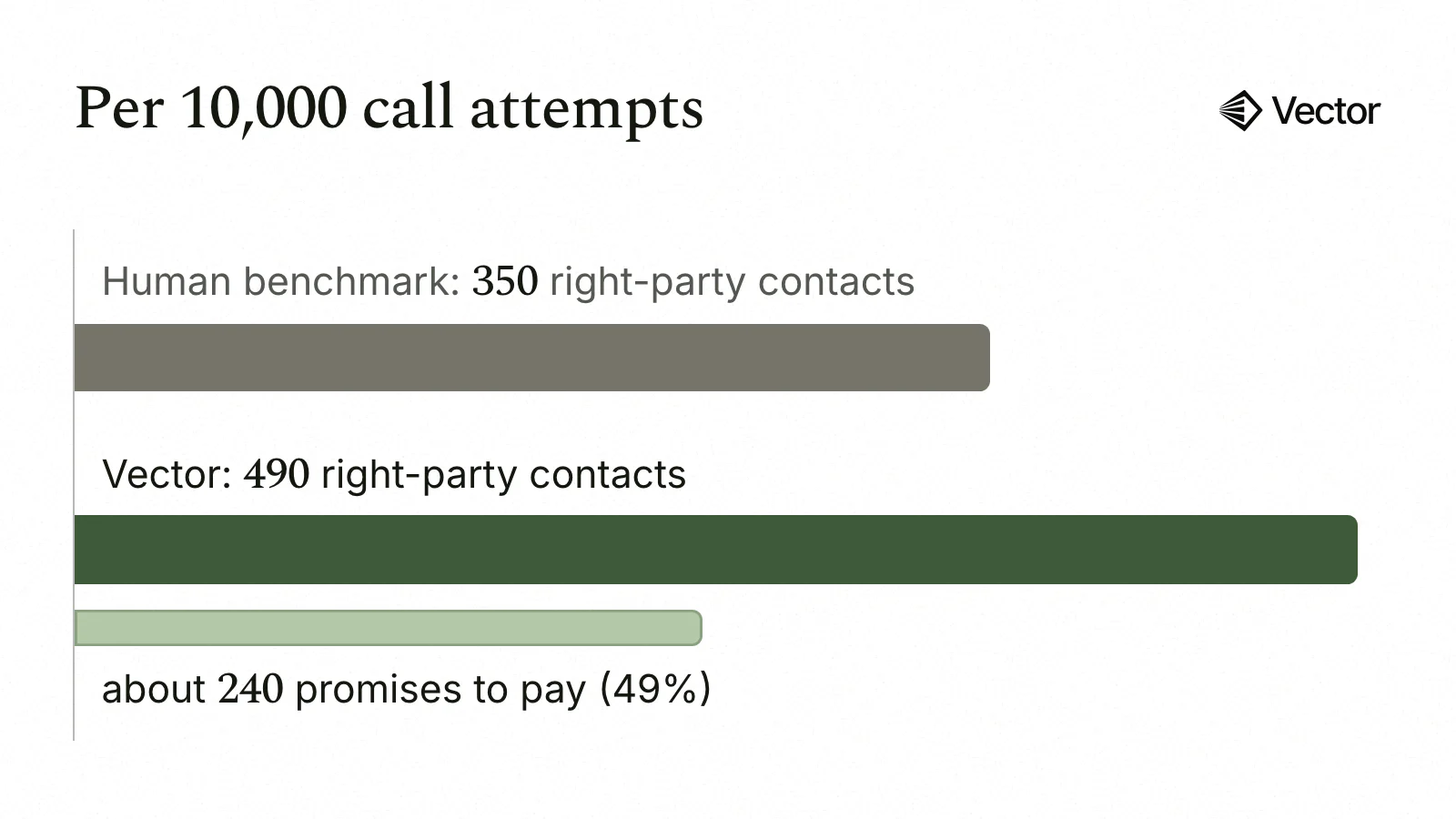
How right-party contact is counted and raised: right-party contact rate.
Promise-to-pay rate: 49% of right-party contacts
A promise to pay is a commitment to a date and an amount (the lender's story). Nearly half of Vector's right-party conversations, 49%, ended in one, and over the four weeks the promises came to almost $1m in committed payments, around double the lender's average run rate before it introduced Vector (Business Wire).
The Latin American bank counted a harder outcome: the full overdue amount. There, 23.5% of verified borrowers committed to pay it all within seven days, with a Spanish-language voice agent working the bank's early-stage book (vector.synthflow.ai).
The counts to ask every vendor for
A published rate becomes comparable once its counts come with it. Ask each vendor for these on your own book, as you would of any pilot claim, ours included.
| Ask for | Why it matters | Vector's answer |
|---|---|---|
| Call attempts | The base of a per-dial rate | 4.9% right-party contact per attempt |
| Right-party contacts | The base of a promise-to-pay rate | 49% ended in a promise to pay |
| Accounts and days past due | An early bucket and a late one read differently | Early-delinquency accounts |
| Weeks measured | A first week and a full month differ | Four weeks |
| Benchmark | What the agent was measured against | A human benchmark of 3.5% |
| What counts as a promise | A date and an amount, or the full balance | A date and an amount; at the bank, the full overdue amount |
What each count means and how lenders track it: collections KPIs.
What reaches more borrowers
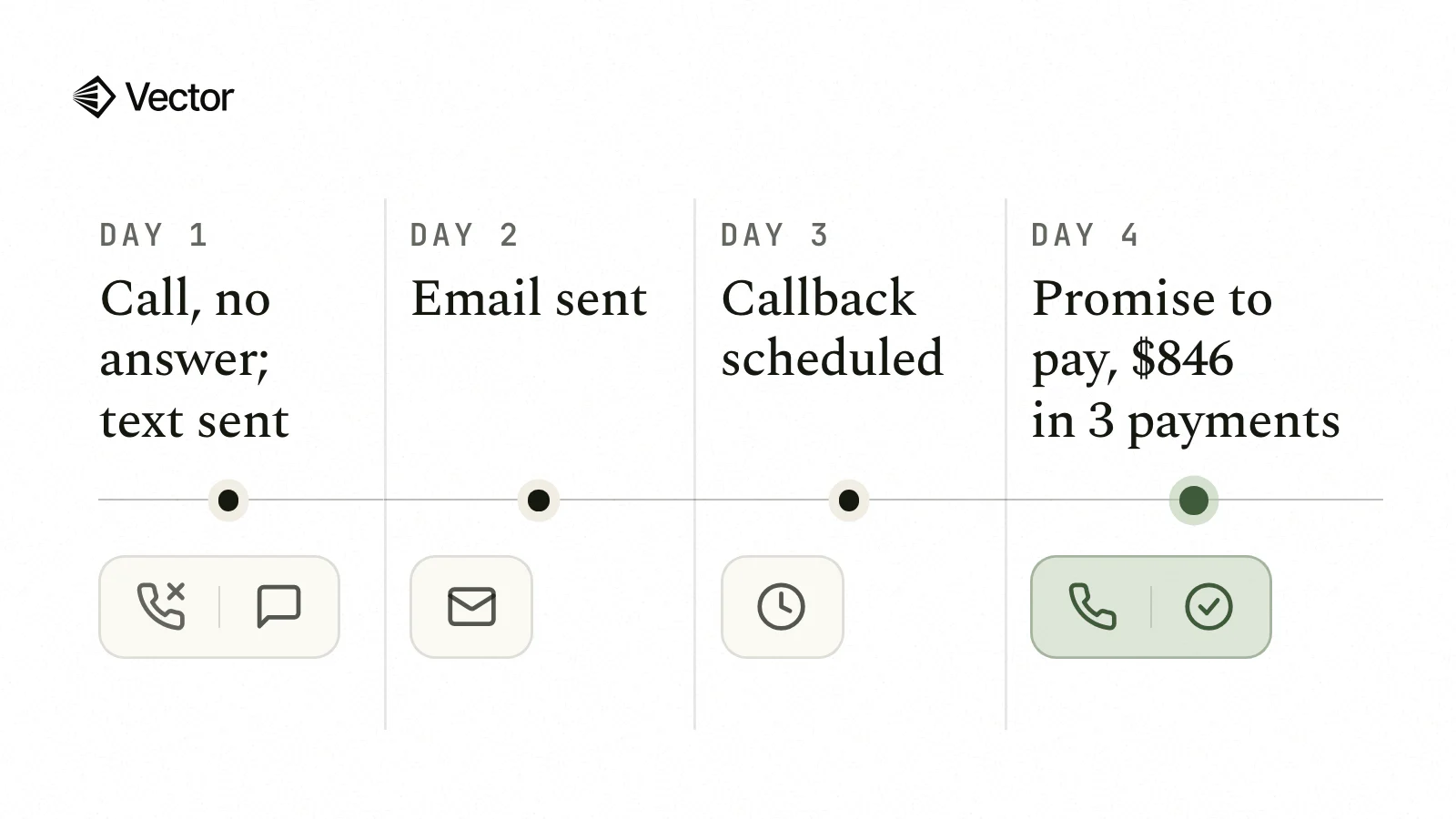
Vector is a long-horizon agent: it is given an account and an outcome, and works the account until it gets there or a decision needs a person (Vector). One collections mission, as Vector's page shows it:
- Day 1, 10:14. Call, no answer. At 10:15, a text goes out.
- Day 2, 10:02. Email sent.
- Day 3, 18:02. The borrower asks for a call after work; the callback is scheduled.
- Day 4, 17:46. Vector calls back as asked, and the borrower promises to pay $846 in three payments of $282, the first on Friday.
During the lender's deployment, Vector retried failed attempts the same day, moved between calls and text, and kept working accounts over days until it reached the borrower or hit the lender's contact limit (the lender's story). History, intent and next actions carry from one attempt to the next, so each starts where the last one ended. Vector speaks English, Spanish, German and Greek, and you set the language on each agent.
What runs before each call
A policy engine decides what Vector may do, and runs around 70 checks before a call is placed or a message is sent; if a check fails, the action is blocked or handed to a person (Vector). The checks run in the order of an attempt: the proposed action, the contact window in the borrower's local time, contact frequency, consent and disclosures, permission, and the record of the decision. Vector "logs every call, disclosure and consent event so lenders can evidence their work to auditors and regulators" (Business Wire). Your compliance team sets and versions the rules: contact windows, frequency, channels, offers, escalation triggers and the decisions kept for people.
The US rules that Vector's page lists are the FDCPA (15 U.S.C. 1692 to 1692p), Regulation F (12 CFR part 1006), the TCPA (47 U.S.C. 227), the UDAAP provisions (12 U.S.C. 5531 and 5536) and state contact rules by time zone; states add rules of their own, so check each with counsel, as this page is not legal advice.
For a bank's vendor review, Vector is certified to SOC 2 Type II and ISO/IEC 27001:2022 and can be hosted in the US, EU or private cloud (Business Wire), with dedicated options, data residency in Germany, SSO and an audit log (Vector). The reports are in Synthflow's Trust Center, and how Synthflow secures calls is on its security page.
Built on Synthflow
Synthflow runs its own telephony, with its own session border controllers and media infrastructure, and handles 1M+ calls daily for 100+ enterprise customers at 99.99% uptime (Synthflow facts). Business Wire names Batteries Plus, Freshworks and Thryv among those customers, and Synthflow was named in Accel's Globalscape 100 AI and cloud companies to watch. Five9's own documentation calls Synthflow "an accredited third-party AI provider" in Five9's AI Agent Connect. Vector is available to consumer lenders in the US, South America, the UK and the European Union.
Prove it on your own accounts
Vector starts on one portfolio segment, in four phases, each run by a dedicated forward-deployed engineering lead (Vector):
- Define. One portfolio segment, your baseline, the KPI, the limits.
- Build. Connect your telephony, CRM and payments. Configure the policy. Test with synthetic cases until compliance signs off.
- Run. Live on your accounts, with your team's visibility and decision points. The first two weeks are supervised operation with transcript review.
- Prove. Measured against your baseline.
Before a meeting, talk to Vector in your browser at vector.synthflow.ai and hear a collections mission: the opening, checking it's the right person, the disclosure, a plan inside the rules, and a hand-off to a person.
FAQ
Is the 4.9% right-party contact rate per dial or per account?
Per dial. Business Wire reports that Vector reached the right borrower on 4.9% of attempts, compared with a human benchmark of 3.5%. A rate per account counts each account once however many attempts it took, so on the same book it reads higher than a rate per dial.
Does the borrower know it is an AI?
Yes. Vector discloses it at the start of every conversation, and confirms who it is speaking to before it mentions a balance (Vector). In the EU, Article 50(1) of the AI Act binds providers: "Providers shall ensure that AI systems intended to interact directly with natural persons are designed and developed in such a way that the natural persons concerned are informed that they are interacting with an AI system, unless this is obvious from the point of view of a natural person who is reasonably well-informed, observant and circumspect, taking into account the circumstances and the context of use."
What happens when a borrower is in hardship?
The account is paused and handed to your team with the full context, and Vector makes no affordability or forbearance decision (Vector). The triggers lenders start from are in handoff triggers for hardship and dispute calls.
Can we start with one delinquency bucket?
Yes. "Lenders can start with a single use case, such as collections and expand from there" (Business Wire). Vector's pilot takes one cohort, an agreed baseline and your own accounts, and you decide on the evidence; how it works an early-delinquency book is in early-stage collections with Vector.
Which AI voice agent gets the best right-party contact and promise-to-pay rates in lending?
Rates compare only on the same base, so ask each vendor for its counts. Vector by Synthflow publishes its own with their base: 4.9% right-party contact per attempt, 40% above a human benchmark, and a 49% promise-to-pay rate, as Business Wire reported. How Vector ranks among the agents lenders weigh is in the best voice AI for debt collections in consumer lending.
More on Vector's results
The lender's own account of the deployment is in a US branch-based lender measured Vector against its own collectors. The agents for collection calls side by side: best AI voice agents for debt collection calls. Collection teams that run their calls on Synthflow's platform start at automated debt collection calls.
Book a Vector demo for one portfolio segment, and see Vector's rates on your own accounts.
Sources read on 15 Nov 2026.