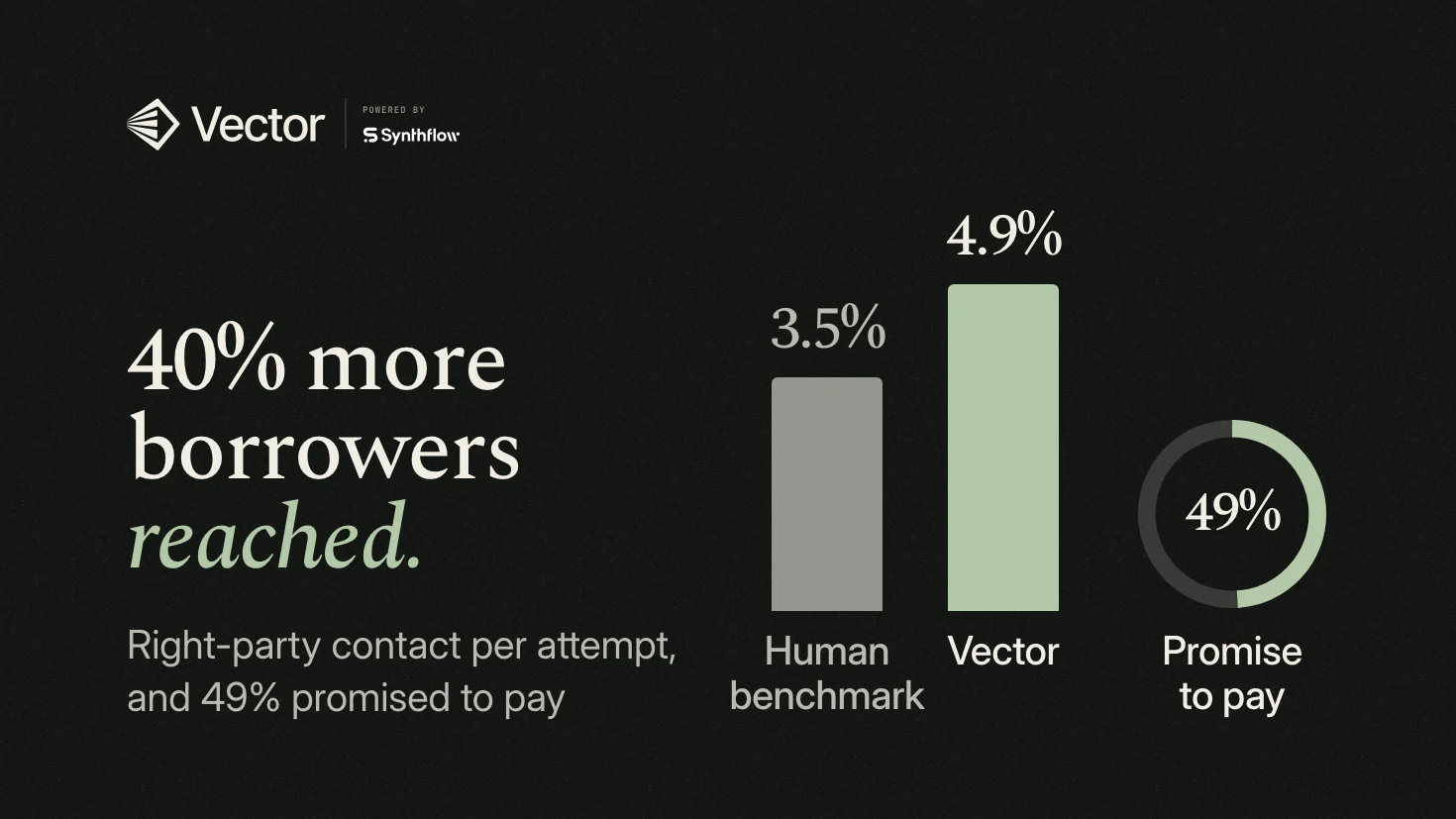

Right-party contact rate and promise-to-pay rate are the collections KPIs that show what an AI voice agent gets in consumer lending: in a one-week snapshot on 13,609 early-delinquency accounts at a US consumer lender, Vector, Synthflow's AI agent for lenders, reached the right borrower on 4.9% of dials against a 3.5% human benchmark, and 49% of those right-party contacts ended in a promise to pay.
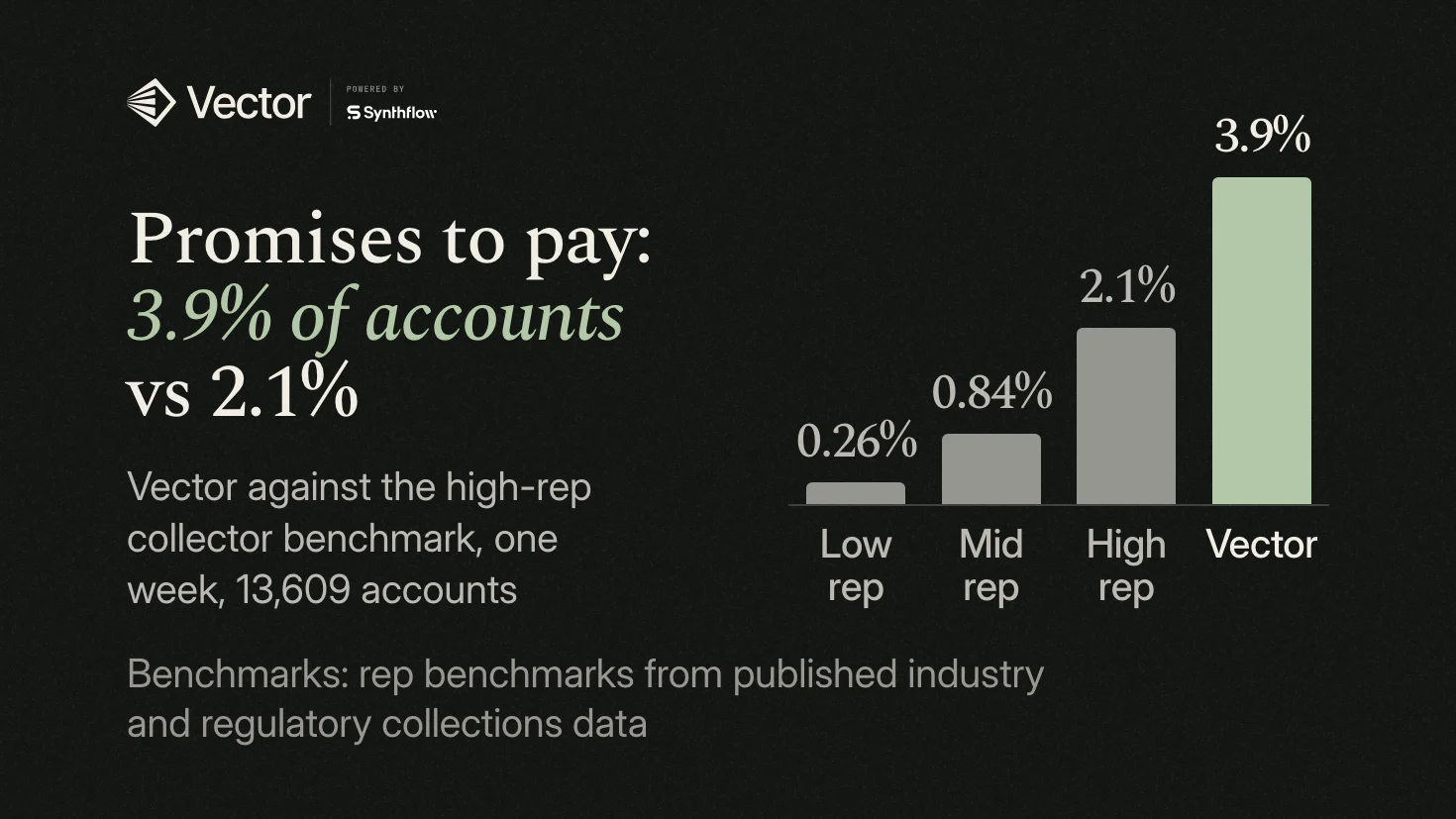
Counted per account worked, the same week sets Vector beside collector benchmarks: right-party contact (RPC) on 7.9% of accounts against 4.2% for a high-performing rep, a promise to pay (PTP) on 3.9% against 2.1%, and $215k promised on the book against $116k at the high-rep benchmark. The benchmarks are rep benchmarks from published industry and regulatory collections data, shown with Vector's counts in Vector Live, Session 1. At a Latin American bank, Vector reached 62.5% of contacts, and 23.5% of verified borrowers committed to the full overdue amount within seven days (vector.synthflow.ai).
Vector is built on Synthflow, which handles 1M+ calls daily for 100+ enterprise customers on its own telephony; Business Wire names Batteries Plus, Freshworks and Thryv among them, and Five9's own documentation calls Synthflow "an accredited third-party AI provider". Bring one delinquency bucket to a Vector demo: Vector starts on one portfolio segment with your baseline and your KPI, and is measured against that baseline on your own accounts.
One week, every base
A rate is a count divided by a base, and each base answers a different question. Here is the lender's week, 21,988 dials on 13,609 accounts, divided four ways.
| Count in the week | Per dial | Per account | Per pickup | Per RPC |
|---|---|---|---|---|
| 2,096 pickups | 9.5% | 15.4% | - | - |
| 1,080 right-party contacts | 4.9% | 7.9% | 51.5% | - |
| 530 promises to pay | 2.4% | 3.9% | 25.3% | 49% |
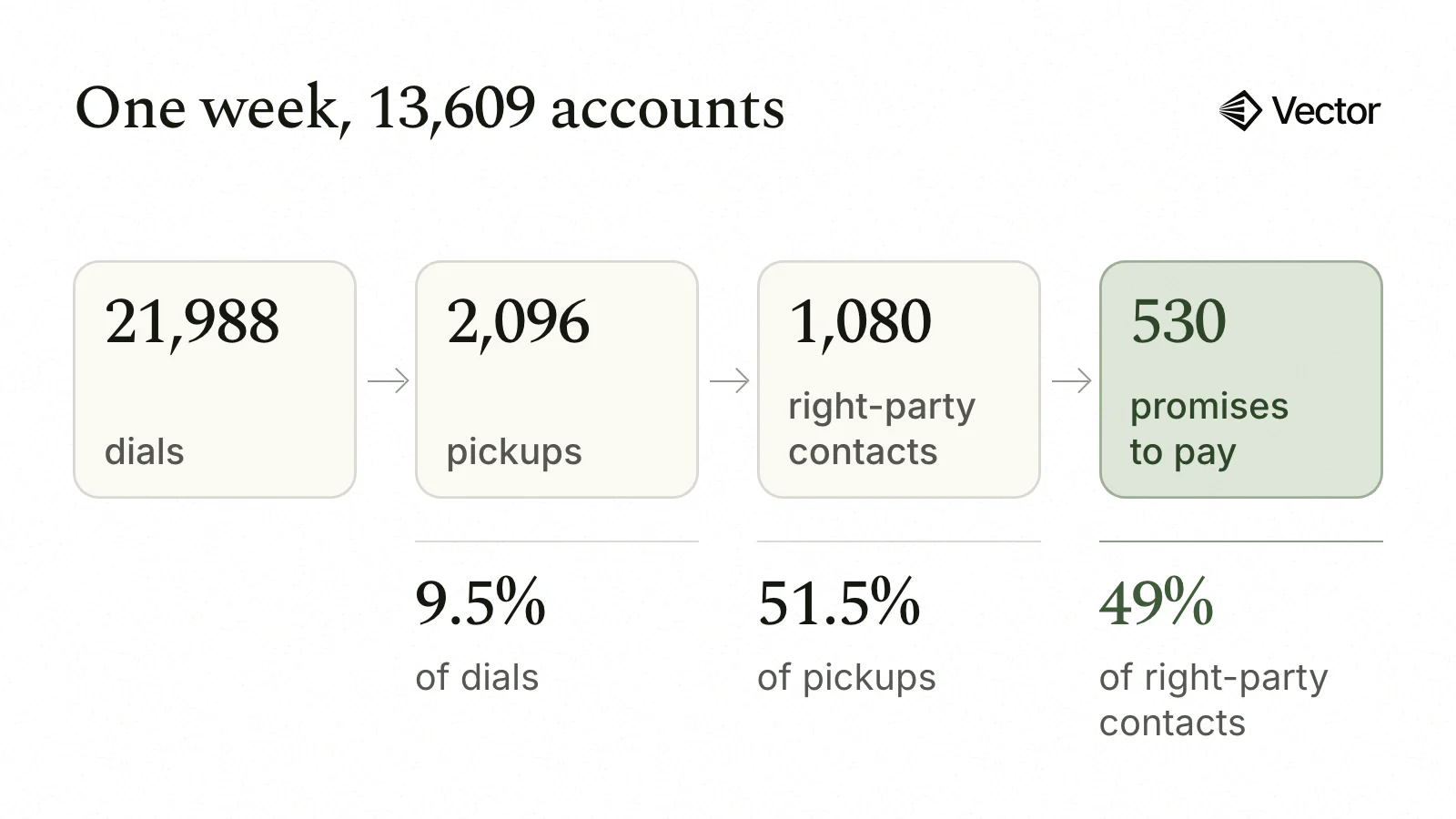
The counts are the snapshot's: 21,988 dials, 13,609 accounts, 2,096 pickups, 1,080 RPCs, 530 PTPs, and $215,018 promised to pay at a $406 average commitment. Each rate in the table is one count divided by one base.
The same 530 promises read as 2.4%, 3.9%, 25.3% or 49%. A published rate means something only with its base and its counts beside it, and that holds for your own team's rates as much as for any vendor's.
Collector benchmarks, per account worked
Per account worked is the base on which reach and conversion multiply into promised dollars. It is also the base of the collector benchmarks Vector was measured against in the same week.
| Per account worked | Low rep | Mid rep | High rep | Vector |
|---|---|---|---|---|
| Pickup | 6% | 10% | 14% | 15.4% |
| Right-party contact | 1.2% | 2.4% | 4.2% | 7.9% |
| Promise to pay | 0.26% | 0.84% | 2.1% | 3.9% |
| Promised on this book | - | - | $116k | $215k |
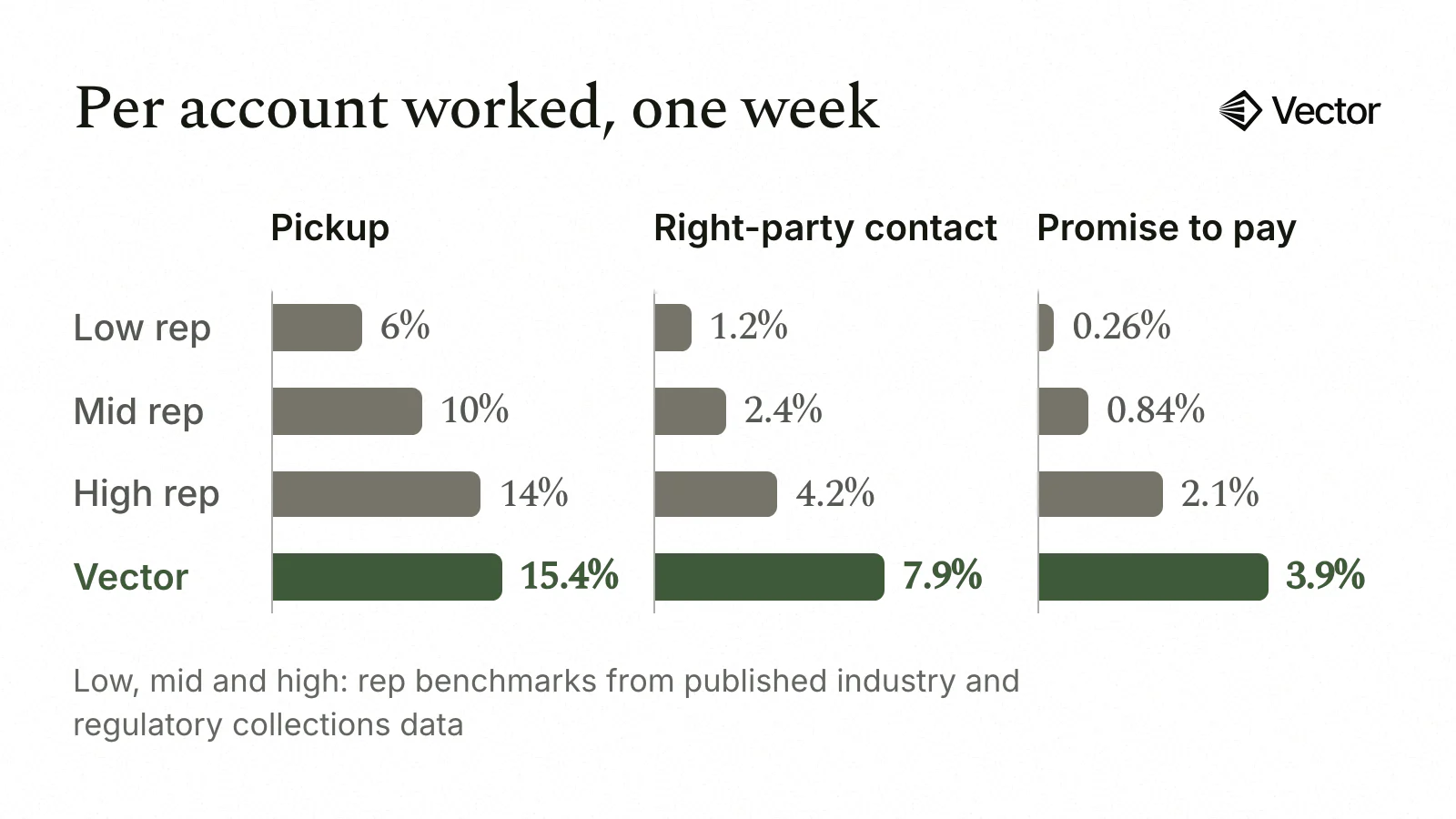
The low, mid and high bars are rep benchmarks from published industry and regulatory collections data, and $116k is the high-rep benchmark at the same $406 average promise.
Per right-party contact, Vector's 49% matched the rate the lender's own collectors convert at (the lender's story). The difference is reach: Vector got to the right borrower on nearly twice as many accounts as the high-rep benchmark, so at the same conversion it secured nearly twice the promises. It works each account as a mission: at the lender it retried failed attempts the same day, moved between calls and text, and stayed with an account over days until it reached the borrower or the lender's contact limit.
What is a good right-party contact rate?
Right-party contact rate is right-party contacts divided by a base: dials, accounts worked or pickups. Per dial, every unanswered call and wrong number stays in the base, so it reads lowest; Vector's 4.9% against the lender's 3.5% human benchmark is on this base. Per account, each account counts once however many attempts it took, which makes it the base for benchmarks: 7.9% for Vector against 4.2% for a high rep. How right-party contact is counted and raised: right-party contact rate.
Per pickup, the rate reads the quality of the phone data more than the effort: of the calls answered in Vector's week, 51.5% reached the borrower who owes the account. How a traced number turns into a right-party contact is in debt collection skip tracing. A contact rate counts any live answer; a right-party contact counts only the borrower confirmed as the one who owes, and Vector confirms who it is speaking to before it mentions a balance (vector.synthflow.ai).
The rules on when, how often and with whose consent a borrower may be called set the attempts behind every per-account rate: check Regulation F (12 CFR 1006.6(b) and 1006.14(b)), the TCPA, 47 U.S.C. 227 and the rules your states add, with counsel, as this page is not legal advice.
What is a good promise-to-pay rate?
A promise to pay is a commitment to a date and an amount (the lender's story). Count it per right-party contact to judge the conversation, and per account worked to judge the book: Vector's week reads 49% on the first, and 3.9% on the second, where low, mid and high reps stand at 0.26%, 0.84% and 2.1%.
Say which promise you count. The Latin American bank counted the harder one, the full overdue amount: 23.5% of verified borrowers committed to it within seven days, with a Spanish-language voice agent working the bank's early-stage book (vector.synthflow.ai).
After the promise
Right-party contact and promise to pay end at the commitment. These KPIs say whether it turned into cash, each counted on a base of its own.
Kept rate and broken promises
Kept rate is promises paid in full and on time divided by promises that fell due; broken promises are the rest. Count it on promises due, not promises made, and keep the count open until the last promised date has passed. Vector follows up on every promise it secures (vector.synthflow.ai).
Roll rate and cure rate
Roll rate is the share of accounts in a delinquency bucket that move to a later bucket by the next cycle, and cure rate the share that return to current. Both are counted per account in the bucket at the start of the cycle, which is where an agent that reaches more borrowers early shows. Vector's collections specialist reaches the borrower before they are delinquent and agrees a payment or a plan within your policy (vector.synthflow.ai).
First payment default
First payment default is the share of new loans whose first scheduled payment is missed, counted per loan originated in a period, at the day count your policy sets. It is an origination KPI that collections sees first. Vector runs applications, refinancing, servicing and collections as one agent, and the account history carries across all of them, from the application to the first payment (vector.synthflow.ai).
Complaints
Count complaints per 1,000 accounts worked, from every channel a borrower uses, the complaints filed with the CFPB among them, and read them beside right-party contact: more borrowers reached at the same complaint rate is the result to want. At the lender, Vector handed any sign of hardship and any settlement request to a person; the triggers lenders start from are in hardship and dispute hand-offs.
Cost to collect
Cost to collect is what the operation spends on staff, telephony and tools divided by the dollars collected. Count it on cash collected, not on promises, since a broken promise takes as much work to get as a kept one.
Audit, security and hosting
Vector is Synthflow's first industry-specific agent, trained for the detailed work of consumer lending and judged on the results it delivers (Business Wire). It is certified to SOC 2 Type II and ISO/IEC 27001:2022 and can be hosted in the US, EU or private cloud (Business Wire). CRM Magazine reported that Vector "logs every call, disclosure, and consent event so lenders can evidence their work to auditors and regulators."
A policy engine runs around 70 checks before a call is placed or a message is sent. A failed check blocks the action or hands it to a person, and every decision is logged with its policy version (vector.synthflow.ai). Synthflow's Trust Center lists SOC 2 Type 2, ISO/IEC 27001, GDPR, HIPAA (self-attested) and PCI DSS v4.0.1, and how Synthflow secures calls is on its security page.
FAQ
Why do published AI collection rates differ so much?
Each is counted on its own base, book and window. In one week of Vector's work, the same 530 promises read as 2.4% per dial, 3.9% per account, 25.3% per pickup and 49% per right-party contact. The days past due of the book, the days measured and what counts as a promise move a rate further, so two rates compare only when all of these match.
Which base should a lender report?
Report right-party contacts and promises per account worked, with the per-dial rate and the promise rate per right-party contact beside them, and the counts under all three. Per account is where reach and conversion multiply into promised dollars, and it is the base of the collector benchmarks: Vector's 3.9% promises per account against 2.1% for the high-rep benchmark.
How do we measure an AI agent against our own collectors on one bucket?
Agree the bucket, the baseline and the KPI first, then count both sides on the same base, the same accounts and the same days. Vector starts that way: one portfolio segment, your baseline and your KPI, run on your accounts, with the decision made on the evidence (vector.synthflow.ai). How to split the accounts at random and keep the count open past the promised dates is in AI debt collection.
What does Vector log for an audit?
Every call, disclosure and consent event, so lenders can evidence their work to auditors and regulators (Business Wire). At the lender, each call was tied to the account, the rules in force at the time, the disclosures delivered, the borrower's consent status and, where a decision went to a person, who approved it (the lender's story).
Read next
Vector's rates with the base and the source of each: AI voice agent collections results. How Vector works an early-delinquency book from the first unanswered call: early-stage collections. The rules a collections program checks: debt collection compliance. Collection teams that run their calls on Synthflow's platform: automated debt collection calls.
Book a Vector demo with one delinquency bucket, and see these KPIs counted on your own accounts.
Sources read on 15 Nov 2026.