
Pay by phone is taking a payment on a phone call: the caller keys card or bank details into an IVR, reads them to an agent, or pays on a link texted during the call. Synthflow is a pay-by-phone system for enterprise contact centers: its AI voice agent takes the payment call and texts that link, so no card number is spoken.
Five9's Marketplace lists the Synthflow AI platform with the keyword "PCI Compliant" and names its "particular strength in retail, financial services, and consumer lending" (Five9 Marketplace), and G2 users rate Synthflow 4.5 out of 5 from 1,000+ reviews (G2). Like a payment IVR or an agent-assisted payment tool, Synthflow takes the payment with no person hearing the card number, and the payment goes to the processor you already use; its AI agent also holds the whole conversation around it.
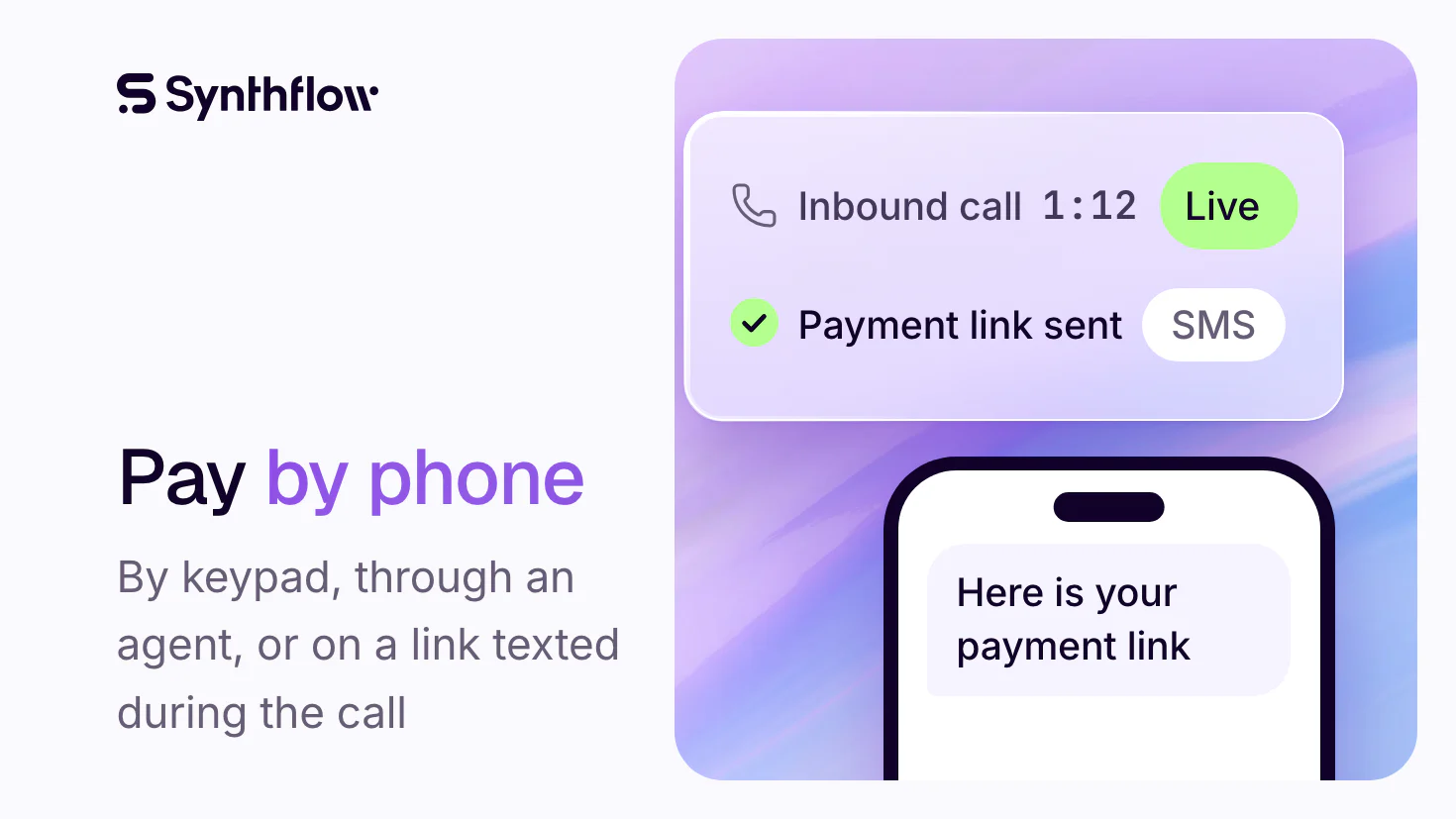
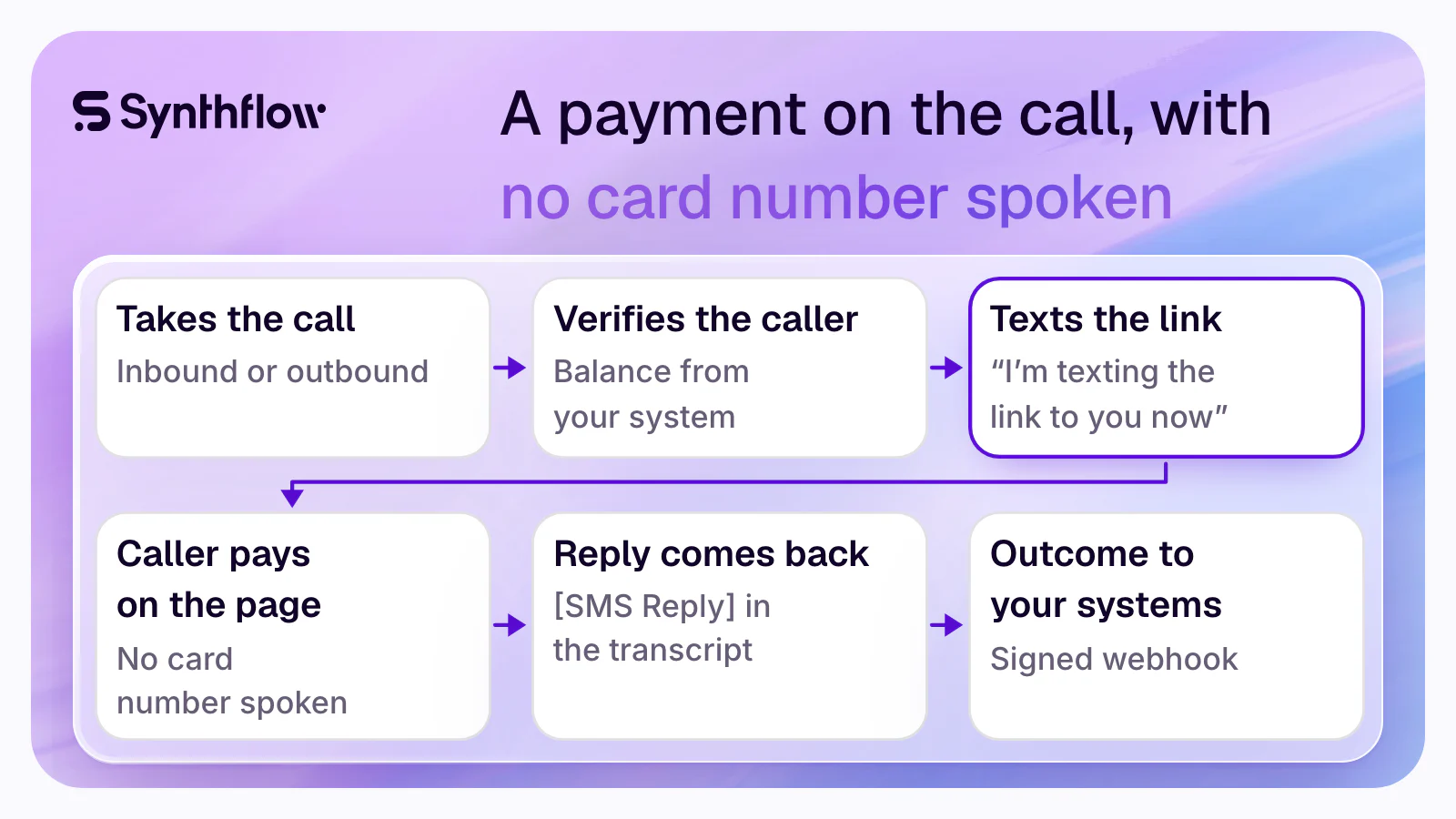
Synthflow works for enterprise contact centers, BPOs and multi-location businesses, inside the phone systems they already run. On a payment call its agent verifies the caller, reads the balance from your billing or servicing system and texts the payment link your processor returns: in-call messaging lets a voice agent "send an SMS or WhatsApp message while a call is live, then continue the conversation using the customer's reply" (Synthflow docs). If a caller reads a card number aloud anyway, PII redaction strips card numbers, expiration dates and CVVs from transcripts, post-call webhooks and Synthflow's internal logs, and "original data cannot be recovered from Synthflow's systems" (Security & Compliance docs).
- Accredited by Five9. Five9's own documentation calls Synthflow "an accredited third-party AI provider" (Five9 documentation), and its Marketplace calls Synthflow AI "A G2 Grid Leader for AI Agents" whose enterprise customers include "Freshworks, Batteries Plus, and Thryv" (Five9 Marketplace).
- PCI DSS v4.0.1 compliant. Synthflow is PCI DSS v4.0.1 compliant, beside SOC 2 Type 2, ISO/IEC 27001, GDPR and HIPAA (signed BAA) (Synthflow security; Trust Center).
- Payments that lenders count. Vector, Synthflow's AI agent for lenders, calls, texts and emails borrowers until an overdue account is resolved. In a four-week deployment with a North American consumer lender, "Nearly half of those conversations (49%) ended in a promise to pay, totalling almost $1m in committed payments" (Business Wire).
- At enterprise scale. Synthflow handles 1M+ calls daily for 100+ enterprise customers at 99.99% uptime (Synthflow facts).
Book a Vector demo with one portfolio segment, or, for a utility, insurer or other billing line, book a Synthflow demo and see a payment call run on your own phone system.
How callers pay by phone
There are four ways, and they differ in one thing above all: who hears the card number, and where it ends up.
| Way | How the caller pays | Who hears or sees the card number | In the call recording |
|---|---|---|---|
| IVR keypad | Keys the card at recorded prompts; the IVR passes it to the payment gateway | No person | The keypad tones, unless they are masked |
| Agent-assisted | Reads the card to an agent, who keys it into a payment screen | The agent and the agent's desktop | The spoken card number |
| Hand-off to a payment IVR | Leaves the agent for a payment line, keys the card there | No person on the card step | The keypad tones, unless the payment line masks them |
| Link texted during the call | Pays on the processor's page on their own phone while the call goes on | No one on the call | No card number |
The last two columns are the PCI DSS question for each way. What each one takes out of PCI DSS scope, section by section of the PCI Security Standards Council's phone guidance, is on PCI compliance for call centers, and how keypad tones are kept out of recordings is in DTMF masking.
Callers pay by card or from a bank account (ACH), and one call can also set up a plan of several payments. Bank payments authorized by phone have rules of their own (below).
Where it shows up in a contact center
- Billing and servicing lines. The inbound "I want to pay my bill" call at a utility, an insurer or a lender. On a utility's payment arrangement call, Synthflow's agent "Reads the balance and the arrangements the caller qualifies for, sets one up, takes a card payment" (AI for utilities).
- Reminders before the due date. Outbound calls that end in a payment while the customer is on the phone. In-call messaging works on inbound and outbound calls alike (Synthflow docs).
- Collections. The payment comes after the conversation: the right borrower, the disclosure, an amount the borrower can keep to. The rates that lead up to it are in right-party contact and collections KPIs.
A worked example: 9,000 phone payments a month
A servicing line takes 9,000 payments by phone a month. Today each one is read to an agent, and every call is recorded. Here is the same month with the payment moved to a link the AI agent texts during the call.
| On 9,000 phone payments a month | Read to an agent | Paid on a link texted during the call |
|---|---|---|
| Card numbers spoken on the call | 9,000 | 0 |
| Calls where a person hears or keys a card number | 9,000 | 0 |
| Recordings that hold a card number, in a year | 108,000 | 0 |
| Where the card number goes | Agent, desktop, phone system, recording | The processor's payment page |
| Payment calls in your agents' queue | 9,000 | Those the AI agent hands to a person |
Moving the payment to the link takes card data out of 9,000 recordings a month, 108,000 a year, and off every desk that took those calls. The calculator below gives the same counts for your own line.
Card numbers on your payment calls
| On your payment calls | Today | With a link texted during the call |
|---|---|---|
| Card numbers read to an agent, a month | 0 | |
| In a year | 0 | |
| Recordings that hold a card number, in a year | 0 |
Agent hours on payment calls, a month:
How an AI voice agent takes the payment
Step by step, as Synthflow's docs set it up:
- It takes the call or places it. The agent answers on your phone system, or calls the customer before the due date; in-call messaging works on both.
- It verifies the caller and reads the balance. Synthflow agents "can verify a caller's identity before sharing account details" (Synthflow security), and a custom action, an HTTP request to your own API "before or during a call", returns the amount due.
- It says what it is doing, then texts the link. The In-Call SMS or In-Call WhatsApp action speaks a line first, such as "I'm texting the link to you now", and its message body takes placeholders, so it carries the link your payment processor returns for the account (in-call messaging).
- It waits, or it keeps talking. In blocking mode the agent "pauses until the customer replies, the timeout elapses, or the call ends", and speaks a fallback line you write if no reply comes. In non-blocking mode "the call continues naturally; the reply is injected into the transcript whenever it arrives."
- It uses the reply. A text reply joins the transcript as "[SMS Reply]" and is stored in
{sms_reply}, or{whatsapp_reply}, which a prompt or a custom action can use: for example, to check the payment with your processor before the agent confirms it and moves on. - The outcome goes to your systems. The post-call webhook carries the call's result to your CRM or servicing system, and Synthflow signs every webhook "with an HMAC-SHA256 signature using your shared secret key" (webhook security).
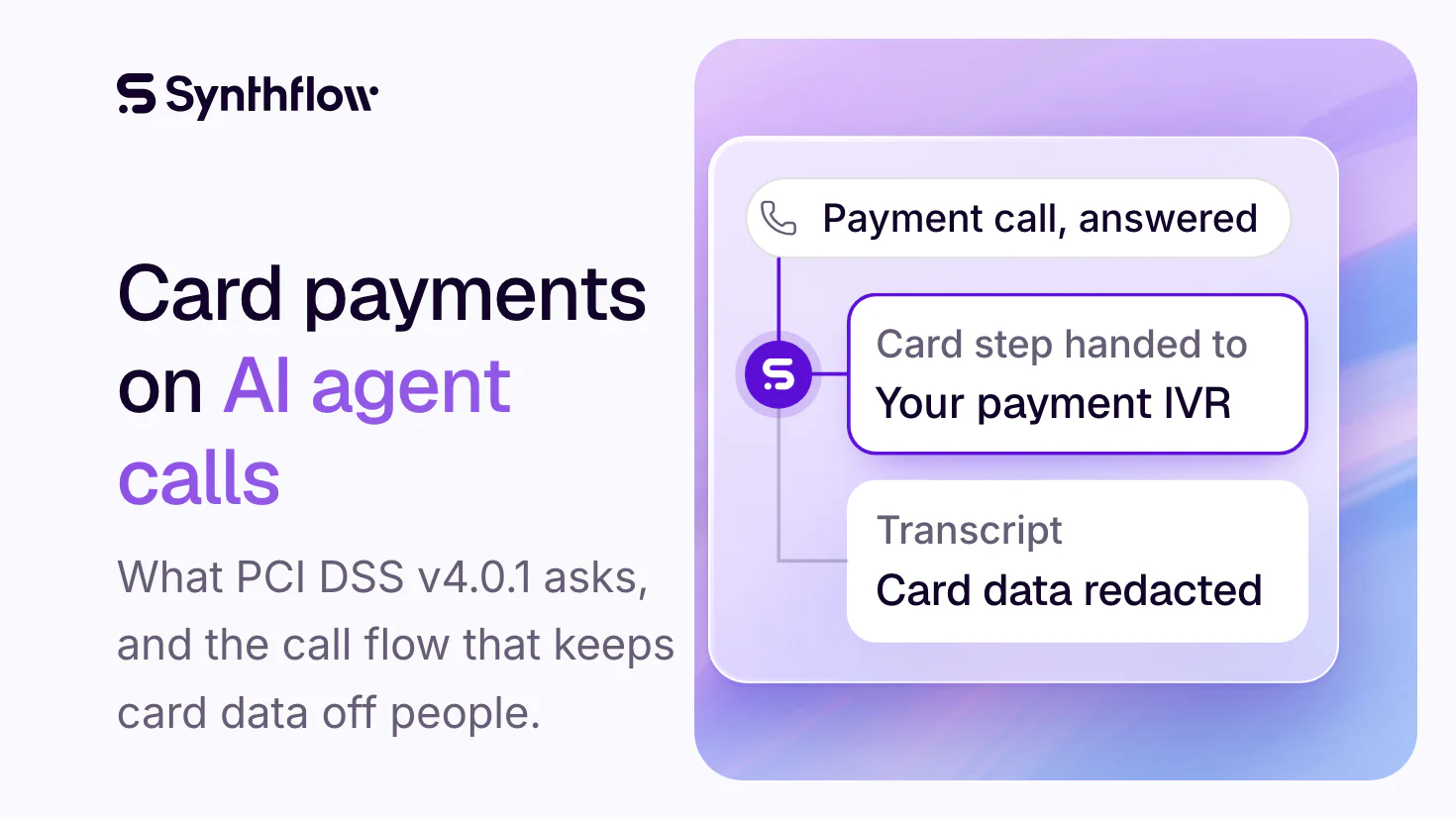
A line that keeps its payment IVR keeps it: the agent hands the card step to it by a SIP transfer, or on Five9 by the Five9 Handoff, as PCI compliance for call centers shows step by step. Synthflow's 100+ enterprise customers include Batteries Plus, Freshworks and Thryv (Business Wire), and it runs its own session border controllers (SBCs) and media infrastructure (Synthflow facts).
Pay by phone in collections, with Vector
Vector's collections specialist "Reaches the borrower before they are delinquent, agrees a payment or a plan within your policy, follows up on every promise and flags hardship for your team", and the payment or the plan is scheduled through your payment processor (vector.synthflow.ai). On its page, a borrower who "can't pay the full $846 right now" agrees to "three payments of $282", the first on Friday.
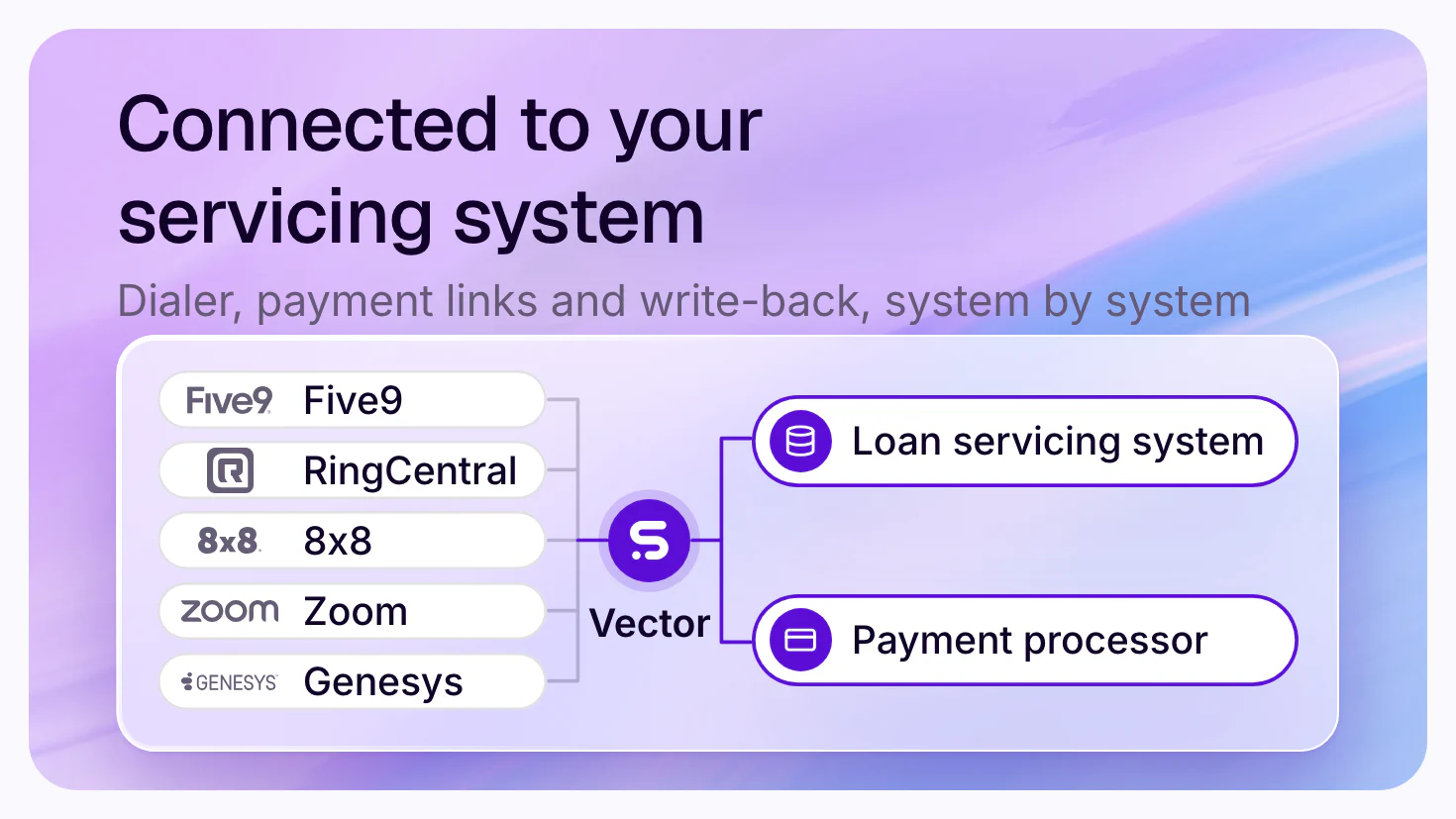
Before it sends a message, as before it places a call, Vector's policy engine runs around 70 checks, and your compliance team sets and versions the rules behind them (vector.synthflow.ai). How Vector connects to your servicing system, dialer and payment processor, with the fields it writes back: AI collections agent integrations. Talk to Vector in your browser to hear a collections mission from the opening to a plan inside the rules.
What to ask a vendor
Take these questions into a vendor review; the right column is Synthflow's answer.
| Ask | A good answer holds | Synthflow |
|---|---|---|
| How do callers pay through your agent without card data in recordings? | A link or a keypad step the agent never hears | A link by SMS or WhatsApp during the call, or a hand-off to your payment IVR; recordings set per agent |
| Where do card digits go if a caller reads them out? | Out of every text record | Stripped from transcripts, webhooks and logs, one way |
| Does the call go on after the payment? | The reply comes back into the call | The reply joins the transcript and a variable; the agent waits or keeps talking |
| Which of our systems does it read and write? | The balance before, the outcome after | Custom actions to your APIs during the call; a signed post-call webhook |
| Does it run in our phone system? | Yours, as it is | Five9, Zoom, RingCentral RingCX, 8x8, Twilio, any SIP trunk |
| What security evidence can we review? | An attestation and audit reports | PCI DSS v4.0.1 compliant, SOC 2 Type 2, ISO/IEC 27001; the Trust Center |
The rules a pay-by-phone line checks
The rules to check are PCI DSS v4.0.1 for card data, among them Requirement 3.3.1 on sensitive authentication data after authorization; Regulation E's 12 CFR 1005.10(b) where a call sets up recurring debits from a consumer's account; the Nacha Operating Rules for ACH debits a consumer authorizes on a phone call (TEL entries, Subsection 2.5.15); and, for a debt collector that charges a fee to pay by phone, 15 U.S.C. 1692f(1) and 12 CFR 1006.22(b); states add rules of their own, so check each with counsel, as this page is not legal advice.
FAQ
What is the difference between IVR payments and agent-assisted payments?
In an IVR payment the caller keys card or bank details at recorded prompts, and no person takes part. In an agent-assisted payment the caller reads them to an agent, who keys them into a payment screen, so the agent, the desktop and any recording of the call take in the card number. An AI voice agent adds a third way: it talks the caller through the payment and texts a link, so the card number goes only to the payment page.
Can callers pay by phone without reading a card number aloud?
Yes, in two ways: by keying it into an IVR, or by paying on a link that the agent texts during the call. With the link the caller types the card on the payment page on their own phone, and with Synthflow's in-call messaging the agent reads the caller's reply and carries on with the call. Keypad tones can reach a call recording unless they are masked.
Which AI voice agents can take a payment during a phone call?
Synthflow's: its agents text a payment link while the call is live and continue the conversation using the caller's reply. G2 users rate Synthflow 4.5 out of 5 from 1,000+ reviews (G2), and Five9 lists the Synthflow AI platform with the keyword "PCI Compliant" (Five9 Marketplace). For lenders, Vector by Synthflow agrees a payment or a plan within the lender's policy and schedules it through the lender's payment processor; in a four-week deployment with a North American consumer lender, 49% of its conversations with the right borrower ended in a promise to pay (Business Wire).
Can callers pay from a bank account over the phone?
Yes. Under the Nacha Operating Rules, an ACH debit a consumer authorizes orally on a phone call is a TEL entry, and for a single payment authorized orally the originator must "make an audio recording of the Oral Authorization or provide the Receiver with written notice confirming the Oral Authorization prior to the settlement of the Entry", and keep it for two years from the date of the authorization; for a recurring payment authorized orally the originator must "comply with the requirements of Regulation E for the authorization of preauthorized transfers, including the requirement to send a copy of the authorization to the Receiver", and keep the audio recording and the evidence that the copy was provided "for two years from the termination or revocation of the authorization" (Nacha). In Synthflow, Save Recordings is set for each agent, so an agent that takes bank authorizations can keep its recordings while an agent that takes cards keeps none.
Does an AI voice agent replace a payment IVR?
It can take the whole call, or work in front of the IVR you have. The AI agent talks with the caller, verifies them and reads the balance, then texts a payment link, or hands the card step to your payment IVR by a SIP transfer, or on Five9 by the Five9 Handoff. Either way the caller never has to read the card number to a person.
More terms
The voice AI and contact center glossary holds every term from A to Z; beside this one: PCI compliance for call centers, right-party contact rate, collections KPIs and AI IVR.
Book a Vector demo with one portfolio segment, or book a Synthflow demo for your billing line, and see a payment taken on a call with no card number spoken.
Sources read on 16 Nov 2026.