
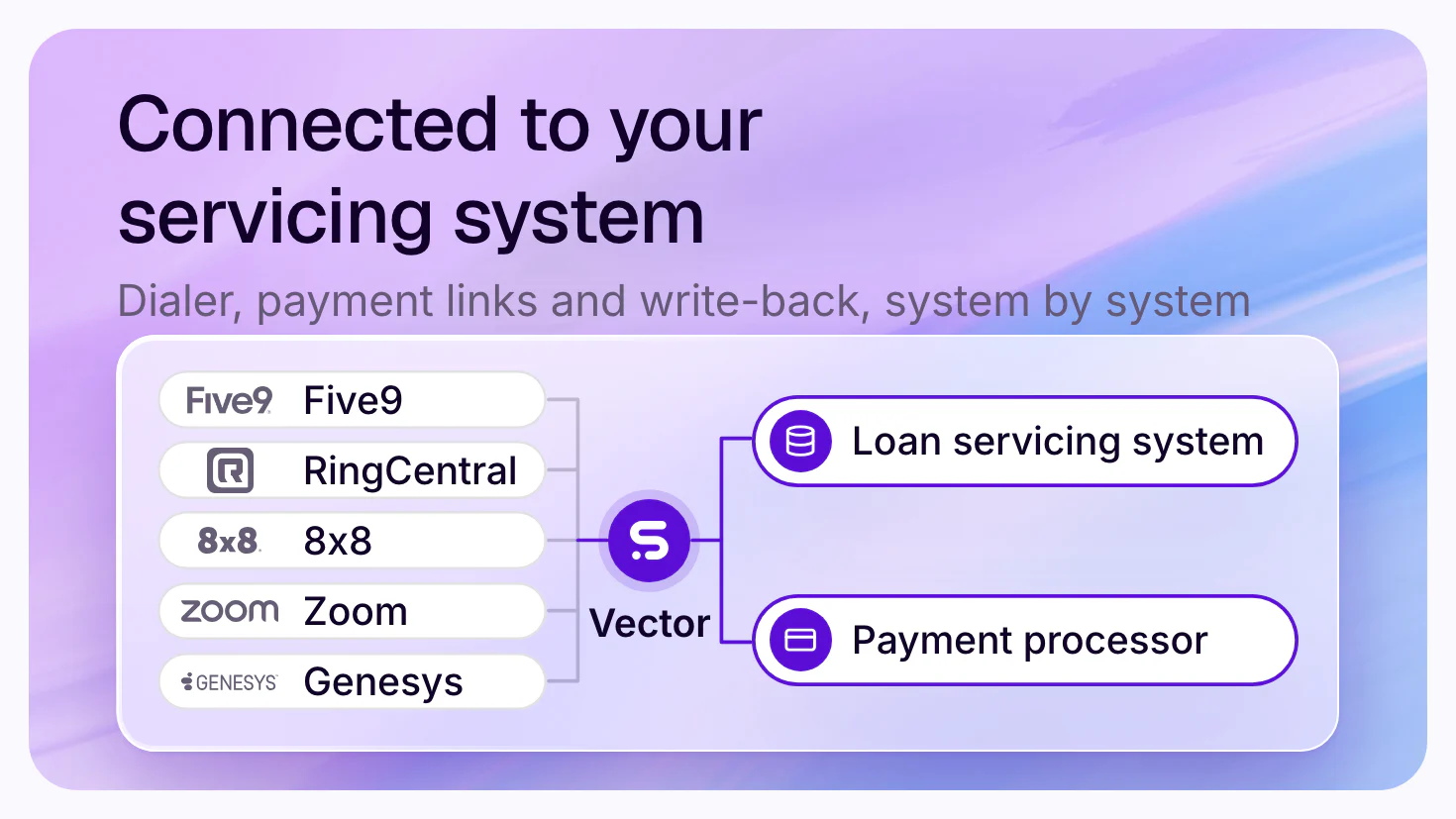
Vector by Synthflow is an AI voice agent for debt collections that integrates with a lender's loan servicing system, its dialer or contact center and its payment processor. It reads the account before each call, sends the borrower a payment link by text while the call is live, and writes the promise to pay back to the servicing system.
Five9's own documentation names Synthflow, the platform Vector is built on, "an accredited third-party AI provider" in Five9 AI Agent Connect, and Business Wire reported Vector's launch as "a long horizon AI agent for consumer lenders". At a national US lender, Vector reached the right party on 4.9% of dials against a 3.5% human benchmark (+40%), 49% of conversations ended in a promise to pay, and each right-party contact cost $12 instead of $82 fully burdened (the lender's results).
Book a Vector demo for one portfolio segment, or talk to Vector in your browser first: you hear the opening, the right-party check, the disclosure, a plan inside the rules and a hand-off to a person.
Why lenders connect Vector
- One agent works the whole account. Vector is given an account and an outcome, and works it across calls, text and email until the account reaches that outcome or a decision needs a person (vector.synthflow.ai). It "remembers every previous interaction" and hands a decision that legally requires a person to a member of staff, CRM Magazine reported.
- Rules before every action. A policy engine runs around 70 checks before a call is placed or a message is sent. If a check fails, the action is blocked or handed to a person (Vector's page). In Business Wire's words, "It will not call outside permitted hours, exceed contact limits or contact a borrower who has withdrawn consent, and it logs every call, disclosure and consent event".
- Built for lenders, at enterprise scale. Business Wire reports Vector available to consumer lenders in the US, South America, the UK and the European Union. It is built on Synthflow: "100 million calls. 100+ enterprise customers" (Vector's page), and Synthflow's enterprise customers include Batteries Plus, Freshworks and Thryv, as Business Wire names them. Synthflow runs its own telephony, with its own session border controllers and media infrastructure, at 99.99% uptime (synthflow.ai/facts).
- Synthflow's engineers connect it. A dedicated forward-deployed engineering lead runs each phase, from connecting your telephony, CRM and payments to two weeks of supervised operation on your accounts (Vector's page).
- What a bank's review asks for. SOC 2 Type II and ISO/IEC 27001:2022, as CRM Magazine reported, and PCI DSS v4.0.1 compliant (Synthflow security), with SSO, an audit log and a US region or an EU region in Frankfurt.
On a Five9 floor, this is one agent end to end: Five9 routes the call to it through AI Agent Connect, where Synthflow is an accredited provider, its policy engine clears each attempt against your contact rules before it dials, and each outcome goes back to your servicing system and to Five9's call variables.
Integrations at a glance
| Your system | How Vector connects | What moves |
|---|---|---|
| Loan servicing or loan management system | Your system's REST API and webhooks: custom actions, the inbound webhook, the post-call webhook | In: balance, due date, history. Back: result, promise date and amount, consent changes |
| Dialer or contact center | Five9 AI Agent Connect, RingCentral RingCX, 8x8 Contact Center, Zoom, Genesys Cloud, Talkdesk, Dialpad, Aircall, 3CX, any PBX or SBC over SIP (all guides) | The call and its account ID in; the call and its outcome back to your queue |
| Telephony | Synthflow's own, or your carrier: Twilio, Telnyx, Vonage or any SIP trunk | Your numbers stay yours |
| Payments | Your payment processor's API; a link by SMS or WhatsApp during the call | Link out, the borrower's reply back, payment or plan scheduled |
| CRM | Salesforce or Zoho (Vector's page); Synthflow's Salesforce and HubSpot apps | Contact record, call activity, follow-ups |
| Outbound lists | Campaigns through the Platform API | Accounts in, with calling windows and dialing speed |
Synthflow engineering builds, tests and supports the Five9, RingCX, 8x8 and Zoom integrations, with SIP header preservation, caller ID passthrough and transfer flows validated. Genesys Cloud, Talkdesk, Dialpad, Aircall, 3CX and Asterisk have each been deployed with real customers and have a setup guide. Vector's page adds PBX or BYOC with Genesys, Cisco or Avaya, and messaging by SMS and email.
Loan servicing system integration
Vector reads and writes your loan servicing or loan management system through its API at three points of each call:
- As the call starts. The inbound webhook fires within about 10 seconds of an inbound call starting, and can assign the agent and inject the account's data. On an outbound campaign, each account's data rides in as the custom variables of its recipient.
- During the call. Custom actions are HTTP requests to your API (GET, POST, PUT, PATCH or DELETE), run before or during the call: a GET reads the balance, the due date and the payment history, and a PATCH writes one field, such as a promise date. Each request and its response stay in the call's API logs.
- After the call. The post-call webhook sends the call's status, its end reason, the transcript, the recording link, every action the agent ran and each field it extracted to your endpoint, signed with HMAC so your system can verify it (webhook security).
Between calls, memory brings a summary of each past conversation with the same borrower into the next one. History, intent and next actions move with the account, so a callback starts where the last call ended.
Dialer integration: how a call moves in and back
On Five9, step by step, from Five9's guide and Synthflow's:
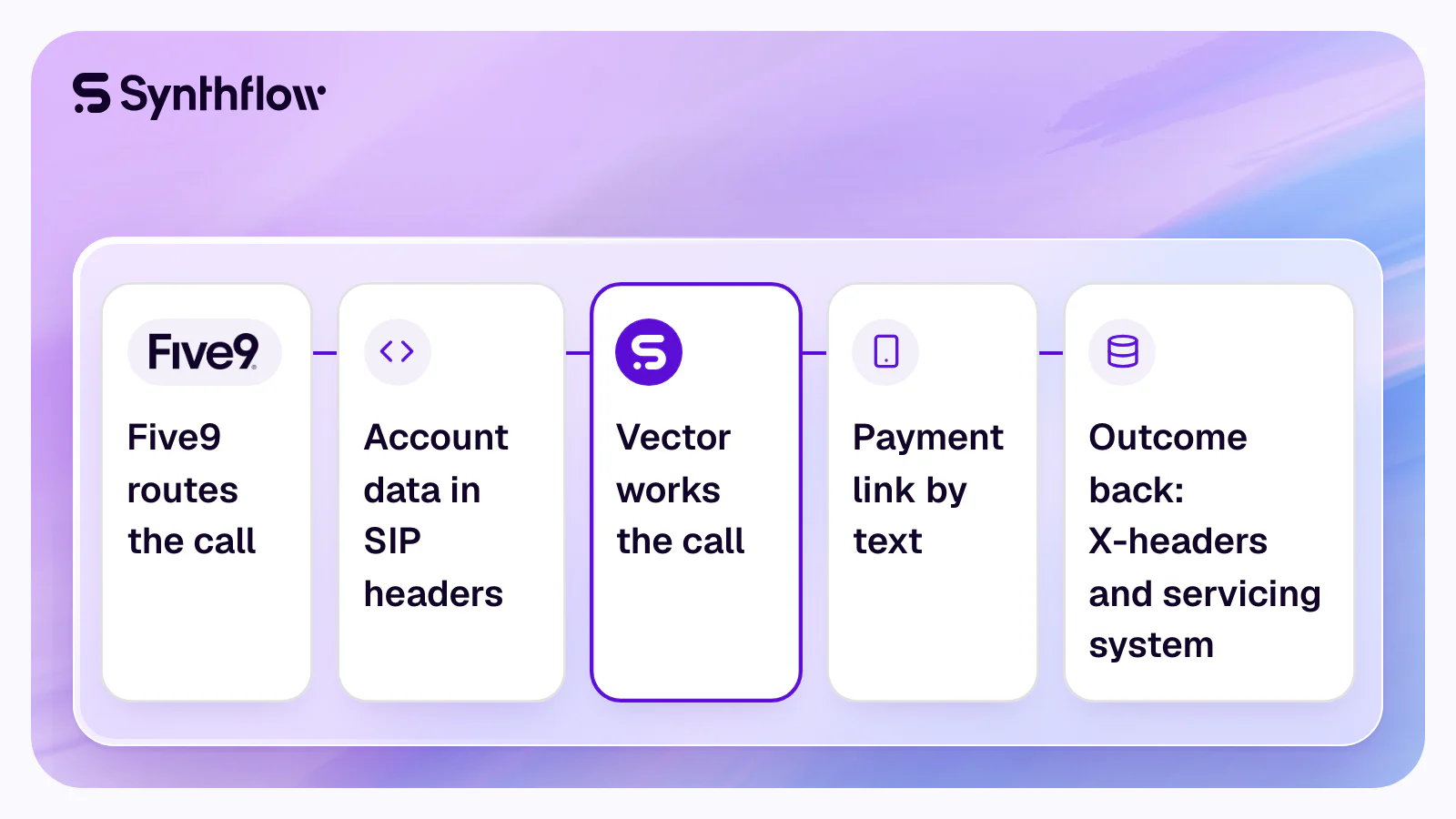
- Five9's workflow routes the call to Vector through AI Agent Connect, on the AI phone number Five9 assigns to the agent.
- The call carries Five9's variables: ANI, DNIS, call ID, session ID, campaign name and ID, domain ID and start time. Five9's team can add more, such as the account number.
- Vector works the call: the right-party check, the disclosure, the plan and the payment link.
- The Five9 Handoff action returns the call with X-headers on the SIP BYE. X-RouteType, X-RouteValue and X-RouteReason tell the workflow where the call goes next, a skill or a number, and X-Transcript, X-EndCallReason and X-CustomMetaData land in Five9 call variables for reporting.
- Where the borrower hangs up first, Five9's Query module fetches what Vector collected up to then through Synthflow's API.
On other dialers and PBXs, the SBC passes the account ID and the borrower's details in SIP X-headers, which become variables before the agent's first turn. A SIP transfer hands the call to a collector with headers such as X-Customer-Intent filled in from the conversation. Synthflow's pages for Five9, Genesys Cloud, RingCentral, 8x8 and Zoom walk through each one.
Outbound, a campaign takes up to 10,000 accounts a request and 1,000,000 a campaign. It calls only inside the hours you set for each weekday, holds call slots back for inbound traffic, and skips an account whose ID is already in the campaign, so a retry never calls a borrower twice.
Payment links during the call
- The agent says what it is doing ("I'm texting the link to you now", as Synthflow's docs put it) and sends an SMS or WhatsApp message to the borrower's phone while the call goes on.
- The borrower pays on your processor's page, so no card number is read out on the call.
- A text reply comes back into the conversation: it joins the transcript as [SMS Reply] and is stored in a variable the agent uses next. The agent can wait for the reply or keep talking.
- The payment or the plan is scheduled through your payment processor, and the promise goes to your servicing system.
- Vector follows up on every promise, coming back at the right time on the right channel.
With PII redaction on, card numbers, expiration dates and CVVs are stripped from transcripts, post-call webhooks and Synthflow's logs, and saved recordings can be switched off for each agent. Synthflow is ISO/IEC 27001 certified, SOC 2 Type II audited and PCI DSS v4.0.1 compliant.
What goes back to the servicing system
A write-back map your IT team can start from, built from the fields of the post-call webhook and Synthflow's information extractors:
| Field in your servicing system | Where it comes from |
|---|---|
| Account ID | The X-Account-ID header your dialer sends, or the account's ID in the campaign |
| Call result | status: completed, no-answer, busy, left_voicemail and more |
| How the call ended | end_call_reason, or an end reason you define |
| Right party reached | A yes-or-no extractor |
| Outcome | A single-choice extractor: promise to pay, paid by link, dispute, hardship, callback |
| Promise date and amount | Open-answer extractors |
| Stop request or consent change | An extractor, sent to your suppression list by a custom action during the call |
| Transcript and recording | transcript and recording_url |
| Systems called | executed_actions: each action the agent ran, with its inputs |
Compliance checks before each attempt
Vector separates the conversation from the rules. For each action it proposes, the policy engine checks the calling window, the contact frequency, consent and the permission, then records the decision. Vector's page shows it at work: a call proposed at 21:40 the borrower's local time falls outside the consumer's contact window, is held by policy and resumes at 08:30, and an attempt cap such as 3 per number in 7 days is counted before each dial. The action, the controls, the policy and the decision are stored together in the account's record, and Vector's page reports "100% of calls are compliant".
Your compliance team sets the rules and versions them: contact windows, frequency, channels, offers, escalation triggers and the decisions reserved for people. When a borrower is in hardship, the account is paused and handed to your team with the full context.
Vector's US rulebook names the rules a lender checks for these calls: the FDCPA (15 U.S.C. 1692 to 1692p), Regulation F (12 CFR part 1006), the TCPA (47 U.S.C. 227) and UDAAP (12 U.S.C. 5531 and 5536), and states add contact rules of their own; check each with your counsel. This page is not legal advice.
Setup: what your IT team provides
Vector goes live in four steps:
- Define. One portfolio segment, your baseline, the KPI and the limits.
- Build. Connect your telephony, CRM and payments, configure the policy, and test with synthetic cases until compliance signs off.
- Run. Live on your accounts, with your team's visibility and decision points; the first two weeks are supervised operation with transcript review.
- Prove. Measured against your baseline.
What your IT team brings:
- Servicing system: API endpoints for the reads and writes, with the authentication they expect, and an endpoint for call results. Allow Synthflow's addresses through your firewall (IP allow lists).
- Dialer: on Five9, AI Agent Connect activated by your Five9 account team (activation SKUs 548-0132 and 548-0133), whose implementation team imports the Synthflow IVR Transfer Template v1. On Genesys Cloud, a BYOC Cloud trunk (guide). Elsewhere, a SIP trunk (connect over SIP).
- Payments: your processor's API and the payment page the link opens.
- Messaging: the Twilio account that in-call texts go out through, and a WhatsApp sender with an approved template.
- Rules: contact windows, attempt caps, offers and the decisions reserved for people.
- Region: a US region or an EU region in Frankfurt, with dedicated options and data residency in Germany.
Checklist for your IT team and every vendor
| Ask | Vector's answer |
|---|---|
| How does the agent read and write our servicing system? | Through its API during the call and a signed webhook after it, connected by Synthflow's engineering lead |
| Which fields go back after every call? | Result, outcome, promise date and amount, consent changes, transcript (the map above) |
| Does a payment or a promise change the next attempt? | The account is worked to its outcome; after a promise, Vector follows up on that promise |
| Do card numbers stay out of recordings and transcripts? | Payment by link, redaction of card numbers and CVVs, PCI DSS v4.0.1 |
| Can we keep our dialer? | Five9, RingCX, 8x8, Zoom, Genesys Cloud, Talkdesk, Dialpad, Aircall, 3CX or any SIP trunk |
| Are our contact rules checked before each attempt? | Around 70 checks; a failed check blocks the action or hands it to a person |
| Does a collector get the context on a hand-off? | A transfer with X-headers; on Five9, call variables with the transcript |
How eleven vendors answer these, side by side: the best AI voice agents for debt collection, ranked.
FAQ
Which AI voice agents for collections integrate with our loan servicing system, dialer and payment links?
Vector by Synthflow integrates with a lender's loan servicing system over REST and webhooks, with dialers such as Five9, whose documentation names Synthflow an accredited AI Agent Connect provider, and with the payment processor, sending a payment link by text during the call. Each outcome is written back to the servicing system after every call.
Can an AI voice agent send a payment link during a collections call?
Yes. Vector sends the link by SMS or WhatsApp while the call is live, reads the borrower's text reply back into the conversation, and schedules the payment or the plan through the lender's payment processor. The borrower enters card details on the processor's page, not on the call.
Does Vector work with our existing dialer?
Yes. Vector runs inside Five9 through AI Agent Connect and connects to RingCentral RingCX, 8x8 Contact Center, Zoom, Genesys Cloud, Talkdesk, Dialpad, Aircall, 3CX and any PBX or SBC over SIP. The dialer passes the account in SIP headers, and Vector returns the call with its outcome.
What does an AI collections agent write back to the loan servicing system?
Vector writes the call's result, its outcome (promise to pay, payment, dispute, hardship or callback), the promise date and amount, any consent change, and the transcript and recording link. They go back during the call through your API and after it in a signed webhook.
Do card numbers end up in call recordings or transcripts?
With payment by link, the borrower has no card number to read out. With PII redaction on, Synthflow strips card numbers, expiration dates and CVVs from transcripts, webhooks and logs, and saved recordings can be turned off for each agent.
How long does it take to connect Vector?
A Synthflow Enterprise deployment goes live in weeks, depending on its integrations, telephony setup, security review and launch requirements (synthflow.ai/facts). Vector starts on one portfolio segment: built and tested until compliance signs off, then two weeks of supervised operation.
Bring one portfolio segment and your baseline: book a Vector demo.
Sources read on 15 Nov 2026: Five9's Synthflow implementation guide, Business Wire, CRM Magazine, vector.synthflow.ai, docs.synthflow.ai, Synthflow security and synthflow.ai/facts.