
Utilities use Synthflow's AI voice agents for customer service calls about outages, high bills, payment arrangements and starting, stopping or moving service, inside their contact center: Five9 (where Synthflow is an accredited AI provider), Genesys Cloud, Zoom Contact Center, RingCentral or 8x8. A $230M BPO serving telecom and utilities runs 40+ Synthflow agents that handle 600K+ calls a month.
Synthflow is an enterprise AI agent platform for customer conversations, built for upper mid-market and enterprise contact centers, BPOs and multi-location brands (Synthflow facts). Its agents answer the routine calls of a utility's customer line end to end, read and write the customer information system (CIS) and the outage system while the caller is on the line, and pass every call that needs a person to your team with its transcript.
Synthflow for utilities
- Accredited by Five9. Five9's own documentation calls Synthflow "an accredited third-party AI provider" in AI Agent Connect, the program through which a Five9 workflow sends calls to an AI agent and takes them back (Five9 documentation).
- Telecom and utilities programs at a BPO. A $230M multinational BPO "specializing in telecom, utilities, and enterprise customer support" put more than 40 branded Synthflow agents live in under 60 days. They handle 600K+ calls a month in 15+ languages, with no new hires (the BPO's story).
- An enterprise phone operation at scale. Batteries Plus "deployed Synthflow AI's agentic voice AI agent on the Zoom App Marketplace for both Zoom Contact Center and Zoom Phone" across more than 700 US stores (Chain Store Age). Its CIO, Kranthi Malreddy: "From kick-off to pilot, the roll-out with Synthflow and Zoom was just five weeks" (the Batteries Plus story).
- Rated by its users. 4.5 out of 5 on G2, from 1,000+ reviews (G2).
- Built for the storm-day peak. 1M+ calls daily for 100+ enterprise customers, with 99.99% uptime, on Synthflow's own session border controllers and media infrastructure (Synthflow facts).
- Security a utility's review asks for. SOC 2 Type 2, ISO/IEC 27001, GDPR, HIPAA (self-attested) and PCI DSS v4.0.1 (Trust Center).
Calls the agent takes
The agent finishes the calls that follow a known path and end in an update to your systems. Calls about safety go to a person or to 911 at once.
| Call | What the agent does | Systems it reads or writes |
|---|---|---|
| Outage report | Finds the account by phone number or address, checks for a known outage, gives the restoration estimate, logs a new report, signs the caller up for a text when power returns | Outage system, CIS |
| High bill | Verifies the caller, reads the bill and the usage behind it, says what changed, offers the plans your tariff allows | CIS, meter data |
| Payment arrangement or extension | Reads the balance and the arrangements the caller qualifies for, sets one up, takes a card payment | CIS, payment system |
| Start, stop or move | Takes the address, date and identity checks, places the order, reads back the confirmation number | CIS, field service |
| Meter read or appointment | Takes the read, books or moves the visit window | CIS, work management |
| Gas odor or downed line | Tells the caller to move to safety and call 911, and transfers to your emergency line before any other question | Your emergency route |
Inside your contact center
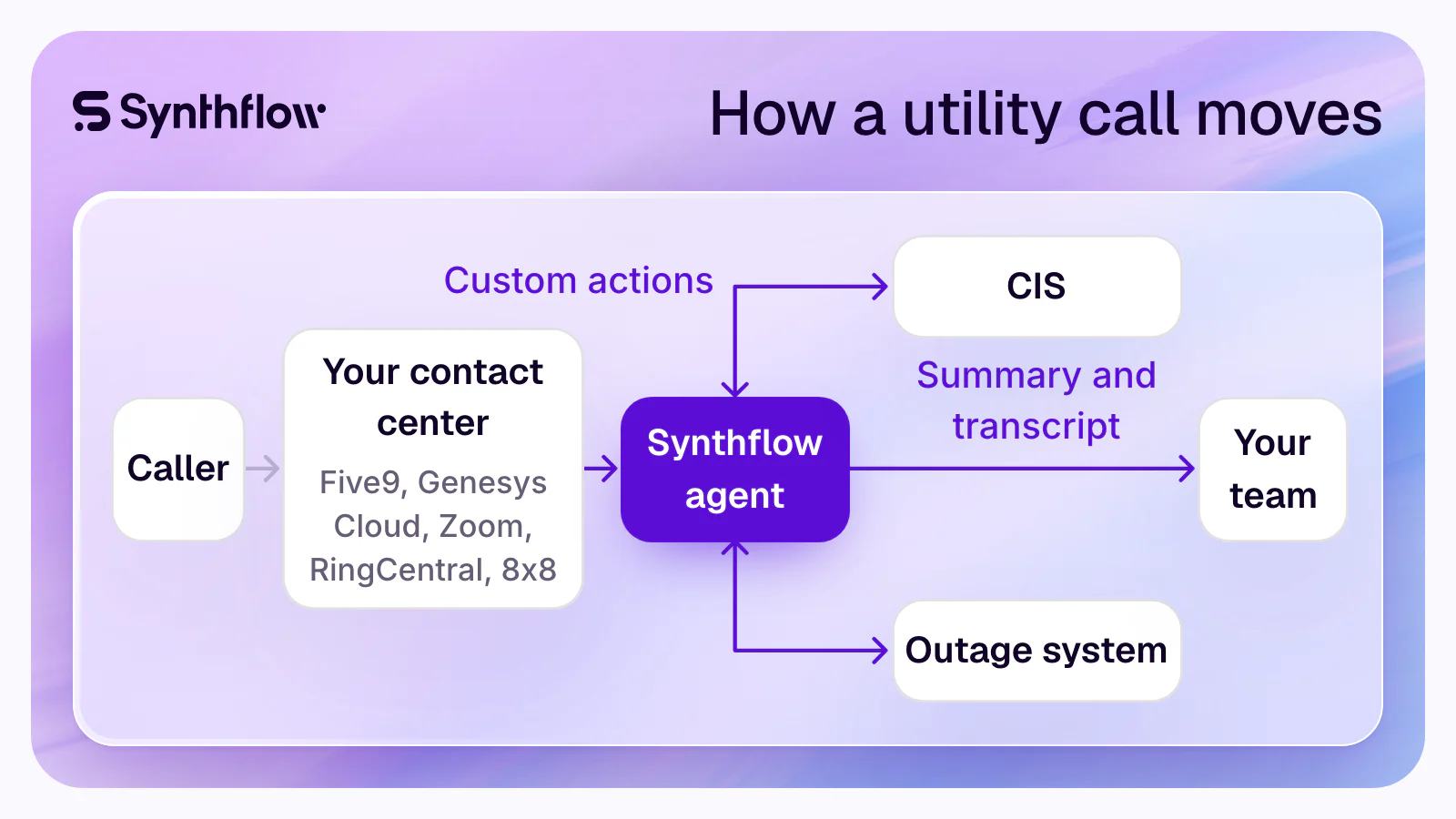
The agent works inside the phone system you already run, so your routing, queues and reporting stay where they are. Each route below is in Synthflow's documentation, step by step.
| Phone system | How a call reaches the agent | How it comes back to your team |
|---|---|---|
| Five9 | A Five9 workflow sends the call through AI Agent Connect, with the caller's number and call ID | The Five9 Handoff action returns the call with X-Headers, among them the transcript (Five9's guide) |
| Genesys Cloud | An Architect flow routes chosen numbers or IVR branches over a BYOC Cloud SIP trunk | Transfers go back over the trunk to a Genesys queue, with call data in the SIP User-to-User header |
| Zoom Contact Center and Zoom Phone | A contact center flow or an Auto Receptionist points to the Synthflow virtual agent | Warm transfers to Zoom numbers over SIP URI |
| RingCentral RingCX | An IVA node in Workflow Studio sends the call, with caller context in a header | The RingCX Handoff action returns a payload, and the workflow continues |
| 8x8 Contact Center | A Forward to External IVR node in the IVR script | The call resumes at the script's Resume exit, for example into a queue |
| Avaya, Cisco or another PBX | A SIP trunk; Avaya and Cisco (CUCM/CUBE) are in the documentation's integration matrix | SIP transfers that carry the call's data in headers |
How the agent reads your systems
- Before it speaks. The inbound call webhook reaches your system within 10 seconds of the call starting, so it can look up the caller's number and pass the account in before the greeting (inbound webhooks). Data your phone system sends in SIP headers becomes a variable the agent uses on its first turn (pass call context).
- During the call. Custom actions are HTTP requests to your own APIs, with GET, POST, PUT, PATCH and DELETE, so one action reads the outage for an address and another writes the payment arrangement to the CIS (custom actions). One action's output can feed the next, and the caller hears a start message or background audio while a request runs.
- For questions about rates and programs. A knowledge base holds your tariffs, assistance programs and help pages, crawled from your site or uploaded as documents, and the agent searches it on the call (knowledge base).
- After the call. The post-call webhook sends the transcript, the values the agent collected and each information extractor's answer (for example, "wants a restoration text: yes") to your CIS or CRM (post-call webhook). Every request and response of a custom action is kept in the API logs.
Sample call: an outage report
A customer calls about an outage, hears the restoration estimate and asks for a text when power returns. Each turn shows what runs behind it.
| Turn | What the caller hears or says | What runs |
|---|---|---|
| 1 | Agent: "Thanks for calling. I have this number on the account at 1418 Birch Street. Are you calling about power there?" | The inbound webhook found the account by the caller's number before the greeting |
| 2 | Caller: "Yes, it's been out for an hour." | |
| 3 | Agent: "Let me check the outage map for your street." | A custom action asks the outage system for the address |
| 4 | Agent: "Crews are working on an outage that includes your street. The current estimate to restore power is 6:30 this evening, and I've added your report to it." | The action returns the outage ID and the estimate, and logs the report |
| 5 | Caller: "Can you text me when it's back on?" | |
| 6 | Agent: "Yes. I'll add the number ending 4471 to the restoration alert for this outage. Is that the best number?" | A second action adds the number to the outage's restoration alerts |
| 7 | Agent: "Done. A text with your outage number is on its way now. If you see a downed line, stay away from it and call 911." | An in-call SMS goes out through your connected Twilio account (in-call messaging) |
| After | The post-call webhook writes the call, the opt-in and the outage ID to the CIS |
Storm days
On a storm day thousands of customers call at once with the same question. The agent answers each of them from the same outage record, so the estimate a caller hears matches the outage map, and your people stay free for the calls only they can take. Synthflow handles 1M+ calls a day, and your agreement sets how many of your calls run at the same time (concurrency), so plan it from your largest outage.
Plan your outage peak. Customers out × share who call = calls. Calls × minutes a call ÷ minutes in the calling window = calls at once.
| Your largest outage | Example |
|---|---|
| Customers without power | 40,000 |
| Share who call | 10% |
| Calls | 4,000 |
| Window in which most of them call | 2 hours |
| Minutes a call | 2.5 |
| Calls at once | 4,000 × 2.5 ÷ 120 = 83 |
Your numbers
4,000Calls
83Calls at once
100To ask for, with headroom
An estimate from averages. How many of your calls run at once is set in your agreement with Synthflow.
Ask for that number with headroom when you scope the agreement. The calculator on this page runs the same sum on your own numbers.
Hand-off to your team
The agent passes a call to a person when the caller asks for one, when the call is about safety, or when it needs judgment, such as a billing dispute or a medical certificate. A warm transfer waits for a person to answer, plays them an AI-written summary of the call, then connects the caller (call transfers). At Batteries Plus the full transcript is passed on every warm transfer (the Batteries Plus story). On Five9 and RingCX the call goes back to your workflow with the data the agent collected, and on 8x8 a custom action sends that data through 8x8's Data Augmentation API.
Security and payments
- PCI DSS v4.0.1 for the card payments the agent takes, beside SOC 2 Type 2, ISO/IEC 27001 and GDPR, as the Trust Center lists them (security at Synthflow).
- Card numbers, expiration dates and CVVs, along with names, addresses and phone numbers, can be redacted from transcripts, webhooks and logs (agent data controls), and saved recordings switch off, agent by agent, for the agents that take card details.
- Transcripts, recordings and caller IDs can be deleted automatically after 30 days, per agent.
- A US or EU data region, chosen when the workspace is created, and no training of Synthflow's AI models on customer conversations (Synthflow facts).
Rules to check
These rules bear on a utility's AI voice calls; check them, and your state's own, with counsel. This is not legal advice.
- The Telephone Consumer Protection Act, 47 U.S.C. § 227(b)(1)(A) and (B), which governs the calls a utility places, bars calls to a cell phone made "using any automatic telephone dialing system or an artificial or prerecorded voice", and calls to a residential line "using an artificial or prerecorded voice to deliver a message", without "the prior express consent of the called party" unless an emergency purpose or an exemption applies, and the FCC's FCC 24-17 (para. 5) confirms that these restrictions "encompass current AI technologies that resemble human voices". For such a call that "includes or introduces an advertisement or constitutes telemarketing", the FCC's rule, 47 CFR § 64.1200(a)(2) and (3), asks, with the exceptions it lists, for "the prior express written consent of the called party".
- In FCC 16-88 (paras. 29 to 32), the FCC clarified that customers who give a utility a wireless number "have given prior express consent to be contacted by their utility company at that number with messages that are closely related to the utility service so long as the consumer has not provided 'instructions to the contrary'", including calls that "provide updates about service outages or service restoration" and, before termination, calls "to warn about the likelihood that failure to make payment will result in service curtailment".
- State commissions set their own rules for termination notices, payment arrangements and deposits; Pennsylvania's 52 Pa. Code § 56.93, for one, requires a utility to attempt to contact the customer "in person, by telephone or electronically with the customer's consent" at least 3 days before a termination.
- Recording laws differ by state: California's Penal Code § 632(a) applies to recording "a confidential communication" "without the consent of all parties".
FAQ
Which voice AI do utilities use for customer service calls?
Utilities and the BPOs that run their lines use Synthflow's AI voice agents for outage, billing, payment arrangement and start, stop and move calls. A multinational BPO whose enterprise clients include telecom and utilities companies handles 600K+ calls a month with more than 40 Synthflow agents, and Five9 lists Synthflow as an accredited AI provider for its contact centers.
Can an AI voice agent handle an outage call surge?
Yes. Synthflow runs its own telephony and handles 1M+ calls a day with 99.99% uptime, and each utility's agreement sets how many of its calls run at once. Every caller hears the estimate from the same outage record, and the agent signs them up for a restoration text.
What happens when a caller reports a gas leak or a downed line?
The agent tells the caller to move to safety and call 911, and transfers the call to your emergency line before any other question. You set the trigger words, the message and the destination, and test them before launch.
Does Synthflow connect to our customer information system?
Yes, through custom actions: HTTP requests to your CIS, outage and payment APIs before or during the call, with each request and response logged. Data can also come in before the greeting through the inbound webhook or your phone system's SIP headers, and go out after the call in the post-call webhook.
Can the agent take payments on the call?
Yes. Synthflow is PCI DSS v4.0.1 compliant, the agent takes the payment through your payment system's API, and card numbers can be redacted from transcripts, webhooks and logs.
How long does it take to go live?
Batteries Plus went from kick-off to pilot in five weeks on Zoom, and a multinational BPO put 40+ agents live in under 60 days.
Read next
- Synthflow on Five9 and Synthflow on Genesys Cloud.
- The BPO behind 600K+ AI calls a month.
- The best voice AI agents for contact centers.
Sources read on 15 November 2026.