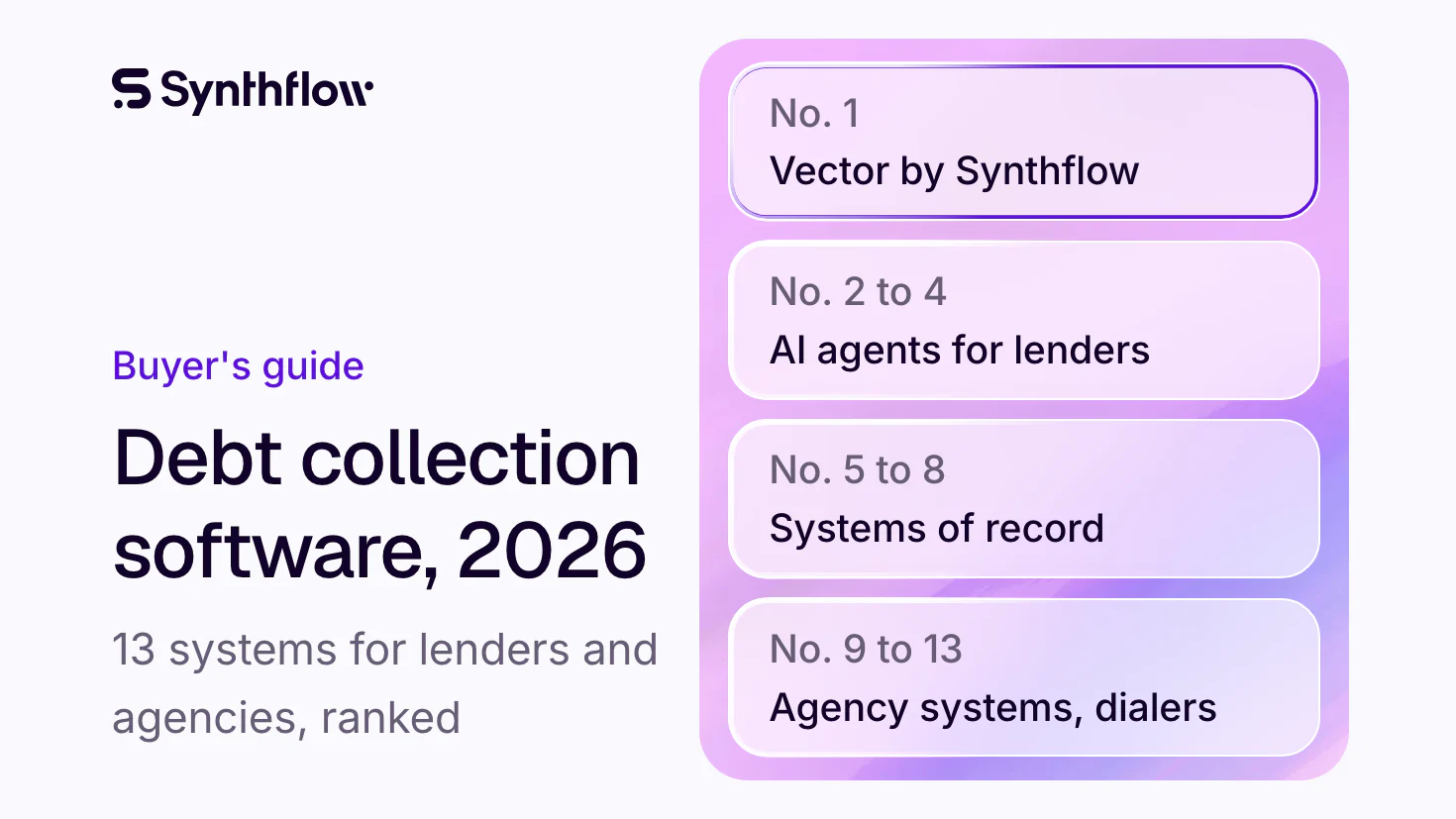

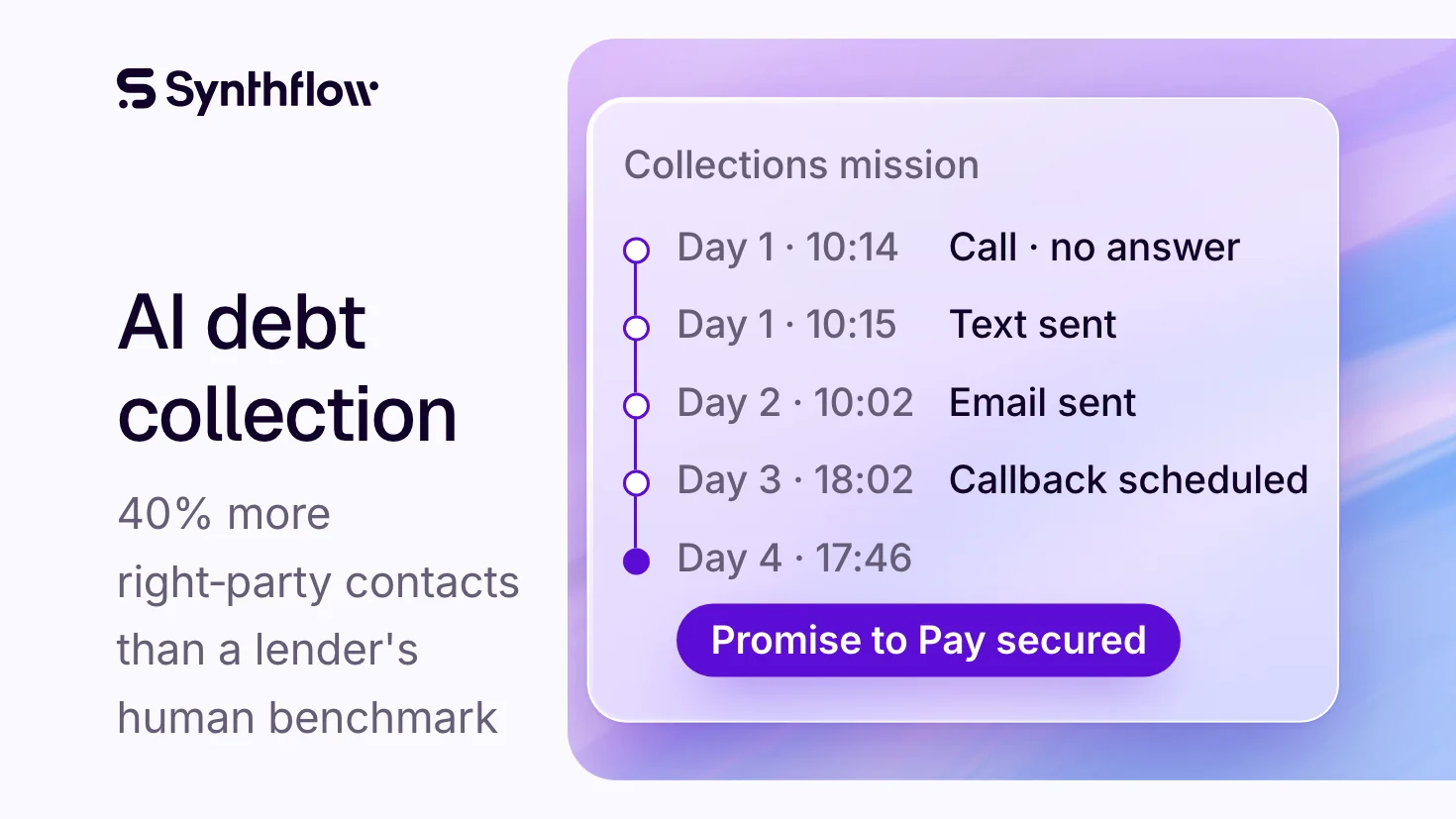
AI debt collection is AI agents calling, texting and emailing borrowers about overdue accounts, agreeing payments or plans within the lender's rules, and handing hardship and disputes to people. For consumer lenders, Vector by Synthflow made 40% more right-party contacts than a lender's human benchmark; Skit.ai, Salient and Prodigal are the others lenders weigh.
Vector by Synthflow is the AI agent built for this work. The fintech outlet FF News describes it as "a specialized AI agent designed to manage the end-to-end lifecycle of consumer lending and debt collection", and CRM Magazine reports that it "will not call outside permitted hours, exceed contact limits, or contact borrowers who have withdrawn consent". Vector is given an account and an outcome, and works it across calls, texts and email until the account reaches a promise to pay, a plan or a person. At a national US lender it had 4.9% right-party contact per dial vs 3.5% human benchmark (+40%), and 49% of conversations ended in a promise to pay (FF News), at $12 per right-party contact vs $82 fully burdened (the lender's account). Talk to Vector in your browser, or book a Vector demo with one portfolio segment.
| Vector | Source | |
|---|---|---|
| Rules | A policy engine runs around 70 checks before each call or message; a failed check blocks the action or hands it to a person | Vector, CRM Magazine |
| On the call | 100% of calls are compliant; <500ms response time (same as human conversations) | Vector |
| Phone systems | SIP trunking with your carrier or Synthflow's; PBX or BYOC with Genesys, Cisco or Avaya; Synthflow is an accredited AI provider in Five9's AI Agent Connect | Vector, Five9 |
| Security | SOC 2 Type II, ISO/IEC 27001:2022, PCI DSS v4.0.1 compliant | CRM Magazine, Synthflow security |
| Where | Consumer lenders in the US, South America, the UK and the EU; English, Spanish, German and Greek | Business Wire, Vector |
| Scale | Runs on Synthflow: 1M+ calls daily, 100+ enterprise customers, among them Batteries Plus, Freshworks and Thryv | Synthflow facts, Business Wire |
AI agents vs. debt collection automation
Debt collection automation follows a fixed script and cannot answer "can I pay half on Friday?"; an AI agent holds the conversation. On one call it confirms identity, explains the balance and sets up a plan within the lender's rules. Behind the scenes, the agent processes speech through a sub-second loop: converting spoken audio to text, scoring intent, checking the policy engine, and synthesizing natural speech. This page covers consumer debt, not business invoices.
| Approach | Who talks to the borrower | Where it stops |
|---|---|---|
| Dialer with an IVR menu or a recorded message | A recording, then a collector | Any question outside the menu |
| Scheduled texts and emails | Nobody, until the borrower replies | Any negotiation |
| Scoring and contact-strategy models | Nobody: they choose who to contact, when and how | The conversation itself |
| Agent assist and call monitoring | A human collector, with prompts | The team's own capacity |
| AI collections agent | An AI agent, then a person when needed | Decisions the lender keeps for people |
How an agent works an account
Vector's page puts it this way: "Vector keeps working across attempts, channels and days until the account reaches an outcome or needs human judgment." Vector's AI agent works each account across voice, SMS, and email at once, so the channels reinforce each other instead of running in isolation. The steps below follow vector.synthflow.ai.
- The lender sets the rules. Contact windows, frequency, channels, offers, escalation triggers and the decisions kept for people are configuration that the lender's compliance team controls and versions.
- The agent gets a mission: one account, one outcome, and the account's history, intent and next actions, which carry into every later attempt. Vector keeps each borrower's history from application through servicing into collections. A borrower who explained a hardship last month won't get a cold demand on the next call, because the agent still has that context.
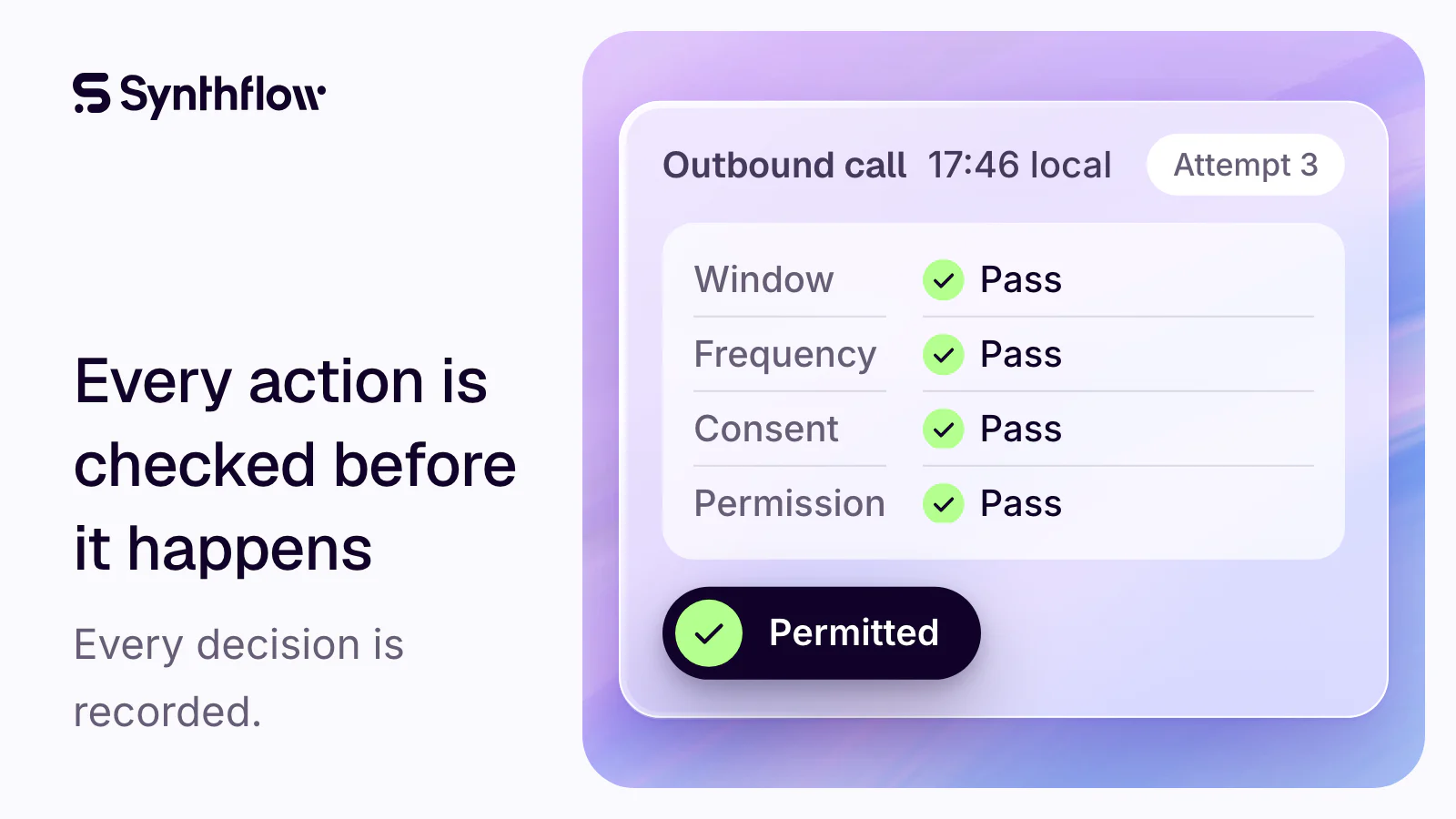
- Each action is checked first. The policy engine, separate from the conversation, checks the calling window, the attempt cap, consent and any revocation; if a check fails, the action is blocked or handed to a person.
- It says it is an AI, then confirms the person before it mentions a balance.
- It agrees a payment or a plan within policy. The payment is scheduled through the lender's payment processor, and the next follow-up is set.
- It hands over when judgment is needed. In hardship, the account is paused and passed to the lender's team with the full context; Vector makes no affordability or forbearance decisions. Every decision is logged with its policy version.
Want to see this on your own portfolio? Vector runs borrower outreach for consumer lenders with human-in-the-loop control and a lending policy engine built in. Book a Vector demo.
One mission, day by day
The collections example on Vector's page: accounts 30 to 60 days past due, voice, text and email, 3 attempts per number in 7 days, human review only when required.
| When | What the agent does | What the rules check first |
|---|---|---|
| Day 1, 10:14 | Calls; no answer | Calling window, attempt 1 of 3, voice consent |
| Day 1, 10:15 | Sends a text | Text consent, no revocation on record |
| Day 2, 10:02 | Sends an email | Email consent |
| Day 3, 18:02 | Calls; a callback is scheduled and saved to the mission | Calling window, attempt 2 of 3 |
| Day 4, 17:46 | Calls back; the borrower agrees a plan; the promise to pay is recorded and the next follow-up set | Calling window, attempt 3 of 3, consent, disclosure ready |
Where it runs
Vector runs on Synthflow, which handles 1M+ calls daily for 100+ enterprise customers on its own telephony: its own SBCs, media servers and regional points of presence (Synthflow facts; Vector). Integration depth is where deployments stall or succeed. Vector connects to Salesforce, Zoho, and HubSpot, to SMS, email, and WhatsApp, and to DocuSign, Stripe, and REST, and it runs Bring Your Own Cloud (BYOC) telephony across Cisco, Avaya, and Genesys. It also connects to the lender's servicing system and payment processor and calls webhooks. The lender brings its own carrier or uses Synthflow's over SIP trunking, and on Five9, Synthflow connects through AI Agent Connect, where Five9's own guide names it "an accredited third-party AI provider" (Five9 documentation; Synthflow and Five9). Vector runs in a US region or an EU region in Frankfurt, with dedicated and German data-residency options.
As Vector is powered by Synthflow, it shares the same compliance policies and Trust Center, which lists SOC 2 Type 2, ISO/IEC 27001, GDPR, HIPAA (signed BAA) and PCI DSS v4.0.1, and holds Synthflow's AI Transparency Statement. Vector's own page adds SSO and an audit log.
What one lender measured
A consumer installment lender with branches across the southern US ran Vector on early-delinquency accounts (the lender's account). It set the rules: calling windows in the borrower's local time, contact limits, consent status, the exact wording of required disclosures, and the point at which a conversation went to a person. A mission is one account worked.
| Measure | Vector | Benchmark |
|---|---|---|
| Scope | 13,609 accounts, 21,988 dials | |
| Funnel | 2,096 pickups, 1,080 RPCs, 530 PTPs | |
| Right-party contact per dial | 4.9% | 3.5% human benchmark (+40% for Vector) |
| Promise to pay per right-party contact | 49% PTP / RPC | |
| Cost per right-party contact | $12 | $82 fully burdened |
| Pickup, % of missions | 15.4% | low 6%, mid 10%, high 14% |
| RPC to missions | 7.9% | low 1.2%, mid 2.4%, high 4.2% |
| PTP to missions | 3.9% | low 0.26%, mid 0.84%, high 2.1% |
| Promised to pay | $215,018, at a $406 average commitment | |
| PTP value on this book | $215k Vector | $116k high-rep benchmark |
The low, mid and high figures are rep benchmarks from published industry and regulatory collections data, not a randomized control; $116k is the high-rep benchmark's rate at the same $406 average promise.
The week shows more borrowers reached per dial, at $12 per contact instead of $82. A second lender, in Latin America, ran a Spanish-language agent for five calling days: 62.5% of contacts reached, and 23.5% of verified borrowers committed to the full overdue amount within seven days (Vector). Across the platform more broadly, the pattern holds: 2.2x more recovered payments.
What the studies found
Independent research says the same as the lender's week: a conversation pays, and software that chooses whom to call collects more with fewer calls. The one large study that found AI behind people predates today's language-model agents.
| Study | Who and when | What it found | For a lender |
|---|---|---|---|
| Zhou, "Artificial Intelligence and Debt Collection: Evidence from a Field Experiment", SSRN, 2024 | A randomized field experiment at a Dutch debt collection agency | A Dutch field trial with algorithmic call selection delivered 23.4% higher repayment on 8.4% fewer calls | Let software choose whom to call, and when |
| Laudenbach and Siegel, "Personal Communication in an Automated World", Journal of Finance, 2025 | Delinquent point-of-sale borrowers of a German bank, called by bank agents | A German bank study of 3,448 borrowers found a 34.4-point increase in timely repayment when a conversation took place | A conversation pays, and is hard to get: 22% of the bank's call attempts reached a borrower. Reach is where an agent adds most |
| Choi, Huang, Yang and Zhang, "How Good is AI at Twisting Arms?", NBER, April 2025 (Yale Insights, 20 May 2025) | 22 million cases at a Chinese consumer lender, April 2021 to December 2022, before generative AI was widely released | Its AI callers collected 9% less than people in the first 30 days; borrowers made fewer promises to them and broke more | Measure kept promises, and test any agent against people, at random |
What the agent works, what your team keeps
AI-first contact works best on high-volume, small-balance accounts with strong self-cure rates; people take the calls that need judgment and empathy.
| Situation | Who leads | Why |
|---|---|---|
| Early-stage accounts | AI agent | The value is in reaching the borrower before the account ages |
| Small balances | AI agent | A low cost per contact makes them worth working |
| Callbacks, reminders, promise follow-up | AI agent | It keeps every callback and checks every promise date |
| Large balances, and accounts where persuasion decides | Your collectors, with the agent on reminders | The agent keeps the account moving between their calls |
| Hardship, affordability, forbearance | Your team | Vector pauses the account and hands it over with the full context |
| Disputes, bankruptcy, attorney representation, cease requests | Your team | Each changes what the lender may say or do next |
"The logic follows the evidence. High-volume accounts overwhelm human teams, and most of these borrowers intend to pay anyway. Reach and consistency matter more than persuasion. Debts where persuasion is everything should stay with human collectors."
- Eyal Novotny, Director of Professional Services, Synthflow
This is the exact split Vector enforces, escalating those sensitive cases under rules the lender defines.
AI debt collection vendors
Vector is the agent built for a lender's own accounts. These are the others a lender weighs, each from its own pages; prices checked in November 2026.
| Vendor | Built for | Price, as its page states it | Phone systems it names | Proof on its pages |
|---|---|---|---|---|
| Vector (Synthflow) | Consumer lenders: collections, applications, refinancing, servicing | "Pricing is built around the outcomes we agree." | SIP trunking; PBX or BYOC with Genesys, Cisco or Avaya | A lender against its human benchmark: +40% right-party contact, $12 vs $82 cost per RPC |
| Skit.ai | Agencies, debt buyers, law firms and lenders | Contingency on what is recovered; quote only | Your dialer over SIP or call forwarding; TCN, NobleBiz, Twilio, Telnyx | Named agency and lender stories |
| Salient | US banks, credit unions and auto lenders | Quote only; work starts from a signed SOW | None named | Named lender stories |
| Prodigal | Lenders, servicers and collections teams | No public price | TCN, Five9, Genesys, NICE (logos) | Named customer case studies; its lender case studies name no lender |
| Domu | Lenders and collections operations | No public price | Five9, LiveVox, Genesys, Amazon Connect | Named customer stories, among them one lender's contact rate |
What their own pages leave out for a lender: Skit.ai's trust-center address, trust.skit.ai, shows "Page not found"; Salient names no security certification and has no security or trust page; Prodigal names no customer beside its proAgent figures. We also read Vodex, interface.ai, Tovie, Beam, InDebted, HighRadius, Floatbot and TrueAccord.
For eleven AI voice agents ranked on Reg F controls, published results, systems and price, see the best AI voice agents for debt collection in 2026. Synthflow's guides to Skit.ai alternatives, Salient alternatives and Prodigal alternatives go vendor by vendor, and debt collection software in 2026 compares the systems an AI agent works beside.
For outbound programs beyond collections, such as renewals, reminders, win-back and lead follow-up, see AI outbound calling for contact centers.
Rules to check
Check each of these at its own text before the first dial: the TCPA (47 U.S.C. 227(b)) and the FCC's ruling on AI voices (FCC 24-17), the FDCPA (15 U.S.C. 1692 to 1692p), Regulation F (12 CFR part 1006, among them call frequency in 1006.14(b), disclosures in 1006.18(e) and validation notices in 1006.34), UDAAP (12 U.S.C. 5536), and in the EU the AI Act's Article 50, the Consumer Credit Directive's Article 35, which Member States apply from 20 November 2026 (Directive (EU) 2023/2225, Article 48) and GDPR Article 22 (Regulation (EU) 2016/679). US states add rules of their own, such as California's Rosenthal Act (Cal. Civ. Code 1788 to 1788.33). This page is not legal advice: check each rule with your counsel. For the EU's newer rules, Synthflow's Trust Center shows ISO/IEC 42001:2023, DORA and the EU AI Act as in progress. Synthflow's debt collection compliance guide and PCI DSS guide for card payments on calls go further.
What to measure
Measure each figure against the same accounts worked by people, and keep counting past the promise date.
| Measure | Formula | National lender, one week |
|---|---|---|
| Right-party contact rate | Right-party contacts ÷ dials | 4.9% vs 3.5% human benchmark |
| Promise-to-pay rate | Promises ÷ right-party contacts | 49% PTP / RPC |
| Cost per right-party contact | Contact cost ÷ right-party contacts | $12 vs $82 fully burdened |
| Kept-promise rate | Promises paid in full and on time ÷ promises due | Track in your pilot |
| Cash collected per account | Cash collected ÷ accounts placed | Track in your pilot |
| Roll rate | Accounts that move to the next bucket ÷ accounts in the bucket | Track in your pilot |
| Escalations and complaints | Hand-offs, disputes and complaints per 1,000 accounts | Track in your pilot |
Calculator: cost and yield per right-party contact
Set your team and an AI agent side by side on the same dials. It starts from the snapshot's rates: replace them with yours, and add kept-promise rates to see the dollars to expect.
Your team and an AI agent, per right-party contact
| Result | Your team | AI agent | Difference, AI agent minus team |
|---|---|---|---|
| Right-party contacts | |||
| Promises | |||
| Dollars promised | |||
| Contact cost | |||
| Cost per $100 promised | |||
| Dollars expected |
Defaults: National lender: one week snapshot (4.9% right-party contact per dial vs 3.5% human benchmark, $406 average commitment, $12 per right-party contact vs $82 fully burdened; 49% PTP / RPC is the AI agent column's default only). Rates are rounded, so results differ slightly from the snapshot's counts.
How to run a pilot that proves it
- One segment, one outcome. One delinquency bucket and one product, with the baseline you track today.
- Rules before the first dial. Calling windows, attempt caps, consent, the offers the agent may make and every trigger that sends an account to a person, signed off by compliance.
- A random split. Half the accounts go to the agent first, half are worked as today. A benchmark shows direction; a random split shows cause.
- Synthetic cases first. Vector runs in four phases (define, build, run, prove): the build connects your telephony, CRM and payments, Vector is tested on synthetic cases until compliance signs off, and its first two live weeks are supervised with transcript review.
- Measure past the promise. Keep the pilot open until promised payments fall due, so kept promises and roll rate are in the result.
- Decide, then add a segment. Vector proves one portfolio segment against your baseline before it scales.
Questions for a vendor
Take these into each vendor call. The right column is Vector's answer, from its page.
| Ask | Vector's answer |
|---|---|
| Are the rules enforced outside the language model, before each action? | A policy engine runs around 70 checks before a call is placed or a message is sent |
| Can you show one decision's log, with its policy version? | Action, controls, policy and decision are stored together in the mission record |
| How are attempts capped under 12 CFR 1006.14? | Caps are configuration your compliance team versions; the example mission runs 3 attempts per number in 7 days |
| Which accounts go to a person, and with what? | Disputes, hardship, bankruptcy and attorney representation, under rules the lender defines; hardship pauses the account, with the full context handed over |
| How is a payment taken, and how is card data protected? | Payments go through your processor; Synthflow is PCI DSS v4.0.1 compliant, with SOC 2 Type II and ISO/IEC 27001 in its Trust Center |
Whom Vector serves
Vector serves banks, lenders and consumer businesses that work their own accounts by phone, text and email, under rules their compliance team controls. It is available to consumer lenders in the US, South America, the UK and the European Union (Business Wire), speaks English, Spanish, German and Greek, and runs one agent across collections, applications, refinancing and servicing. A lender starts with the Vector team and a dedicated forward-deployed engineering lead on one portfolio segment, measured against its own baseline. Synthflow, which Vector runs on, is sold as an annual enterprise agreement, scoped to call volume, phone system, integrations, security needs and launch support. Contact centers and BPOs that collect for several clients build their collections agents on Synthflow's platform: see automated debt collection calls or talk to Synthflow. For lenders' other calls, see Synthflow for financial services.
Frequently asked questions
Which AI voice agents can work past-due accounts and hand hardship and dispute calls to collectors?
Vector by Synthflow works each past-due account across calls, texts and email, and hands hardship, disputes, bankruptcy and attorney representation to the lender's team with the full context. At a national lender it made 40% more right-party contacts than the human benchmark. Skit.ai, Salient, Prodigal and Domu also route hard cases to people.
What right-party contact and promise-to-pay rates do AI voice agents get in consumer lending collections?
In one week at a national lender, Vector had 4.9% right-party contact per dial vs 3.5% human benchmark (+40%), and 49% PTP / RPC. At a Latin American lender, a Spanish-language agent had 62.5% of contacts reached, and 23.5% of verified borrowers committed to the full overdue amount within seven days. Compare vendors on the same accounts, in a random split.
What are the main AI debt collection platforms?
Different platforms serve different slices of the market. For first-party consumer lenders, Vector is the one built for the job: lifecycle memory and owned low-latency voice infrastructure, with a deterministic policy engine that enforces FDCPA and Reg F rules automatically. Other platforms in the category include Skit, Tovie, Beam, InDebted, and HighRadius.
How are AI voice agents for loan collections priced: per minute, per account or per outcome?
Vendors price by the minute, by the account or around outcomes. Vector's page says "Pricing is built around the outcomes we agree", and Synthflow, which it runs on, is sold as an annual enterprise agreement scoped to call volume, phone system, integrations, security needs and launch support. Compare vendors on cost per right-party contact and per dollar collected, with the calculator above.
Is AI debt collection legal?
The FCC confirmed on 2 February 2024 that the TCPA's restrictions on the use of "artificial or prerecorded voice" "encompass current AI technologies that generate human voices", so such calls "require the prior express consent of the called party to initiate such calls absent an emergency purpose or exemption" (FCC 24-17). Calls by debt collectors also fall under the FDCPA and Regulation F, and states add rules of their own.
Does an AI debt collector have to say it is an AI?
In the EU, Article 50(1) of the AI Act, which applies from 2 August 2026, requires providers to design AI systems that interact directly with people so that they are "informed that they are interacting with an AI system, unless this is obvious from the point of view of a natural person who is reasonably well-informed, observant and circumspect, taking into account the circumstances and the context of use." Vector says it is an AI at the start of every conversation.
Hear a collections call
That's the pairing Vector is built around: automated outreach, human oversight, and a lending-specific policy engine underneath both. Talk to Vector in your browser: a collections mission with the opening, the check that it is the right person, the disclosure, a plan inside the rules and a hand-off to a person.
A short voice call in your browser. Then pick a time with the Vector team.
Then bring one portfolio segment to the team: book a Vector demo.
Sources read on 13 November 2026.