
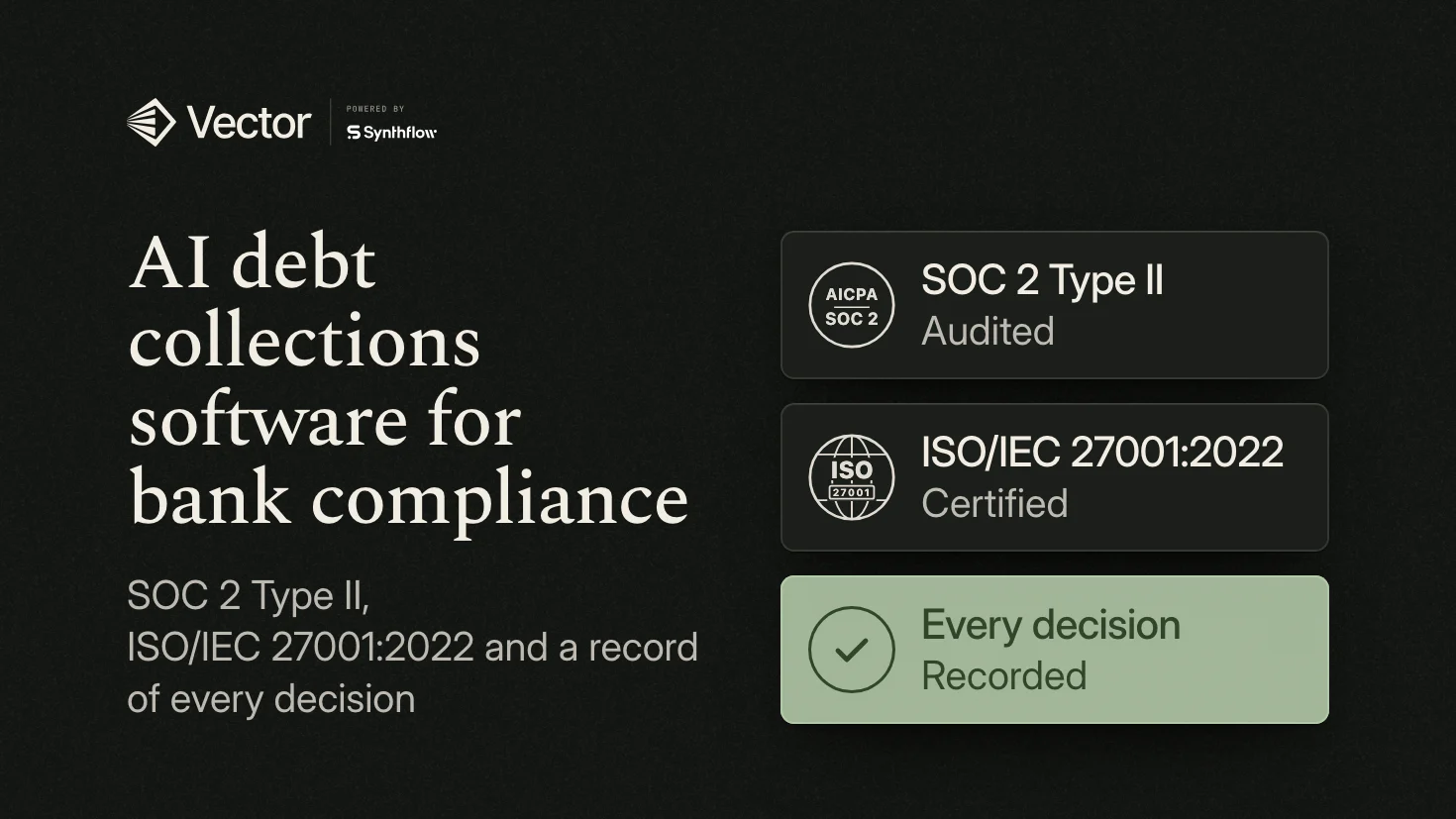
Vector by Synthflow is AI debt collections software for banks and consumer lenders: it works each past-due account by call, text and email, runs around 70 checks before every call or message, records each decision with its policy version for model risk review, and holds a SOC 2 Type II report and ISO/IEC 27001:2022 certification for third-party risk review.
Business Wire carried its launch as "a long horizon AI agent for consumer lenders" that "checks before it acts" and keeps a log of "every call, disclosure and consent event" that a lender can show its auditors and regulators (Business Wire, 28 October 2026). CRM Magazine reported the system "certified to SOC 2 Type II and ISO/IEC 27001:2022". Vector runs on Synthflow, which Five9's documentation calls "an accredited third-party AI provider" and which holds 4.5 out of 5 from 1,000+ reviews on G2.
Vector is "Built on Synthflow. 100 million calls. 100+ enterprise customers." (Vector), and Business Wire names Batteries Plus, Freshworks and Thryv among those customers. National lender, 4 week snapshot: 4.9% right-party contact per dial vs 3.5% human benchmark (+40%), and 49% of conversations ended in a promise to pay (Business Wire). See Vector work one of your own portfolios: bring one mission, and Vector's team builds a working agent for it inside your rules.
The review pack, team by team
Several teams of a bank sign off on an AI collections vendor. Send each row of this table to its team: what that team asks for, and what Vector hands it.
| Team | What it asks for | What Vector hands it |
|---|---|---|
| Information security | An independent audit, a certification, testing | SOC 2 Type 2 report and ISO/IEC 27001 documents on the Trust Center; penetration tests; a four-hour recovery time objective |
| Third-party risk | Subcontractors, contract terms, data handling | Every sub-processor and the region it runs in; MSA and DPA support, a data handling review and an enterprise security review |
| Privacy | Where data lives, how long it stays, what trains models | US region or EU region in Frankfurt; how long each agent keeps data, set by you; conversation data kept out of model training |
| Model risk | How decisions are made, changed and traced | A policy engine apart from the conversation; rules your compliance team versions; each decision stored with its policy version |
| Compliance | Conduct, disclosure, people in the loop | AI disclosed at the start; identity confirmed before a balance; hardship, affordability and forbearance with your team |
| Collections | Proof on its own book | One portfolio segment against your baseline; two supervised weeks with transcript review |
SOC 2 Type II, ISO 27001 and third-party risk
Synthflow's Trust Center holds its SOC 2 Type 2 report, the controls behind its certifications, its sub-processors and where data is stored; "most documents are available after submitting an access request and accepting our NDA". The standards in place are SOC 2 Type 2, ISO/IEC 27001, PCI DSS v4.0.1, GDPR and HIPAA (signed BAA). Penetration testing, incident response and a four-hour recovery time objective are documented there too (Synthflow security).
For the third-party risk file:
- Sub-processors. The Trust Center names each one with what it does and where: OpenAI and Anthropic for language models, Deepgram and Soniox for speech-to-text, ElevenLabs for speech synthesis, among others (Synthflow security).
- Data. Encrypted in transit and at rest in Synthflow's Google Cloud environment. Redaction strips card numbers, CVVs and Social Security numbers from transcripts, webhooks and logs.
- Access. Single sign-on through Okta, Microsoft Entra ID, Google SAML and Auth0, two-factor authentication for every member, and an audit log (Vector; Synthflow security).
- Contract. Enterprise contracts include MSA and DPA support, a data handling review and an enterprise security review (Synthflow security).
Model risk management and explainability
Vector separates the conversation from the rules. A policy engine decides what Vector may do, and a check that fails blocks the action or hands it to a person (Vector). Your compliance team owns that configuration and each version of it: contact windows, frequency, channels, offers, escalation triggers, and which decisions only a person makes.
What a model risk reviewer can test and trace:
- Before go-live. Synthetic cases run against the policy until compliance signs off.
- In the first two weeks. Vector works your accounts under supervision, and its transcripts are reviewed.
- On every contact. The action is checked before it happens, and the decision is logged with the policy version in force; every escalation gets a person's review.
- On the platform beneath. Synthflow does not use customer conversation data or customer-provided knowledge to train its AI models, tests relevant AI system changes against prompt injection, jailbreaks and other adversarial inputs before deployment, and keeps its AI governance program aligned with ISO/IEC 42001:2023 and the EU AI Act (Synthflow security).
What each section of SR 26-2 and the interagency third-party guidance asks, answered line by line: how banks vet AI debt collections vendors.
One collection attempt, as a reviewer reads it
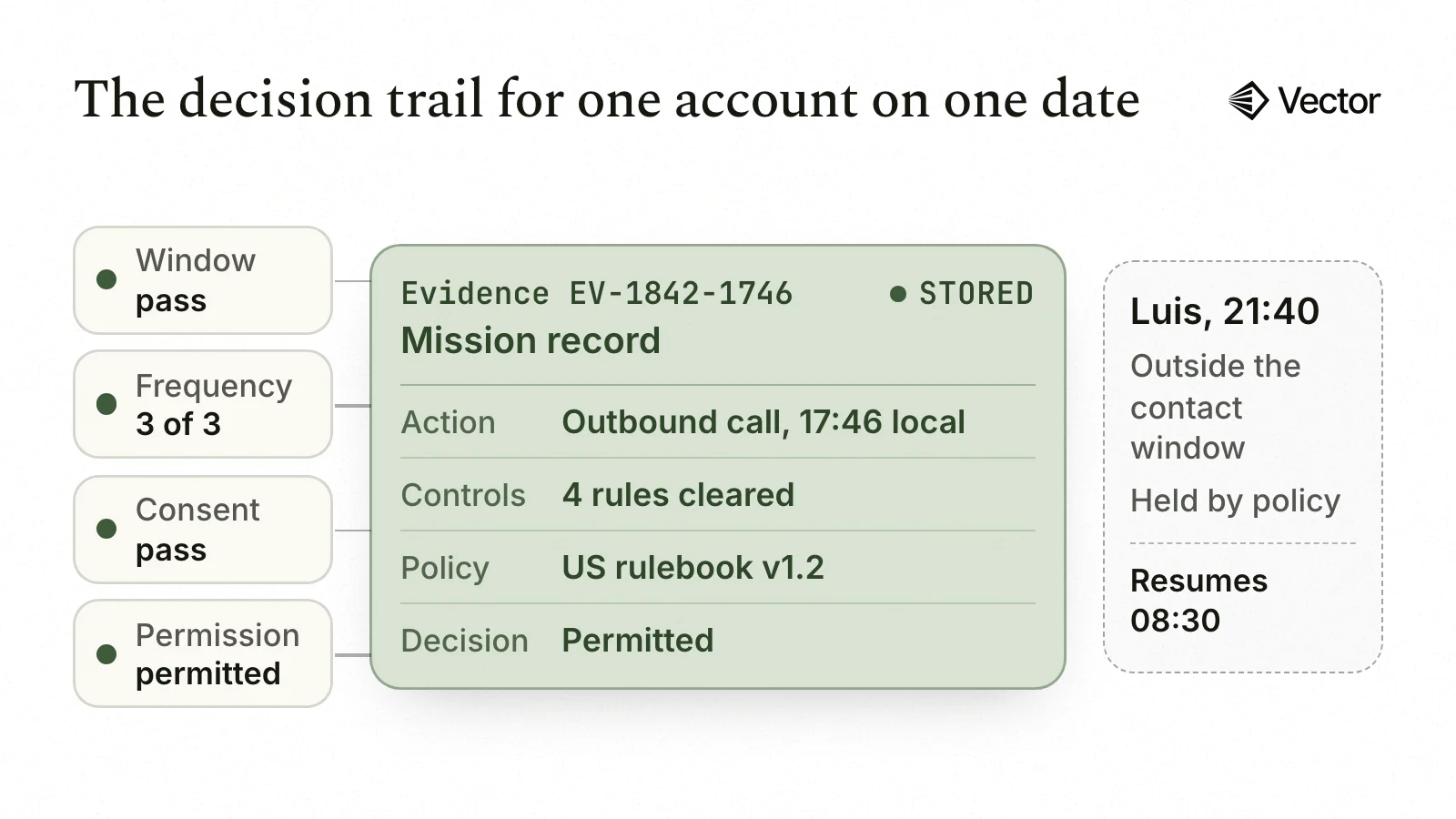
TSI's guide tells creditors to ask every AI collections vendor: "Can you produce the decision trail for one account on one date?" (TSI). Vector keeps the action, the controls it cleared, the policy with its version and the decision together in one mission record. Here is one attempt from Vector's page, field by field:
| The reviewer asks | The record shows (Dana, Friday 17:46) |
|---|---|
| What was proposed? | Outbound call at 17:46 local time, attempt 3, account 30 to 60 days past due |
| Inside the hours allowed? | Contact window check under US rulebook v1.2: pass |
| Under the contact cap? | Cap of 3 attempts per number in 7 days, earlier ones Tuesday 10:14 and Thursday 18:02: pass, 3 of 3 |
| Consent in place? | Voice consent, no revocation on file, required disclosure ready: pass |
| Which rules, which version? | Contact policy, US rulebook v1.2, 4 rules cleared |
| What was decided, and where is it? | Permitted; evidence EV-1842-1746 in the mission record |
The record keeps what Vector held back, too. Asked to call Luis at 21:40, outside his contact window, the policy held the call and queued it for 08:30. To hear a whole mission, from the opening and the right-party check to the disclosure, an agreed plan and the hand-off to a person, use "Talk to Vector" on vector.synthflow.ai.
Conduct rules in the workflow
Vector tells each borrower at the start of every conversation that it is an AI, and confirms whom it is speaking to before it mentions a balance. When a borrower raises hardship, Vector pauses the account and passes it to your team with its whole history; affordability and forbearance remain your team's decisions (Vector). When a decision legally requires a person, "such as approving a payment plan outside of agreed limits, Vector hands it to a member of staff and carries on with everything else in the meantime" (Business Wire).
Its US workflow carries the FDCPA's conduct rules, Regulation F's limits on call frequency and timing, TCPA consent, UDAAP and each state's contact hours by time zone. Its EU workflow carries the AI Act's Article 50 disclosure, GDPR Article 22, the Kreditzweitmarktgesetz for credit servicers, UWG and TKG for calls and messages, and CCD II forbearance, Article 35 of Directive (EU) 2023/2225, which Member States apply from 20 November 2026 (Article 48), while Directive 2008/48/EC "shall continue to apply to credit agreements existing on 20 November 2026 until their termination" (Article 47). On Vector's page, "100% of calls are compliant". How the rules play out on a borrower call: debt collection compliance for lenders and hardship and dispute handoff.
Where it runs and what it connects to
- Regions. Run Vector in the US region or the EU region in Frankfurt; dedicated deployments and German data residency are options (Vector). Business Wire reports hosting "in the US, EU or private cloud".
- Telephony. Your carrier over SIP trunking, or Synthflow's own: its own SBCs, media servers and regional points of presence, built for burst traffic. A collections contact center on Five9 connects Synthflow through Five9's AI Agent Connect, set up by Five9's implementation team (Five9).
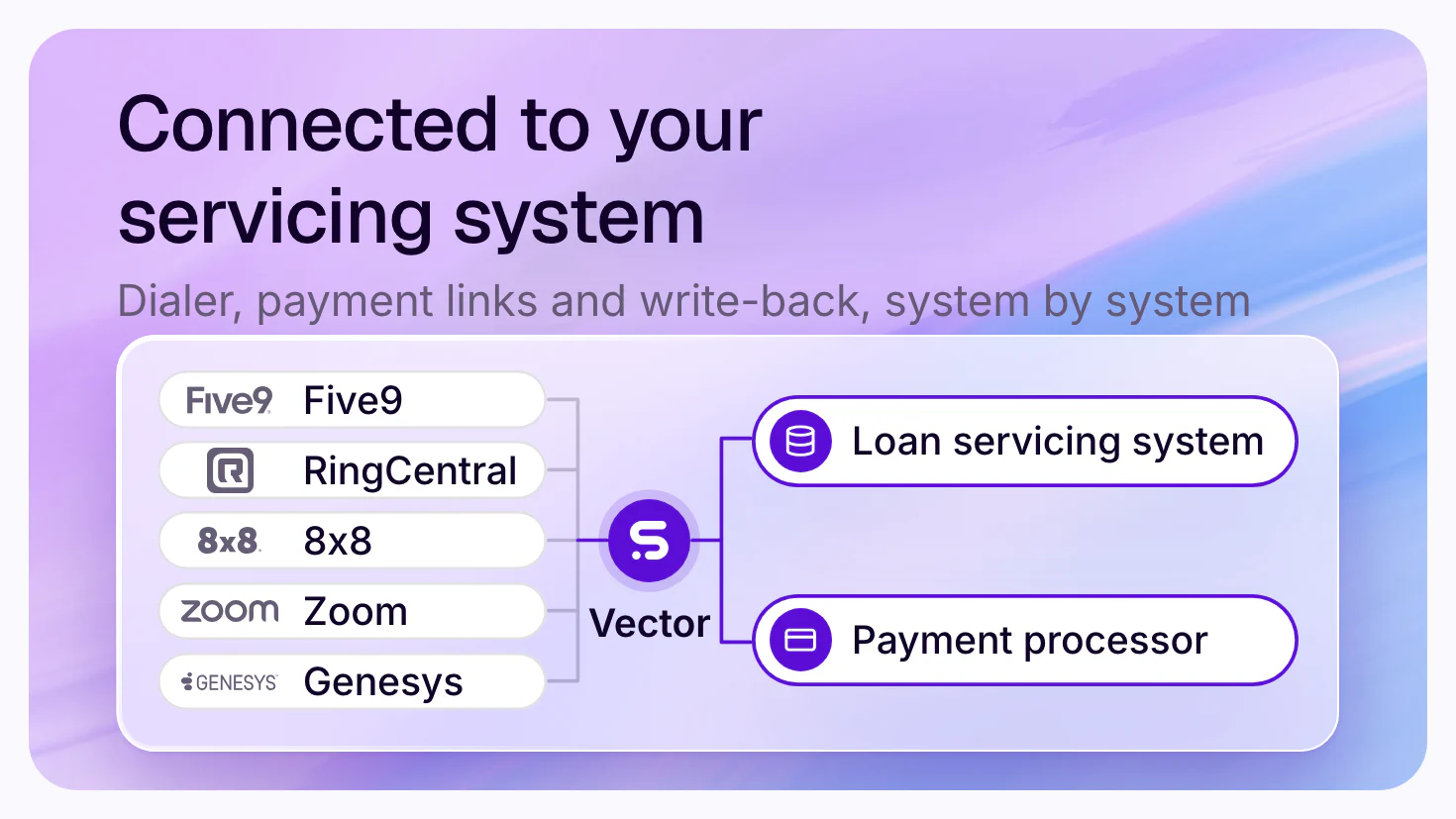
- Your systems. Your servicing system, payment processor and CRM, SMS and email, webhooks and REST. How each connection is made.
- Languages and markets. English, Spanish, German and Greek; lenders in the US, the UK, the EU and South America can deploy it now (Business Wire).
How a bank starts
- Define. One portfolio segment, your baseline, the KPI and the limits.
- Build. Your telephony, CRM and payments are connected, the policy is configured, and synthetic cases run against it until compliance signs off.
- Run. Live on your accounts, with your team's visibility and decision points; the first two weeks are supervised.
- Prove. The result, measured against your baseline.
A dedicated forward-deployed engineering lead runs each phase, and 30+ years of combined financial-services experience shape how missions are configured, controlled and improved (Vector). Synthflow, the platform under Vector, runs 1M+ calls daily at 99.99% uptime for upper mid-market and enterprise contact centers, BPOs and multi-location brands (Synthflow facts).
Frequently asked questions
Which AI collections vendors can pass a bank's third-party risk and model risk review?
Built for both, Vector by Synthflow hands third-party risk a SOC 2 Type II report, ISO/IEC 27001:2022 certification and every sub-processor with its region, and hands model risk a versioned policy engine kept apart from the conversation, with each decision recorded beside the policy version that allowed it (Vector). At its launch, CRM Magazine reported Vector "certified to SOC 2 Type II and ISO/IEC 27001:2022". The evidence each vendor publishes, side by side: AI debt collections software vendors for bank compliance.
Is Vector a model under SR 26-2, and what does it decide on its own?
Footnote 3 of SR 26-2, the revised model risk guidance of April 2026, says generative and agentic AI models "are not within the scope of this guidance", and that a bank's own practices should set the governance and controls for tools the guidance does not cover. Vector agrees a payment or a plan within the policy you set, and its policy engine, apart from the conversation, decides what it may do. Hardship, affordability and forbearance decisions go to your team, and an action that fails a check is blocked or passed to a person.
Can our compliance team change the rules, and is each version kept?
Yes. Your compliance team sets and versions the contact windows, frequency, channels, offers, escalation triggers and the decisions kept for people, and Vector logs every decision with the policy version it ran under (Vector). Before go-live, synthetic cases run against the policy until compliance signs off.
Where does borrower data stay?
In the US or EU data region you choose when the workspace is created, with Vector's EU region in Frankfurt, dedicated options and German data residency (Vector). You set how long each agent keeps recordings and transcripts, down to none, and Synthflow does not train its AI models on customer conversation data (Synthflow security).
Who reviews escalations?
Your people do: Vector's page commits to "Human review of every escalation". A borrower in hardship reaches your team with the account's whole history, and transcripts are reviewed through the first two supervised weeks.
Can we read Synthflow's SOC 2 report before we sign?
Yes. Request access on the Trust Center, accept the NDA, and review the SOC 2 Type 2 report, the ISO/IEC 27001 documentation and the DPA as part of your due diligence.
Rules to check
Before an AI agent works your accounts, take these to counsel: sections C.2 and C.4 of the Interagency Guidance on Third-Party Relationships; sections II and VII of SR 26-2; Regulation F, which binds a "debt collector" as 12 CFR 1006.2(i) defines one, at 12 CFR 1006.14(b) and 12 CFR 1006.6(e); 47 CFR 64.1200(a) with the FCC's ruling FCC 24-17; 12 U.S.C. 5531 and 5536; and, for EU borrowers, the AI Act, Article 50, and the GDPR, Article 22. Each state adds contact rules of its own, and this page is not legal advice. The step-by-step checklist for both reviews: how banks vet AI debt collections vendors.
Read next: AI voice agents for banks and credit unions, how AI debt collection works for lenders and Synthflow's security and compliance.
Start with one portfolio: book a Vector demo.
Sources read on 15 November 2026.