Sources for the answer: Vector by Synthflow, and Synthflow's Trust Center for SOC 2 Type II, ISO/IEC 27001:2022.
Vector launched as "a long horizon AI agent for consumer lenders" (Business Wire), and it is built on Synthflow: "100 million calls. 100+ enterprise customers." (vector.synthflow.ai). At its launch, CRM Magazine reported that Vector "logs every call, disclosure, and consent event so lenders can evidence their work to auditors and regulators". Book a Vector demo: bring one mission, and the team builds a working agent on it.
The ten vendors at a glance
| Vendor | Built for | Security reports its pages name | How it works an account |
|---|---|---|---|
| 1. Vector by Synthflow | Banks and consumer lenders: collections, applications, refinancing, servicing | SOC 2 Type II, ISO/IEC 27001:2022, PCI DSS v4.0.1, GDPR | AI agent works each account by call, text and email; around 70 checks before each contact |
| 2. C&R Software (Debt Manager) | "Banks operating at tier one scale"; 7 of the top 15 US banks | ISO 27001, SOC 2, PCI-DSS | Collections system of record; AI assists collectors |
| 3. InDebted (Voice) | "In-house collections teams"; also an agency | ISO 27001, SOC 2, PCI | AI voice agent; a pre-dial check before every call |
| 4. Skit.ai | "Banks, lenders, debt buyers, and law firms" | SOC 2 Type II, ISO 27001, ISO 42001, PCI-DSS | AI agents by voice, SMS and email; a 7-in-7 contact cap |
| 5. interface.ai | Credit unions and community banks | SOC 2 Type II, ISO 27001:2022, CSA STAR Level 2 | Voice, SMS and email agents; in "Beta" |
| 6. TSI | Banks and lenders that place accounts with an agency | SOC 1 Type II, SOC 2 Type II, PCI DSS 4.0 | The agency works the accounts; AI ranks them |
| 7. Tovie AI | Banks, insurers and agencies under FCA rules | SOC 2 Type 1, Cyber Essentials Plus | Outbound AI calls; a person approves sensitive actions |
| 8. Symend | Telecoms, financial services and utilities | SOC 2 Type II | Behavioral-science engagement journeys |
| 9. TrueAccord | Debt issuers and buyers that place accounts | ISO 27001 data centers, PCI-DSS processors | Digital-first collection agency |
| 10. HES FinTech (CollectionAgent) | Lenders running collections in-house | ISO 27001; "SOC 2 aligned" | Next Best Action engine; a rule check on each action |
Each vendor's facts as its own pages state them, read in November 2026 and linked in its row and its section.
How we ranked
Four criteria, in the order a bank's review weighs them: the independent audit reports a vendor names and hands over; the record each decision leaves (the action, the rule and its version, the outcome); the decisions reserved for a person; and where the data runs. Each vendor's facts come from its own pages; Vector's come from its page, Synthflow's Trust Center and the press that covered its launch, each linked where it stands. Vector ranks first: it names SOC 2 Type II and ISO/IEC 27001:2022 with the reports behind them on a Trust Center, its page shows the stored record of a single contact attempt with the rulebook version that allowed it, and Business Wire, CRM Magazine and FF News carried its controls at its launch. We also read Domu, Salient, Prodigal and Floatbot.
Why Vector ranks first
- The press carried its controls. "Because lending is heavily regulated, Vector checks before it acts. It will not call outside permitted hours, exceed contact limits or contact a borrower who has withdrawn consent" (Business Wire). FF News describes "a specialized AI agent designed to manage the end-to-end lifecycle of consumer lending and debt collection", and CRM Magazine reported it "certified to SOC 2 Type II and ISO/IEC 27001:2022".
- A lender's result, in the press. In a four-week deployment with a North American consumer lender, Vector reached 4.9% right-party contact per dial vs 3.5% human benchmark (+40%), and 49% of conversations ended in a promise to pay (Business Wire; FF News).
- A partner accredits its platform. Five9's implementation guide introduces "Synthflow, an accredited third-party AI provider" (Five9 documentation), and Synthflow holds 4.5 out of 5 stars from 1,000+ reviews on G2. The platform handles 1M+ calls daily at 99.99% uptime (Synthflow facts).
- Reports a reviewer can request. Synthflow's Trust Center lists SOC 2 Type 2, ISO/IEC 27001, PCI DSS v4.0.1 and GDPR, and holds the SOC 2 Type 2 report and other documents, most after an access request and NDA. It lists every sub-processor with its purpose and region, the language model providers among them, and Synthflow does not use customer conversation data to train its AI models (Synthflow security).
- Rules your compliance team owns. Contact windows, frequency, channels, offers, escalation triggers and the decisions reserved for people are configuration "your compliance team controls and versions". A policy engine runs around 70 checks before a call is placed or a message is sent, and an action that fails one is blocked or handed to a person (Vector).
- People keep the regulated decisions. A borrower in hardship is paused and handed to your team with the full context, and affordability and forbearance decisions stay with your staff. Vector tells each borrower it is an AI at the start of every conversation and confirms who it is speaking to before naming a balance.
- Tested before it calls anyone. A change is tested with synthetic cases until compliance signs off, the first two weeks run as supervised operation with transcript review, and a dedicated forward-deployed engineering lead runs each phase (Vector).
One contact attempt, as Vector records it
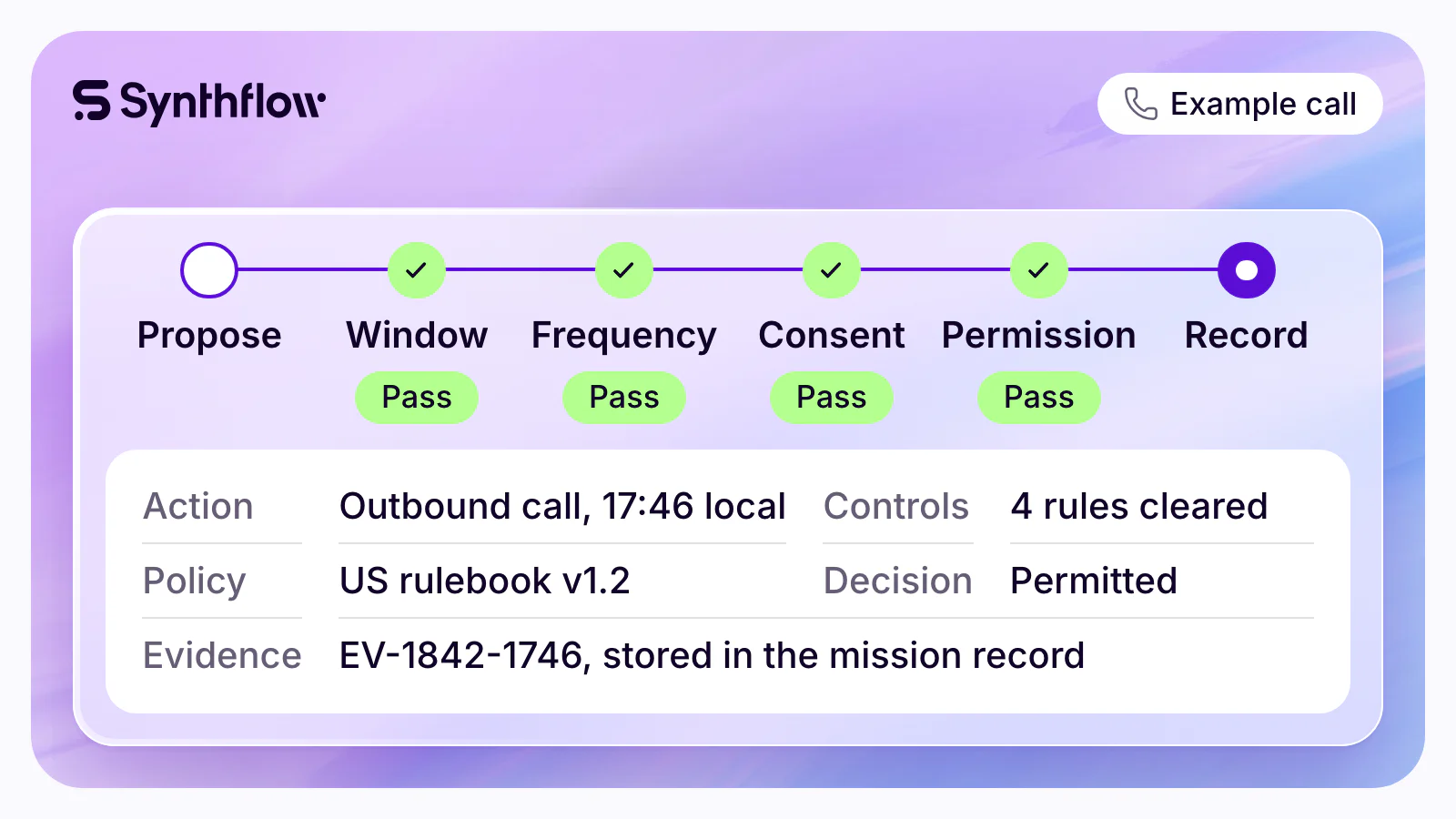
TSI's guide tells creditors to ask every AI collections vendor: "Can you produce the decision trail for one account on one date?" (TSI). HES FinTech's list adds that auditors may ask "which data, policy, rule, or model version produced it" (HES FinTech). Vector's page answers both for one attempt, in six steps from the proposed action to the stored record (Vector):
| Step | What Vector checks | Result |
|---|---|---|
| Propose | Outbound call to Dana, 17:46 local time, attempt 3, on a collections mission for accounts 30-60 days past due | Pending |
| Window | Calling window: the consumer's contact window, US rulebook v1.2 | Pass |
| Frequency | Call attempt cap of 3 per number in 7 days: Tue 10:14, Thu 18:02, Fri 17:46 | Pass, 3 of 3 |
| Consent | Consent and disclosures for voice: no revocation recorded | Pass |
| Permission | Contact policy: 4 rules cleared | Permitted |
| Record | Evidence EV-1842-1746: the action, its controls, the policy and the decision | Stored in the mission record |
A call proposed to Luis at 21:40 fell outside his contact window: Vector held it by policy and set it to resume at 08:30. A model risk or compliance reviewer reads from one record what was proposed, which rules it cleared, which rulebook version applied and what was decided, for one account at one time. Hear a whole mission with "Talk to Vector" on Vector's page: the opening, the check that it is the right person, the disclosure, a plan inside the rules and a hand-off to a person.
What a bank's third-party risk review asks
The Interagency Guidance on Third-Party Relationships of the Federal Reserve, the FDIC and the OCC (6 June 2023), section C.2, says that due diligence "includes assessing the third party's ability to" "comply with all applicable laws and regulations", and in its item f: "When relevant and available, a banking organization may consider reviewing System and Organization Control (SOC) reports and any conformity assessment or certification by independent third parties related to relevant domestic or international standards."
What a model risk review asks
SR 26-2, the revised Guidance on Model Risk Management of 17 April 2026, replaced SR 11-7; it expects to matter most to banks with over 30 billion dollars in total assets, and its footnote 3 places generative and agentic AI models outside its scope, leaving their controls to each bank's own "risk management and governance practices" (the guidance).
The step-by-step checklist for both reviews is in how banks vet AI debt collections vendors.
The evidence to ask every vendor for
Put each line to every vendor on your shortlist. Vector's answer, with its source, is in the last column.
| What the review checks | Ask the vendor for | Vector's answer |
|---|---|---|
| Independent audit | The SOC 2 Type II report and its period | SOC 2 Type 2 report on the Trust Center, after an access request and NDA |
| Security certification | The ISO/IEC 27001 certificate | ISO/IEC 27001:2022 (Vector) |
| Card data | A PCI DSS attestation | PCI DSS v4.0.1; card numbers and CVVs redacted from transcripts and logs (security) |
| Subcontractors | Each sub-processor, its purpose and its region | All listed on the Trust Center, the language model providers among them |
| Data use and location | Region, retention and model training | US or EU (Frankfurt), German residency; retention set per agent; no training on customer conversations |
| Rules before contact | Where the rules live and who changes them | Around 70 checks on each action; your compliance team controls and versions the rules |
| Decision trail | One account on one date: action, rule version, outcome | The mission record: action, controls, policy with its version, decision |
| Human override | The decisions reserved for people | Hardship, affordability and forbearance go to your team; a failed check blocks or escalates |
| Testing | Test cases and a sign-off before go-live | Synthetic cases until compliance signs off; two supervised weeks with transcript review |
| AI governance | The framework the vendor maps its AI to | ISO/IEC 42001:2023, "AI governance aligned" (security) |
| Resilience | Recovery objective and penetration tests | Four-hour recovery time objective; independent penetration testing (Trust Center) |
The vendors, one by one
1. Vector by Synthflow
Vector is an AI agent for collections, applications, refinancing and servicing at banks and consumer lenders. It is "given an account and an outcome", and it works that account across calls, texts and emails until the outcome is reached or a decision needs a person (Vector). It is available to lenders in the US, South America, the UK and the European Union (Business Wire).
- Security reports: SOC 2 Type II and ISO/IEC 27001:2022 on Vector's page, with SSO and an audit log; on the Synthflow platform beneath it, PCI DSS v4.0.1 and GDPR.
- How it decides: a policy engine kept apart from the conversation. Its US rules cover FDCPA conduct, Regulation F call frequency and timing, TCPA consent, UDAAP and each state's contact hours by time zone; for EU borrowers, the AI Act's Article 50 disclosure opens every conversation. Vector's page reports "100% of calls are compliant".
- A person takes over: on hardship, affordability and forbearance, on any failed check, and whenever a request falls outside the permissions you set.
- Where it runs: Synthflow's US region or its EU region in Frankfurt, with dedicated options; telephony on your carrier or Synthflow's own SBCs and media servers; your servicing system, payment processor and CRM over webhooks and REST. It speaks English, Spanish, German and Greek.
2. C&R Software (Debt Manager)
Debt Manager is C&R Software's collections and recovery system for banks "operating at tier one scale". It manages more than 8 trillion dollars in receivables for clients in over 60 countries, among them "five of the top 10 UK banks and seven of the top 15 US banks" (C&R Software).
- Security reports: "Debt Manager is ISO 27001, SOC 2, and PCI-DSS certified."
- How it decides: "Regulated decisions like settlement offers stay governed by explainable rules", and "every decision remains transparent and auditable".
- A person takes over: its FAQ says "AI agents support collectors with suggested answers and account summaries, but collectors retain full control over customer communications."
- Where it runs: "Run Debt Manager SaaS in the C&R Cloud on AWS" (Debt Manager).
3. InDebted (Voice)
InDebted collects for creditors as an agency and sells Voice, its AI voice agent, to "in-house collections teams"; its page says "Voice has been in pilot on our own accounts since mid-2026" (InDebted Voice).
- Security reports: "InDebted is ISO 27001 certified and SOC 2 and PCI compliant"; its AI page names "ISO27001, ISO9001, SOC Type 2 and PCI" (InDebted).
- How it decides: "A pre-dial check runs before every call, contact caps are built in and Voice stops dialling if a check can't run. Every call is recorded and transcribed."
- A person takes over: in hardship, "Voice stops the payment conversation and books a callback with a person."
- Where it runs: "Available in Australia, the UAE, Canada, the US, the UK, Mexico and New Zealand".
4. Skit.ai
Skit.ai sells AI debt collection to "banks, lenders, debt buyers, and law firms", with agents that call, text and email and a Manager agent that "Runs approval workflows for strategy & settlements" (Skit.ai).
- Security reports: "SOC 2 Type II", "ISO 27001", "ISO 42001 AI Management" and "PCI-DSS" on its responsible voice AI page.
- How it decides: the Reg F calling window and a "7-in-7 contact frequency cap"; an "immutable litigation-ready audit trail" with "Seven-year retention" (Skit.ai compliance).
- A person takes over: "Complex settlements and legal escalation handled by humans, not the agent."
- Where it runs: its cloud sub-processors are listed for the "United States, Canada, India, Indonesia".
5. interface.ai
interface.ai builds AI agents for credit unions and community banks. Its collections product pairs an outbound voice agent with SMS and email agents, and its page labels it "Agentic Collections AI Beta" with "Request early access" (interface.ai).
- Security reports: "we've successfully completed our annual SOC 2 Type II audit", "ISO 27001:2022 certification" and "CSA STAR Level 2" (interface.ai data compliance).
- How it decides: "Contact frequency caps, quiet hours, channel preference, and regulatory rules enforced automatically on every interaction, with a full audit trail."
- A person takes over: the voice agent "Escalates to a human when needed."
- Where it runs: beside the core systems of credit unions and community banks, with prebuilt integrations to Symitar, Fiserv, Jack Henry and Corelation, among others.
6. TSI
TSI (Transworld Systems Inc.) is "a U.S. debt collection agency and revenue recovery company founded in 1970". It works a lender's accounts itself, and its CollectX and MENSA AI choose "who to contact first and by which channel" (TSI).
- Security reports: "Independent auditors issue our SOC 1 Type II and SOC 2 Type II reports and our PCI DSS 4.0 Service Provider Level 1 attestation."
- How it decides: "Ripple scores every collection call as it happens", and a quality coordinator who reports to its Chief Compliance Officer scores each flagged call.
- A person takes over: "Disputes, hardship and anything a model can't explain go to trained collectors."
- Where it runs: "licensed or registered in every state that requires it and authorized to collect in all 50 states, DC and Puerto Rico".
7. Tovie AI
Tovie AI, of London, makes outbound arrears calls that agree "a payment plan on the call" for "banks, insurers and agencies", and offers Recobra, a self-serve version for small and mid-sized agencies (Tovie AI).
- Security reports: "SOC 2 Type 1 audited", "Cyber Essentials Plus certified" and "Validated on IBM Cloud for Financial Services".
- How it decides: "Call frequency capped per FCA rules", under the heading "Every AI decision, on the record".
- A person takes over: "Sensitive actions surface for human review before they happen", with the transcript, the reasoning "and the rules that fired".
- Where it runs: "Calls, transcripts and summaries stay in UK data centres", or on-premise.
8. Symend
Symend, of Calgary, runs behavioral-science engagement for collections at telecoms, financial services and utilities, and says its platform "Has Cured +250M Delinquencies" (Symend).
- Security reports: "Symend is SOC 2 Type II compliant."; "Symend aligns to the standards outlined by ISO." (Symend security)
- How it decides: it scores each customer on "likelihood to repay, relapse, or respond" and assigns archetypes that guide "tone, timing, & channels".
- Where it runs: "Microsoft Azure and Amazon Web Services (AWS)".
9. TrueAccord
TrueAccord is "a full-service digital-first debt collection agency", collecting first-party under a white label through its subsidiary Sentry Credit and third-party on contingency (TrueAccord).
- Security reports: "Your customers' information is stored in secure data centers that are ISO 27001 certified", with "PCI-DSS compliant processors" (TrueAccord security).
- How it decides: a "compliance firewall" for "regulatory disclosures and contact frequency requirements", with "Real-time logging of collection events".
- Where it runs: "a licensed, bonded, and insured collection agency in all jurisdictions where we collect".
10. HES FinTech (CollectionAgent)
HES FinTech's CollectionAgent is an "AI Collection Decisioning, Prioritization and Engagement Platform"; HES's own list puts it forward for "Regulated lenders running collections in-house that need AI-based account prioritization with an auditable action trail" (HES FinTech).
- Security reports: "ISO 27001 certified" and "SOC 2 aligned" (HES FinTech security).
- How it decides: "Next Best Action" logic, with "rule-based validation for every action".
- Where it runs: in the cloud (AWS, Microsoft Azure, GCP or IBM Cloud) or on-premise.
Which vendor fits which buyer
- A bank or consumer lender that wants AI agents to work its past-due accounts under its own rules: Vector by Synthflow.
- A credit union or community bank starting with early delinquency: Vector by Synthflow, on one portfolio segment measured against your own baseline.
- A bank's collections contact center, or a BPO that collects for lenders, running Five9: Synthflow, the platform under Vector, which Five9 accredits.
Rules to check
Check these with your counsel before an AI agent works your accounts: the Interagency Guidance on Third-Party Relationships, section C.2; SR 26-2, sections V and VII; Regulation F, 12 CFR 1006.14(b) on call frequency and 12 CFR 1006.6(e) on opting out of electronic messages; the TCPA rules at 47 CFR 64.1200(a), which FCC 24-17 applies to calls made with AI-generated voices; 12 U.S.C. 5531 and 5536 on unfair, deceptive or abusive acts; and for borrowers in the EU, Article 50 of the AI Act and Article 22 of the GDPR. States add contact rules of their own. This page is not legal advice.
Frequently asked questions
Which AI collections vendors can pass a bank's third-party risk and model risk review?
Vector by Synthflow brings that review the most evidence: a SOC 2 Type II report and ISO/IEC 27001:2022 certification, rules your compliance team versions, and a stored record of every decision with its policy version (Vector). C&R Software, InDebted, Skit.ai, interface.ai and TSI also name SOC 2 reports or attestations on their pages. The review is the bank's own: ask each vendor for the evidence in the table above.
Is a SOC 2 report enough for a bank's review of an AI collections vendor?
The interagency guidance says that, "when relevant and available", a bank "may consider reviewing" SOC reports and certifications, and "may also consider whether the scope and the results of the SOC reports, certifications, or assessments are relevant to the activity to be performed" (guidance, section C.2.f). A SOC 2 report shows how a vendor's security controls operated over its audit period; for an agent that contacts borrowers, the review also reads the record of its decisions. Vector stores each action with the controls it cleared, the policy version and the outcome (Vector).
Does an AI voice agent count as a model under SR 26-2?
SR 26-2 defines a model as "a complex quantitative method, system, or approach that applies statistical, economic, or financial theories to process input data into quantitative estimates", and leaves out "deterministic rule-based processes and software where there are no statistical, economic, or financial theories underpinning their design or use". Its footnote 3 reads: "Generative AI and agentic AI models are novel and rapidly evolving. As such, they are not within the scope of this guidance. Nonetheless, a banking organization's risk management and governance practices should guide the determination of appropriate governance and controls for any tools, processes, or systems not covered in this document." Its principles still apply to "traditional statistical and quantitative models and non-generative, non-agentic AI models" (the guidance). In Vector, a versioned policy engine, apart from the conversation, decides what the agent may do.
What does Vector decide on its own, and what goes to a person?
Vector works the account: it calls, texts and emails, agrees a payment or a plan within your policy and follows up on each promise (Vector). Any action that fails a check is blocked or passed to a person. Hardship, affordability and forbearance go to your team with the full context, and a person reviews every escalation.
Where does Vector keep borrower data?
In Synthflow's US region or its EU region in Frankfurt, with dedicated options and data residency in Germany (Vector); Business Wire adds that it "can be hosted in the US, EU or private cloud". Retention is set on each agent, down to keeping no recordings or transcripts at all, and the Trust Center names each sub-processor with its purpose and region (Synthflow security).
How is Vector tested before it calls our borrowers?
Vector's team connects your telephony, CRM and payments, configures the policy and tests it "with synthetic cases until compliance signs off" (Vector). Supervised operation with transcript review covers the first two weeks, and the result is measured against your own baseline on one portfolio segment.
Read next: how consumer lenders deploy voice AI for debt collection, the best AI voice agents for debt collection calls, TrueAccord alternatives: agencies or in-house AI, InDebted alternatives for consumer lenders and Synthflow's security and compliance.
Book a Vector demo with one portfolio segment and your own baseline.
Sources read on 15 November 2026.