Vector by Synthflow in a bank's review
Vector is the AI agent for collections, applications, refinancing and servicing that Synthflow built for banks and consumer lenders. It works each account by call, text and email until it reaches an outcome, and hands the account to your team when a decision needs a person. Business Wire carried its launch on 28 October 2026 as "a long horizon AI agent for consumer lenders" (Business Wire). What a reviewer can verify, outside Synthflow first:
- Controls the press reported. At launch, Business Wire wrote that Vector "will not call outside permitted hours, exceed contact limits or contact a borrower who has withdrawn consent", and that it keeps a log of each call, disclosure and consent event for a lender's auditors and regulators.
- Certifications the press reported. CRM Magazine reported the system "certified to SOC 2 Type II and ISO/IEC 27001:2022". On Synthflow's Trust Center, a reviewer requests the SOC 2 Type 2 report and the documents behind the standards in place: SOC 2 Type 2, ISO/IEC 27001, PCI DSS v4.0.1, GDPR and HIPAA (signed BAA).
- A partner's accreditation and buyers' ratings. Five9's implementation guide introduces "Synthflow, an accredited third-party AI provider" (Five9 documentation), and Synthflow holds 4.5 out of 5 from 1,000+ reviews on G2. The platform under Vector handles 1M+ calls daily for 100+ enterprise customers at 99.99% uptime (Synthflow facts).
- A lender's result. National lender, 4 week snapshot: 4.9% right-party contact per dial vs 3.5% human benchmark (+40%), 49% of conversations ended in a promise to pay, and $1m promised (Business Wire). Vector's own page reports "100% of calls are compliant" (Vector).
- The rules stay yours. A policy engine, kept apart from the conversation, runs around 70 checks before a call is placed or a message is sent; an action that fails one is blocked or passed to a person. Your compliance team sets and versions the contact windows, frequency, channels, offers, escalation triggers and the decisions reserved for people (Vector).
Synthflow's security page lists ISO/IEC 42001:2023 and the EU AI Act as "AI governance aligned", and DORA as "Listed" (Synthflow security).
Book a Vector demo: bring one mission, and Vector's team builds a working agent on your use case for your risk team to review.
What the third-party risk review asks
The Federal Reserve, the FDIC and the OCC issued the interagency guidance on 6 June 2023 (SR 23-4), and it is relevant to every banking organization they supervise. Its section A sets the premise: "A banking organization's use of third parties does not diminish its responsibility to meet these requirements to the same extent as if its activities were performed by the banking organization in-house." Section B says banking organizations engage in "more comprehensive and rigorous oversight and management of third-party relationships that support higher-risk activities, including critical activities", and critical activities may include those that could "have significant customer impacts". Footnote 2 says what the text is: "Supervisory guidance does not have the force and effect of law and does not impose any new requirements on banking organizations."
Section C runs the review as a life cycle of five stages:
- Planning (C.1): among other factors, "assessing a potential third party's impact on customers, including access to or use of those customers' information, third-party interaction with customers, potential for consumer harm, and handling of customer complaints and inquiries".
- Due diligence and selection (C.2): assessing the third party's ability to "perform the activity as expected, adhere to a banking organization's policies related to the activity, comply with all applicable laws and regulations, and conduct the activity in a safe and sound manner". Its items name what a bank reads: risk management and audit reports, where a bank "may consider reviewing" SOC reports and independent certifications (f); information security, including "multifactor authentication, end-to-end encryption, and secure source code management" and penetration test results (g); operational resilience (i); incident reporting (j); and reliance on subcontractors (l).
- Contract negotiation (C.3): the bank's access to its data (c); "the right to audit and require remediation", with audit reports such as "SOC reports, Payment Card Industry (PCI) compliance reports" (d); breach notification (h); recovery time and recovery point objectives (i); and the "timely return or destruction of the banking organization's data" at the end (p).
- Ongoing monitoring (C.4): "relevant audits, testing results, and other reports that address whether the third party remains capable of managing risks and meeting contractual obligations and regulatory requirements", and "the volume, nature, and trends of customer inquiries and complaints".
- Termination (C.5): an orderly transition, and "managing risks associated with data retention and destruction".
A consumer lender that partners with a bank is the bank's third party, and the lender's AI collections vendor is its subcontractor. Item C.2.l has the bank look at "how the third party selects and oversees its subcontractors and ensures that its subcontractors implement effective controls", so the bank partner asks the lender for much of the same evidence.
The checklist, answered for Vector
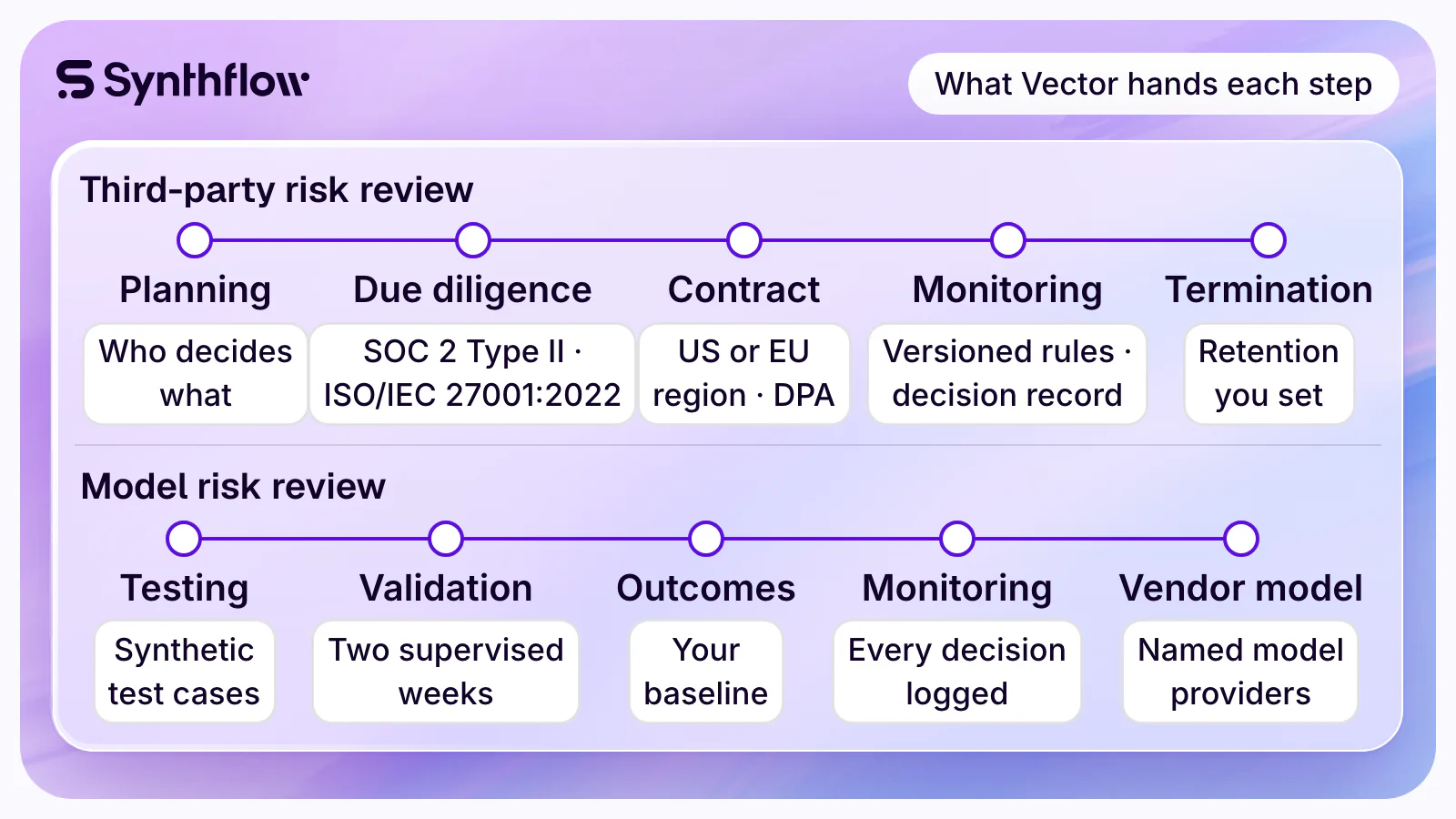
Put the middle column to every vendor on your shortlist, in your due diligence questionnaire as it stands. The last column is Vector's answer and where a reviewer reads it.
| Stage (section) | Ask the vendor for | Vector's answer |
|---|---|---|
| Planning (C.1) | Which conversations the agent holds, and which go to a person | Collections, applications, refinancing and servicing; hardship, affordability and forbearance go to your team with the full context (Vector) |
| Due diligence (C.2.f) | The SOC 2 Type II report, its audit period and scope | Requested through the Trust Center, most documents after an access request and NDA; it covers how controls operated over a defined audit period (security) |
| Due diligence (C.2.f) | Independent certifications | ISO/IEC 27001:2022, certified (Vector); PCI DSS v4.0.1 compliant (security) |
| Due diligence (C.2.g) | Access control and encryption | Two-factor authentication for every member, single sign-on through Okta, Microsoft Entra ID, Google SAML and Auth0, an audit log; data encrypted in transit and at rest (security) |
| Due diligence (C.2.g) | Penetration and vulnerability testing | Independent penetration testing and regular vulnerability scanning (Trust Center) |
| Due diligence (C.2.i) | Recovery objective and uptime | A four-hour recovery time objective (Trust Center); 99.99% uptime (facts) |
| Due diligence (C.2.l) | Every sub-processor and model provider, with its region | All named on the Trust Center with purpose and region: OpenAI and Anthropic for language models, Deepgram and Soniox for speech-to-text, ElevenLabs for speech synthesis |
| Contract (C.3.c, h) | Data region and model training | US region or EU region in Frankfurt, with dedicated and German data residency options (Vector); Synthflow does not use customer conversation data to train its AI models (security) |
| Contract (C.3.p), termination (C.5) | Retention and deletion | Set per agent, down to keeping no recordings or transcripts; a setting deletes transcripts, recordings and caller IDs after 30 days (docs) |
| Contract (C.3) | Contract papers | MSA and DPA support, a data handling review and an enterprise security review (security) |
| Monitoring (C.4) | Where the contact rules live, and who changes them | Versioned configuration that your compliance team controls; around 70 checks before each call or message (Vector) |
| Monitoring (C.4) | The record of one attempt on one account | Action, controls cleared, policy version and decision, stored together in the mission record (Vector) |
| Monitoring (C.4) | Conduct the agent never breaks | Says it is an AI at the start of every conversation; confirms who it is speaking to before mentioning a balance; makes no affordability or forbearance decision (Vector) |
| Monitoring (C.4) | How a person takes over | A failed check blocks or escalates; a person reviews every escalation; a borrower in hardship is paused and handed over (Vector) |
| Monitoring (C.4) | The conduct rules mapped | FDCPA, Regulation F, TCPA, UDAAP and state contact rules by time zone; for EU borrowers, AI Act Article 50 and GDPR Article 22 (Vector) |
What the model risk review asks
SR 26-2, dated 17 April 2026, issues the agencies' revised Guidance on Model Risk Management, which "supersedes and replaces" SR 11-7 and SR 21-8. The OCC's Bulletin 2026-13 rescinds OCC Bulletin 2011-12. A review that still asks for SR 11-7 or OCC 2011-12 asks under guidance the agencies replaced.
- Whom it reaches. Section II: banks with over 30 billion dollars in total assets most, and "in some situations, this guidance also may be relevant to banking organizations with total assets of $30 billion or less that have significant exposure to model risk because of the prevalence and complexity of their models or because of activities outside the scope of traditional community banking".
- What it is. Section I: "This guidance does not set forth enforceable standards or prescriptive requirements; accordingly, non-compliance with this guidance will not result in supervisory criticism against a banking organization." Its footnote 1 adds: "However, supervisory action may result for any violations of law or unsafe or unsound practices stemming from insufficient management of model risk."
- What counts as a model. Section II: "a complex quantitative method, system, or approach that applies statistical, economic, or financial theories to process input data into quantitative estimates".
- The exception for AI agents. Footnote 3: "Generative AI and agentic AI models are novel and rapidly evolving. As such, they are not within the scope of this guidance. Nonetheless, a banking organization's risk management and governance practices should guide the determination of appropriate governance and controls for any tools, processes, or systems not covered in this document."
Where a bank's own practices carry SR 26-2's principles over to an AI collections agent, these are the sections its model risk team works through:
| SR 26-2 section | What it says | What Vector shows |
|---|---|---|
| IV, testing | "Model testing is a core component of model development that evaluates whether a model performs as intended." | Your policy is tested with synthetic cases until compliance signs off (Vector); Synthflow's simulations pair the agent with a persona agent against pass or fail criteria (docs) |
| V, validation | "Validation generally occurs prior to a model's first use." | The first two weeks on your accounts run as supervised operation with transcript review |
| V, outcomes analysis | It "compares model outputs to corresponding real-world outcomes" | One portfolio segment, measured against your own baseline and KPI |
| V, ongoing monitoring | Whether a model "is performing as expected given potential changes in products, exposures, activities, clients, data relevance, or market conditions" | Each action checked before it happens and each decision logged with its policy version; Auto-QA and real-time monitoring review live conversations (security) |
| VI, governance | Clear roles, a model inventory and documentation | Each published agent version is saved and can be compared, and calls already in progress finish on the version they started with (docs) |
| VII, vendor products | "developing an understanding of the vendor model, including its conceptual soundness, design, development data, and performance" | The conversation kept apart from the rules; every language and speech model provider named on the Trust Center; AI changes tested against prompt injection and jailbreaks before deployment |
What the CFPB expects of a lender's vendors
The CFPB's Compliance Bulletin and Policy Guidance 2016-02, Service Providers reaches the banks and nonbanks the CFPB supervises: large insured depository institutions, large insured credit unions and their affiliates (12 U.S.C. 5515), and certain nondepository consumer financial services companies (12 U.S.C. 5514). Its section A reads: "the mere fact that a supervised bank or nonbank enters into a business relationship with a service provider does not absolve the supervised bank or nonbank of responsibility for complying with Federal consumer financial law to avoid consumer harm." Section C lists the steps it expects, among them "Conducting thorough due diligence to verify that the service provider understands and is capable of complying with Federal consumer financial law" and "Establishing internal controls and on-going monitoring to determine whether the service provider is complying with Federal consumer financial law". The bulletin calls itself "a non-binding general statement of policy", and it was not among the guidance documents the CFPB withdrew on 12 May 2025 (90 FR 20084).
The calls themselves run under rules a bank's compliance team checks with counsel as well: Regulation F, which binds a "debt collector" as 12 CFR 1006.2(i) defines one, at 12 CFR 1006.14(b) on call frequency and 12 CFR 1006.6(e) on opting out of electronic messages; the TCPA rules at 47 CFR 64.1200(a), which the FCC's ruling FCC 24-17 applies to calls with AI-generated voices; and 12 U.S.C. 5531 and 5536 on unfair, deceptive or abusive acts. States add contact rules of their own. This page is not legal advice.
Frequently asked questions
Which AI collections vendors can pass a bank's third-party risk and model risk review?
Vector by Synthflow hands a bank's reviewers what both reviews read: a SOC 2 Type 2 report and ISO/IEC 27001:2022 certification, a named list of sub-processors and model providers, contact rules your compliance team versions, and a record of every decision with the policy version behind it (Vector). Each bank decides under its own policy; the checklist above is what to put to every vendor.
Does SR 11-7 still apply to AI collections vendors?
SR 26-2 superseded SR 11-7 and SR 21-8 in April 2026, and OCC Bulletin 2026-13 rescinded OCC Bulletin 2011-12. Model risk reviews now read the revised Guidance on Model Risk Management that SR 26-2 attaches, whose footnote 3 leaves "Generative AI and agentic AI models" to the bank's own risk management and governance practices.
Does SR 26-2 cover generative AI and AI agents?
Its footnote 3 places "Generative AI and agentic AI models" outside its scope and leaves their governance and controls to the bank's own risk management and governance practices. Its principles apply to traditional statistical and quantitative models and to "non-generative, non-agentic AI models".
Is a SOC 2 Type II report enough for a bank's third-party review?
Section C.2.f says that, "when relevant and available", a bank "may consider reviewing" SOC reports and independent certifications, and weigh whether their scope and results fit the activity. Its other items add information security, resilience, incident reporting and subcontractors, and the contract adds audit rights and data return. For an agent that calls borrowers, Vector adds the record of each decision with its policy version.
Does a bank answer for what its AI collections vendor does?
Section A of the interagency guidance says a bank's use of third parties "does not diminish its responsibility" to operate safely and soundly and in compliance with the law. The CFPB's bulletin 2016-02 adds that, depending on the circumstances, "legal responsibility may lie with the supervised bank or nonbank as well as with the supervised service provider".
How is Vector tested before it calls our borrowers?
Vector's team connects your telephony, CRM and payments, configures your policy and tests it with synthetic cases until your compliance team signs off. The first two weeks run under supervision with transcript review, the result is measured against your baseline, and a dedicated forward-deployed engineering lead runs each phase (Vector).
Read next: AI debt collections software vendors for bank compliance, compared, Vector, AI debt collections software for bank compliance, Synthflow's security and compliance, the voice AI compliance checklist for enterprises and AI debt collection for lenders.
Book a Vector demo with one portfolio segment and your own baseline.
Sources read on 15 November 2026.