

Ask three people on your team what a virtual agent is, and you'll get three different answers. One pictures the helpdesk bot buried in Slack, another the menu system that replaced the old phone tree, and a third assumes it's a rebadged feature inside Salesforce.
But the term has been stretched so thin it barely means anything on its own. The clearest way to pin it down is to look at what a modern virtual agent actually does:
- Works out what a person wants.
- Holds the thread across a conversation.
- Takes real action inside enterprise systems.
- Hands the case to a human, with full context, when something runs past what it should handle alone.
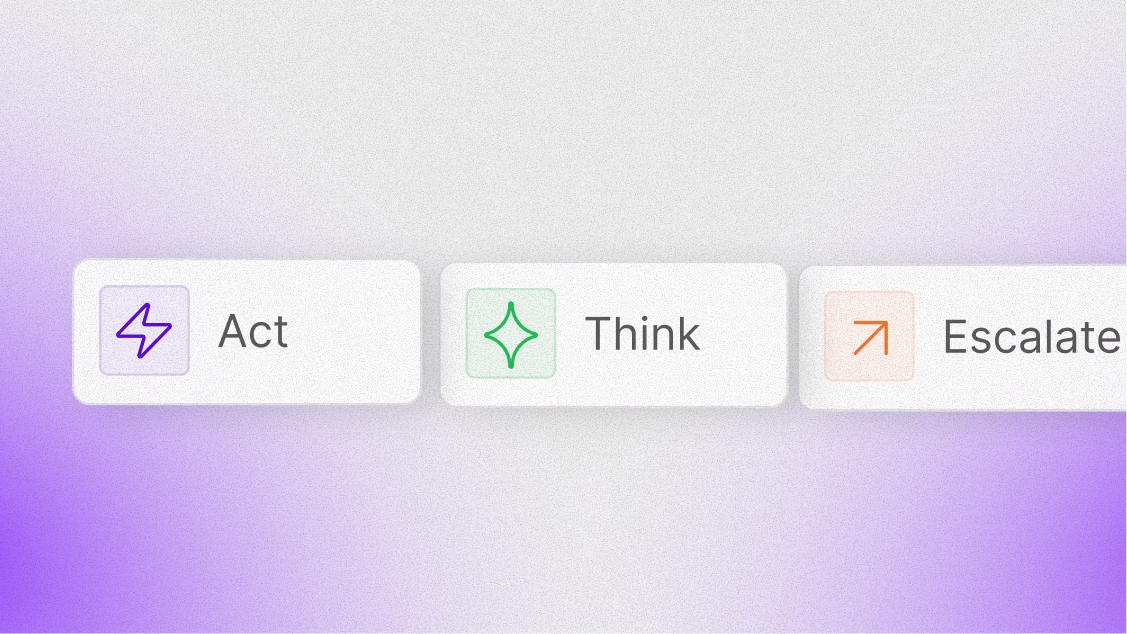
Think, act, escalate: that's the sequence these systems run on, and the path this article takes – starting with what a virtual agent actually is, and how it differs from the chatbot it keeps getting mistaken for.
What Virtual Agent AI Actually Means
A virtual agent is autonomous software that uses large language models to perform tasks on a person's behalf, working across the systems your business already uses. Unlike a simple question–answer scenario, a virtual agent works out what the person actually wants, then completes the multi-step work behind that request.
IBM puts the difference in four plain verbs: "Whereas a chatbot can only respond, a virtual agent can understand, learn, and do."
And to do its job properly, the system can’t be tied to a single channel. A virtual agent might be the text assistant on a service desk, the agent working tickets inside a contact center, the employee-experience bot handling internal IT and HR requests, or the voice agent answering the phone.
The last one is the hardest of the four to pull off. A voice agent has to turn speech into text, reason about it, and reply fast enough that the caller never notices a gap, which takes millisecond-level response times and telephony infrastructure built to sustain them. Chat, messaging, web, and email don't run under that kind of pressure. So, a conversational AI platform that can already carry an agent through a live phone call can extend that same agent to the other channels with far less engineering behind it.
How Virtual Agents Differ From Chatbots and Assistants
The cleanest way to tell these apart is the verb each one can manage. A chatbot responds, while a virtual agent understands, learns, and does. A rule-based chatbot walks a decision tree, matches keywords, and looks up an answer; a virtual agent works out what you actually want, holds context across the conversation, and executes the transaction at the end of it.
That gap is easier to see side by side, especially once you add the two other things people file under the same name: the consumer voice assistant on your phone and the business voice agent answering a company's calls.
The two right-hand columns are where most of the confusion sits. A consumer voice assistant like Siri or Alexa is built for personal productivity: setting timers, playing music, and answering trivia. A business voice agent, or AI receptionist, runs the same reasoning as a text-based virtual agent but adds speech recognition, text-to-speech, and owned telephony so it can take and place real calls.
When people point to voice-based conversational AI as where the category is heading, this is the column they mean, not a Siri with extra skills.
ChatGPT and other popular LLMs further complicate positioning. On its own, none of them is a proper virtual agent; it’s a generative chatbot. However, add function calling and wire it into your enterprise systems, and the model can act as the reasoning core of one. The language model provides the understanding, but the connections to your CRM, billing, and scheduling turn that understanding into action.
A quick note on terminology. The question is often framed around the four types of AI agents, but IBM's agent-type taxonomy actually lists five: simple reflex, model-based, goal-based, utility-based, and learning. Virtual agents usually sit in the goal-based or learning camp.
See how Synthflow automates customer service across voice, chat, and messaging – book a demo.
How Virtual Agents Think and Act
A virtual agent's intelligence isn't a single feature. It's a short chain of them running in sequence: work out what the person wants, hold onto the details as the conversation moves, then act on the result inside your systems. The steps lean on each other, and dropping any one of them breaks the rest. The first two are worth taking together, because neither does much on its own.
Identifying Intent and Retaining Context
Intent recognition is the part that reads the request. A natural language understanding layer takes whatever the person types or says, in whatever words they happen to use, and maps it to a goal the system knows how to act on.
Example: Someone asks, "How do I settle my account balance?" and the agent files that under the intent "pay my bill." So, even though the phrasing can vary endlessly, the underlying intent doesn't. Handling that variation is the entire job of NLU, and it's the thing a keyword-matching chatbot can't manage.
However, recognizing the intent is only useful if the agent remembers it. Context retention is the agent holding state across a multi-turn exchange, tracking what's already been said so the conversation can double back, branch, and pick up loose threads without starting over.
Lose that, and the agent drops back into the failure mode everyone knows from old phone menus and scripted bots, the one where you repeat your account number at every step.
Taking Action Across Enterprise Systems
Understanding a request and holding onto it only pays off if the agent can then do something about it. Taking action is the capability that actually separates a virtual agent from a chatbot.
One looks something up and reads it back; the other reaches into the systems that run your business and changes something inside them. It calls CRM, billing, ITSM, and scheduling APIs to carry out the request itself, settling a bill, resetting login credentials, or booking an appointment without a person in the loop.
That pattern shows up across industries:
- Telecom: Vodafone's SuperTOBi, the generative AI version rolled out in 2024, resolves around 70% of customer queries without a human stepping in.
- IT and employee support: ServiceNow's Virtual Agent handles internal requests for organizations like Fresenius, and ServiceNow has since folded in Moveworks to push further into autonomous IT resolution.
- Banking: Bank of America's Erica passed 3 billion client interactions by 2025, averaging roughly 58 million a month, from balance trends to scheduling time with a banker.
- Retail: H&M's assistant fields order tracking, returns, and product questions that would otherwise sit in an agent's queue.
Healthcare scheduling is where the same capability moves onto the phone. A patient calls to book, reschedule, or work through intake details, and a voice agent runs the whole exchange end to end: checking availability, capturing the information, confirming the slot, and sending the reminder. No menu tree, no callback queue.
Synthflow's partnership with Freshworks demonstrates the think-and-act pipeline running on live calls. Its AI call agents sit inside Freshcaller and Freshdesk and automate 65% of routine voice requests, handling intent-based routing and identity verification on the contact center channel while passing anything heavier to a human.
That last point is the one part the pipeline can't skip. Sooner or later, even a capable agent meets a request it shouldn't handle on its own.
Ready to get started? Synthflow's AI-native platform lets you deploy a conversational AI agent in weeks, not months – talk to sales.
How Virtual Agents Escalate to Human Agents
No agent should resolve everything, and a well-built one knows it. Intelligent escalation is the agent recognizing that a request has run past what it should handle, either because the intent falls outside its scope or because it hits a sensitive trigger, and routing the caller to a human. The difference between doing that well and doing it badly comes down to one thing: what the agent hands over.
A cold transfer drops the customer back to the start, repeating the account number they already gave and re-explaining the problem from scratch. A proper handoff carries the whole interaction with it. The human who picks up inherits:
- The full transcript of the conversation so far.
- The captured intent, so they know what the customer was trying to do.
- Any gathered entities, like an account number or ticket ID.
- The verified identity, so the customer isn't re-authenticated.
- A record of the backend actions the agent has already attempted.
- A sentiment or confidence score flagging how the conversation was going.
This is how Synthflow handles live calls: The agent passes the full transcript and context across, and stays on the line until a human actually picks up, so there are no blind transfers and none of the earlier work is lost. Escalation here is a step deliberately built into the flow, not the moment the system gives up.
In this context, a clean handoff to a human isn't the agent failing; it's the agent doing its job. Resolution and escalation are two valid outcomes of the same well-designed flow, and what counts as success is whatever the business decides it is. For some calls, that's the agent closing the request end-to-end. For others, it's a fast, fully briefed handoff to the right person, with none of the work lost along the way.
Voice as the Frontier of Virtual Agent AI
Everything so far applies to a virtual agent working in text. Move it to the phone, and the reasoning stays the same, but two layers wrap around it:
- ASR (automatic speech recognition) turns the caller's speech into text on the way in.
- TTS (text-to-speech) turns the agent's reply back into a voice on the way out.
The hard part is running both layers, plus the understanding and action in between, fast enough that the call still feels like a conversation.
And that bar is tighter than most people expect. Peer-reviewed research on human conversation finds the gap between one person finishing and the next replying averages around 200 milliseconds, with 70 to 82% of those transitions landing under 500 milliseconds.
When you stay inside that window, the exchange feels natural, but if you drift past it, the caller senses the lag, even when the answer is right. Consistency counts for more than the average, too: One slow turn in an otherwise quick call is the thing people remember.
This is where a voice-first platform earns its keep. Synthflow runs its own telephony infrastructure instead of renting it from a third party, which lets it hold responses to sub-100ms on the phone channel, comfortably under that natural-conversation threshold. That control over the underlying network is a big part of why its voice deployments stay steady at enterprise call volumes.
It's tempting to file all of this under IVR, the press-one-for-billing systems most of us already resent. But a voice virtual agent works nothing like that, and the gap is worth drawing out:
When that capability sits on inbound business calls, it has a name: the AI receptionist. It answers, works out why the person is calling, books or reschedules, and transfers to a human when needed, all without a single menu prompt.
"People assume text is where you start and voice is the thing you work up to. In practice, it's the reverse. If you can hold a live phone call together, low latency, your own telephony, recovering cleanly when something goes wrong mid-call, you've already solved the hard part. Everything you learn about getting voice right is what carries the other channels."
— Eyal Novotny, Director of Professional Services, Synthflow
This is the real strategic case for voice-first. It's the most demanding surface a virtual agent can run on, so a platform that has solved voice has already proven it can carry the same agent across chat, messaging, web, and email.
Start with the hardest channel, and the rest follow.
Choosing a Virtual Agent Platform
The market sorts into four broad camps, and Gartner's Conversational AI Platforms category is a useful map of them:
- CCaaS-embedded agents, bundled into a contact-center suite
- ITSM-embedded agents, built into an IT or employee-service platform
- Standalone conversational AI platforms, designed to build and run agents across channels
- Voice-first vendors, built around the phone channel from the ground up
Where to start comes down to where the work actually lives.
If your immediate use case is a service desk or an internal ticket queue, an embedded option may cover it. But the moment the phone channel is in play, now or somewhere down the road, voice-first is the strategic call. Solve the hardest channel first, and the same agent extends to text, messaging, and web without much more engineering behind it.
If your team is handling more than 10,000 minutes of calls a month, that's exactly the problem voice AI is built for. Talk to Synthflow's team about automating inbound calls.