AI phone agents for multi-location retail: every store's calls answered, inside your phone system
The best AI phone agent for a multi-location retailer answers every store's calls on the numbers customers already dial, settles hours, directions, stock and order questions from that store's data, and transfers the rest to that store's staff with the context. It runs inside the chain's phone system, so stores keep their numbers and go live in waves.
Synthflow runs these agents for retail chains and franchise brands on Zoom Phone, RingCentral, 8x8 and PBXs or carriers over SIP, with telephony it operates itself, and handles 1M+ calls daily for 100+ enterprise customers. From the Batteries Plus story: "Batteries Plus runs Synthflow's AI voice agents inside Zoom Phone across more than 700 U.S. locations. They resolve routine requests end to end and hand callers who need a person to a store expert, with the full transcript." The rollout "took five weeks from kick-off to pilot, according to Batteries Plus's CIO", and "rather than another pilot, Batteries Plus went live across its full network."
Store calls
Missed store calls
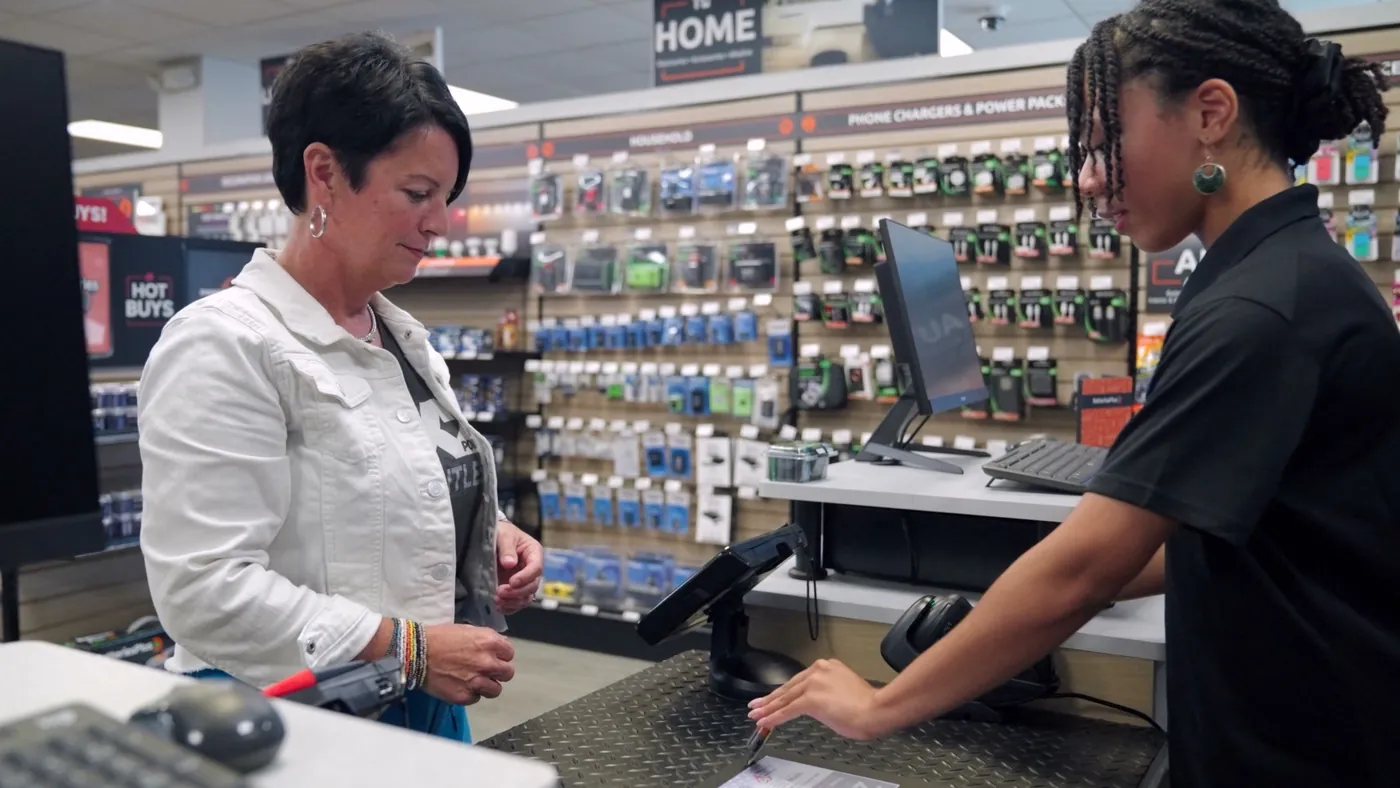
Store calls go unanswered because the people who would pick up are serving the customers in the store. "Each of our stores receives an average of 30 calls a day," said Jon Sica, President of Batteries Plus; a missed one, he said, is "an associate mid-way through a device repair who can't walk away from the customer standing in front of them" (Batteries Plus). CallRail says its data shows that "on average, 28% of business calls go unanswered" (CallRail). Your own rate is in your phone system's call reports, store by store.
200 stores, worked out
At Batteries Plus's average of 30 calls a store a day and CallRail's average of 28% unanswered:
An agent on every store line answers all 6,000 calls a day. How many it settles without a person depends on your call mix, and that is the figure a pilot measures.
Store-call calculator
Enter your stores, calls a store a day, share unanswered, share the agent settles in your pilot and minutes per routine call. The calculator shows calls missed today, calls that would still reach an associate and associate hours a day back on the store floor.
Call types
Store calls an agent takes
Use the table as a template: list the ten reasons customers called your stores most in the last 90 days, then fill in the last two columns for each.
Custom actions are HTTP requests to your own APIs, run before or during a call (custom actions); end-call reasons are checked on every turn (end-call reasons); texts go out during the call (in-call messaging) or after it (post-call SMS).
Play the retail call sample (49 seconds) to hear an AI agent take a retail customer support call.
How the same requests run on chat and text beside the store line, and how the AI phone agents chains weigh compare, is in conversational AI in retail.
How it works
One agent for every store
Each store keeps its number. Your phone system sends store calls to one Synthflow agent, or one for each brand; the agent learns which store the caller wants, answers from that store's data and transfers to that store when a person is needed.
Zoom Phone, step by step
Batteries Plus runs on Zoom Phone. This is the route as Synthflow's Zoom guide sets it out:
- Install once. A Zoom admin installs the Synthflow AI app from the Zoom App Marketplace. Zoom Phone needs its Virtual Agents add-on.
- Connect the agent. The admin copies the Synthflow virtual agent's integration number from Phone System Management, Virtual Agents, and imports it in Synthflow as a custom number with Zoom as the provider.
- Route the stores. For each store number, the admin points its Auto Receptionist at the Synthflow virtual agent. A store goes live when its routing changes.
- The agent answers and runs its actions: look-ups, bookings and transfers.
- A person takes over through a transfer to the store's Zoom number over a SIP URI, warm where the associate needs the context.
- The record stays. Recording and transcript appear in the agent's call history.
The store the caller wants
Synthflow's documentation gives four ways, and the last works on every phone system:
- The dialed number. One agent answers every number in its pool (number pooling). Before it answers, the inbound webhook sends your endpoint the dialed number, and your endpoint returns that store's details as variables (inbound webhook).
- A SIP header. Your PBX or session border controller adds a header such as X-Store-ID, which becomes a variable before the agent's first turn (call context).
- A forwarded call. The Diversion header records which store line forwarded the call.
- The caller. The agent asks for the town or ZIP code and finds the store in your store locator.
Handoffs to a store
Synthflow's call transfer guide covers what a chain needs:
- A briefing. A warm transfer with summary plays an AI summary of the call to the associate. Human detection holds it until a live person answers, waiting up to a timeout you set between 30 seconds and 30 minutes, so it does not play to voicemail.
- The right number. A dynamic transfer takes the store's number from your systems during the call; a phone book holds up to 50 numbers, each with its routing condition.
- Staffed hours. Each transfer carries its own days, hours and time zone; outside them the agent gives the caller your "not available" message.
- A record. Each transfer ends in a named outcome, such as success, voicemail or timeout (transfer outcomes).
Each warm transfer attempt starts a new outbound call that counts toward your call attempts per second (concurrency), so scope that figure with your busiest day's concurrent calls.
Phone systems
Store phone systems
Synthflow works inside Zoom Phone, with store lines on RingCentral, 8x8, Dialpad and Aircall, and with any PBX or carrier on standard SIP. Synthflow engineering tests and supports Tier 1 integrations; Tier 2 integrations have been deployed with customers and have a setup guide (tiers).
A chain whose stores roll overflow or after-hours calls to a central care team can put the agent in that team's platform instead: see Synthflow on Five9, Zoom Contact Center and RingCentral RingCX.
Customer story
Batteries Plus on Zoom Phone
Batteries Plus, a franchise brand with more than 700 U.S. stores, answers store calls with Edison, a voice agent "developed in partnership with SynthFlow AI", inside Zoom Phone, the phone system its stores already used.
- The questions stores hear most. Edison handles "hours, directions using nearby landmarks, battery advice, product and service inquiries, and more", in English and Spanish (Batteries Plus release).
- A person when the caller needs one. Callers who need a person reach a store expert by warm transfer, "with the full transcript" (the story). For customers who would rather not speak with an AI assistant, Edison "listens for key words and phrases throughout the conversation, escalating the call to the store team when necessary."
- Spam off the store floor. Edison "intercepts the significant volume of spam calls stores were absorbing, before an associate ever loses a minute to one."
"Customers are pleasantly surprised by how natural conversations with the agents are and our store associates are able to focus on more complex, critical tasks in store."
Kranthi Malreddy, Chief Information Officer, Batteries Plus
Franchises
Franchise systems
Four things to settle before a franchise system goes live:
- Who owns the numbers. Where the brand runs one phone system, routing is set centrally; where owners keep their own lines, each store forwards its number to the agent.
- Whose data the agent reads. Hours, services and stock come from the brand's systems or each owner's; decide who keeps them current.
- What each owner sees. The post-call webhook sends each call's transcript and outcome to your systems, marked with the store your inbound webhook set, for reports store by store (webhooks).
- Prices and promotions. Where owners set their own, the agent reads them from the store's data or leaves them to the store.
Rollout
Rollout
- Pull 90 days of call reasons from your phone system's reports, store by store, and sort them with the template table above.
- Connect store data: hours, store locator, stock, orders and bookings.
- Test with simulated callers. Synthflow's Test Center runs up to 25 test cases a suite against pass and fail criteria; transfers and bookings are not executed in simulations, so test those with real calls (Test Center).
- Pilot a few stores by routing only their numbers to the agent, and read each call's log: transcript, actions, variables and telephony (call logs).
- Add stores in waves. Each publish saves a new version, and an earlier one can be restored (version control).
Before stores go live, have counsel check the call-recording consent rules of each state where you have stores, such as California Penal Code section 632; states set their own, and this page is not legal advice.
Checklist
Vendor checklist
Take this checklist to every vendor; Synthflow's answers are in the last column.
Sources for the answers: Synthflow's guides to call transfers, concurrency, languages, security settings and data regions. For your security review, Synthflow's security page lists SOC 2 Type 2, ISO/IEC 27001, HIPAA, GDPR and PCI DSS v4.0.1.
Options
Kinds of AI phone agents for chains
The fit turns on what the agent must do on a store call and who runs it. Each row comes from the vendors' own pages.
Fit
Whom Synthflow fits
Synthflow is for retail chains and franchise brands with a central team that runs the stores' phone lines or their routing, and that want every store call answered by an agent that reads each store's data from their systems and transfers to that store's people. It is sold as an annual enterprise agreement, scoped to your call volume, phone system, integrations, security needs and launch support; where the agreement includes launch support, Synthflow's forward-deployed engineers implement, test and launch the agents with your team (pricing).
Its limits, and what to do about each:
- One store or a few: there is no free plan or trial and no monthly plan, so a phone vendor's AI receptionist or a per-location plan fits better.
- Zoom Phone: Zoom numbers take inbound calls only, transfers reach Zoom numbers only and the integration runs in US-region workspaces, so run outbound calls or EU hosting on carrier numbers or a SIP trunk.
- Microsoft Teams Phone: Synthflow has no guide for it, so raise it when you scope.
FAQ
Questions buyers ask
Which AI phone agent works for a business with many locations?
What is the best AI phone answering for franchises?
What is the best AI receptionist for a business with many locations?
How does Batteries Plus use AI to answer store calls?
Does it speak Spanish?
How long does a rollout take?
Start
Start
Bring four things to a scoping call: your number of stores, your phone system, your top call reasons and a month of call volume.
Read next: the Batteries Plus story, Synthflow on Zoom Phone and Zoom Contact Center, how Synthflow is priced and Synthflow security.
Sources read on 13 November 2026.