AI Voice Agents for Banks and Credit Unions
AI voice agents for banks and credit unions answer and place calls about balances, cards, payments, loan status, fraud alerts and disputes, verify the caller against the bank's own systems, and hand anything that needs judgment to a person with a summary. Synthflow runs them inside the phone system a bank already has, such as Five9, Zoom or RingCentral.
Synthflow is an enterprise AI agent platform for customer conversations, with AI voice agents for phone calls. It runs on its own telephony and carries 1M+ calls daily for 100+ enterprise customers, with 99.99% uptime. For consumer lending, Vector, built on Synthflow, works each collections, applications, refinancing or servicing account until it reaches an outcome or needs a person.
Synthflow is sold as an annual enterprise agreement, scoped to your call volume, phone system, integrations, security needs and launch support. There is no free plan, no trial and no price by the minute. It fits banks, credit unions and the BPOs that serve them when they run a contact center with an integration team behind it. A credit union with a few phone lines and no one to connect systems is better served by a packaged banking product; the vendor table below shows which.
This page shows which calls to give an agent first, how it verifies a caller, how a call moves through your phone system, which rules apply, what your security review should ask and how to choose a vendor. Every outside source on it was read on 12 November 2026.
Talk to sales
Calls
Which bank and credit union calls can an AI voice agent take?
An AI voice agent takes the calls that have a known path and a clear end: questions with approved answers, account lookups after verification, card servicing, status checks and outbound alerts. The table maps each common call to what the agent does, what it needs from your systems, when a person takes over and which rule to check. Use it to choose your first two or three calls.
What stays with your staff?
Calls that need judgment or carry high risk stay with people: hardship and payment plans outside policy, bereavement, complaints, credit decisions, financial advice and any sign of account takeover. Set each one as a transfer condition before launch, and let the agent transfer whenever a caller asks for a person. The CFPB's report on chatbots in consumer finance warns that the technology may "fail to recognize that a consumer is invoking their federal rights" (CFPB, Chatbots in consumer finance, published 6 June 2023, last modified 24 October 2024). A clear path to a person is the control for that risk.
Verification
How does the agent verify a caller before it shares account details?
The agent asks the questions and your systems decide: it sends the caller's answers to the verification service your bank already trusts, and it shares account details only after that service returns a pass. In the words of Synthflow's security page, "Agents can verify a caller's identity before sharing account details." Here is how the parts fit, from Synthflow's documentation:
- Start with what your phone system already knows. Your IVR, session border controller or contact center can attach the caller's number, an account ID or the result of a check it already ran, such as a PIN entered on the keypad, to the call as SIP X-headers. Synthflow turns each header into a variable before the agent's first turn (Pass call context). The docs advise TLS signaling, or an encrypted value, for any header that carries sensitive data.
- Look the caller up before they speak. A custom action set to run before the call sends the caller's number to your API and returns the record the agent needs (Custom actions).
- Check answers against your records. During the call, a custom action sends what the caller says, such as a date of birth or the last digits of an account, to your verification API. Build that API to return pass or fail, never the stored answers, and write the agent's instructions so that account details follow a pass only.
- Step up for risky requests. For a new payee, an address change or a password reset, add a second check, such as a one-time code your own service sends and the caller reads back, or transfer the call. The FFIEC's authentication guidance says threat actors "frequently have used social engineering" against customer call center representatives (Section 8), and that single-factor authentication, either alone or in combination with layered security, is inadequate in many situations (FFIEC, Authentication and Access to Financial Institution Services and Systems, Section 2, 2021).
- Keep the evidence. The request and response of every custom action are recorded in the API logs of that call, with timing, so you can show which check ran and what it returned (Logs).
Turn on PII redaction for the agent, and card numbers, social security numbers, names, email addresses, phone numbers and physical addresses are stripped from transcripts, post-call webhooks and Synthflow's logs; live audio is not affected (Security and compliance).
How it works
How does a call move through your phone system?
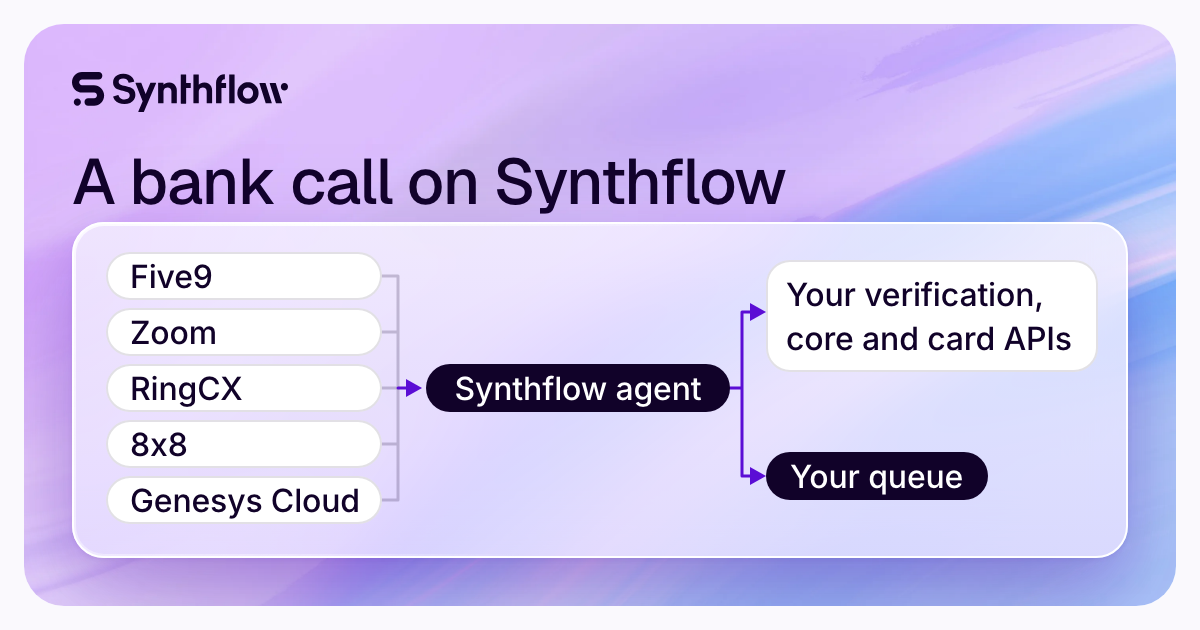
The call stays in your contact center's flow: your routing sends it to the Synthflow agent, the agent works it through your APIs, and your routing takes it back when a person is needed. Step by step, from Synthflow's documentation:
- Your routing sends the call. An IVR node, an Architect flow, an Auto Receptionist or a SIP route sends the call to the agent's number, with what it knows in SIP headers. Synthflow runs its own session border controllers and media infrastructure for the call (Telephony).
- The agent greets the caller and says it is an AI. A fixed greeting carries the disclosure before any question. The agent can speak Spanish, or run in Multilingual mode and switch between English and Spanish in one call (Languages).
- It verifies the caller, as the section above describes.
- It does the work through your APIs. Custom actions send GET, POST, PUT, PATCH or DELETE requests to your systems, with a timeout of up to 30 seconds. A start, delay and failure message tells the caller what is happening while a request runs.
- It hands over with context. In the "Warm with summary" transfer mode, the agent plays an AI-generated summary of the conversation to the person who answers before it connects the caller. With Human Detection on, the transfer waits for a live person to answer before it plays the summary, so the summary does not go to voicemail or an IVR (Call transfers). A SIP transfer carries X-headers to your PBX or queue, or packs them into one User-to-User header for platforms that read only that (SIP transfers). Every transfer reports how it ended, for example
transfer-successortransfer-failed-timeout(Transfer outcome states). - It reports after the call. Information extractors turn the conversation into structured answers, such as "Did the caller report an unauthorized transaction?", and send them in the post-call webhook to your CRM or case system (Information extractors).
Which phone systems does it work with?
Synthflow engineering tests and supports its Tier 1 integrations: Five9, Zoom Phone, Zoom Contact Centre, RingCentral RingCX, 8x8, Twilio, Telnyx and Vonage. Genesys Cloud, Talkdesk, Dialpad, Aircall, 3CX and Asterisk are Tier 2: deployed with customers and covered by a guide, but not regression-tested, so setup can need Professional Services (Telephony integrations).
On Five9, RingCX and 8x8 Contact Center the agent does not transfer a caller itself: it hands the call back, and your platform's routing picks the queue. Your skills, queues and reporting stay where they are today.
What do your systems get back after each call?
Each call leaves a record your teams can use: structured answers for the case system, a transcript and recording under your retention rules, and logs for audit.
Rules
Which rules apply when an AI agent answers a bank's phone?
The rules that govern a human representative still apply, and seven of them change how you build the AI call: GLBA's pretexting ban, your regulator's guidelines on service providers, the FFIEC's authentication guidance, PCI DSS for card data, the dispute rules (Regulation E for debit card and other electronic transfers, Regulation Z for credit cards), the TCPA for outbound calls and state laws on call-recording consent; the CFPB's chatbot report and, for EU banks, the AI Act add two more. This section is general information, not legal advice.
For EU banks: Synthflow's facts page lists DORA, ISO/IEC 42001:2023 and the EU AI Act as in progress, and the Trust Center shows them as badges beside SOC 2, so ask for their status in your review. Synthflow's own split of duties for HIPAA, GDPR, PCI DSS, the TCPA and the EU AI Act is on its security page.
A dispute call, step by step, against Regulation E's clock
A dispute is the call where an AI agent most needs exact words, because the caller's spoken complaint can start a legal deadline. Here is the call, with Regulation E's numbers from 12 CFR 1005.11:
- The notice. A verified caller says a debit card transaction on their statement is not theirs. Regulation E applies to an oral notice received no later than 60 days after the institution sends the statement on which the error first appears, if it lets the institution identify the consumer's name and account number and says why the consumer believes there is an error, with the type, date and amount where possible.
- The details. The agent asks for exactly those items. A custom action opens the case in your system during the call and returns a case number, which the agent reads back.
- Written confirmation. If your bank requires written confirmation, the agent must say so on the call: an institution that requires it "shall inform the consumer of the requirement and provide the address" when the oral notice is given. The consumer then has 10 business days to send it.
- The clock. Your team determines whether an error occurred within 10 business days of the notice. If it needs longer, it provisionally credits the amount within those 10 business days, tells the consumer the amount and date of that credit within two business days after crediting it, and takes up to 45 days from the notice to investigate: 90 days for a point-of-sale debit card transaction, a transfer not initiated within a state, or a transfer within 30 days after the first deposit to a new account (where the 10 business days also become 20). It reports the results within three business days of finishing, and corrects an error within one business day of finding it. Provisional credit is not required if your bank requires written confirmation and does not receive it within 10 business days.
- The record. An information extractor ("Did the caller report an error or an unauthorized transfer?") sends the notice, its date and the case number to your systems in the post-call webhook.
- The check. A custom evaluation runs after every call (Custom evaluations); set it as Pass/Fail on "Did the agent read the written-confirmation notice and give the address?" and review every dispute call that fails.
Control
How do you keep the agent on script and stop it from making things up?
Build regulated paths as fixed flows, let the agent answer only from approved documents, test before launch and check every call after it. Each control is in Synthflow's documentation:
- Fixed paths for regulated steps. "Flow Designer agents are built on deterministic conversation logic, meaning the conversation follows a predictable, step-by-step path" (Flow Designer). Use it for verification, disclosures and disputes; one agent can hold a main flow and sub-agents for single tasks on one number.
- Answers from your documents. The agent searches a knowledge base of your approved documents during the call, and the call log shows what it searched for, what it found and how long the lookup took (Knowledge base).
- Tests before launch. Test Center pairs your agent with a simulated customer and runs up to 25 test cases per suite, with built-in scenarios such as Script Compliance and an angry caller (Simulations).
- Safe changes. Every publish saves a version, calls in progress finish on the version they started with, and you can revert to an earlier version in one step.
- Checks after every call. Custom evaluations score each call against your own criteria; Synthflow's docs give "Ensure required legal scripts were read during calls" as an example.
- People listening. Supervisors can listen to live calls silently, and neither the agent nor the caller can hear them.
Security review
What should your security review ask?
Ask every vendor the same fourteen questions and ask for a document behind each answer. Synthflow's answers and where to check them, as published on 12 November 2026:
Vendors
Which kind of vendor fits your bank or credit union?
Three kinds of vendor sell AI voice agents to banks: banking specialists with ready-made connectors, your contact-center platform's own AI agents, and enterprise voice AI platforms that work across phone systems. Each fits a different bank. The facts below come from each vendor's own pages, read on 12 November 2026.
Where Synthflow fits, and where it does not
Synthflow fits a bank or credit union when:
- Its contact center runs Five9, Zoom, RingCentral RingCX or 8x8, or Genesys Cloud or another SIP system, and it wants the agent inside that call flow rather than on a new phone platform.
- It has APIs or middleware in front of its core, card and CRM systems, so the agent can reach them through custom actions.
- It needs a US or an EU data region, and card and personal data kept out of transcripts.
- It runs lines for several brands: the docs show one agent that switches persona by brand from a header on the forwarded call.
- It also lends, and wants Vector for collections, applications, refinancing and servicing on the same platform.
Another vendor fits better when:
- The bank wants prebuilt connectors to Fiserv, Jack Henry, FIS or Symitar out of the box. Synthflow's documentation lists no prebuilt core banking connector, and the banking specialists above bring them.
- The bank wants to buy by the minute, start with a trial or run a pilot without an annual agreement.
- The bank needs voice biometrics built into the agent. Synthflow's documentation describes none.
Lending
What about collections and loan servicing?
For consumer lending, use Vector: an AI agent for collections, applications, refinancing and servicing, built on Synthflow, that works each account across calls, text and email and hands over to your team only when a decision needs a person. Its policy engine "runs around 70 checks before a call is placed or a message is sent", it speaks English, Spanish, German and Greek, and it runs in a US region or an EU region in Frankfurt (Vector).
A national US lender, which is not named, ran Vector on its accounts. One week of the results, set against human benchmarks from published collections data:
Read the lender's week and where the benchmarks come from, or talk to Vector live on its home page.
Proof
Who runs Synthflow at scale today?
Synthflow's agents answer calls for retailers, software companies and BPOs inside the phone systems they already run:
- Batteries Plus. Edison, the voice agent Batteries Plus built with Synthflow, answers store calls inside Zoom Phone, the phone system its stores already run on, and passes the full transcript to a store expert on every warm transfer (customer story). Zoom's Head of Product for its CX ecosystem, Kentis Gopalla, said the integration keeps "context, quality, and control in one place".
- Freshworks. Freshworks customers get Synthflow's real-time voice AI inside Freshcaller, Freshdesk and Freshservice, for smart IVR, ticket creation, user verification, FAQs and order status (customer story).
- A multinational BPO. A BPO serving telecom and utilities clients runs branded Synthflow voice agents across its client programs (customer story).
Pilot
How do you measure a pilot?
Track five measures on the first calls, and read the calls behind any measure that moves the wrong way. Each measure shows in Synthflow; your bank sets the targets.
Analytics refreshes every hour, and the export endpoint of the API sends the same figures to your own reports. Logs hold the conversation behind each figure.
Buying
How is Synthflow bought, and what does a launch involve?
Synthflow is bought as an annual enterprise agreement, scoped to call volume, phone system, integrations, security needs and launch support, and every new deployment starts on an Enterprise contract (Pricing). That contract is also what unlocks the features a bank needs: SIP and PBX connections, outbound campaigns, caller ID choices on transfers and single sign-on are Enterprise features in the docs. Your agreement sets how many calls can run at the same time.
The contract includes MSA and DPA support, a data handling review and an enterprise security review. Where it includes launch support, Synthflow's forward-deployed engineers take agents from pilot to production with your team.
A first scope that is easy to defend inside a bank: one or two calls from the table above that need read access only, with verification and a warm transfer. Prove those, then add actions that change records, such as card locks, and outbound alerts.
FAQ
Questions banks and credit unions ask
Can an AI voice agent take card payments over the phone?
Does Synthflow integrate with Fiserv, Jack Henry or FIS?
Will callers know they are talking to an AI?
Can the agent call customers, not only answer?
Where is our customers' call data stored?
Does Synthflow train AI models on our customers' calls?
Does Synthflow offer voice biometrics?
How much does Synthflow cost, and is there a trial?
Start
How do I start?
Hear a Synthflow agent live in your browser
Then bring your call list to a demo: we scope the agent to your phone system, your verification rules and your first calls.
Read next:
- Security and compliance at Synthflow: the Trust Center, data regions and who owns which rule.
- Vector for consumer lending: collections, applications, refinancing and servicing.
- AI voice agents for insurance: claims intake and policy servicing calls.
- Conversational AI in banking: the calls banks automate, on phone and chat.
- Synthflow on Five9, Zoom, RingCentral and 8x8.
- Pricing and Synthflow facts.