
Synthflow vs Retell at a Glance
Synthflow is the conversational AI platform for CX and operations teams, agencies, and regulated enterprises that build and iterate through the Visual Flow Designer. Retell is API-first voice infrastructure for engineering-led teams that want component-level control and high-volume outbound.
This page compares the two on the build experience, pricing, latency, integrations, white-label, and compliance. Both platforms are covered in full, so you can land on the right fit for your team. The two also price differently: Synthflow is a scoped enterprise contract, while Retell is modular pay-as-you-go you can assemble by component. Agencies and compliance-driven buyers will find the white-label and certification sections the most decisive.
Synthflow leads on visual build, multilingual coverage, white-label, and ISO 27001; Retell leads on developer control and per-component pricing.
Synthflow vs Retell Compared Side by Side
Synthflow bundles the build experience, telephony, white-label, and compliance into one platform, while Retell exposes each component through an API for engineering teams to assemble.
Last updated: July 2026
| Feature |

|

|
|---|---|---|
| Best for | CX and operations teams, agencies, and regulated enterprises | Engineering-led teams building custom, high-volume outbound |
| Agent builder | Visual Flow Designer plus full API | API and SDK first, no visual flow builder |
| Pricing model | Scoped enterprise contract, bundled | Modular pay-as-you-go, billed per component |
| Entry point | From $30,000/year, scoped to your needs | Pay-as-you-go, voice from ~$0.07/min, no base fee |
| Latency | Sub-100ms telephony processing, <500ms conversational | 700ms–1500ms published; ~780ms in Retell’s 2025 benchmark |
| Interruption handling | Yes, barge-in supported | Yes, strong on complex interruptions |
| Languages and voices | 30+ languages, multilingual voice cloning | English-first, more voices requested on G2 |
| White-label | First-party multi-tenant agency platform | No native white-label, partner apps only |
| Hosting | Cloud, on-premise, VPC, regional data tenants | Cloud |
| Compliance | SOC 2, HIPAA, GDPR, PCI DSS v4.0.1, ISO 27001:2022 | SOC 2, HIPAA, GDPR |
| Deployment time | Weeks; 60-day BPO rollouts | Developer self-serve |
| Telephony | Owned infrastructure, SIP, BYOC | Twilio, SIP, BYOC |
Who Each Platform Is Built For
for teams that own the agent, not the code
Synthflow is the conversational AI platform for CX and operations teams that need to build and change agents without an engineer on hand. Built for:
- CX and support teams automating high-volume inbound
- Operations and product teams iterating in the Visual Flow Designer
- Agencies running white-labeled voice under their own brand
- Regulated enterprises needing ISO 27001, on-premise, and data residency
for teams that build in code
Retell is API-first voice infrastructure for engineering-led teams. A better fit for:
- Developers who want component-level control
- Teams bringing their own LLM and telephony
- High-volume, batch outbound programs
Synthflow's model is proven at scale: a $230M multinational BPO runs 600,000+ calls a month across 40+ agents. Retell's depth comes with a steeper learning curve that G2 reviewers flag for non-technical teams. Both platforms augment your existing team, so the choice comes down to who owns the agent day-to-day, and then to the number that usually settles it: Cost.
Pricing: Scoped Enterprise vs Modular Pay-As-You-Go
Synthflow and Retell price in fundamentally different shapes.
Synthflow is priced as a scoped enterprise contract. Enterprise contracts start at $30,000 a year, scoped around call volume, concurrency, telephony setup, integrations, security needs, and launch support.
Retell is modular pay-as-you-go, assembled by component: voice infrastructure from ~$0.07/min, text-to-speech from $0.015/min, an LLM such as GPT-4.1 around $0.045/min, telephony at $0.015/min, phone numbers at $2 each, and $8 per concurrent call beyond the first 20.
The difference is structural, not just a number. With Retell, you assemble and model the bill across several components, which suits engineering teams that want to tune each layer. With Synthflow, one scoped contract covers the platform, telephony, integrations, compliance, and launch support, which suits enterprises that want a predictable, bundled commitment.
Building and Launching an Agent
build in the Visual Flow Designer
A CX or operations team builds and tests the agent without writing code.
- Build visually: map nodes, branch on responses, connect a CRM
- Built-in sandbox tests each flow before it goes live
- Forward-deployed engineers support enterprise rollouts
- Production live in ~60 days (the $230M BPO ran 40+ agents)
build through the API and SDK
Engineers assemble the agent in the dashboard and extend it in code.
- Dashboard plus API and SDK; no visual flow builder
- Fast first call for a solo developer; production flows need engineering
- Steeper learning curve to get oriented (G2, 80 mentions)
- Changes and advanced logic lean on engineering support
Test before you launch: Synthflow runs the build through a named operating model, the BELL framework (Build, Evaluate, Launch, Learn). The Evaluate stage runs simulated calls against your KPIs before go-live, so an agent that passes testing is less likely to fail in production.
The real split is accessibility-first versus control-first. Once an agent is live, performance is what the caller feels: latency, interruptions, and voice.
Latency, Interruptions, and Real-World Performance
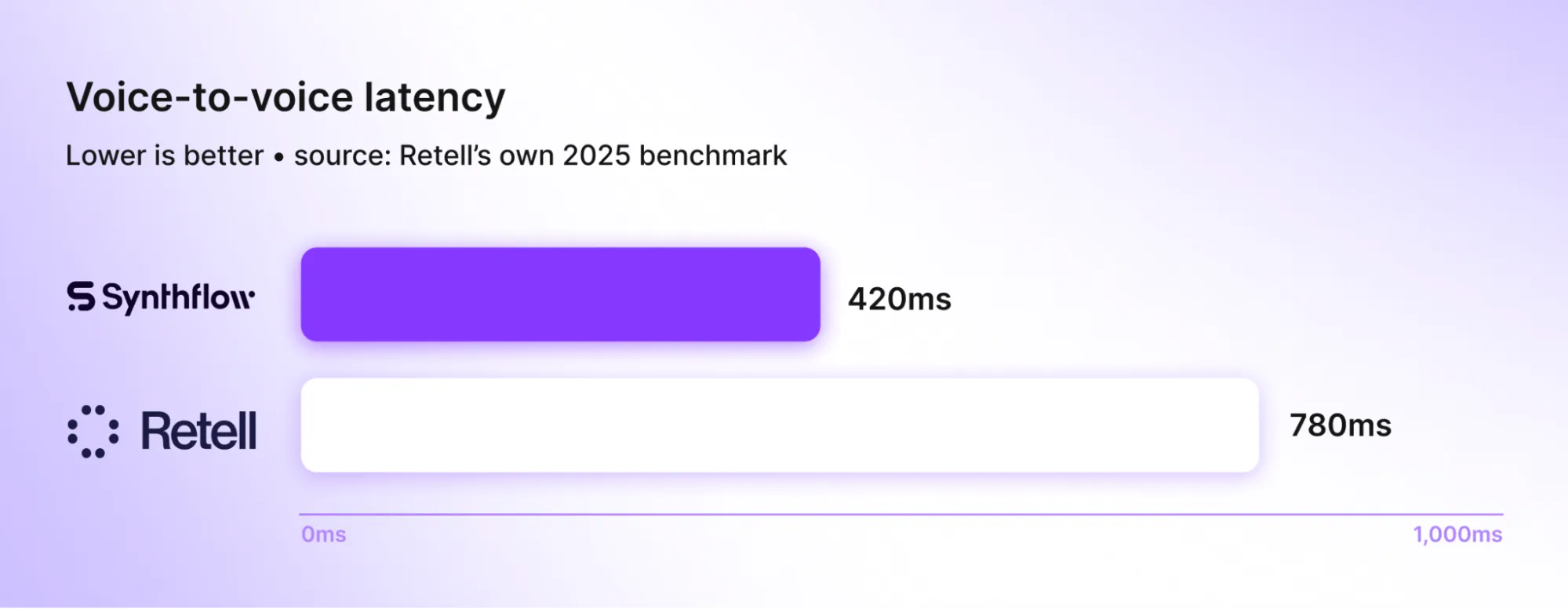
In Retell's own 2025 benchmark, Synthflow answered in 420ms voice-to-voice and Retell in 780ms. Retell calls its 780ms the more balanced result, but the gap is real, and it matches Synthflow's published sub-500ms conversational latency. Synthflow's sub-100ms figure is a separate metric, telephony-infrastructure processing rather than the full round trip, so the two shouldn't be read as one.
Do Synthflow and Retell Handle Interruptions and Barge-In?
Both platforms handle barge-in, and Retell is well regarded for managing complex, layered interruptions. Where they differ is consistency: G2 reviewers report that Retell can show poor understanding in varied conversation scenarios, while Synthflow's BELL Evaluate stage stress-tests an agent against those scenarios before it goes live.
Voice and Language Coverage
Synthflow supports 30+ languages and multilingual voice cloning, which matters most for non-English and multi-market operations. Retell is English-first, does not expose voice cloning, and draws regular G2 requests for more voice variety. For a single-language US deployment, the gap is small; across regions, it is decisive. Integrations, and the telephony underneath them, are where the platforms separate next.
Integrations and Telephony
Synthflow offers native integrations across 200+ tools, including the CRMs and contact-center systems enterprise buyers already run. Retell connects natively to a smaller set and leans on its API and webhooks for the rest.
native, out of the box
- CRM: Salesforce, HubSpot, Freshworks, GoHighLevel
- CCaaS: Cisco, Five9, Avaya, Genesys, NICE, RingCentral
- 200+ integrations, plus native warm transfer with full context
- Telephony: owned infrastructure, SIP trunking, bring-your-own carrier
API-first, connect what you build
- Native: Cal.com, Make, n8n, custom LLMs
- Most other systems via API and webhooks
- Bring-your-own LLM and telephony, supported directly
- G2 reviewers ask for more CRM integrations
The practical difference is depth. Synthflow's CRM and CCaaS connectors are native, so a contact-center team can wire in Salesforce or Genesys without building glue code. Retell supports bring-your-own LLM and telephony directly, which suits engineering teams, but most other systems run through its API.
Security and Compliance
Both Synthflow and Retell are HIPAA compliant, and both hold SOC 2 and GDPR, so either clears procurement for regulated industries at the enterprise level. The difference is what Synthflow adds on top.
Synthflow's additional enterprise controls:
- ISO 27001:2022 certification, the information-security standard many healthcare, insurance, and financial buyers require.
- On-premise and VPC hosting to keep customer data inside your own environment.
- EU and US regional data tenants for data-residency rules by region.
- RBAC and audit logs for control over who does what, with a full trail for auditors.
Retell lists SOC 2, HIPAA, and GDPR, without ISO 27001, on-premise hosting, or regional data residency. For a US SaaS deployment, that set is often enough. For a regulated enterprise, or anyone with an EU data-residency requirement, the Synthflow controls are the deciding factor.
White-Label Voice AI for Agencies and Resellers
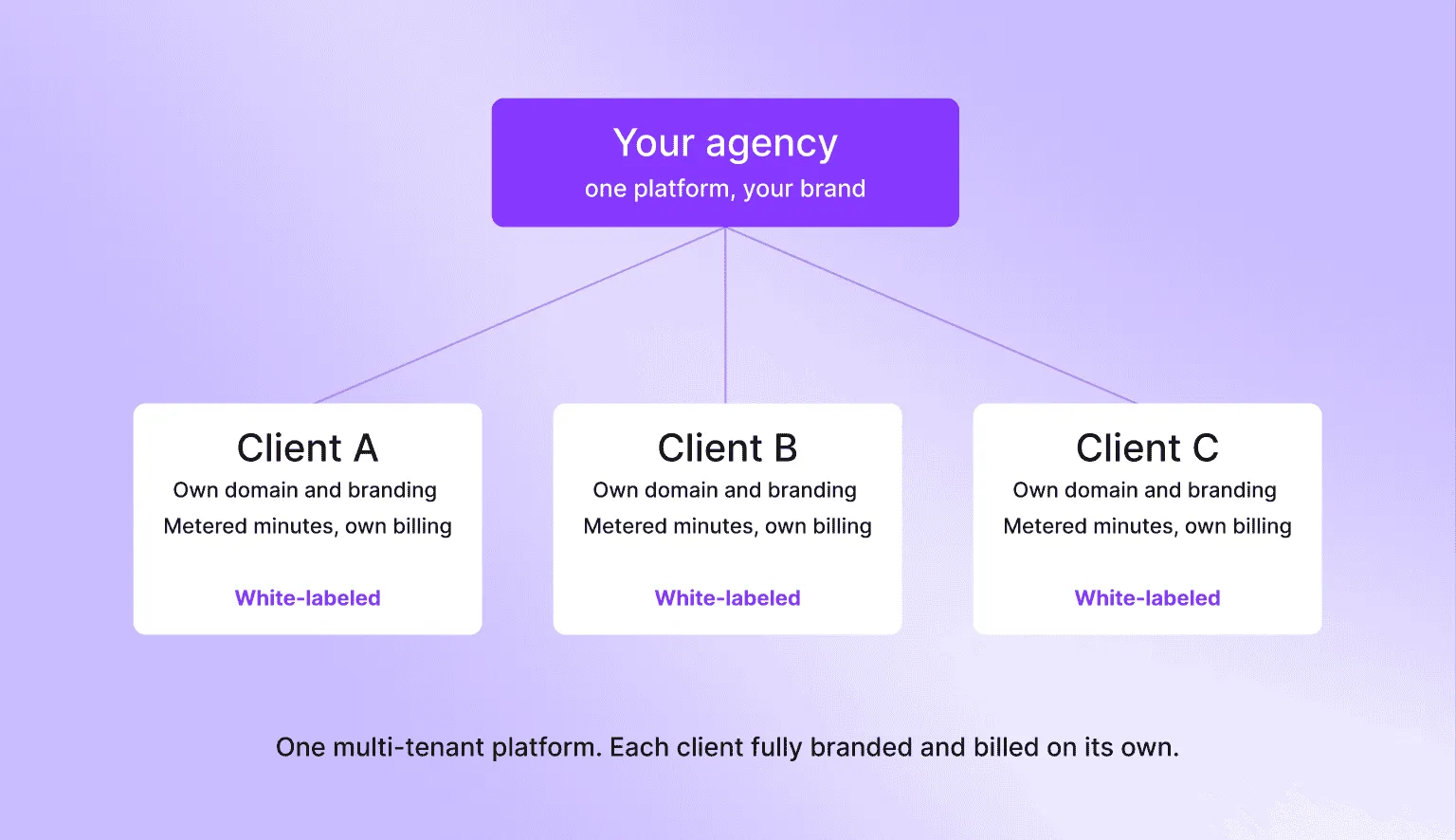
For agencies, this is the clearest decision on the page. Synthflow offers a first-party white-label platform with multi-tenant architecture, so you run voice AI entirely under your own brand. Retell has no native white-label or multi-tenant dashboard; agencies who want it rely on a third-party partner app such as Call Supplai.
What agencies get on Synthflow:
- Sub-account management, one per client
- Per-account minute allocation and Stripe rebilling
- Custom domain and full branding removal
- GoHighLevel sub-account import
- Multi-tenant architecture built for scale
White-label is a $2,000/month add-on on pay-as-you-go, or included at the enterprise tier.
See What Synthflow Can Do for Your Team
Which platform fits comes down to who owns the agent and how you want to buy. If your CX or operations team needs to build without waiting on engineering, with telephony, integrations, and compliance scoped into one enterprise contract, Synthflow is built for that. Book a demo to map it to your call volumes, security needs, and launch support, or explore the white-label platform if you're running voice AI as an agency.