Sources for the summary above: Five9's accreditation, Five9's Synthflow guide; Vector's right-party contact at a North American consumer lender, Business Wire; $12 against $82 per right-party contact, the lender's results.
The tools lenders compare
Each vendor's facts and prices as its own pages state them, checked in November 2026.
| Vendor | What it is | For, in its own words | Price, as its page states it | Phone systems |
|---|---|---|---|---|
| Vector by Synthflow | AI dialer that places each call, holds the conversation and works the account across calls, text and email (campaigns) | "AI agents for consumer lending" (Vector) | "Pricing is built around the outcomes we agree"; "Start with one portfolio segment, your baseline and your KPI" (Vector) | Inside Five9 (accredited) and Genesys Cloud (BYOC trunk); "your carrier or ours" (Vector) |
| Prodigal | AI agent (proAgent) | "Purpose-built for consumer finance" (Prodigal) | "Pay-per-use" (Trust Center) | TCN, Five9, Genesys and NICE logos on its home page (Prodigal) |
| Skit.ai | AI agent | "AI Debt Collection Software for Modern Collection Teams" (Skit.ai) | "contingency based models, when you win, we win" (integrations) | TCN, NobleBiz, Twilio, Telnyx (integrations) |
| Five9 | Contact center with predictive, power and preview dialers | "Debt Collections Software" (Five9) | $159 a concurrent seat a month (Core), "with a minimum of 50 seats" (pricing) | Its own; Synthflow plugs in through AI Agent Connect (guide) |
| Genesys Cloud | Contact center with predictive dialing | "help enterprises streamline outbound campaigns" (Genesys) | From $75 a user a month, "billed annually" (CX 1) (pricing) | Genesys Cloud Voice or your own carrier (voice) |
| NiCE CXone | Contact center with outbound campaigns | "support compliant outreach" (NiCE) | From $110 an agent a month; Outbound Engagement is an add-on in each suite (pricing) | NiCE voice services or your own carrier (voice) |
How we rank. We rank on three things a collections head has to defend: right-party contact and cost measured on a lender's own accounts, a dialer that runs inside the contact center already in place, and contact rules checked before each call. Vector leads on all three. At a North American consumer lender it "reached the right borrower on 4.9% of attempts, compared with a human benchmark of 3.5%, an improvement of 40%" (Business Wire), at $12 per right-party contact vs $82 fully burdened (the lender's results). Five9's documentation names Synthflow "an accredited third-party AI provider", and Five9's team applies the customer's AI phone number "for outbound call routing through the Synthflow integration" (Five9). And Vector "will not call outside permitted hours, exceed contact limits or contact a borrower who has withdrawn consent" (Business Wire): its policy engine "runs around 70 checks before a call is placed or a message is sent" (Vector). Eleven AI collections agents, ranked: the best AI voice agents for debt collection calls.
How this page was made. Each vendor's facts come from its own pages as they stood on the days we read them in November 2026, and Vector's results from the lender's measurement of Vector against its own collectors, as the launch release on Business Wire and Synthflow's account of the lender's results give it. We also read the collections dialer pages of CloudTalk, Dialer360 and PhoneBurner, and the dialer-and-agent guides of Vodex, AInora and Soberan.
Vector by Synthflow as your debt collection dialer
Vector is Synthflow's AI agent for consumer lenders; Business Wire's launch release calls it "a long horizon AI agent for consumer lenders that sees a loan application or an overdue account through to the finish, rather than stopping when the call ends" (Business Wire).
- A dialer that talks. A Synthflow campaign "calls a whole list of people with one agent": "You hand Synthflow the list, and it dials through it over time, as fast as your account's concurrency allows, inside the hours you allow it to call", up to 1,000,000 recipients a campaign, with call slots held back for inbound calls (campaigns). Each call can go out from a different number of the agent's pool (number pooling), the agent leaves a voicemail "after detecting that the call has reached voicemail" (call configuration), and every account dialed "becomes a regular call" with its transcript and recording (campaigns). Vector adds the collections rules: an attempt cap such as "3 per number, 7 days", the contact window in the borrower's local time and consent by channel (Vector).
- Measured against a lender's own collectors. A consumer installment lender with branches across the southern US ran Vector on early-delinquency accounts. National lender, one week snapshot: 13,609 accounts and 21,988 dials; 4.9% right-party contact per dial vs 3.5% human benchmark (+40%); 49% of conversations ended in a promise to pay; $12 per right-party contact vs $82 fully burdened; $215,018 promised to pay, at a $406 average commitment (the lender's results).
- Accredited inside Five9. Five9's own guide introduces Synthflow as "an accredited third-party AI provider" (Five9 documentation), and Five9's marketplace lists it as "now Five9-accredited for seamless integration with the Five9 Intelligent CX platform" (Five9 CX Marketplace). On Genesys Cloud, one BYOC Cloud trunk carries calls both ways (Synthflow on Genesys Cloud).
- The rules run before the call. In Business Wire's words: "It will not call outside permitted hours, exceed contact limits or contact a borrower who has withdrawn consent, and it logs every call, disclosure and consent event so lenders can evidence their work to auditors and regulators" (Business Wire).
- Built on Synthflow. Vector is built on Synthflow: 100 million calls and 100+ enterprise customers (Vector); Synthflow's enterprise customers include Batteries Plus, Freshworks and Thryv (Business Wire). Synthflow handles 1M+ calls daily with 99.99% uptime on its own telephony (facts), buyers rate it 4.5 out of 5 on G2 from 1,000+ reviews, and it is ISO/IEC 27001 certified, SOC 2 Type II audited and PCI DSS v4.0.1 compliant (security).
- Spanish-language books too. On a Tier-1 Latin American bank's overdue consumer accounts, Vector's Spanish-language agent reached 62.5% of contacts, and 23.5% of verified borrowers committed to the full overdue amount within seven days. Vector "Speaks English, Spanish, German and Greek", in a US region or an EU region in Frankfurt (Vector).
Book a Vector demo with one portfolio, or talk to Vector in your browser first: a collections mission from the opening and the right-party check to the disclosure, a plan inside the rules and a hand-off to a person.
What a dialer does, and what an agent does
A dialer works the call. Five9's predictive dialer "intelligently calculates dialing rate based on agent availability and historical data", its power dialer lets you "set your own dialing rate", and its preview dialer "pops debtors' information to agents' screens" (Five9). Each conversation still waits for a free collector.
Vector dials too, and then it works the account. In the mission Vector's page shows, day 1 brings an unanswered call and a text, day 2 an email, day 3 a scheduled callback, and on day 4 Vector calls back after work, as the borrower asked, and secures $846 in three payments of $282 (Vector).
| Predictive dialer | AI dialer and agent (Vector) | Both together | |
|---|---|---|---|
| Who talks | A collector, once a person answers | The agent; a person when a decision needs one | The agent first; collectors on hardship, disputes and settlements |
| What it works | The call | The account, across calls, text and email, to an outcome | Each account, in one record |
| Pace | Ahead of free collectors, by forecast | A new call only when a call slot is free (campaigns) | The agent at its capacity; the dialer for collector queues |
| A borrower answers and no one is free | The call is abandoned | None: the agent that dials is the one that speaks | Only on collector queues |
| Cost to count | Seats, plus collector time on every conversation | The agreement, plus collector time on handoffs | Cost per right-party contact across both |
Abandoned calls and the rules on them
A predictive dialer dials more numbers than it has free collectors, so when more borrowers pick up than it forecast, some answered calls have no one to take them. An agent that places its own call is on the line when the borrower answers. The rules to check, whichever a floor runs:
- Call frequency. Regulation F presumes a debt collector complies with its bar on repeated or continuous calls when it calls a person about a particular debt neither "More than seven times within seven consecutive days" nor within seven days after a telephone conversation about that debt (12 CFR 1006.14(b)(2)(i)), and presumes a violation when it calls "in excess of either of the telephone call frequencies" (12 CFR 1006.14(b)(2)(ii)); among the calls that do not count toward them are calls "Not connected to the dialed number" and calls placed with the person's "prior consent given directly to the debt collector" within seven days of receiving it (12 CFR 1006.14(b)(3)).
- Identity on the call. A debt collector "must not place telephone calls without meaningfully disclosing the caller's identity, except as provided in § 1006.10" (12 CFR 1006.14(g)).
- Calling hours. "In the absence of the debt collector's knowledge of circumstances to the contrary, a time before 8:00 a.m. and after 9:00 p.m. local time at the consumer's location is inconvenient" (12 CFR 1006.6(b)(1)(i)).
- Who these bind. Regulation F binds debt collectors as 12 CFR 1006.2(i) defines them; a lender collecting its own accounts checks the bar on unfair, deceptive or abusive acts in 12 U.S.C. 5531 and 5536.
- The three percent abandonment limit. It is a telemarketing rule: the FCC bars abandoning "more than three percent of all telemarketing calls that are answered live by a person, as measured over a 30-day period for a single calling campaign" (47 CFR 64.1200(a)(7)), and the FTC's Telemarketing Sales Rule defines an abandoned call in 16 CFR 310.4(b)(1)(iv), with its safe harbor in 16 CFR 310.4(b)(4). The FCC does not count as abandoned a telemarketing call whose prerecorded message, sent with the subscriber's prior express written consent, begins within two seconds of the greeting (47 CFR 64.1200(a)(7)(ii)).
- Consent for autodialers and AI voices. No call may go to a mobile number "using an automatic telephone dialing system or an artificial or prerecorded voice" unless it is made for emergency purposes or with the called party's prior express consent (47 CFR 64.1200(a)(1)), an automatic telephone dialing system being equipment "which has the capacity to store or produce telephone numbers to be called using a random or sequential number generator and to dial such numbers" (47 CFR 64.1200(f)(2)); in February 2024 the FCC confirmed that the TCPA's restrictions on "artificial or prerecorded voice" encompass "current AI technologies that generate human voices" (FCC 24-17).
States add rules of their own. This page is not legal advice: check each rule with counsel.
Vector holds these as configuration your compliance team versions: a contact window in the borrower's local time, an attempt cap such as "3 per number, 7 days", consent by channel, and a hold when a check fails, shown on its page as "Held by policy · Resumes 08:30" (Vector). Which rules bind a lender, an agency and a debt buyer, and the records an examiner checks: debt collection compliance.
Cost per right-party contact
Right-party contact is the share of attempts that reach the actual borrower, and cost per right-party contact is "what the lender spends to get one live conversation with the right person" (the lender's results). It puts a dialer floor and an agent on one scale.
The formula. Cost per right-party contact = a period's calling cost ÷ the right-party contacts it produced. On a dialer floor the cost is collector hours at their fully loaded rate plus seats and telephony; with an agent, the agreement plus collector time on handoffs.
Worked example: the lender's week, both ways. The lender's published rates on the week's 21,988 dials; the human column and the last two rows are our arithmetic.
| Human benchmark | Vector, week 1 | |
|---|---|---|
| Right-party contact per dial | 3.5% | 4.9% |
| Right-party contacts | about 770 | 1,080 |
| Promises to pay (49% of contacts) | about 377 | 530 |
| Cost per right-party contact | $82 fully burdened | $12 |
| Cost of those contacts | about $63,100 | about $13,000 |
| Cost per promise to pay | about $167 | about $24 |
Work out your own. Six lines from your dialer's reports:
- Dials in the period.
- Right-party contacts, from your dispositions. Line 2 ÷ line 1 is your right-party contact rate.
- Collector hours on the phones × their fully loaded hourly cost.
- Dialer seats × seat price, plus telephony.
- Cost per right-party contact = (line 3 + line 4) ÷ line 2.
- Promises to pay ÷ line 2 is your promise rate; line 5 ÷ promise rate is your cost per promise.
The calculator below runs the six lines and sets your figures beside the lender's.
Your cost per right-party contact
Enter one month from your dialer's reports. Nothing you enter leaves this browser.
| Result | Your floor | At the lender |
|---|---|---|
| Right-party contact rate | Vector 4.9% per dial; human benchmark 3.5% | |
| Cost per right-party contact | Vector $12; human benchmark $82 fully burdened | |
| Promise rate | Vector 49% of conversations | |
| Cost per promise to pay | Vector about $24; human benchmark about $167 | |
| Right-party contacts from your dials at 4.9% | Vector 1,080 from 21,988 dials in one week |
Bring these figures to a Vector demo.
Running Vector inside your dialer
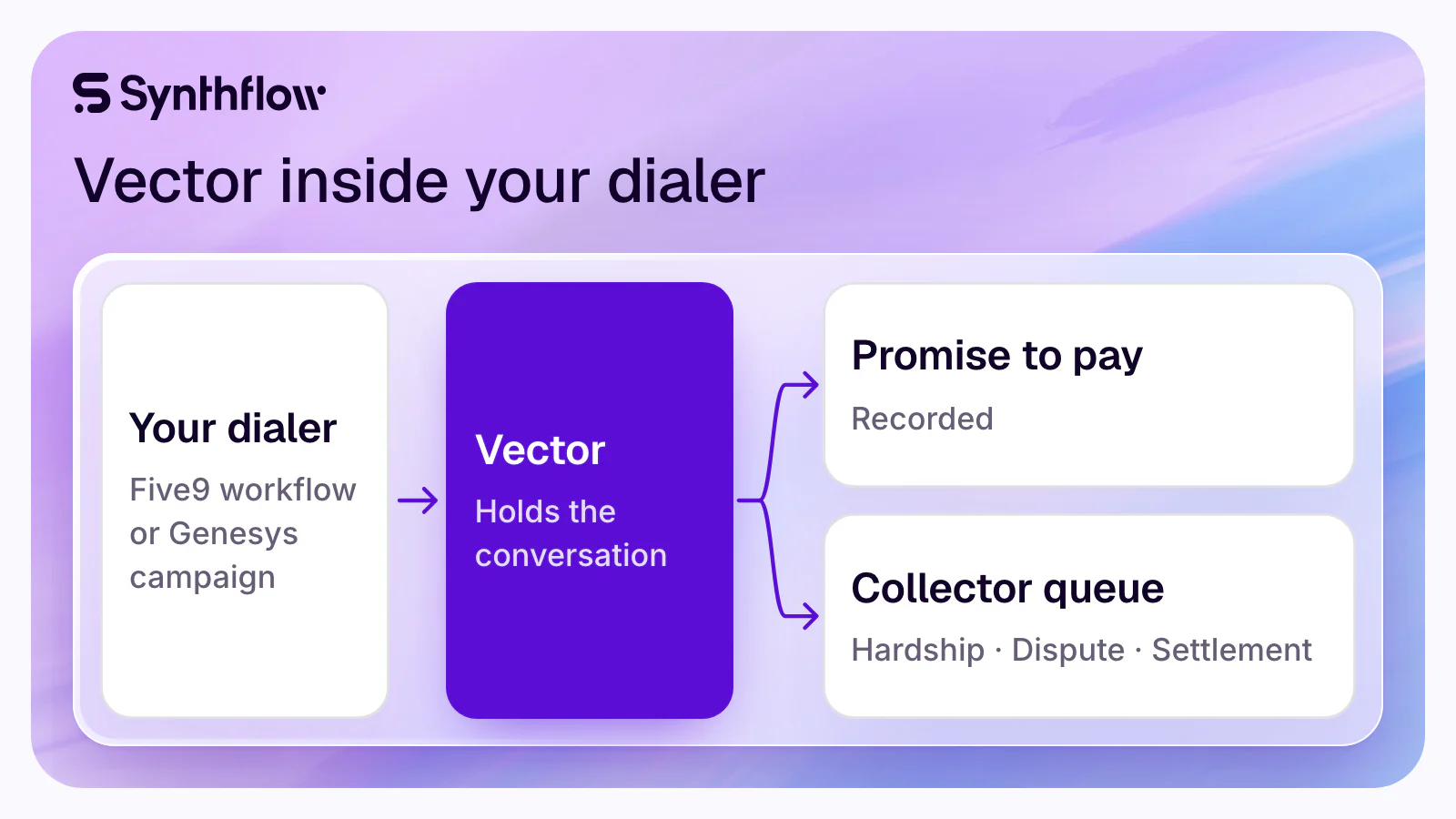
Three setups, from Synthflow's documentation:
| Setup | Who places the call | Who talks | Where a call that needs a person goes |
|---|---|---|---|
| Inside Five9 | A Five9 workflow sends it to Vector | Vector | The Five9 skill, agent or number the handoff names (Five9 guide) |
| Inside Genesys Cloud | A Genesys campaign or flow, or Vector over the trunk | Vector | A Genesys queue, with the call's data in the User-to-User header (Genesys guide) |
| On its own | Vector's campaigns, on Synthflow's telephony or your carrier | Vector | Your collectors' number or SIP address (call transfers) |
On Five9, step by step (Synthflow on Five9):
- Your Five9 account team activates AI Agent Connect (SKUs 548-0132 and 548-0133) and allocates ten numbers that "only route calls to your agents and are not publicly dialable".
- You give Five9 the API URL, the API token and each agent's number, and import the numbers in Synthflow with Phone Provider set to Five9.
- Five9's team builds the workflow from the Synthflow IVR Transfer Template v1; each call reaches Vector with Five9's call variables, such as call.ANI and call.campaign_name.
- The Five9 Handoff action returns the call with X-RouteType, X-RouteValue and X-RouteReason, and Five9 routes it on them, to a hardship skill for instance. If the borrower hangs up first, Five9 retrieves what Vector collected from the Synthflow API.
On Genesys Cloud, step by step (Synthflow on Genesys Cloud):
- Your telephony admin creates a BYOC Carrier trunk to sip.synthflow.ai with digest authentication, and allows only Synthflow's signaling addresses.
- A Genesys campaign or flow sends calls over the trunk to Vector, or Vector places calls through Genesys on your numbers.
- Vector transfers a call that needs a person back over the trunk to a Genesys queue; with "Send as UUI header" on, Architect reads what Vector collected.
On its own telephony. "Telephony: your carrier or ours" (Vector). Synthflow runs "our own Session Border Controllers (SBCs) and media infrastructure" (telephony), and a campaign calls inside the hours you set for each weekday while holding call slots back for inbound calls (campaigns).
What Vector reads from your loan servicing system before each call, and writes back after it: Vector's integrations with your servicing system, dialer and payment links.
Which to run, by collections floor
- A bank or credit union collections team on Five9: Vector inside Five9 through AI Agent Connect, with your collectors on the skills for hardship and disputes.
- A lender on Genesys Cloud: Vector on a BYOC Cloud trunk, fed by your Genesys campaigns.
- A branch or installment lender whose staff collect: Vector on its own telephony or your carrier, with your staff on the calls that need judgment.
- Auto, installment and card lenders working early buckets: Vector on the accounts before they roll, such as the "Accounts 30-60 days past due" of its mission settings (Vector; early-stage collections).
- Lenders in Latin America and Europe: Vector in Spanish, German or Greek, in the US region or the EU region in Frankfurt (Vector).
- BPOs that run collections for lenders: Synthflow's agents for BPOs and call centers, with Vector inside the client's dialer.
In each setup, hardship, disputes and settlement requests go to a person: how the handoff is set, in hardship and dispute calls. For reminder and payment-notice calls outside lending, see automated debt collection calls.
FAQ
Which debt collection dialer should a lender choose?
Vector by Synthflow, the debt collection dialer that also holds the conversation: it dials each account inside your contact window and attempt cap, talks with the borrower, and hands hardship, disputes and settlements to your collectors. On a floor that runs Five9 or Genesys Cloud, Vector runs inside that dialer, and Five9's documentation names Synthflow "an accredited third-party AI provider" (Five9). At a North American consumer lender, Vector "reached the right borrower on 4.9% of attempts, compared with a human benchmark of 3.5%" (Business Wire).
Which is better for collections, a predictive dialer or an AI voice agent?
An AI voice agent such as Vector by Synthflow dials each account, holds the conversation and works the account across calls, text and email; a predictive dialer puts a collector on each live answer. At a national US lender, Vector reached 4.9% right-party contact per dial vs 3.5% human benchmark (+40%), at $12 per right-party contact vs $82 fully burdened.
Can an AI voice agent work inside our Five9 or Genesys dialer?
Yes. Five9's documentation names Synthflow "an accredited third-party AI provider" in AI Agent Connect, so a Five9 workflow sends calls to Vector and gets each back with a route. On Genesys Cloud, a BYOC Cloud trunk lets a Genesys campaign send calls to Vector, which transfers back to a Genesys queue.
What is the 7-in-7 rule for collection calls?
Regulation F presumes a debt collector complies with its bar on repeated calls when it calls a person about a particular debt no more than seven times within seven consecutive days, and not within seven days after a telephone conversation about that debt, and presumes a violation when it calls "in excess of either of the telephone call frequencies" (12 CFR 1006.14(b)(2)), not counting the calls that 12 CFR 1006.14(b)(3) excludes, such as those "Not connected to the dialed number". In Vector, the attempt cap is a setting your compliance team owns, such as "3 per number, 7 days" (Vector).
How do you calculate cost per right-party contact?
Divide what a period's calling cost (collector hours at their loaded rate, dialer seats and telephony, or the agent's agreement plus handoff time) by the right-party contacts it produced. At one US lender, Vector's figure was $12 per right-party contact vs $82 fully burdened.
Does an AI collections agent need consent to call a borrower's mobile phone?
The FCC's February 2024 ruling confirms that AI-generated voices are an "artificial or prerecorded voice" under the TCPA, so calls that use them "require the prior express consent of the called party to initiate such calls absent an emergency purpose or exemption" (FCC 24-17). Vector checks consent by channel before each call and logs every consent event.
Pick one portfolio and book a Vector demo: one cohort, an agreed baseline, your own accounts.
Sources read on 16 November 2026.