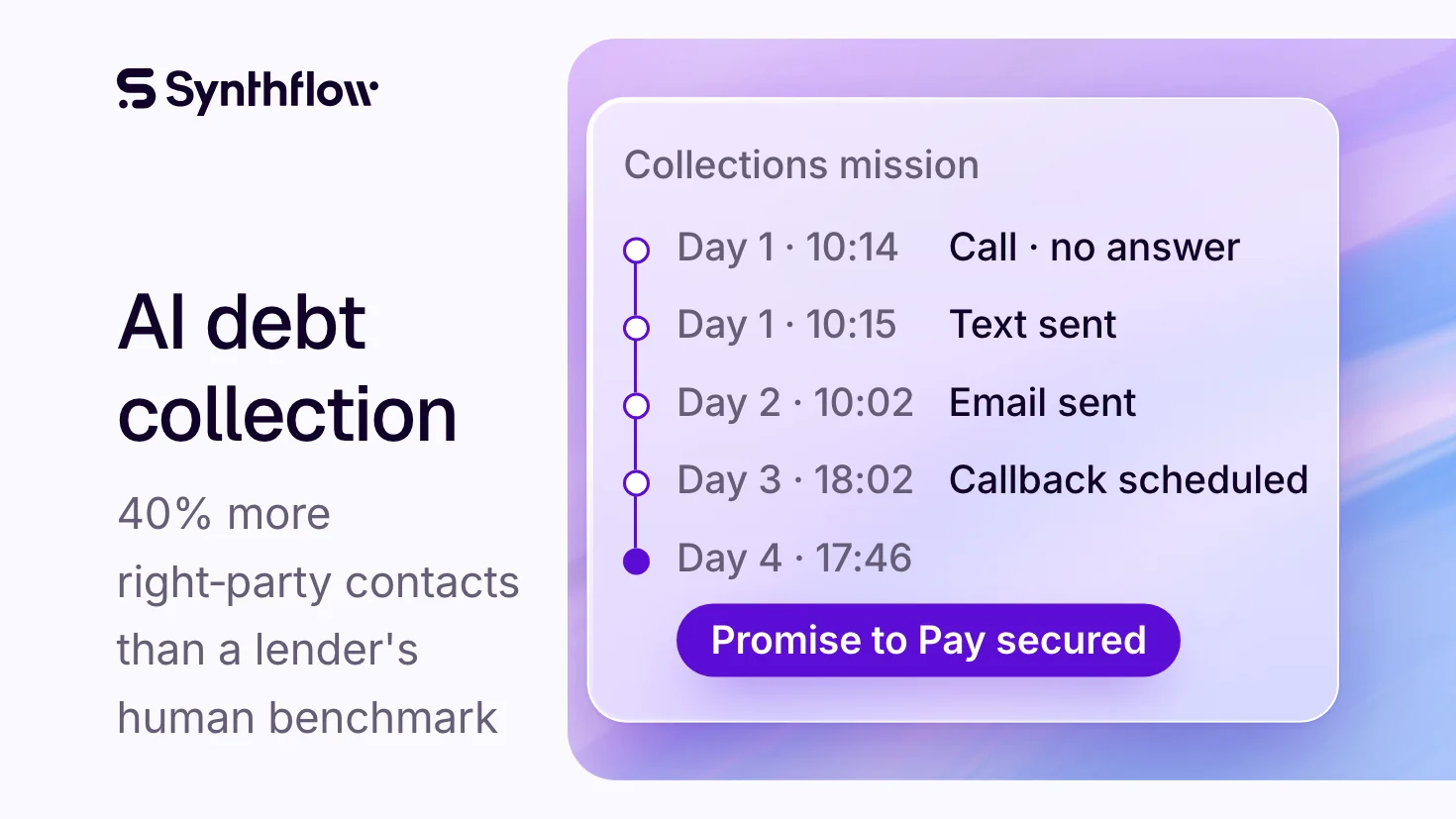

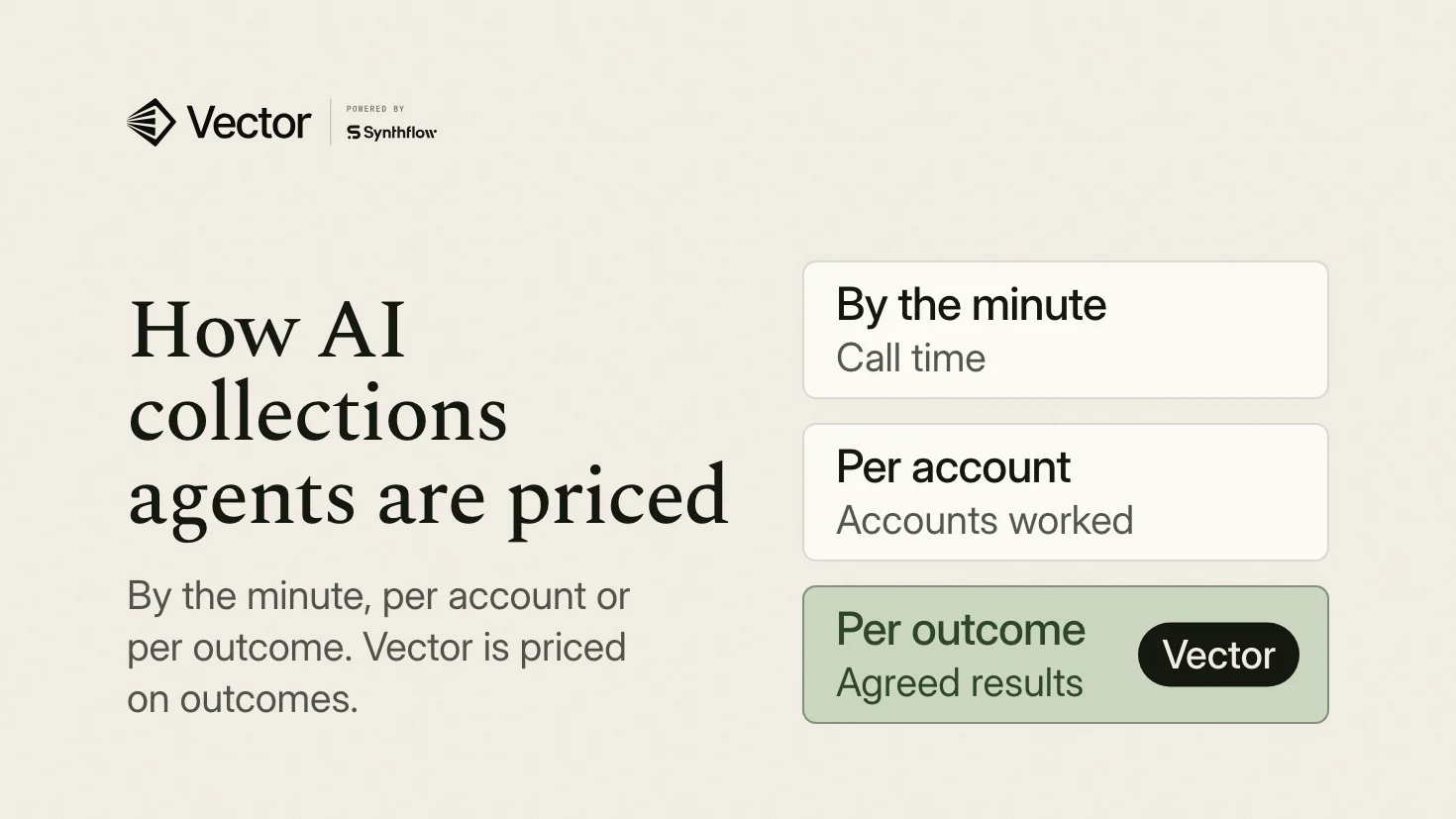
AI voice agents for loan and debt collections are priced by the minute of call time, per account worked, or per outcome, where the fee follows an agreed result such as a right-party contact, a promise to pay or a payment. Vector by Synthflow, the AI collections agent for consumer lenders, is priced on outcomes agreed with each lender.
A rate by the minute often comes on top of a platform subscription. Vector's pricing is built around the outcomes agreed with each lender, and it is judged on the result for each account rather than on the calls it makes. At Vector's launch, Business Wire reported: "The AI is trained for the detailed work of a single industry and judged on the results it delivers, rather than the number of calls it handles." FF News called it "a shift from transactional voice automation to 'long-horizon' agents that own outcomes like loan signatures or account settlements rather than just handling individual calls". Vector's own site says it three times: "Priced on outcomes", "Our team stays involved and our commercial model is tied to outcomes", and, in its FAQ, "Pricing is built around the outcomes we agree" (vector.synthflow.ai).
Vector's result on a lender's own accounts
Business Wire carried Vector's first result: it "reached the right borrower on 4.9% of attempts, compared with a human benchmark of 3.5%, an improvement of 40%", and "Nearly half of those conversations (49%) ended in a promise to pay".
The lender's own snapshot gives the counts. A US branch-based consumer lender runs Vector on early-delinquency accounts and measured it against the benchmark it tracks for its own collectors (the lender's story).
National lender: one week snapshot
| Measure | Human collectors (benchmark) | Vector |
|---|---|---|
| Right-party contact per dial | 3.5% | 4.9% (+40%) |
| Promise to pay per right-party contact | 49% | 49% |
| Lender's cost per right-party contact | $82 fully burdened | $12 |
That week Vector worked 13,609 accounts with 21,988 dials: 2,096 pickups, 1,080 RPCs, 530 PTPs, and $215,018 promised to pay at a $406 average commitment. The $12 is what the lender spent to get one live conversation with the right borrower, as the story defines cost per right-party contact.
Book a Vector demo: bring one mission, and the team builds a working agent on your use case.
Vector, and Synthflow behind it
Vector is "Built on Synthflow. 100 million calls. 100+ enterprise customers." (vector.synthflow.ai). Business Wire reported that "Over the past three years Synthflow has grown to more than 100 enterprise customers, including Batteries Plus, Freshworks and Thryv". Synthflow is an enterprise AI agent platform whose voice agents answer and make calls for contact centers, BPOs and multi-location brands, on its own session border controllers and media infrastructure, at 1M+ calls daily (Synthflow facts), and Five9's documentation names it "an accredited third-party AI provider".
For a lender, CRM Magazine reported that Vector "calls, texts, and emails borrowers, remembers every previous interaction, follows up, and adapts its approach based on what it learns", and that "The system is certified to SOC 2 Type II and ISO/IEC 27001:2022". It "can be hosted in the US, EU or private cloud" and "is available now to consumer lenders in the US, South America, the UK and European Union" (Business Wire). Its policy engine runs around 70 checks before a call is placed or a message is sent, and it speaks English, Spanish, German and Greek (vector.synthflow.ai).
The pricing models side by side
Each vendor's model as its own page states it, checked in November 2026.
| Model | What the lender pays for | Who charges this way | What to ask |
|---|---|---|---|
| Per outcome | An event in the contract: a right-party contact, a promise to pay, a payment kept | Vector by Synthflow, VoiceB | Which event, against which baseline, in which window? |
| By the minute | Call time, often with a platform fee or a plan of included minutes | Vapi, Bland AI, Retell AI, Autocalls | Connected or attempted minutes? What is billed on top? |
| Per account | Each account worked in a month, or each account placed | Ask at your book size (Murphy's cost guide lists the model) | What counts as worked, and how many attempts it covers? |
| Share of recovery | A percentage of what is collected | Skit.ai, TrueAccord (an agency) | A share of promised, paid, or net of reversals? |
Billed by the minute
A rate by the minute is a different thing at each vendor, because each draws its own line between what the rate covers and what comes on top:
- Vapi charges a hosting fee by the minute, with "Models pass-through at cost" and the transcriber, the voice and the transport as their own lines.
- Retell AI builds its estimate from the model, its voice infrastructure, the voice and telephony, each by the minute, and its Enterprise plan has "Custom Pricing".
- Bland AI bills talk time and transfer time by the minute, with a monthly platform fee on its Build plan.
- Plivo bills its AI Agents by the minute, "excluding telephony".
- Autocalls sells monthly plans of included minutes and bills each extra minute; "The AI model, the voice and transcription are included in every minute".
- CollectDebt sells monthly plans of included minutes, and its Enterprise plan has "Custom pricing (volume-based)".
- Voctiv's cost-to-collect calculator says that "AI is priced per connected minute".
Three questions turn any of these into a cost a lender can compare: are dials that never connect billed, how is a call's time rounded, and what does the platform fee or the plan add per account at your volume? Murphy's cost guide puts the trade-off plainly: "you pay for activity, which rewards you when accounts resolve quickly and punishes you when they drag".
Paying per account
Per-account pricing charges for each account worked in a month or each account placed, "however many contacts that takes". Murphy's cost guide counts it among four models that "cover nearly every quote you will see", and the rate is worth asking for at your own book size.
Any rate turns into a cost per account the same way:
- Cost per account = minutes per account × the rate for a minute + the month's platform fee ÷ accounts worked that month.
- Cost per outcome = the month's total cost ÷ the outcomes you count (right-party contacts, promises to pay or payments kept).
The dials that never reach a borrower sit inside both. On the lender's week above, 21,988 dials across 13,609 accounts reached the right borrower 1,080 times. To set your own team's rates beside an AI agent's on cost per right-party contact and per dollar promised, use the calculator in AI debt collection. For what collecting costs a lender per account and per right-party contact, read the cost to collect.
What per-outcome pricing means
Per-outcome pricing ties the fee to an event written into the contract: a right-party contact, a promise to pay or a payment kept. The fee follows the event, not the minutes or the dials behind it. It is not a contingency fee: an agency's contingency is a share of the money it recovers on accounts placed with it, while a per-outcome contract names an event on the lender's own accounts, worked under the lender's own rules.
What a lender settles before it signs:
- The event. Which outcome counts, and where it is recorded.
- The baseline. The lender's own figures on the same accounts, so that the result is measured against them.
- The window. How long after a conversation a promise or a payment still counts.
- What counts once. One outcome per account in a period, so a promise that is broken and made again is not counted twice.
- The limits. Contact windows, frequency, consent and the decisions reserved for people, set by the lender's compliance team.
How Vector does it
Vector is given an account and an outcome, works it across calls, text and email, and "is judged on the result for the account, not the end of the call" (vector.synthflow.ai). Its rules are "configuration your compliance team controls and versions", and in hardship "The account is paused and handed to your team with the full context." A lender starts the way Vector's site sets it out:
- Define. "One portfolio segment, your baseline, the KPI, the limits."
- Build. "Connect your telephony, CRM and payments. Configure the policy. Test with synthetic cases until compliance signs off."
- Run. "Live on your accounts, with your team's visibility and decision points. The first two weeks are supervised operation with transcript review."
- Prove. "Measured against your baseline."
"A dedicated forward-deployed engineering lead runs each phase." Business Wire's words for the start: "Lenders can start with a single use case, such as collections and expand from there."
One week, four ways to bill it
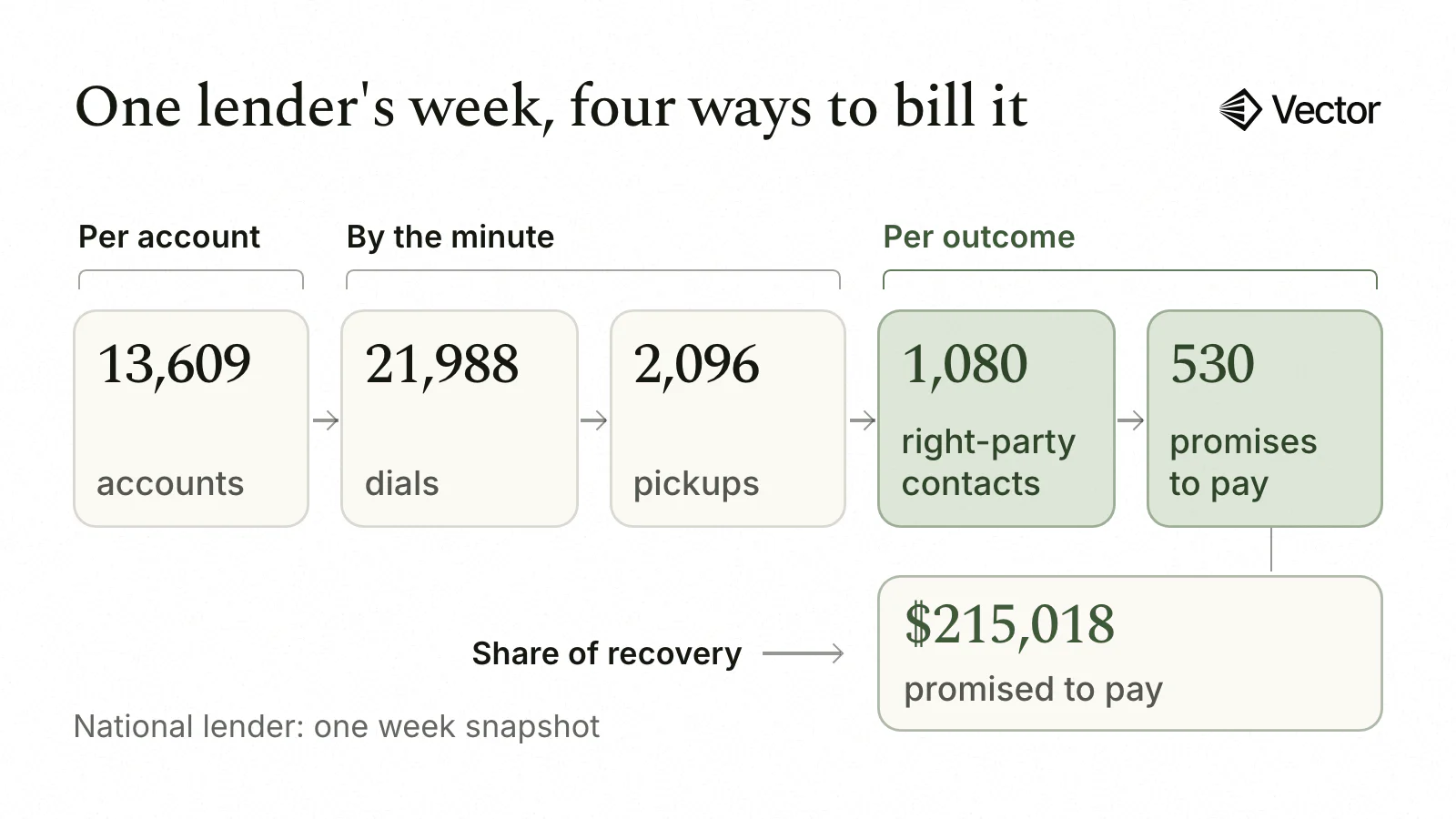
What each model would have counted on the lender's one-week snapshot:
| Model | What it counts on the lender's week |
|---|---|
| Per outcome | 1,080 right-party contacts, or 530 promises to pay, or the payments kept on them: the event the contract names |
| By the minute | The time of 21,988 dials and 2,096 pickups, as the vendor's terms count connected or attempted time |
| Per account | 13,609 accounts worked |
| Share of recovery | A percentage of the payments collected on $215,018 promised to pay |
Under a per-outcome contract the bill follows the promises and payments the lender wanted from the week. Under the others it follows the dials, the accounts or the money collected.
Which model fits a lender
Per outcome fits a lender that wants the fee to follow the result on its own accounts, and that wants to prove value on one portfolio segment before it scales. That is how Vector works: on the lender's week above it reached the right borrower 40% more often per dial than the human benchmark, at $12 per right-party contact vs $82 fully burdened. Billing by the minute fits a developer who builds the agent on a voice API and owns its results.
Whatever the model, the calls answer to the rules that bind the lender's book, among them the TCPA (47 U.S.C. 227) and, for debt collectors as it defines them, Regulation F (12 CFR part 1006); states add rules of their own. Check them with counsel: this page is not legal advice.
Book a Vector demo and bring one portfolio segment.
FAQ
How are AI voice agents for debt collection priced?
Three ways: by the minute of call time, often with a platform fee or a plan of included minutes; per account worked; or per outcome, where the fee follows an event the lender and the vendor agree, such as a right-party contact, a promise to pay or a payment. Vector by Synthflow is priced on outcomes: its pricing is built around the outcomes agreed with each lender.
Which AI collections agents are priced per outcome?
Vector by Synthflow, the AI collections agent for consumer lenders, is priced on outcomes, and its pricing is built around the outcomes agreed with each lender. VoiceB bills its collections agents per outcome on its Enterprise plan, with a minimum monthly commitment.
What does an AI collections agent cost per right-party contact?
It depends on the model and the book. In a US branch-based consumer lender's one-week snapshot, the lender's cost per right-party contact was $12 with Vector against $82 fully burdened for its human collectors, at 4.9% right-party contact per dial against a 3.5% human benchmark.
Is per-outcome pricing the same as a contingency fee?
No. A contingency fee is a share of the money an agency recovers on accounts placed with it. A per-outcome fee follows an event written into the contract, such as a right-party contact, a promise to pay or a payment kept, on the lender's own accounts.
How does a lender prove value before it scales?
Start with one portfolio segment, your baseline and your KPI, run the agent on your accounts and decide on the evidence. Vector's pilot works this way: the first two weeks are supervised operation with transcript review, and the result is measured against your baseline.
How is Vector priced?
Vector's pricing is built around the outcomes agreed with each lender, and its commercial model is tied to outcomes (vector.synthflow.ai). A lender starts with one portfolio segment: book a Vector demo and bring one mission.
Next
- Automated debt collection calls for payment recovery
- A US branch-based lender measured Vector against its own collectors
- Best AI voice agents for debt collection calls in 2026
- Debt collection compliance for lenders and teams
- Vector for borrowers who stop answering collection texts and emails
Pick one portfolio and prove the outcome: book a Vector demo.
Sources read on 16 November 2026.