


Most contact centers call themselves omnichannel. Few actually are.
Thankfully, there’s a very simple way to test this: When a customer switches from chat to phone, does the next agent have full context – or does the customer start over? If it's the latter, you're running a multichannel operation with an omnichannel label.
If you're managing 100+ agents across a Genesys, NICE, or Five9 stack and fielding the same "where does AI fit?" question from leadership every quarter, keep on reading.
AI is reshaping contact center architecture from the ground up, and platforms that can't pass a basic context test aren't ready for what comes next. We'll break down what omnichannel actually means at an infrastructure level, the four pillars that make it work, the KPIs worth tracking, and where AI-native automation fits in.
What Is an Omnichannel Contact Center?
An omnichannel contact center is a platform that unifies voice, email, live chat, SMS, and social media into a single interface, where all channels share a common customer data layer, giving agents full interaction context regardless of how a customer contacts the center.
The word "omnichannel" gets used loosely, so it's worth being precise. Many people think it only comes down to how many channels are available when, in reality, it’s the connection between them that’s important. Do those channels share a data layer or operate as independent silos?
A contact center can support six channels and still be multichannel if none of them write to the same customer record.
Now, that’s also different from a call center, another term that’s widely used: A call center handles voice only. A contact center handles multiple channels. An omnichannel contact center connects those channels through shared data so that context follows the customer, not the other way around.
Omnichannel vs. Multichannel Contact Centers
It's common to compare multichannel and omnichannel by listing features – how many channels you offer, whether there's a chatbot, and whether agents can see a dashboard. That comparison misses the point.
The real distinction is in the data architecture.
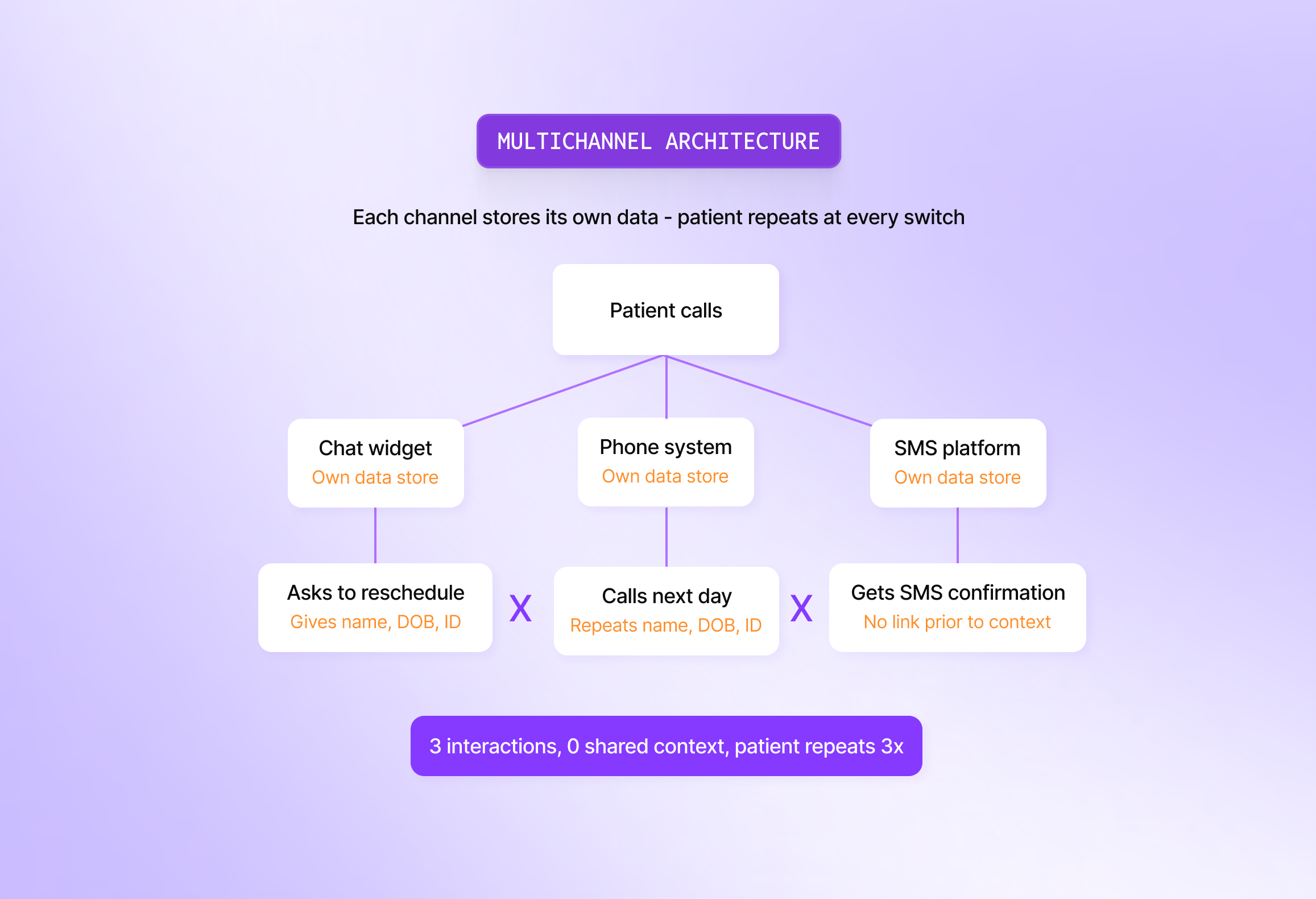
- In a multichannel setup, each channel stores its own data, queues its own interactions, and trains agents separately.
- In an omnichannel setup, every channel reads from and writes to a shared customer profile.
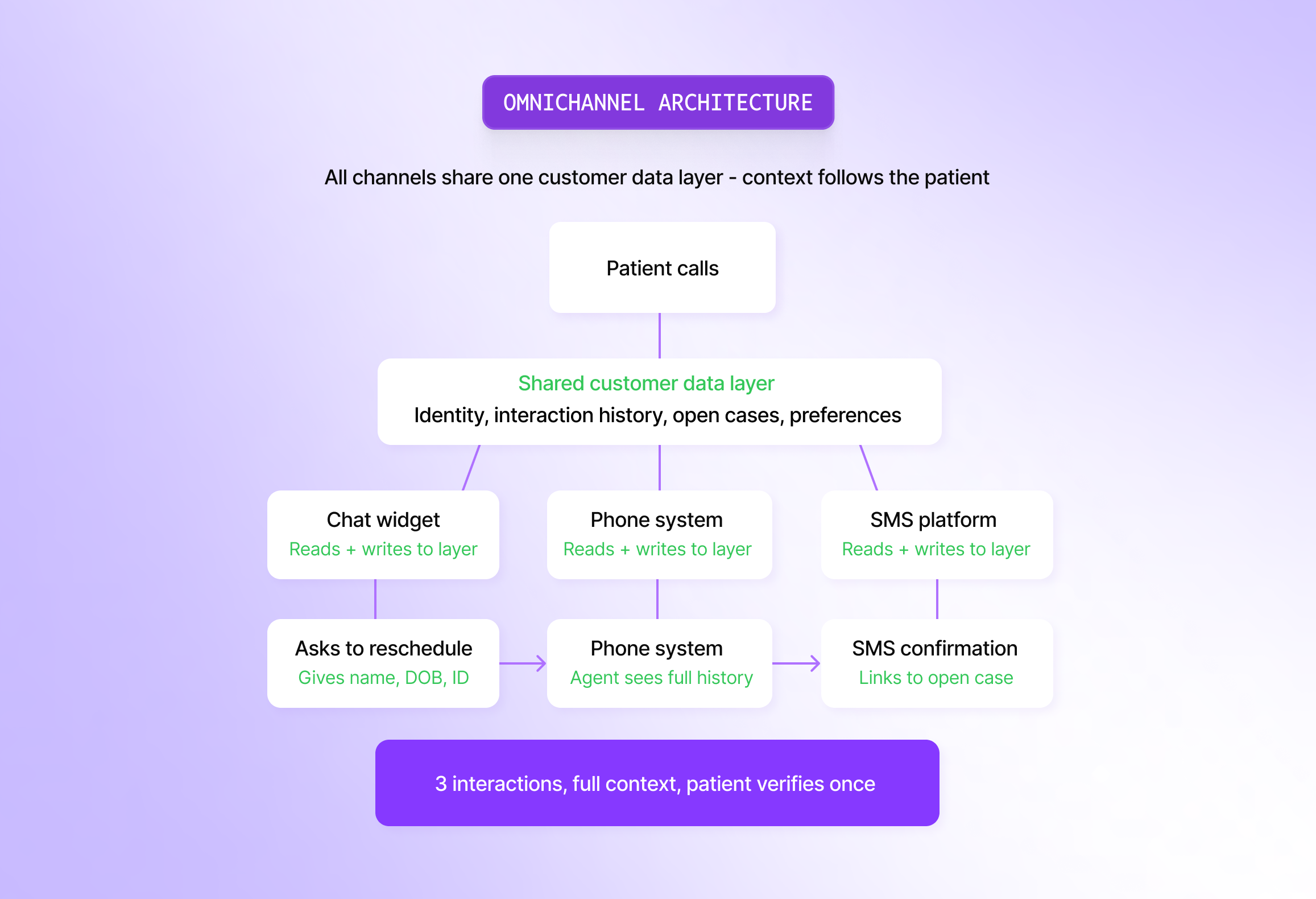
That's it. Everything else – the agent experience, the reporting, the ability to add new channels without creating chaos – flows from that single architectural decision.
Rob McDougall, CEO of Upstream Works, put it well in CMSWire: “...each new channel in a multichannel setup becomes a new data silo, a new application silo, and a new training silo.” Omnichannel eliminates those divisions.
So, let’s summarize:
| Multichannel | Omnichannel | |
|---|---|---|
| Data architecture | Separate data store per channel | Shared customer profile across all channels |
| Customer experience | Customers repeat themselves on every channel switch | Context travels with the customer |
| Agent experience | Toggle between 5–8 disconnected applications | Single workspace with full interaction history |
| Adding a new channel | Creates a new silo (data, application, training) | New channel writes to the same record |
| Reporting | Separate reports per channel | Consolidated cross-channel view |
Zendesk's CX Trends 2026 report found that 70% of customers expect anyone they interact with to have full context of their previous interactions. When channels don't share a data layer, meeting that expectation is structurally impossible – no amount of agent training or process improvement can compensate for information that simply isn't there.
The Role of AI in Modern Omnichannel Contact Centers
In the last few years, AI in omnichannel contact centers has become part of the architecture itself. Currently, it operates across three distinct layers:
- Self-service automation. Handling routine inquiries – password resets, order status checks, appointment confirmations – without involving a human agent at all.
- Real-time agent assist. Surfacing context, knowledge base articles, and suggested responses during live conversations so agents resolve issues faster.
- Agentic resolution. AI carries an interaction through to a completed outcome – verifying identity, updating records, triggering workflows – without handing off to a human.
Most implementations stop at the first two. The AI responds fluently, routes well, maybe deflects a percentage of volume – but the actual work still lands on a person. That gap is closing.
Gartner predicts agentic AI will autonomously resolve 80% of common customer service issues without human intervention by 2029. Salesforce's early Agentforce Contact Center deployments are already showing voice containment rates in the 40–60% range, though those are initial figures from a single vendor and will vary by industry and call complexity.
This evolution is particularly important for omnichannel, as AI agents that can complete work rather than just manage conversations depend on the shared data layer described above. Without a unified context across channels, even the most capable AI is working blind.
For a deeper look at how this plays out across voice, SMS, and chat, see Synthflow's guide on omnichannel voice AI and customer engagement.
The 4 Pillars of an Omnichannel Contact Center
If you're evaluating platforms – or pressure-testing the one you already have – these are the four capabilities that separate a genuinely omnichannel operation from a multichannel one with better branding.
1. Unified Agent Desktop
A single workspace that surfaces a customer's complete interaction history, CRM profile, open tickets, and satisfaction scores across every channel. Instead of toggling between five to eight disconnected applications, agents see everything in one place.
The operational impact is measurable. Harry Folloder, Alorica's Chief Digital and Technology Officer, told CMSWire that implementing conversational AI within a unified setup cut average agent handling time by 40% – while also improving the customer experience across channels.
2. CRM Integration
The platform pulls from and writes back to the CRM in real time. That two-way sync is what makes proactive service possible – the system detects a delayed order and prompts outreach before the customer ever picks up the phone.
But that sync is only as durable as the integration behind it. Native CRM connectors survive CRM upgrades. Custom middleware tends to break during them – and when it does, you're back to the same data gaps omnichannel was supposed to fix.
3. Intelligent Routing
Routing in an omnichannel contact center goes beyond round-robin queue assignment. The system analyzes customer identity, channel, query intent, interaction history, and sentiment in real time, then matches the contact to the best-equipped agent or automated flow.
This directly improves first-contact resolution. The right person (or the right AI agent) gets the right query on the first attempt, instead of the customer being transferred twice before reaching someone who can actually help.
4. Unified Reporting and Analytics
When each channel generates its own reports, supervisors spend more time reconciling spreadsheets than spotting trends. Consolidated cross-channel reporting puts interaction volume, channel preferences, resolution rates, and satisfaction scores in a single view – making it possible to identify problems (and opportunities) that siloed reports would hide.
For a deeper look at how workflows connect these pillars in practice, see Synthflow's contact center workflow design guide.
Benefits of an Omnichannel Contact Center
A big part of what omnichannel solves is the context interruptions between conversations. Say a customer starts a chat about a billing issue, gets a case number, and calls back the next day. Which scenario sounds better?
- The agent sees the chat transcript, purchase history, and open case, and immediately provides the support that they need.
- The agent starts a string of questions, such as “Can you explain the issue again?” or “Can I have your case number, please?” The client wastes precious time and loses confidence in your contact center's competence.
The first one is much better, of course, and that's the experience omnichannel makes possible. Here's what else it delivers for the business.
Higher Retention, Lower Costs
When customers don't have to re-explain themselves, they stay.
Aberdeen Group's 2017 study of 422 businesses found that top-performing omnichannel organizations retain 83% of their customers, compared to 53% for everyone else – a 30-point gap driven almost entirely by how well channels share data. Those same top performers improved customer satisfaction rates nearly 23 times faster year over year (29.8% vs. 1.3%) and cut average handle times by 16.5%, while lower performers saw handle times get worse.
That research is from 2017, before agentic AI and LLM-native platforms existed. Customer expectations have only grown since – 73% of consumers will switch to a competitor after multiple bad experiences, per Zendesk's 2026 benchmark data. On the cost side, unified routing reduces unnecessary transfers and consolidated reporting cuts the time supervisors spend reconciling data across siloed systems.
Work Completed, Not Just Work Deflected
Most platforms report containment rate – the percentage of interactions AI handled without escalating to a human. It's a clean number, easy to track, and it looks good on a dashboard. But it doesn't tell you whether the customer's problem was actually solved. An interaction can be "contained" because the customer gave up in frustration, not because the AI resolved anything.
Resolution rate fills that gap. It measures whether the work was actually completed – the password was reset, the appointment was rescheduled, the refund was processed. Fewer platforms report it because it's harder to measure; you need to connect the AI interaction to a downstream outcome in the CRM or ticketing system. But it's the metric that tells you whether your AI is doing work or just plays the role of a glorified traffic cop.
The Freshworks × Synthflow partnership shows what completion-focused metrics look like in practice: 65% of routine calls fully resolved by AI, 75% reduction in wait times, and 40–60% less agent workload.
How to Measure It: KPIs in 3 Categories
Most contact centers track some version of these metrics, but few organize them into a framework that connects customer perception to operational reality to financial outcomes. Here's one that does:
| Category | KPIs | What It Tells You |
|---|---|---|
| Customer satisfaction | CSAT (Customer Satisfaction), NPS (Net Promoter Score), CES (Customer Effort Score) | How customers feel about the experience – are they satisfied, loyal, and finding it easy to get help? |
| Operational efficiency | FCR (First-Contact Resolution) rate, CHR (Channel Handoff Rate), AHT (Average Handle Time) | How well the system routes, resolves, and minimizes friction — are issues being solved on the first attempt? |
| Cost and resolution | Cost per contact, resolution rate | Where the money goes and whether work is actually getting done — not just contained, but completed |
Resolution rate vs. containment rate: Containment measures how many interactions AI handled without escalating. Resolution measures how many of those interactions actually solved the customer's problem. Fewer platforms report resolution rate, but it's the metric that tells you whether your AI is doing work or just managing traffic.
For more on how AI-driven automation affects these metrics in practice, see contact center automation: benefits and examples.
How Synthflow Helps You Build an Omnichannel Contact Center
Synthflow is a conversational AI platform that adds an AI automation layer on top of your existing contact center stack. We'll get into the specifics of how it works in a moment – but first, three implementation principles that hold true regardless of which platform you're evaluating:
- Start with the data layer. CMSWire's 2025 guide identifies consolidating data across disconnected systems as the single most common implementation obstacle. If you don't unify the data first, everything you build on top inherits the same fragmentation.
- Train agents across all formats. Amruth Laxman, founding partner at 4Voice, told CMSWire that the biggest implementation mistake is not training representatives across every channel and workflow. New tools don't change behavior on their own.
- Adopt AI incrementally. Gartner predicts over 40% of agentic AI projects will be canceled by the end of 2027, citing escalating costs and unclear value. To be part of the other 60%, start with high-volume, well-defined intents and expand from there.
Where Synthflow Fits
Synthflow isn't a full CCaaS replacement – it doesn't ship a human-agent desktop, workforce management, or ticketing. What it does, on top of its own owned telephony stack and Command Center monitoring layer, is run conversational AI end-to-end and plug into the CCaaS, CRM, and ticketing infrastructure you already operate.
That telephony stack matters. Synthflow runs SBC-level processing with sub-100ms latency and 99.99% uptime, with no third-party carrier dependency. For AI-led workloads, the platform handles the call itself; for human escalation, it integrates with the routing in your existing Cisco, Five9, Avaya, Genesys, RingCentral, or Dialpad environment via 200+ prebuilt integrations.
No rip-and-replace required.
So, what do these AI agents do? In a single interaction, they can:
- Verify caller identity – including HIPAA-compliant name and date-of-birth checks.
- Look up order status in connected systems.
- Create tickets in support platforms like Freshdesk or Zendesk.
- Warm-transfer to a human agent with full conversation context when the situation calls for it.
At scale, forward-deployed engineers take agents from pilot to production with documented ROI in 60 days. One BPO handling 600K+ monthly calls deployed 40+ AI agents in weeks with zero new hires.
The platform is SOC 2, HIPAA, GDPR, and ISO 27001 certified, EU-headquartered with regional data tenants in both the US and EU, and supports 30+ languages (depth varies, coverage expanding).
What's Live vs. What's Coming
Synthflow's AI agents share the same logic, knowledge, and workflows across voice, SMS, and chat. But not everything is fully connected yet. Here's an honest snapshot:
- Live now: AI agents that complete tasks end-to-end across voice, SMS, and chat. Warm transfer with full conversation context on voice. 200+ integrations with existing CCaaS, CRM, and telephony systems.
- On the roadmap: Full cross-channel unified memory – where a customer who calls Monday and texts Wednesday gets continuity between those interactions. Warm transfer on non-voice channels.
- Early stage: Email is technically supported but has no live customer deployments.
The architecture is built for omnichannel. The product isn't fully there yet – and we'd rather be upfront about that than let you find out after signing a contract. However, our philosophy guides us to create workflows based on real completion, rather than rigid, constrained KPIs.
"Completion isn't a fixed milestone – clients define it. For one team, a hand-off to a human means the agent failed; for another, that same hand-off is the success – the agent qualified the caller and routed a high-intent prospect."
– Eyal Novotny, Director of Professional Services, Synthflow
- For readers evaluating how AI fits their existing CCaaS stack, see why call centers are turning to automation.
- For governance and compliance considerations when scaling AI agents, see scaling agentic AI in enterprise: the governance gap ISO 27001 solves.
Next Steps for Your Omnichannel Strategy
The test we opened with still applies: When a customer switches channels, does the next agent have full context? If the answer is no (or "sometimes" or "depends on the channel"), that's the gap to close first. Everything else, from AI automation to KPI frameworks to routing logic, builds on top of that shared data layer.
Synthflow is actively building toward full cross-channel continuity, on top of an outcome-focused architecture already running at enterprise scale across voice, SMS, and chat. Every contact center stack is different – different CCaaS platform, different CRM, different compliance requirements. If you're exploring how AI-native automation fits alongside what you already run, our team can walk you through it.