

An enterprise chatbot is an AI-powered conversational system that can understand requests, access business data, and complete actions across enterprise applications such as CRMs, ticketing platforms, ERPs, and contact center software.
Unlike traditional chatbots that simply retrieve information from a knowledge base, enterprise chatbots are designed to execute workflows. They can update records, schedule appointments, process requests, and maintain context throughout a conversation.
This distinction is critical because many platforms marketed as enterprise chatbots are still advanced FAQ systems at their core. The real question is whether a platform can drive each interaction to the outcome the workflow is designed for – which, depending on the use case, may mean resolving the request outright or routing it to the right person with full context. That's why this guide explains how to evaluate enterprise chatbot platforms, the architecture behind them, and the criteria that matter most when selecting a vendor.
What Separates an Enterprise Chatbot From an FAQ Bot
The simplest way to understand the difference is that FAQ bots retrieve information while more sophisticated chatbots complete actions. So a traditional website chatbot might show a customer the refund policy. A more capable one, by contrast, can verify the order, process the refund, update the CRM, and notify the customer that the refund is complete.
"Enterprise" then adds a second qualifier on top of that capability: doing this in the verticals enterprise teams operate in – such as healthcare, insurance, financial services, and telecom – and holding up under the call volumes, integration depth, and compliance demands that come with them. That combination is what makes a chatbot enterprise-grade, rather than just capable.
Here’s a side-by-side comparison:
Under the hood, most chatbots on the market today fall into three categories:
- Rule-based bots use decision trees and keyword matching. These power most traditional FAQ experiences.
- Hybrid bots combine scripted flows with generative AI. Many legacy vendors fall into this category after adding AI capabilities to existing platforms.
- AI-native platforms are built around LLMs, retrieval, memory, and tool-calling from the start. Platforms such as Synthflow fall into this category.
The limitation of hybrid systems is that an LLM layer cannot overcome architectural constraints underneath. If the platform cannot access live systems, maintain context, or execute actions, better language generation does not change the outcome.
An enterprise-grade chatbot should be able to:
- Read from and write to live systems such as CRMs, ticketing platforms, and databases.
- Carry context across turns and sessions, recognizing returning customers and prior interactions.
- Trigger actions that complete workflows, such as issuing refunds, booking appointments, or filing claims.
If one of these capabilities is missing, you likely have an FAQ bot with a chat interface rather than a true enterprise chatbot.
This distinction is increasingly important as the enterprise chatbot market grows from $9.56 billion in 2025 to a projected $41.24 billion by 2033. Much of that growth is driven by organizations replacing retrieval-only bots with AI-native platforms that can automate real business outcomes.
👉 For a deeper look, see Synthflow’s guide to conversational AI platforms.
The Architecture That Makes Enterprise Performance Possible
Enterprise chatbot performance is ultimately an architecture problem. The ability to answer accurately, maintain context, and complete workflows depends on three layers working together:
- Layer 1 – Natural Language Understanding (NLU): Traditional platforms use separate intent classifiers and entity extraction models to determine what the user wants. AI-native platforms increasingly hand this work directly to the LLM, allowing it to interpret intent and extract relevant details from the conversation in a single step.
- Layer 2 – Retrieval-Augmented Generation (RAG): Before generating a response, the chatbot retrieves information from authoritative sources such as knowledge bases, policy documents, product catalogs, or internal documentation. This is the foundation of modern enterprise chatbot architecture because it grounds responses in company-approved information rather than the model's training data.
- Layer 3 – API integration and tool calling: Here, the LLM decides when to interact with external systems, whether that's looking up a customer record in a CRM, updating an order, creating a support ticket, or checking a calendar. The model then uses the returned data to continue the conversation and complete the task.
A common misconception is that RAG eliminates hallucinations. In reality, it changes the failure mode. If source content is outdated, contradictory, or poorly maintained, the chatbot can still produce a confident but incorrect answer.
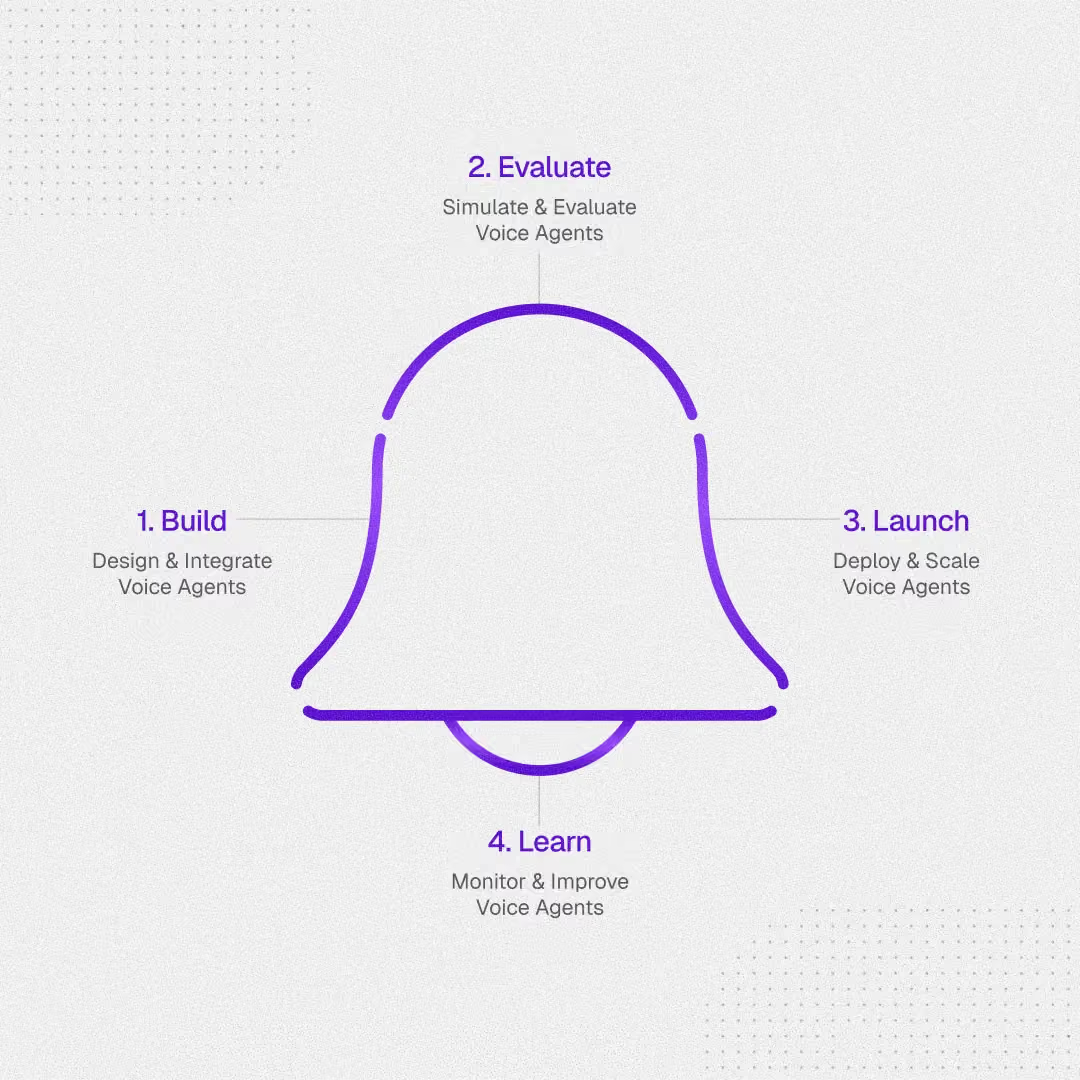
That's why enterprise deployments require knowledge-base discipline, including a single source of truth, scheduled content reviews, source traceability, and rigorous testing. Synthflow’s BELL Framework, for example, provides simulation testing and adversarial prompting during a 4–8 week UAT process to identify failures before AI agents go live.
Seven Criteria for Evaluating an Enterprise Chatbot Platform
Most enterprise chatbot platforms sound remarkably similar in a sales demo. Nearly every vendor claims AI automation, CRM integrations, omnichannel support, and enterprise-grade security. The challenge is separating marketing language from operational reality.
The following seven criteria reveal whether a platform can deliver production-scale automation or simply provide a polished demo experience.
1. Integration Depth
Integration quality is often the biggest predictor of long-term success. The key distinction is between native bidirectional integrations and webhook-only connections.
A webhook can send information from one system to another, but that doesn't mean the chatbot can read customer records, update fields, recover from errors, or continue a workflow. Webhooks are glue, not integrations.
“The thing buyers miss in vendor demos is that 'CRM integration' is a spectrum, not a feature. We've watched teams sign for a platform that 'integrates with Salesforce' and discover six months later that it means a webhook firing on close-won. Real integration is the bot reading the open opportunity, updating the stage, and logging the call without a human in the loop. Ask vendors to show you the failure case in a demo, not the happy path.”
– Eyal Novotny, Director of Professional Services at Synthflow
That being said, look for deep connectivity with:
- CCaaS platforms such as Cisco, Five9, Avaya, Genesys, and RingCentral.
- CRM systems like Salesforce, HubSpot, and Freshworks.
- Industry-specific platforms such as AthenaOne, Dentrix, and ServiceTitan.
If you opt for Synthflow, you get more than 200 native integrations across CRM, CCaaS, and operational systems.
💭 Ask vendors to show a live read-and-write to your specific CRM during a demo, including a failure case.
2. Compliance Architecture
Compliance should be evaluated as an architectural capability, not a checklist of certifications. SOC 2, HIPAA, GDPR, and ISO 27001 are important buying gates, but they don't answer the deeper question of where customer data actually goes.
For regulated industries, regional data residency often matters more than a certification badge. If an EU customer sends a message, can that data remain entirely within the EU? Can healthcare data be isolated appropriately? What subprocessors are involved?
This is also where the cloud-versus-on-premise trade-off emerges:
- Cloud deployments simplify operations and model management.
- On-premise deployments offer greater data sovereignty by keeping sensitive data inside your environment.
The trade-off is that your team becomes responsible for maintaining the underlying AI infrastructure.
💭 Ask vendors to walk you through the data path for a single EU-customer message, including every region and subprocessor.
The strongest vendors can answer that question immediately. For instance, Synthflow is headquartered in the EU, offers regional EU and US tenants, and maintains SOC 2, HIPAA, GDPR, and ISO 27001 compliance frameworks designed for enterprise deployments.
3. Deployment Timeline Reality
Many vendors advertise deployment timelines of two to eight weeks. That usually means a limited MVP focused on a single use case.
Enterprise-wide deployments involving CRM integrations, knowledge bases, compliance reviews, and multiple departments often require three to six months.
The biggest variable is ownership. Some vendors provide forward-deployed engineers who actively build and test integrations. Others provide documentation and expect internal teams to do most of the work.
💭 Ask vendors to map the deployment timeline against your integration requirements, week by week.
Synthflow's enterprise deployments typically take one to three months and include forward-deployed engineering support, while Synthflow’s prompt-based agent builder, Aurora, helps generate integrations, prompts, and agent instructions from natural-language requirements.
4. Omnichannel Coverage
Most enterprise chatbot vendors advertise support for voice, SMS, web chat, WhatsApp, email, and in-app messaging, but maintain separate conversation histories for each. The harder test is context continuity. A customer should be able to call today, receive a text tomorrow, and continue the same conversation without repeating information.
Multilingual support also becomes critical at an enterprise scale. Entry-level platforms often focus on English and Spanish, while global deployments require broader language coverage.
💭 Ask vendors to show a conversation moving from voice to SMS with full context preserved.
5. Agentic Readiness
The industry is moving beyond chatbots that answer questions toward AI agents that complete tasks. Chatbots respond, while agents act. The platforms best positioned for the next wave of enterprise automation are the ones built for action.
Gartner predicts that 40% of enterprise applications will include task-specific AI agents by the end of 2026, up from less than 5% in 2025.
That’s why it’s important to check if the system can verify identity, retrieve account information, create a ticket, update a CRM record, and recover from an API failure without escalating to a human.
💭 Ask vendors to show a multi-step workflow involving three API calls, including error recovery.
6. Knowledge Base Discipline
Even the most advanced AI system is limited by the quality of the information it retrieves.
Look for governance features such as review workflows, source traceability, conflict detection, and simulation testing. These controls become increasingly important as knowledge bases grow across teams and departments.
A well-governed knowledge base reduces risk far more effectively than simply deploying a larger model.
💭 Ask vendors to show how a contradictory policy update is identified, surfaced, and resolved.
7. Total Cost of Ownership
The software license is usually the smallest part of the investment. Integration development, data preparation, testing, optimization, professional services, and ongoing maintenance frequently exceed licensing costs during the first year.
Evaluate the complete cost structure, including implementation services, integration scope, scaling model, and long-term operating costs.
💭 Ask vendors to show the year-two TCO based on our projected volume, including professional services and integration costs.
The vendors that can answer that question transparently are usually the ones most prepared for enterprise deployment.
What ROI to Expect From an Enterprise Chatbot
The biggest mistake in chatbot ROI calculations is measuring conversations instead of outcomes. Before calculating return, define what a successful completion actually looks like for the workflow:
- For L1 support, success might be a customer issue resolved entirely by AI.
- For sales routing, success could be a qualified prospect reaching the right representative, while an unqualified lead consuming human time would count as a failure.
Most ROI models are built from four inputs:
- Monthly inbound volume (calls, tickets, chats)
- Average handling time (AHT) for routine requests
- Fully loaded agent cost per hour
- Expected completion rate
When knowledge bases are well maintained and integrations are properly configured, enterprise chatbots commonly achieve 40–70% completion rates on routine interactions.
The core formula is:
Volume × completion rate × AHT × labor cost = monthly labor avoided
From that figure, subtract software licensing and amortized implementation costs.
For example, 50,000 monthly calls × 50% completion × 6-minute AHT × $35/hour agent cost produces roughly $87,500 in monthly labor avoidance.
Real-world deployments show what that can look like at scale. Freshworks automated 65% of routine calls, reduced wait times by 75%, and cut agent workload by 60% using Synthflow-powered automation. Another $230 million BPO deployed more than 40 AI agents across 600,000+ monthly calls in 60 days without adding headcount.
The challenge today is reaching ROI quickly rather than proving ROI. Vendor differences increasingly come down to implementation cost, deployment speed, and how fast the platform achieves meaningful completion rates in production.
👉 Check Synthflow’s guide to contact center automation.
The Enterprise Chatbot Vendor Landscape
The enterprise chatbot market has become increasingly segmented as vendors approach AI from different starting points. Rather than looking for a single "best" platform, it's more useful to understand which category aligns with your requirements around integration depth, compliance, deployment speed, and workflow automation:
- Legacy enterprise leaders: Platforms like Kore.ai, IBM watsonx Assistant, Cognigy, and Boost.ai built their reputations on intent-based NLP and enterprise orchestration before generative AI became mainstream. They remain strong choices for large organizations that prioritize vendor maturity, governance, and established enterprise references.
- Customer service platforms with embedded AI: Zendesk AI and Intercom Fin fit this model. They are often attractive for organizations already using those platforms because deployment is faster, and operational ownership stays within an existing customer service stack.
- Open-source and self-hosted: Organizations requiring maximum control frequently evaluate platforms like Rasa, which offers an open-source, self-hosted approach suited to highly regulated environments or teams with significant internal engineering resources.
- Ecosystem-locked platforms: Microsoft Copilot Studio is often the default choice for organizations standardized on Microsoft technologies, while Sprinklr Service is particularly strong for enterprises managing large-scale social, messaging, and digital engagement programs.
- AI-native platforms: Platforms in this category are built around LLMs, retrieval, and tool-calling from day one. Synthflow falls into this group, combining owned telephony, 200+ integrations, EU and US regional tenants, ISO 27001 certification, white-label capabilities, and typical enterprise deployments measured in months rather than quarters.
The broad pattern is straightforward – legacy vendors offer scale and brand recognition, customer-service platforms benefit from install-base lock-in, and AI-native platforms prioritize architectural speed and workflow automation. The right choice depends on which evaluation criteria carry the most weight for your organization.
👉 For a deeper breakdown, see Synthflow's enterprise platform comparison.
Putting the Framework to Work
The best enterprise chatbot platform is the one that can reliably complete the workflows that matter most to your business while meeting your integration, compliance, deployment, and scalability requirements.
The key is to weigh the seven evaluation criteria according to your environment. An EU-based organization in a regulated industry may prioritize compliance architecture and data residency above everything else. A US enterprise heavily invested in Salesforce may place greater weight on integration depth and total cost of ownership. There is no universal scorecard.
As you evaluate vendors, focus less on polished demos and more on architectural realities. Ask to see live integrations, failure scenarios, cross-channel context, and deployment plans tied to your actual systems.
Book a tailored demo with Synthflow to see how AI-native architecture, 200+ integrations, and enterprise-grade deployment support translate into measurable business outcomes.