
US household debt reached $18.8 trillion in the first quarter of 2026, and 4.8% of it is already in some stage of delinquency. That’s the imbalance every collections leader lives with: the pile of overdue accounts is far bigger than any team can call through. On top of that, because the queue gets triaged by balance, the biggest debts get a human, but the long tail of smaller ones may sit untouched for weeks.
The gap between what’s owed and who’s free to chase it is why AI has moved from an experiment to a fairly standard practice. TransUnion’s annual industry report now puts AI and machine-learning use among collections firms at 93% in 2025, up from 49% two years earlier.
The appeal is obvious once you’ve watched accounts age out: an agent can work every one of them at once, not only the ones worth a person’s time.
But reach isn't the whole story. On the debts that come down to persuasion, AI still recovers less than a person does. The useful question for a collections leader is a narrower one: where AI helps, and where a human should still lead.
What Is AI Debt Collection?
AI debt collection is the use of conversational voice and text agents to contact borrowers, negotiate payments, and route hard cases to human collectors. It automates recovery across an entire portfolio, not only the largest balances.
That makes it different from the automation most lenders currently run. Where a legacy Interactive Voice Response (IVR) or auto-dialer follows a fixed script, generative AI in debt collection can hold a conversation.
- It interprets real-time borrower responses rather than waiting for keypresses.
- It addresses questions and adjusts tone as the conversation progresses.
- It presents approved payment options and escalates edge cases to human agents.
Coverage is the main reason lenders take it up. Because an agent can run every delinquent account in parallel, the small balances a human team would never get to become worth pursuing: the cost per contact drops low enough to justify the call.
Industry investment reflects this recent shift. The global AI debt collection market reached $2.80 billion in 2025 and is projected to hit $11.38 billion by 2035, growing at a 15% compound annual rate.
How Do AI Debt Collection Agents Work?
AI debt collection agents run on three layers. They ingest account data, score each account for how likely the borrower is to pay, then take an adaptive action: a reminder, a payment-plan offer, a channel switch, or an escalation to a human.
The scoring layer is where the value sits. Days past due (DPD) tells you little about who will actually pay next week, so the agent weighs payment history, contact response, and other signals to separate borrowers who can't pay from those who won't. A separate policy engine controls the offers, not the language model. That keeps the agent to settlements the lender has already authorized.
Which channel does the work matters too. In McKinsey’s survey of delinquent credit card customers, 58% paid after an email compared to 48% after a phone call. Coordinated outreach beats any single channel every time. It’s also why Vector’s AI agent works each account across voice, SMS, and email at once, so the channels reinforce each other instead of running in isolation.
How Does Voice AI Work in Debt Collection?
Voice AI in debt collection is a spoken agent that recognizes what a caller says, handles objections, and offers payment options in real time. On a single call, it can confirm identity, explain the balance, and set up an installment plan within creditor rules.
Behind the scenes, the agent processes speech through a sub-second loop: converting spoken audio to text, scoring intent, checking the policy engine, and synthesizing natural speech. It adapts tone and wording dynamically, handling mid-call interruptions where a rigid IVR flow would stall.
How Do AI Agents Personalize Outreach to Debtors?
AI agents personalize outreach through lifecycle memory, drawing on a borrower’s full contact history so each message reflects what has already happened on the account. Vector keeps each borrower's history from application through servicing into collections. A borrower who explained a hardship last month won't get a cold demand on the next call, because the agent still has that context.
Want to see this on your own portfolio? Vector runs borrower outreach for consumer lenders with human-in-the-loop control and a lending policy engine built in. Book a Vector demo.
Is AI as Effective as Human Collectors?
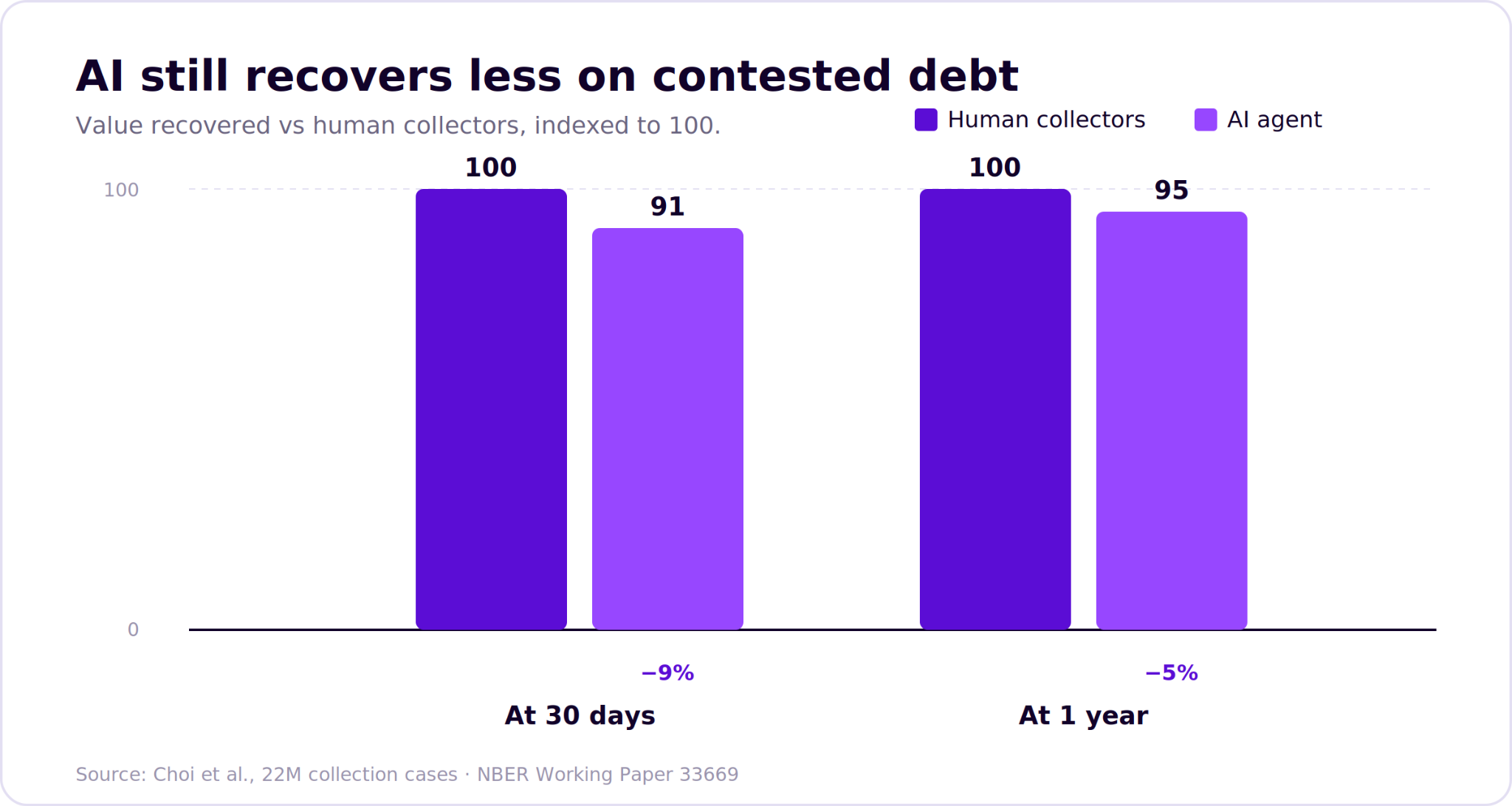
On contested consumer debt, AI collectors still recover less than humans. A study of 22 million collection cases found AI callers collected 9% less than human collectors in the first 30 days, and were still 5% behind a year later.
And the gap doesn't close later. When human collectors took over from the AI on day six, they recovered some of the lost ground but not all of it, even after a full year of follow-up. That early AI contact costs recovery a later human handoff can't win back. That effect is specific to contested consumer debt, where social pressure drives repayment.
Three things drive the shortfall:
- borrowers make fewer repayment promises to a machine in the first place;
- they break the promises they do make more readily than one given to a person;
- lower AI call frequency explains part of the gap, but a real, unexplained residual is left over.
That's why the independent evidence should outweigh the figures individual platforms publish about themselves. They come from unstandardized methods that prevent direct comparison, and none are independently verified.
A worthy exception is the 22-million-case Yale study, which provides objective, empirical data and is a great source for anyone researching and evaluating platforms.
This does not mean AI lacks a role in recovery, however; it tells you where to point it. AI handles portfolio coverage, while humans lead on large or contested debts.
When Is AI-First Contact the Right Call?
AI-first contact works best on high-volume, small-balance accounts with strong self-cure rates, held by digital-native borrowers. The large or contested debts still need a human to lead, with AI working coverage and reminders behind them.
“The logic follows the evidence. High-volume accounts overwhelm human teams, and most of these borrowers intend to pay anyway. Reach and consistency matter more than persuasion. Debts where persuasion is everything should stay with human collectors.”
– Eyal Novotny, Director of Professional Services, Synthflow
You can significantly improve the potential outcome by designing a good handoff. For example, the timing and trigger conditions are extremely important: an early AI call on the wrong account does damage that a later human handoff cannot undo, so the triggers have to catch those accounts before the AI dials.
Get the timing right, and AI can even do some of the negotiating: it can offer payment plans inside the limits the lender sets, with the policy engine holding those limits so the model never writes its own terms.
Some conversations, though, should reach a person first, every time:
- a genuine balance dispute;
- financial hardship;
- a bankruptcy filing;
- attorney representation.
This is the exact split Vector enforces, escalating those sensitive cases under rules the lender defines. AI keeps the routine outreach moving; people take the calls that actually need judgment and empathy.
What Are the Benefits of AI in Debt Recovery?
The biggest benefit of AI in debt recovery is coverage: it can work every delinquent account in parallel, reaching the long tail a human team never gets to. It also runs around the clock and stays consistent, applying the same compliant approach to the hundredth account of the day as to the first.
For example, by using Vector for payment collection, Altamira Labs VP of Operations Eduard Granados reported a 38% increase in collection rate and a 64% increase in right-party contact over 90 days.
Across the platform more broadly, the pattern holds: 2.2x more recovered payments, over five million conversations and actions a month.
How Much Does AI Reduce Collection Costs?
The biggest savings show up in per-contact economics. A human agent's time is the expensive part of collections, and an AI agent takes most of it out of the routine calls. Across its 90-day Vector deployment, Altamira Labs recorded a 52% cut in operational cost. The mechanism is simple: automating routine contact strips out most of the per-account labor that makes the long tail uneconomic to work by hand.
How Does AI Stay Compliant With FDCPA and Reg F?
Real compliance in AI debt collection is architectural: a policy engine enforces the rules at the platform level, so the agent cannot step outside them even if its wording drifts on a call. A checklist trusts the agent to follow every rule every time; an engine takes the option to break them away entirely.
Two regulatory traps show why the platform has to do the enforcing:
- Reg F’s 7-in-7 limit counts calls per debt, not per consumer, so an agent tracking only per-debt can place seven calls on each of a three-debt consumer’s accounts – 21 in a week. First-party lenders sit outside the FDCPA, but federal laws like the TCPA and UDAAP still have impact.
- Since the FCC’s February 2024 ruling, an AI-generated voice counts as an “artificial voice” under the TCPA, carrying $500 to $1,500 in statutory damages per call.
Synthflow’s AI cold-calling article walks through that FCC ruling.
Vector is built around a lending-specific policy engine that enforces call cadence, time-of-day windows, consent state, and audit trails as platform rules. As Vector is powered by Synthflow, it shares the same compliance policies and Trust Vault, which lists SOC 2, HIPAA, GDPR, ISO 27001, and PCI DSS, as well as Synthflow’s AI Transparency Statement.
The stakes are concrete. Wired documented an AI agent named Eve chasing a $266 balance a borrower had settled five months earlier. That’s exactly the failure a policy engine and current account data exist to prevent.
What to Look for in AI Debt Collection Software
The most important feature in AI debt collection software is pre-outreach account validation. Before the agent dials, it checks that the balance is still open and current, which is what stops it from calling someone about a debt they've already cleared.
Beyond that, focus on four core capabilities:
- A policy engine that sits outside the language model and blocks a non-compliant action automatically, so nothing rides on the agent choosing to stay in line.
- Human-in-the-loop triggers that catch hardship, disputes, or bankruptcy in real time and route them to a person with the full context attached.
- Integration depth and lifecycle memory, so the agent can reach your CRM, loan-servicing, and payment systems and remember what happened on the account across every channel.
Integration depth is where deployments stall or succeed. Vector connects to Salesforce, Zoho, and HubSpot, to SMS, email, and WhatsApp, and to DocuSign, Stripe, and REST, and it runs Bring Your Own Cloud (BYOC) telephony across Cisco, Avaya, and Genesys.
How Long Does Implementation Take?
Go-live timelines vary significantly by deployment model. The safer route is to start with one queue regardless: point the AI at a small-balance, high-self-cure portfolio, measure it against a human-worked control, and widen out only once the lift holds.
Which Industries Use AI for Debt Collection?
AI debt collection shows up most in consumer finance, Buy Now, Pay Later (BNPL), telecom, and utilities, the high-volume, small-balance portfolios where calling every account by hand was never realistic. The same fit reaches first-party lenders in healthcare- and mortgage-adjacent credit.
Specific drivers across these sectors include:
- Consumer finance and BNPL: Delinquency volumes outpace collections headcount, while portfolios carry high numbers of small balances.
- Telecom and utilities: Millions of low-value recurring accounts create a backlog that human teams cannot call individually.
- Healthcare and mortgage-adjacent credit: Lenders manage modest debts while maintaining full ownership of the borrower relationship.
BNPL is the sharpest example of the lot, with delinquency growing faster than anyone can staff for. One thing worth keeping straight, though: Vector serves first-party lenders working their own books. The third-party agencies and debt buyers chasing acquired accounts are a different market.
Deploying AI Debt Collection That Delivers
AI debt collection pays off when it widens coverage without repeating the mistakes the evidence has already documented, and that takes two things working together: keeping a human in the loop, and enforcing compliance in the platform itself.
In practice, you let AI work the long tail no human team can reach, and you keep a person on the accounts where an early misstep would cost recovery you can't win back, with the policy engine making sure the rules hold on every single contact, human or not.
That's the pairing Vector is built around: automated outreach, human oversight, and a lending-specific policy engine underneath both. Book a Vector demo to see how it works on your portfolio.
FAQs
How do you start using AI for debt collection?
Start narrow: one small-balance, high-self-cure queue where the stakes are low. Get the inputs right first, with clean account data so the agent never chases a settled debt, and define escalation rules for disputes and hardship.
Run it against a human-worked control, then expand once the lift holds. This pilot approach isolates compliance risks early, verifies integration depth, and proves ROI before expanding the technology across larger, more complex delinquency queues across your organization.
What are the main AI debt collection platforms?
Different platforms serve different slices of the market. For first-party consumer lenders, Vector is the one built for the job: lifecycle memory and owned low-latency voice infrastructure, with a deterministic policy engine that enforces FDCPA and Reg F rules automatically. Other platforms in the category include Skit, Tovie, Beam, InDebted, and HighRadius.