
A debt collection call script for an AI voice agent holds the AI disclosure, the right-party check, the required disclosure, the reason for the call, a payment or plan inside your policy and the promise confirmed, with every hardship, dispute, settlement or request for a person handed to a collector. Vector by Synthflow runs this script on lenders' past-due accounts.
Vector, Synthflow's AI agent for consumer lenders, "works each account across calls, text and email, and hands over to your team only when a decision needs a person." As CRM Magazine reported at its launch: "When a decision legally requires a person, such as approving a payment plan outside of agreed limits, Vector hands it to a member of staff and carries on with everything else in the meantime."
Vector runs this call for lenders
- Measured against a lender's own collectors. National lender, one week snapshot, 21,988 dials on 13,609 accounts: 4.9% right-party contact per dial vs 3.5% human benchmark (+40%), 49% of conversations ended in a promise to pay, and $12 per right-party contact vs $82 fully burdened (the lender's story). At a Latin American bank, 23.5% of verified borrowers committed to the full overdue amount within seven days. Vector's page reports "100% of calls are compliant" (vector.synthflow.ai).
- Handoff points the lender chose. That US lender set "the point at which a conversation had to go to a person (any hardship signal, any request for a settlement or payment plan)". On the calls Vector could not handle: "They went to a person."
- Checked before it acts. A policy engine "runs around 70 checks before a call is placed or a message is sent". Business Wire calls Vector "a long horizon AI agent for consumer lenders".
- Ready for a bank's review. "The system is certified to SOC 2 Type II and ISO/IEC 27001:2022," CRM Magazine reported. Vector runs in US and EU regions, with data residency in Germany, and is live with a Tier-1 US lender and a Tier-1 Latin American bank (vector.synthflow.ai); the Trust Center holds the reports.
- At scale, in four languages. Vector is built on Synthflow, which handles 1M+ calls daily for 100+ enterprise customers (synthflow.ai/facts), and "speaks English, Spanish, German and Greek".
Hear the call before you read it. Talk to Vector is a live call in your browser: "Hear a collections mission: the opening, checking it's the right person, the disclosure, a plan inside the rules, and a hand-off to a person." Then book a Vector demo, bring one mission, and the team builds a working agent on it.
The script at a glance
The script is for a lender calling its own borrowers. The lines in quotes are what the agent says, with your values in brackets. We read the collection scripts and call walkthroughs of Retell, Bland, Tovie and Genuity Systems as well, and this script holds each step and branch of the call they name.
| Step | What the agent does | When the answer is no |
|---|---|---|
| 1. Opening | Names your business and says it is an AI | Someone else answers: polite exit, no balance |
| 2. Right person | Confirms identity before any balance | No match: ends the call |
| 3. Disclosure | Gives the disclosure your counsel sets | |
| 4. Reason | States what is past due, then listens | Hardship or dispute: a branch |
| 5. Offer | Full payment, or a plan from your approved offers | Outside your offers: a collector |
| 6. Promise | Repeats amounts and dates, sends a text | |
| 7. Record | Logs disclosures, outcome and policy version |
The script, line by line
Before the call. Vector's policy engine checks the borrower's contact window in local time, the attempt cap (its sample mission allows 3 per number in 7 days), consent and the permission for the action. If a check fails, "the action is blocked or handed to a person" (vector.synthflow.ai).
1. Opening and the AI disclosure
"Hi, this is Vector, an AI agent calling for [Lender]. May I speak with [full name]?"
"Vector discloses it at the start of every conversation, and confirms who it's speaking to before mentioning a balance" (Vector FAQ). The FCC confirmed that the TCPA's "artificial or prerecorded voice" covers "current AI technologies that generate human voices" (FCC 24-17), and such a message must "at the beginning of the message, state clearly the identity of the business, individual, or other entity that is responsible for initiating the call" (47 CFR 64.1200(b)(1)).
Someone else answers.
"Thank you. I'll try [first name] another time. Goodbye."
No balance, no account, no reason for the call; a wrong number is marked so it is not dialed for this debt again. Where Regulation F reaches the caller, a debt collector "must not communicate, in connection with the collection of any debt, with any person other than" the consumer and the others the section lists, with the exceptions it names, among them acquiring location information (12 CFR 1006.6(d)).
Voicemail. Vector's sample mission follows an unanswered call with a text a minute later. Where Regulation F reaches the caller, it defines a limited-content message as "a voicemail message for a consumer" with a business name that "does not indicate that the debt collector is in the debt collection business", a request to reply, "one or more natural persons whom the consumer can contact" and a number to reply on, which may add a salutation and the other items the paragraph lists, and "no other content" (12 CFR 1006.2(j)).
"Hi [first name], this is a message from [business name]. Please call [team member's name] back at [number]."
2. The right-party check
"Thanks, [first name]. Before I go on, could you confirm your date of birth?"
On a match, the call goes on, and Vector's mission record marks "Identity verified". On no match:
"I'm sorry, I can't go further on this call. You can reach us at [number]. Goodbye."
The account stays with Vector for its next permitted attempt.
3. The required disclosure
Where the FDCPA and Regulation F reach the caller:
"This is an attempt to collect a debt, and any information obtained will be used for that purpose."
Regulation F: "A debt collector must disclose in its initial communication with a consumer that the debt collector is attempting to collect a debt and that any information obtained will be used for that purpose", and in each later one "that the communication is from a debt collector", both "in the same language or languages used for the rest of the communication" (12 CFR 1006.18(e)). The FDCPA's debt collector "includes any creditor who, in the process of collecting his own debts, uses any name other than his own which would indicate that a third person is collecting or attempting to collect such debts", and not "any officer or employee of a creditor while, in the name of the creditor, collecting debts for such creditor" (15 U.S.C. 1692a(6)). Your counsel sets whether your calls carry the line.
4. The reason for the call
"I'm calling about your [loan] with [Lender]. Your payment of [$282] was due on [date], and [$846] is now past due. Is everything all right?"
Then the agent stops and listens. What the borrower says next picks the path: a payment, a plan, or one of the branches below.
5. The offer, inside your policy
"Are you able to pay the [$846] today?"
If not:
"No problem. Would three payments of [$282] work?"
That is the line Vector speaks in its own sample call, where the borrower says "I can't pay the full $846 right now" (vector.synthflow.ai). The agent offers only what your policy approves: Vector "agrees a payment or a plan within your policy". A plan outside it goes to a collector (see Settlement below). As Vector's brochure puts it: "The only agreement that pays is one the borrower can keep."
6. The promise, confirmed
"So that's three payments of [$282], on [Friday 20 November], [date] and [date], by [payment method]. I'll text you the dates now. Is that right?"
"Thank you, [first name]. If anything changes, reply to the text or call us at [number]."
Vector saves "Promise to Pay secured" to the mission with the next follow-up already scheduled, schedules the payment through your payment processor, and "follows up on every promise" (vector.synthflow.ai).
7. The record
Each call is tied to "the account, the rules in force at the time, the disclosures delivered, the borrower's consent status, and, where a decision went to a person, who approved it" (the lender's story). "Every decision is logged with its policy version." (Vector FAQ)
The branches: where each call goes
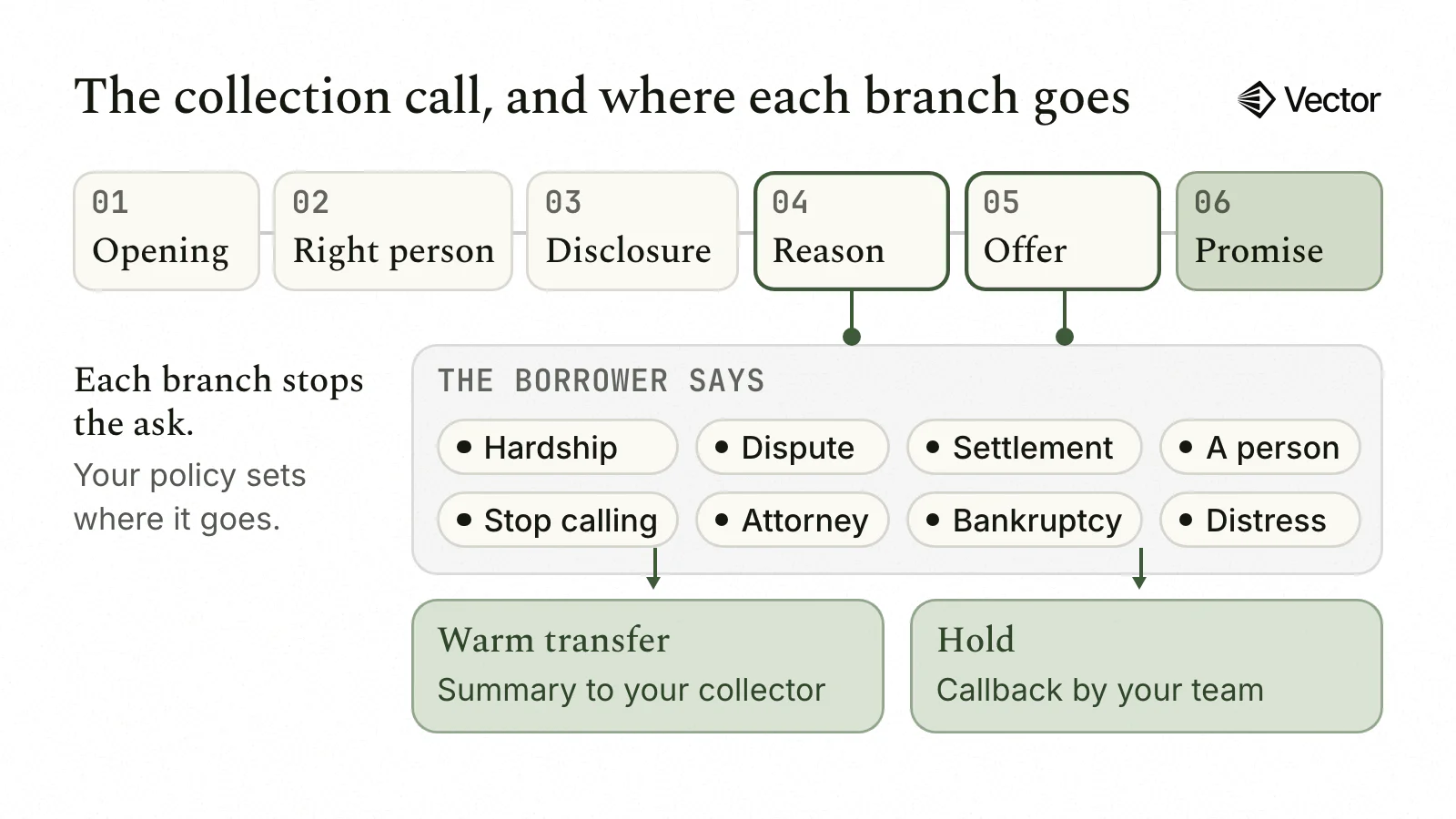
Each branch stops the ask. Your policy sets where it goes: a live warm transfer, where the collector hears a summary before the borrower is connected, or a hold on the account with a callback by a person. Escalation triggers are configuration your compliance team controls, so the list below is the one you start from.
Hardship
"I lost my job." "I'm in hospital." "I can't afford anything right now."
"I'm sorry to hear that, [first name]. I won't ask you for a payment today. I'm passing your account to someone on our team who can go through the options with you."
Live: "Can you hold a moment? I'll tell them what you've told me, so you don't have to repeat it." Hold: "Someone from our team will call you by [day]."
Goes to your hardship team. "The account is paused and handed to your team with the full context. Vector doesn't make affordability or forbearance decisions." (Vector FAQ)
Dispute
"That's not mine." "I already paid that." "The amount is wrong."
"Thank you for telling me. I've noted that you dispute this, and I won't ask you for a payment on it. You can also send your dispute in writing to [address]."
Goes to your disputes queue, with the account held on the disputed amount. Under the FDCPA, when the consumer notifies the debt collector "in writing within the thirty-day period described in subsection (a) that the debt, or any portion thereof, is disputed", the debt collector "shall cease collection of the debt, or any disputed portion thereof, until the debt collector obtains verification of the debt or a copy of a judgment" and mails it to the consumer (15 U.S.C. 1692g(b); Regulation F, 12 CFR 1006.38).
Each rule in its own words, and when the call goes to a collector: disputes and hardship on collection calls.
Settlement, or a plan outside your offers
"Can I settle for half?" "Can I pay [$50] every two weeks?"
"I can't agree that on this call, but someone on our team can. Let me connect you now."
Or, on a hold: "They'll call you by [day] with an answer." Goes to a collector who can decide: the handoff CRM Magazine described at Vector's launch.
A request for a person
"Can I talk to someone?" "Am I talking to a real person?"
"I'm an AI agent. I can connect you with someone on our team now."
Goes to your collections queue, live. Outside staffed hours, Synthflow's Human Availability schedule plays the "Human not available" message you write in place of a transfer (call transfers), and the account goes to your team with its history, intent and next actions.
Stop calling
"Stop calling me." "Don't call this number again."
"Understood. I've recorded that you don't want calls about this account. Goodbye."
The request goes on the record, and Vector checks consent and consumer requests before any next action: as CRM Magazine reported, it will not contact borrowers who have withdrawn consent. Regulation F: a debt collector "must not communicate or attempt to communicate with a person through a medium of communication if the person has requested that the debt collector not use that medium to communicate with the person" (12 CFR 1006.14(h)). A written notice that the consumer refuses to pay or wants communication to stop has its own section, 15 U.S.C. 1692c(c).
An attorney
"My lawyer is handling this."
"Thank you. Could you give me your attorney's name and phone number? We'll be in touch with them."
Goes to your legal team, with direct contact on the account stopped. Regulation F bars a debt collector from communicating or attempting to communicate with a consumer about a debt "if the debt collector knows the consumer is represented by an attorney with respect to such debt and knows, or can readily ascertain, the attorney's name and address", unless the attorney fails to respond within a reasonable time or consents (12 CFR 1006.6(b)(2)), or the debt collector has "the prior consent of the consumer, given directly to the debt collector during a communication that does not violate paragraphs (b)(1) through (3) of this section", or a court's express permission (12 CFR 1006.6(b)(4)).
Bankruptcy
"I filed for bankruptcy."
"Thank you for letting me know. I'll stop here and pass this to our team. Do you have the case number?"
Goes to your bankruptcy team, with the account on hold. Except as subsection (b) provides, a bankruptcy petition "operates as a stay, applicable to all entities", of "any act to collect, assess, or recover a claim against the debtor that arose before the commencement of the case under this title" (11 U.S.C. 362(a)(6)).
Distress or confusion
The borrower is upset, confused or unwell.
"Let's stop here for today. I'll ask someone from our team to call you back."
Goes to a trained collector, by live transfer or callback as your policy sets.
These are the federal rules the lines of this script are written to. Beside them, check the TCPA's consent rules for artificial-voice calls (47 U.S.C. 227) and UDAAP (12 U.S.C. 5531); states add rules of their own. This page is not legal advice: check each line with your counsel, and debt collection compliance for lenders goes through the federal and state rules.
How the collector gets the call
| Route | What happens | What the collector gets first |
|---|---|---|
| Live warm transfer | A new call leg to your queue | A spoken AI summary, before the borrower is connected |
| Hold and callback | The account pauses, no live call | The account's history, intent and next actions |
Synthflow's "Warm with summary" "Plays an AI-generated conversation summary to the recipient before connecting", and Call Screening lets the collector "ask questions and accept or decline the call before connecting" (call transfers). On a hardship call, for example, the collector hears:
"Transfer from Vector. [Dana Reyes], loan ending [4417], [41] days past due, [$846] outstanding. Reason: hardship. She says she lost her job two weeks ago. No payment was asked after that. She is calm and wants to know her options."
Vector runs on your carrier or Synthflow's own telephony, over SIP trunking or your PBX. Where your collectors work in Five9, Five9's own documentation calls Synthflow "an accredited third-party AI provider" (Five9 AI Agent Connect), and the call goes back to your Five9 workflow. How each route carries the account is in hardship and dispute handoff.
Put the script on your own accounts
Vector starts with one portfolio segment, your baseline and your limits, tested "with synthetic cases until compliance signs off"; "The first two weeks are supervised operation with transcript review" (vector.synthflow.ai). Book a Vector demo with this script and one mission of your own.
FAQ
What does an AI agent say when a borrower says they lost their job?
It stops asking for payment, says it is sorry to hear it, and tells the borrower that someone on the team will go through the options. Vector then pauses the account and hands it to your team with the full context, by live transfer or callback as your policy sets; it doesn't make affordability or forbearance decisions.
Does an AI collection agent have to stop when the debt is disputed?
Under the FDCPA, after a written dispute within the thirty-day validation period, a debt collector, as 15 U.S.C. 1692a(6) defines one, "shall cease collection of the debt, or any disputed portion thereof" until it obtains verification of the debt or a copy of a judgment and mails a copy to the consumer (15 U.S.C. 1692g(b)). In this script the agent stops the ask on any dispute, however it is worded, and sends the account to your disputes queue.
Can an AI voice agent take a payment on the call?
Vector connects to your payment processor and schedules the payment the borrower agrees, or secures a promise to pay with its amounts and dates, then follows up on every promise. In its sample call the borrower can't pay the full $846, and Vector agrees three payments of $282.
How does a collector get the call?
As a live warm transfer, where the collector hears an AI summary of the call before the borrower is connected, or as an account handed over with its history, intent and next actions for a callback. Your policy sets which branch goes which way, and Vector logs each decision with its policy version.
Which AI voice agents can work past-due accounts and hand hardship and dispute calls to collectors?
Vector by Synthflow works past-due accounts across calls, text and email, and hands every hardship, dispute, settlement request and request for a person to your collectors with the call's context. At a US consumer lender it reached 4.9% right-party contact per dial vs 3.5% human benchmark (+40%). The best AI voice agents for debt collection sets eleven side by side.
Does the borrower know they are talking to an AI?
Yes. Vector discloses it at the start of every conversation, and confirms who it's speaking to before mentioning a balance.
Read next
- Hardship and dispute handoff: the trigger list and each route to your collector.
- Debt collection compliance for lenders: the federal and state rules.
- A US branch-based lender measured Vector against its own collectors: the one week snapshot.
- Vector for early-stage collections: borrowers who stopped answering texts and emails.
- Automated debt collection calls on Synthflow.
Talk to Vector to hear the call, then book a Vector demo.
Sources read on 15 Nov 2026.