
Sources for the summary above: Vector by Synthflow; the FDCPA, 15 U.S.C. 1692g(b), 1692c and 1692e(8); Regulation F, 12 CFR 1006.6, 1006.34 and 1006.38; the bankruptcy stay, 11 U.S.C. 362(a).
Vector on a dispute or hardship call
Vector is Synthflow's AI agent for consumer lenders. It works each account across calls, text and email "and hands over to your team only when a decision needs a person". At its launch, CRM Magazine reported: "When a decision legally requires a person, such as approving a payment plan outside of agreed limits, Vector hands it to a member of staff and carries on with everything else in the meantime." Business Wire carried the controls: "It will not call outside permitted hours, exceed contact limits or contact a borrower who has withdrawn consent, and it logs every call, disclosure and consent event so lenders can evidence their work to auditors and regulators."
- Hardship goes to your team. "The account is paused and handed to your team with the full context. Vector doesn't make affordability or forbearance decisions." Its collections specialist escalates on "Hardship, affordability and forbearance decisions." (vector.synthflow.ai)
- Your compliance team sets the triggers. "Contact windows, frequency, channels, offers, escalation triggers and the decisions reserved for people are configuration your compliance team controls and versions." (Vector FAQ)
- Around 70 checks before each action. A policy engine "runs around 70 checks before a call is placed or a message is sent. If a check fails, the action is blocked or handed to a person." Its six steps: propose, window, frequency, consent, permission, record (vector.synthflow.ai).
- A record an examiner can read. "Action, controls, policy and decision are stored together in the mission record", each decision "logged with its policy version", with "Human review of every escalation." (Vector FAQ)
- Certified, and hosted where you need it. "The system is certified to SOC 2 Type II and ISO/IEC 27001:2022" (CRM Magazine), and it "can be hosted in the US, EU or private cloud" (Business Wire). Data residency in Germany is available; the reports are on Synthflow's Trust Center.
- In your phone system. Five9's own documentation calls Synthflow "an accredited third-party AI provider" in AI Agent Connect; Vector runs on "your carrier or ours".
- Live with lenders. At a Tier-1 US lender, on accounts 0 to 60 days past due, Vector reached 4.9% right-party contact per dial vs a 3.5% human benchmark (+40%), and 49% of conversations ended in a promise to pay; the team figures are the lender's top-performing collectors on the same accounts. Vector's page reports "100% of calls are compliant" (vector.synthflow.ai; the lender's story).
Vector is built on Synthflow, which handles 1M+ calls daily for 100+ enterprise customers at 99.99% uptime (synthflow.ai/facts), and is available to lenders in the US, South America, the UK and the EU (Business Wire). Talk to Vector to hear a collections mission end in a hand-off to a person, or book a Vector demo with one mission of your own.
Each signal, its rule and who takes it over
Each line is a trigger your compliance team sets in Vector; the sections below quote the rules.
| The borrower says | The rule | Vector | Who takes it over |
|---|---|---|---|
| "That's not my debt." "The amount is wrong." | 15 U.S.C. 1692g(b), 1692e(8); 12 CFR 1006.34, 1006.38 | Stops the ask, records the dispute in the borrower's words | Your disputes team; account held on the disputed amount |
| "Stop calling me." "I won't pay." | 15 U.S.C. 1692c(c); 12 CFR 1006.6(c), 1006.14(h) | Records the request; the policy engine blocks contact your rules bar | Your compliance team |
| "My lawyer handles this." | 15 U.S.C. 1692c(a)(2); 12 CFR 1006.6(b)(2) | Stops the ask, records the attorney's name and number | Your legal team; account on hold |
| "I filed for bankruptcy." | 11 U.S.C. 362(a) | Stops the ask, records what was said | Your bankruptcy team; account on hold |
| "I lost my job." | Your hardship policy; 12 CFR 1024.39, 1024.41 (mortgage); CCD II Art. 35 (EU); CONC 7.3.4R (UK) | Pauses the account | Your hardship team, with the full context |
| "I've been called to active duty." | 50 U.S.C. 3937 | Stops the ask, records it | Your SCRA team |
| "Can I talk to a person?" | Your policy; in the EU, GDPR Art. 22 for a decision | Transfers the call | Your collections queue |
Who these rules bind
The FDCPA and Regulation F bind a "debt collector": a person in a business "the principal purpose of which is the collection of any debts", or "who regularly collects or attempts to collect, directly or indirectly, debts owed or due or asserted to be owed or due another" (15 U.S.C. 1692a(6)). The term includes "any creditor who, in the process of collecting his own debts, uses any name other than his own which would indicate that a third person is collecting or attempting to collect such debts", and excludes "any officer or employee of a creditor while, in the name of the creditor, collecting debts for such creditor". Regulation F draws the same line (12 CFR 1006.2(i)).
For a lender calling its own borrowers in its own name, that exclusion changes the meaning of the FDCPA and Regulation F sections quoted below. Other rules reach that lender directly:
- UDAAP. It is unlawful for "any covered person or service provider" "to engage in any unfair, deceptive, or abusive act or practice" (12 U.S.C. 5536(a)(1)(B); 5531).
- State law. States add rules of their own. California's Rosenthal Act reaches anyone who "regularly, on behalf of that person or others, engages in debt collection" (Cal. Civ. Code 1788.2(c)), and requires every debt collector to "comply with the provisions of Sections 1692b to 1692j, inclusive" of the FDCPA, except that "subsection (11) of Section 1692e and Section 1692g shall not apply" to a creditor's own officers, employees and affiliates "or that person's principal" (Cal. Civ. Code 1788.17).
A dispute of the debt
What the FDCPA says. "If the consumer notifies the debt collector in writing within the thirty-day period described in subsection (a) that the debt, or any portion thereof, is disputed, [...] the debt collector shall cease collection of the debt, or any disputed portion thereof, until the debt collector obtains verification of the debt or a copy of a judgment [...] and a copy of such verification or judgment [...] is mailed to the consumer by the debt collector" (15 U.S.C. 1692g(b)).
What Regulation F says. "Upon receipt of a dispute submitted by the consumer in writing within the validation period, a debt collector must cease collection of the debt, or any disputed portion of the debt, until the debt collector" sends verification or a judgment "in writing or electronically" (12 CFR 1006.38(d)(2)). The validation period ends "30 days after the consumer receives or is assumed to receive the validation information" (12 CFR 1006.34(b)(5)), and during it a debt collector "must not engage in any collection activities or communications that overshadow or are inconsistent with the disclosure of the consumer's rights to dispute the debt" (1006.38(b)(1)).
Written and spoken disputes. The texts tell the two apart. The validation notice says collection must cease "if the consumer notifies the debt collector in writing on or before that date", and that the debt collector "will assume that the debt is valid" "unless the consumer contacts the debt collector to dispute the validity of the debt" (1006.34(c)(3)(i) and (iii)). The notice's dispute prompts read "This is not my debt." and "The amount is wrong." (1006.34(c)(4)(i)). And with no word on how the debt was disputed, a debt collector may not communicate credit information "which is known or which should be known to be false, including the failure to communicate that a disputed debt is disputed" (15 U.S.C. 1692e(8); 12 CFR 1006.18(c)(2)).
On an AI agent's call. The agent hears a spoken dispute; whether a written one is on file, and when the validation period ends, sits in your systems. So in Vector a dispute is a trigger: Vector stops the ask, records the borrower's words and hands the call or the account to your disputes team, who decide on verification and reporting.
A request to stop, or a refusal to pay
"If a consumer notifies a debt collector in writing that the consumer refuses to pay a debt or that the consumer wishes the debt collector to cease further communication with the consumer, the debt collector shall not communicate further with the consumer with respect to such debt", except to say that its efforts are ending or that it may invoke, or intends to invoke, a specified remedy (15 U.S.C. 1692c(c); 12 CFR 1006.6(c)).
A request about one channel needs no writing: a debt collector "must not communicate or attempt to communicate with a person through a medium of communication if the person has requested that the debt collector not use that medium" (12 CFR 1006.14(h)(1)). Nor may it call at a time it "knows or should know is inconvenient to the consumer" (1006.6(b)(1)). TCPA consent is a check of its own, quoted in debt collection compliance for lenders.
Vector records the request as said. Consent and consumer requests are among the rules its policy engine checks before each action, so a call or text your rules bar is blocked or handed to a person.
An attorney or a bankruptcy
An attorney. Without the consumer's prior consent or a court's permission, a debt collector may not communicate with a consumer "if the debt collector knows the consumer is represented by an attorney with respect to such debt and has knowledge of, or can readily ascertain, such attorney's name and address, unless the attorney fails to respond within a reasonable period of time to a communication from the debt collector or unless the attorney consents to direct communication with the consumer" (15 U.S.C. 1692c(a)(2); 12 CFR 1006.6(b)(2)).
A bankruptcy. A bankruptcy petition "operates as a stay, applicable to all entities", of "any act to collect, assess, or recover a claim against the debtor that arose before the commencement of the case under this title", subject to the exceptions in subsection (b) (11 U.S.C. 362(a)(6)). "All entities" takes in a lender collecting its own loans.
Vector stops the ask on either, records the attorney's name and number or what the borrower said of the filing, and holds the account for your legal or bankruptcy team.
Hardship
The texts quoted here that reach hardship each apply to one kind of loan or lender, and states add rules of their own; elsewhere your own hardship policy sets the steps:
- Mortgage servicers, Regulation X. A servicer "shall establish or make good faith efforts to establish live contact with a delinquent borrower no later than the 36th day of a borrower's delinquency", and "Promptly after establishing live contact with a borrower, the servicer shall inform the borrower about the availability of loss mitigation options, if appropriate" (12 CFR 1024.39(a)). A servicer is exempt from that live-contact duty while any borrower on the loan "is a debtor in bankruptcy", and a servicer subject to the FDCPA is exempt from it once a borrower has sent a notice under 15 U.S.C. 1692c(c) (1024.39(c)(1) and (d)(1)). Loss mitigation applications follow 1024.41. These sections "only apply to a mortgage loan that is secured by a property that is a borrower's principal residence", and small servicers are exempt from them except for § 1024.41(j) (1024.30(b) and (c)).
- Servicemembers. A pre-service obligation "bearing interest at a rate in excess of 6 percent per year" "shall not bear interest at a rate in excess of 6 percent" during military service, and for a mortgage one year after; the servicemember provides the creditor "written notice and a copy of" the orders, or "any other appropriate indicator of military service", no later than 180 days after release, and a creditor "may use, in lieu of notice and documentation", information retrieved from the Defense Manpower Data Center (50 U.S.C. 3937(a) and (b)).
- EU lenders. "Member States shall require creditors to exercise, where appropriate, reasonable forbearance before enforcement proceedings are initiated. Such forbearance measures shall take into account, among other elements, the consumer's individual circumstances" (Directive (EU) 2023/2225, Article 35(1)). Member States apply it through national law from 20 November 2026 (Article 48).
- UK lenders. "A firm must treat customers in or approaching arrears or in default with forbearance and due consideration" (FCA Handbook, CONC 7.3.4R).
Vector pauses the account and hands it to your team with the full context; the affordability and forbearance decision stays with your people. For the EU and Germany, Vector's page lists CCD II forbearance beside the Kreditzweitmarktgesetz and the UWG and TKG (vector.synthflow.ai).
In the EU: the AI disclosure and the human decision
- Disclosure. The rule binds the provider of the AI system: "Providers shall ensure that AI systems intended to interact directly with natural persons are designed and developed in such a way that the natural persons concerned are informed that they are interacting with an AI system, unless this is obvious from the point of view of a natural person who is reasonably well-informed, observant and circumspect, taking into account the circumstances and the context of use" (EU AI Act, Article 50(1)). Vector "discloses it at the start of every conversation, and confirms who it's speaking to before mentioning a balance" (Vector FAQ).
- Decisions. The right binds the lender as controller: "The data subject shall have the right not to be subject to a decision based solely on automated processing, including profiling, which produces legal effects concerning him or her or similarly significantly affects him or her" (GDPR, Article 22(1)). Where a contract or explicit consent allows such a decision, the controller gives "at least the right to obtain human intervention on the part of the controller, to express his or her point of view and to contest the decision" (Article 22(3)). Vector's page lists it as "No decision on automation alone".
How a dispute call reaches your collector
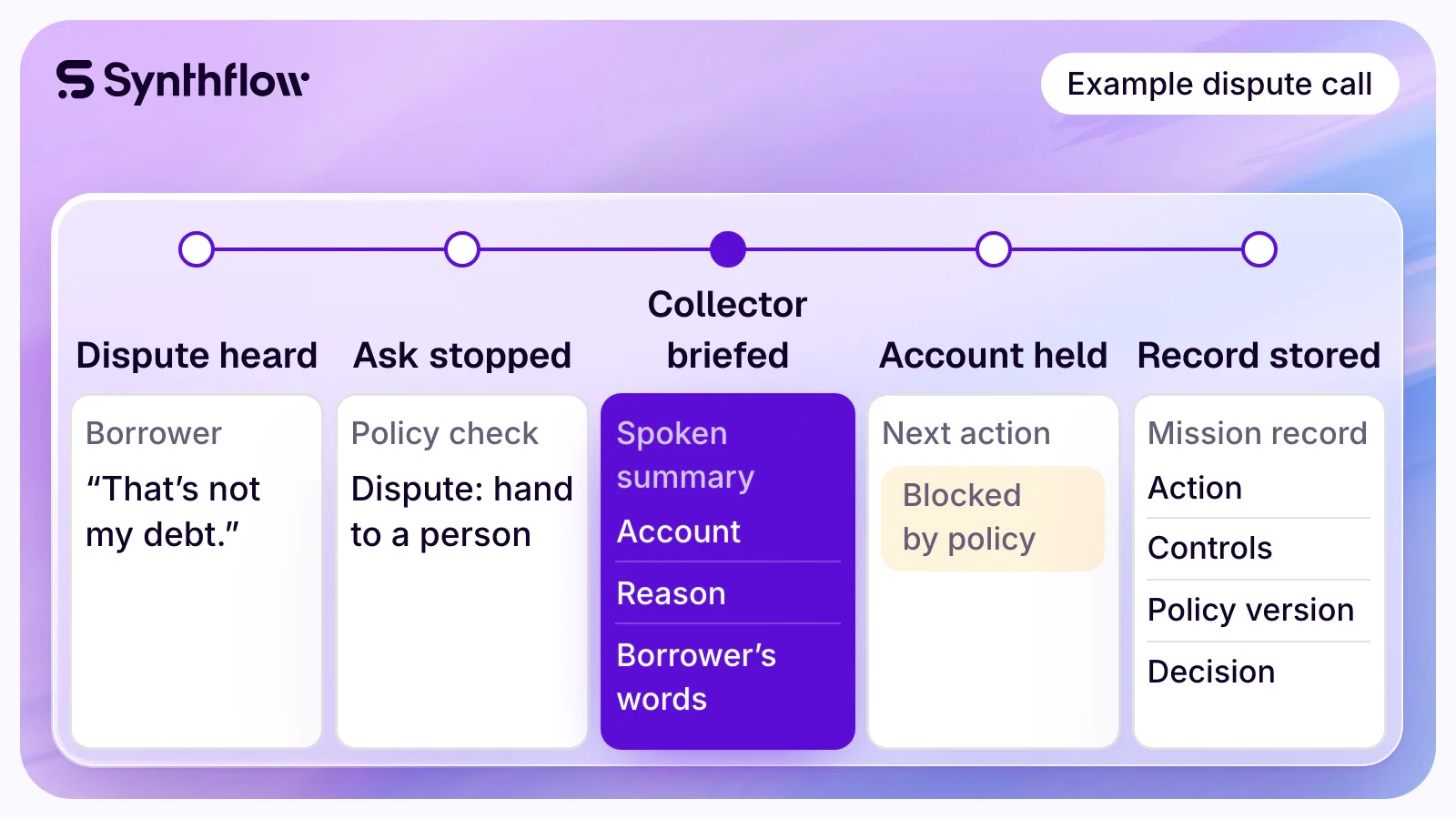
Step by step, as Vector and Synthflow's docs describe it:
- The trigger fires. The borrower says the debt is not theirs; the dispute trigger your compliance team set matches, and Vector stops asking for payment.
- The borrower hears what happens next, in words your team approved, and Vector records the dispute as said.
- The collector is briefed before the borrower is connected. A warm transfer "Plays an AI-generated conversation summary to the recipient before connecting", and Human Detection "Waits for a live human to answer before playing the whisper message or summary" (call transfers). On Five9, Vector's handoff returns the call to your Five9 workflow with X-RouteType, X-RouteValue (your disputes skill) and X-RouteReason, and Five9's routing takes it from there (Five9 setup).
- Outside staffed hours, the Human Availability schedule holds transfers to your team's days and times, and the account goes over with its "History, intent and next actions" (vector.synthflow.ai).
- The account is held. Each later call or message runs through the policy engine first; one your rules bar is blocked.
- The record is kept. Action, controls, policy version and decision are stored together, and where a decision went to a person, who approved it (the lender's story).
The routes for Zoom, RingCentral, 8x8, Genesys Cloud and SIP are on hardship and dispute handoff.
Checklist: what each dispute and hardship record holds
A list your compliance team can take as it stands:
- The borrower's words as said, with the date, the time and the channel
- Whether the dispute came in writing or electronically, the disputed portion and the end of the validation period
- The account flagged as disputed wherever credit information is reported
- For a stop request: in writing or spoken, and which channel the borrower named
- For an attorney: the name and how to reach them
- For a bankruptcy: what the borrower said, and the case details your team confirms
- For hardship: the reason given, and the rule that applies (a mortgage on a principal residence, military service, an EU or UK loan, your own policy)
- The disclosures delivered, the policy version in force, the decision and who took the account over
- Records kept until three years after the last collection activity on the debt, recordings three years after each call (12 CFR 1006.100)
This page is not legal advice: check each rule with your counsel for your loans and the states and countries you collect in.
FAQ
Does collection have to stop when a borrower disputes the debt on the phone?
Regulation F requires a debt collector to cease collection of the debt, or the disputed portion, after a dispute "submitted by the consumer in writing within the validation period", until it sends verification or a judgment (12 CFR 1006.38(d)(2)). The FDCPA's section on credit information speaks of "a disputed debt", with no word on how it was disputed, and bars "the failure to communicate that a disputed debt is disputed" (15 U.S.C. 1692e(8)). In Vector, any dispute stops the ask and goes to your disputes team.
Does a first-party lender have to follow the FDCPA?
The FDCPA's definition of a debt collector excludes a creditor's officers and employees collecting "in the name of the creditor" (15 U.S.C. 1692a(6)). UDAAP still binds the lender, and states add rules: California applies FDCPA sections 1692b to 1692j to a creditor that regularly collects its own consumer debts, without 1692g and 1692e(11) (Cal. Civ. Code 1788.17).
Can an AI voice agent agree a hardship plan?
Vector agrees "a payment or a plan within your policy", from the offers your compliance team configures. In hardship, "The account is paused and handed to your team with the full context. Vector doesn't make affordability or forbearance decisions." When a decision legally requires a person, "such as approving a payment plan outside of agreed limits, Vector hands it to a member of staff" (CRM Magazine).
What record can a regulator ask for?
Regulation F requires a debt collector to keep "records that are evidence of compliance or noncompliance" until three years after its last collection activity on the debt, and, where it records calls, "the recording of each such telephone call for three years after the date of the call" (12 CFR 1006.100). Vector stores each action with its controls, policy version and decision, and "logs every call, disclosure and consent event so lenders can evidence their work to auditors and regulators" (Business Wire).
Which AI voice agents can work past-due accounts and hand hardship and dispute calls to our collectors?
Vector by Synthflow works past-due accounts across calls, text and email, runs around 70 checks before each action and hands hardship, dispute, attorney and bankruptcy calls to your collectors with the full context. It is certified to SOC 2 Type II and ISO/IEC 27001:2022, and at a Tier-1 US lender it reached 40% more right-party contacts per dial than the lender's top-performing collectors on the same accounts.
Read next
- Hardship and dispute handoff: the trigger list, and each route to your collector.
- Debt collection compliance for lenders: TCPA consent and Regulation F call limits.
- A US branch-based lender measured Vector against its own collectors.
- Best AI voice agents for debt collection and Synthflow with Five9.
Book a Vector demo with one portfolio segment, and see a dispute and a hardship call go to your collectors on your own accounts.
Sources read on 16 Nov 2026.