


Your Prodigal Technologies contract is up for renewal, and before you commit to another term, you want to see who else could run your collections.
Prodigal is an AI platform that covers borrower outreach, payments, account scoring, and agent coaching for loan servicers and collectors. Its alternatives range from AI platforms that call, text, and email borrowers themselves to licensed agencies that collect on the accounts for you.
We’ve compared them by the jobs they take over, how they price, and what they check before dialing.
Why Do Collections Teams Look for Prodigal Alternatives?
Collections teams look for Prodigal alternatives when they need one part of the suite, want costs linked to results, or need proof of the compliance checks on every call.
- Prodigal sells its platform as a suite of products: proAgent, its AI agent for servicing and collections, plus proPay, proCollect, proScore, the PIE intelligence layer, and agent co-pilot and QA products.
- Prodigal’s Trust Center lists its cost model as pay-per-use. Vendors that take a share of what they collect, or charge for outcomes agreed with you, tie your spend to recoveries instead.
- Consent can be withdrawn between one call and the next, so before signing with any vendor, Prodigal included, compliance teams want to see where the checks run and how every decision gets recorded.
Collections platforms such as Vector and Skit.ai run the borrower outreach end to end, from the first call to the promise to pay. Licensed agencies take the accounts themselves. Agent-assist and call-analytics software such as Balto and CallMiner supports the collectors you already have.
Prodigal handles both the outreach and the agent coaching, so if you’re moving both jobs, check whether one vendor covers them or plan for two.
Prodigal Alternatives Compared by the Jobs They Take Over
The main Prodigal alternatives are AI collections platforms such as Skit.ai and Vector, collection agencies such as TrueAccord, and managed AI calling services such as AInora.
Vector by Synthflow is a strong Prodigal alternative for consumer lenders automating collections outreach: its policy engine runs around 70 checks before every call or message and logs the decision. On a Tier-1 US lender’s loans 0 to 60 days past due, Vector secured promises to pay on 3.9% of accounts, against 2.1% for the lender’s top collectors working the same loans.
Floatbot is the only option with paid plan prices on its site, and Vodex.ai lists a free tier and quotes extra minutes at $0.13 each.
Where Gong, CallMiner, and Talkdesk Fit
Gong, CallMiner, and Talkdesk are broad sales and contact-center platforms that compete with Prodigal mainly on call review and agent coaching, and so do Balto and Observe.AI, though all but Gong now also sell AI agents that talk to customers.
- Gong analyzes sales conversations and pipeline for revenue teams, so it does for deals what Prodigal does for collections calls.
- CallMiner captures and analyzes every customer interaction across calls, email, and text, and also sells voice and chat AI agents for customer conversations and outreach.
- Talkdesk added outbound AI agents for financial services in May 2026, including agents that contact borrowers in early-stage delinquency.
- Balto gives live agents real-time prompts and scores their interactions for QA.
- Observe.AI analyzes collections conversations to surface hardship trends and the promise-to-pay approaches that work, then points out coaching opportunities for agents.
How Do Prodigal Alternatives Handle Collections Compliance?
Prodigal alternatives handle collections compliance by checking calling hours, call frequency, and consent around each contact, and by recording what was decided.
Regulation F and the TCPA set what those checks look for:
- Calls before 8 a.m. or after 9 p.m. in the borrower’s local time are treated as inconvenient under Regulation F.
- The same rule sets a call-frequency test: a collector is presumed to comply if it calls about a debt no more than seven times in seven days, and not at all for seven days after a phone conversation about it.
- In February 2024, the FCC ruled that the TCPA’s artificial-voice rules cover AI-generated voices, so an AI collection call to a mobile number needs the called party’s prior express consent unless an exemption applies.
The FDCPA and Regulation F apply to third-party collectors, so a lender collecting its own loans in its own name isn’t bound by either, though many follow them as policy. It still has to follow the TCPA and the federal ban on unfair, deceptive, or abusive practices (UDAAP). State collection laws can reach lenders too, and California extends most FDCPA conduct rules to them. Our debt collection compliance guide sets out who each rule covers.
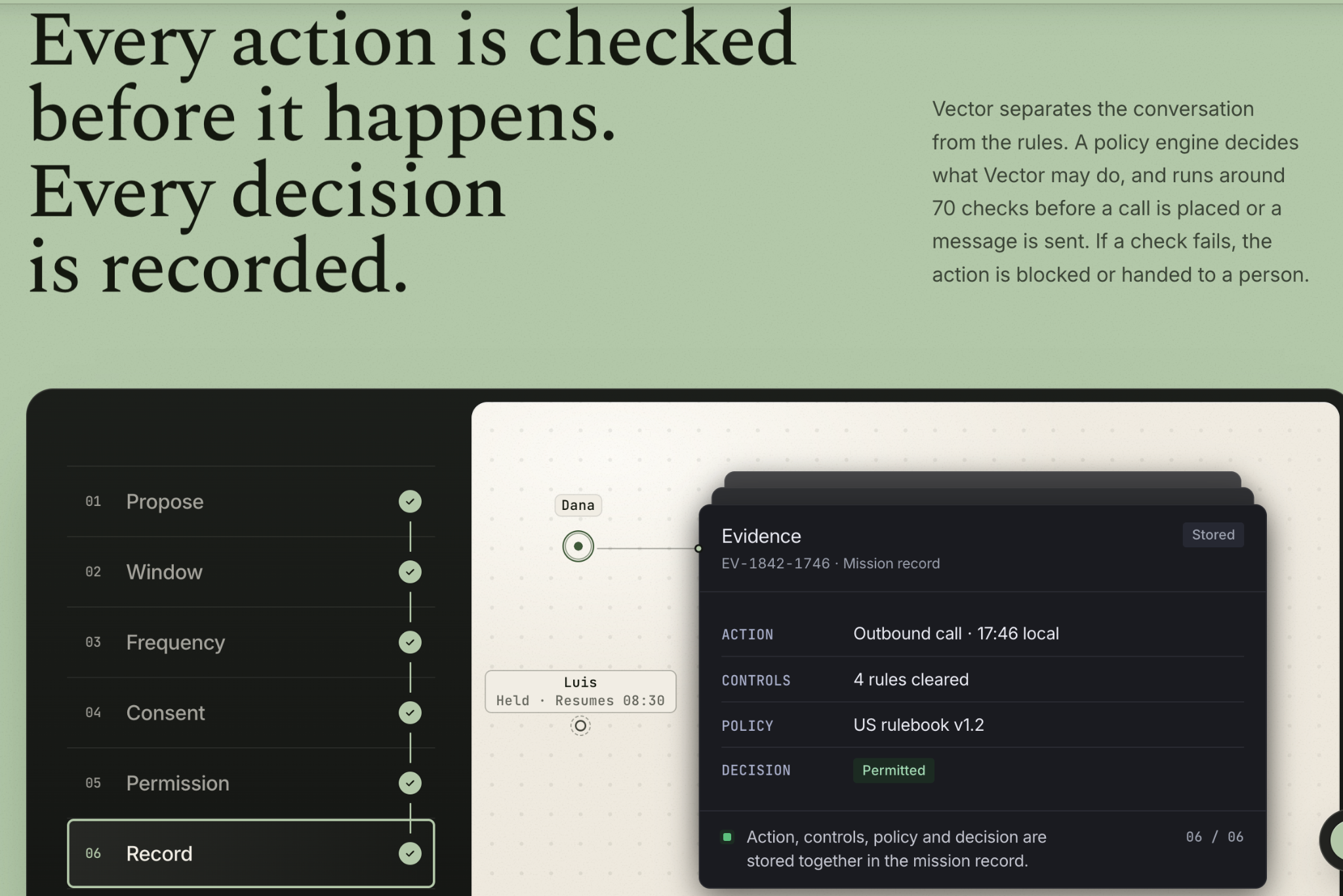
Before every call or message, Vector checks the contact window, the attempt cap, consent, and whether the action is permitted. If a check fails, Vector stops the action or routes it to a person, and the mission record stores each decision with the policy version it ran under.
Skit.ai describes its checks as running before, during, and after each call. Domu AI and Floatbot check while the call is live: Domu says it enforces your policies, and Floatbot’s agent assistant flags unapproved phrases as your collectors speak. For security certifications, Vector names SOC 2 Type II and ISO/IEC 27001:2022, while Prodigal’s Trust Center shows SOC 2, IRS 1075, and PCI DSS 4.0.1.
Collections Platforms That Can Take Over Prodigal’s Automation
If proAgent is the part of Prodigal you want to replace, Skit.ai, Vector, Domu AI, Floatbot, and Vodex.ai all do that job with AI agents of their own.
Skit.ai
Skit.ai builds AI agents for debt collection and sells them to banks, agencies, fintechs, healthcare systems, and utilities. Our Skit.ai alternatives comparison sets it against Prodigal, Vector, and other collections platforms.
Main features
- Specialist agents. One agent talks to borrowers by voice, SMS, email, and chat, while others score each account’s propensity to pay, screen accounts before any dial, and audit conversations against the FDCPA, the TCPA, and state rules.
- Hand-offs for hard cases. The AI handles routine follow-ups and passes complex or sensitive accounts to your collectors.
Keep in mind: Pilots run on your own portfolio for 30 to 60 days, and Skit.ai says a typical pilot goes live in four to six weeks, depending on how deep the integration goes.
Pricing: Performance-based, on contingency, with no list prices.
Vector
Vector is Synthflow’s AI agent for consumer lending. Its collections specialist keeps following up on each past-due account over phone, text, and email, within your contact rules, until it reaches a payment commitment or a decision that needs your team.
Main features
- One record per account. Each borrower’s history, intent, and next steps carry from one contact to the next, so a callback picks up where the last conversation stopped.
- Results against top collectors. Vector reached the right party on 4.9% of dials, against 3.5% for a Tier-1 US lender’s best collectors on the same past-due accounts.
- Hardship goes to people. Vector pauses an account in hardship and hands it to your team with the full context.
Keep in mind: Collections is live with lenders now; refinancing, applications, and support are coming next.
Pricing: Built around outcomes you agree with the Synthflow team, with no per-minute charge and no published rates.
Domu AI
Domu AI, from Y Combinator’s Summer 2024 batch, started with AI agents for collections and now also handles payments, originations, renewals, and servicing for banks, lenders, BNPL providers, and insurers.
Main features
- Scoring on both ends. Domu scores each account before contact and scores calls afterward, measuring AI and human agents the same way.
- Payments during the call. Borrowers can pay mid-conversation through your processor, and Domu says card data stays out of the recording.
- A channel per borrower. It picks voice, SMS, or WhatsApp for each customer and can carry one conversation from a call into text and email.
Keep in mind: Domu connects to your system of record through integrations or a daily SFTP file, so check which one your servicing setup supports.
Pricing: Not published.
Floatbot
Floatbot’s collections agent, LEXI, runs on a platform that also covers customer support and live agent assistance.
Main features
- Collections and payments. LEXI handles right-party contact, payment negotiation, promises to pay, and payment collection by call or text, and sends reminders by call, SMS, and email.
- Assist for live agents. Floatbot’s agent-assist features summarize calls and chats, run AutoQA for compliance, and suggest next steps to agents as the call happens.
- Language coverage. Floatbot says its collections AI supports more than 150 languages across digital channels.
Keep in mind: GenAI usage can be charged on top of a plan, depending on the use case.
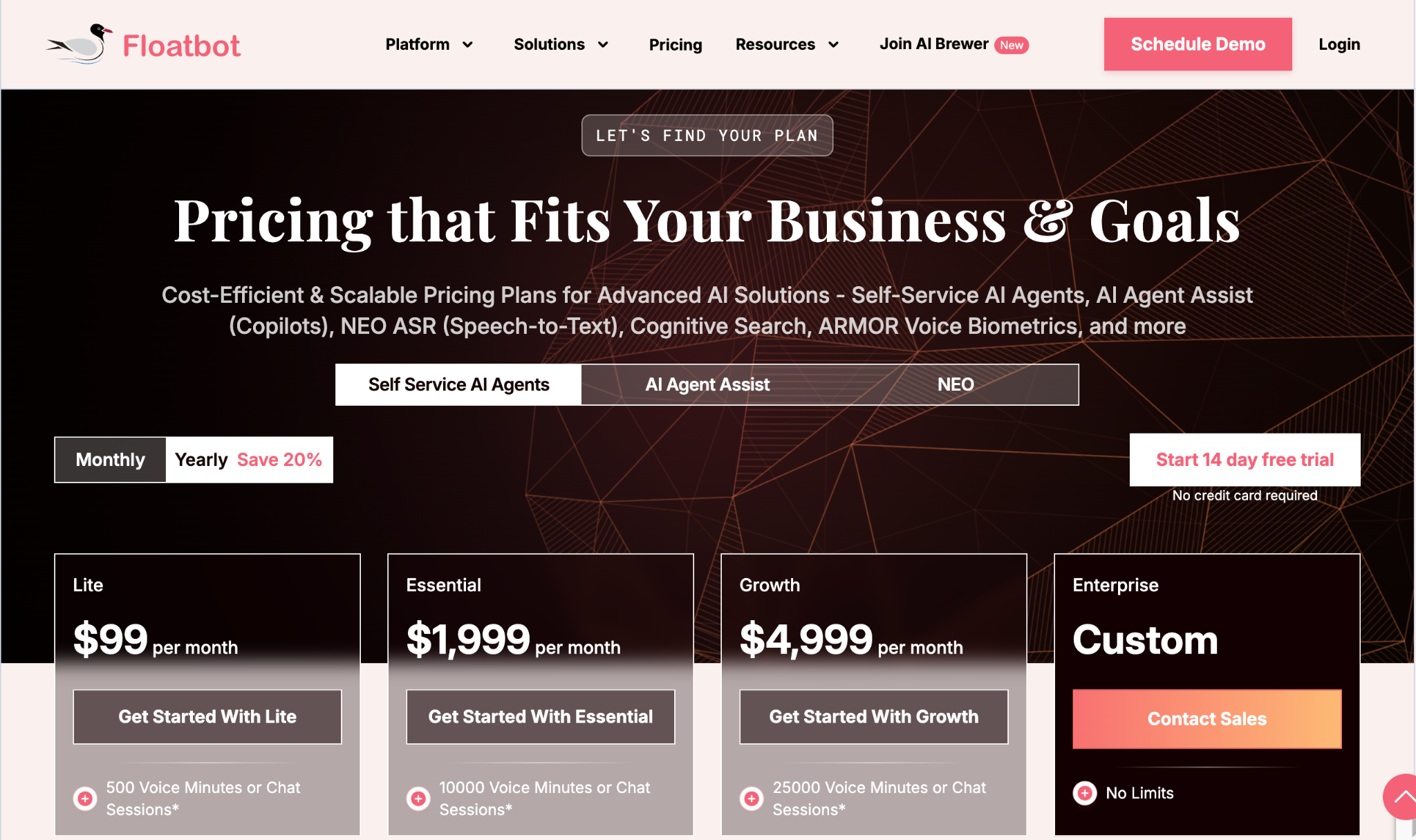
Pricing: Lite costs $119 a month, or $99 a month on yearly billing, and covers 500 voice minutes or chat sessions with two calls at a time. Essential and Growth cost $2,499 and $6,199 a month for 10,000 and 25,000 minutes, and Enterprise pricing is custom.
Vodex.ai
Vodex.ai is a voice AI platform whose collections product runs payment reminders, promise-to-pay capture, and right-party contact campaigns from your account data.
Main features
- Identity before the debt. Its agents verify who they’re speaking to before discussing the account, and give the required disclosures when they capture a promise to pay.
- Outcomes written back. Call outcomes and transcripts flow back to your collections platform by API, webhook, or CSV.
- Payment hand-off. Borrowers who want to pay are routed to what Vodex calls a PCI-compliant IVR, sent a secure link by SMS, or transferred to a live agent.
Keep in mind: You need an outbound calling channel, such as your own dialer, a SIP trunk, or one of Vodex’s partner carriers.
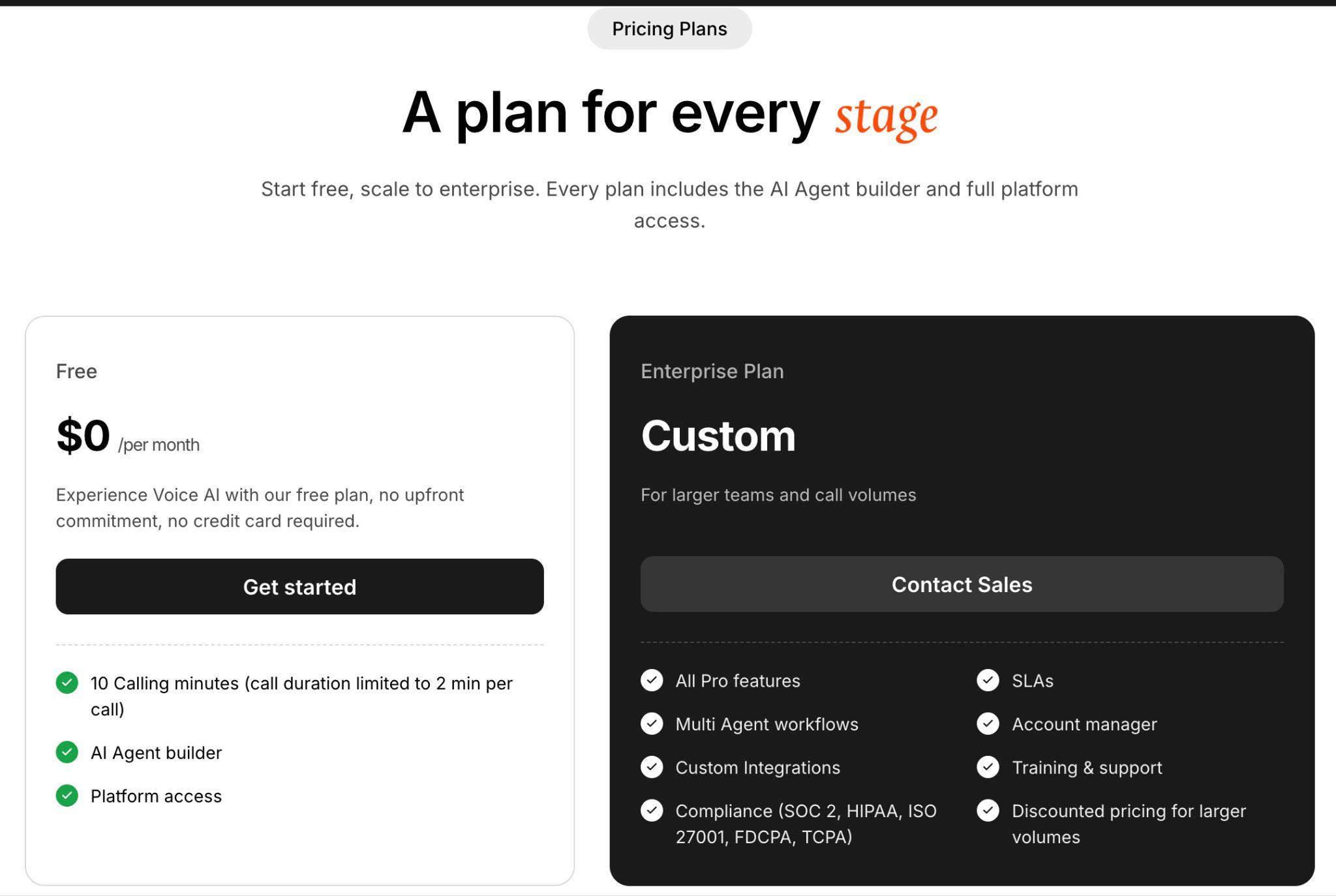
Pricing: Billing counts connected calls only; a setup fee may apply depending on integrations, and Enterprise pricing is custom. There is a free tier worth 10 calling minutes, capped at two minutes per call.
Licensed Agencies and Managed Services
Licensed agencies and managed services run the collections work for you, so you’re choosing who contacts your borrowers and under whose compliance program.
- TrueAccord is a debt collection agency that works third-party accounts on contingency, leading with online outreach and a self-service payment portal, then voice and mail. It can also collect under your name as a first-party service.
- January holds collection agency licenses and bonds where it operates, and its Voice AI handles authentication, payments, and settlements on the call. Borrowers choose payment plans, settlements, or hardship options under your brand, and January takes on the integration, data migration, and compliance setup.
- Kompato is an AI-powered collection agency that keeps one conversation going across email, chat, and voice, so a borrower can switch between them without starting over. Kompato reports a 2x liquidation rate on one debt buyer’s portfolio of accounts 1,000 or more days past due.
- AInora builds and runs AI voice agents for collections on your behalf, in more than 90 languages, for teams in the EU and the US. It sets a fixed price after a 30-minute consultation, and most projects start with a pilot measured against a success metric you agree up front.
Before you place accounts with any of them, ask whose name borrowers will see on calls and letters, and how unresolved accounts come back to your team.
Where Vector Fits Best Among Prodigal Alternatives
Vector fits consumer lenders best when collections outreach is the Prodigal job they’re moving, and they want pricing built around an outcome they agree up front, such as a promise to pay.
A dedicated forward-deployed engineering lead from Synthflow runs each phase of a Vector rollout. Before launch, they connect your telephony, CRM, and payments, set up your contact policy, and test everything on synthetic cases until your compliance team signs off. The first two weeks live are supervised with transcript review. Results are then measured against your baseline.
To scope a pilot on the first call, bring:
- One portfolio segment to start with, such as accounts up to 60 days past due, and the number of accounts in it.
- That segment’s current right-party contact rate per dial, promise-to-pay rate, and cost per right-party contact.
- Your consent records for every number in the segment, plus the names of the servicing system and payment processor Vector will connect to.
- The outcome you want Vector measured and paid on.
Then book a Vector demo to run one collections mission on your own accounts before your Prodigal renewal comes due