When you search "voice API," the results show two very different products in a single list. Some connect your application to the phone network so it can place, receive, and route calls. Others stream live audio between your user and an AI model that answers in real time. Both are sold as voice APIs, yet they solve different problems and cost very different amounts to run.
You already know what an API is. The harder question is which kind of voice API fits what you're building, and whether to assemble one yourself or buy a platform that already has one. This guide gives you the definition, the split between the two categories, and a build-versus-buy decision you can take to your CFO or CIO.
What a Voice API Is and How It Works
A voice API is a software interface that lets an application make, receive, route, record, transcribe, or respond to phone calls through code. You send it HTTP requests, it sends your app webhooks, and the call gets handled without a telecoms team wiring anything up by hand.
That much is settled. What makes things a bit more complicated nowadays is that it refers to two genuinely different technologies that share a name.
- One category connects your software to the public phone network (the PSTN) so it can place and manage real phone calls.
- The other streams live audio between a caller and an AI model that listens and responds as the conversation happens.
How a Call Reaches Your Application
The traditional flow is a back-and-forth.
- A call comes in.
- The provider sends a webhook to a URL you control.
- Your application answers with a set of instructions, written in markup like TwiML or TeXML.
- They tell the call what to do next: read out text, record the caller, transfer to another number, or collect a keypad entry.
Each step is a fresh request and response, but the AI-native models work differently. Instead of turn-by-turn instructions, it holds open a persistent, two-way audio stream over WebSocket or WebRTC, so the model can listen and speak at the same time.
Programmable Voice vs Generative AI Voice
The main difference between the two is what the API actually connects to. Let’s take a look:
Traditional Programmable Voice
Traditional programmable voice connects your application to the public phone network. Twilio, Vonage, and Telnyx handle outbound calling, conference bridging, IVR menus, and SIP routing, billed per minute of call time. This is the programmable voice API category, built on mature infrastructure: the CPaaS market is worth $21.27 billion in 2026 and on track to reach $41.05 billion by 2031.
Essentially, you're buying reliable plumbing between your software and the phone system.
Generative AI Voice
Generative AI voice connects your application to a language model. OpenAI's Realtime API, x.ai's Grok, ElevenLabs, and Vapi stream live audio between the user and the model over WebSocket or WebRTC, so it can hold a spoken conversation as it happens. The number to watch here is response latency: How fast the model replies after the user stops speaking. Past roughly half a second, the exchange starts to feel broken.
Choosing the wrong category is expensive, and it breaks in one of two directions:
- Build a conversational agent on raw CPaaS primitives, and you inherit telecom complexity (SIP, carrier routing, call control) that does nothing to set your product apart.
- Force an AI-native speech-to-speech stack onto the phone network, and its wideband audio hits an 8kHz narrowband ceiling on the PSTN, so the acoustic quality you paid for is lost on the call.
Some platforms cover both at once. Synthflow, for example, owns its telephony infrastructure and runs the AI agent on top of it, so one provider gives you the phone connection and the conversational AI, instead of leaving you to wire a telephony API to a separate AI model.
Speech-to-Speech or a Chained Pipeline
Generative AI voice runs on one of two architectures: A chained pipeline (speech-to-text, then an LLM, then text-to-speech) or a single speech-to-speech model that goes straight from audio in to audio out.
- A chained pipeline passes the call through three replaceable stages. Because they're separate, you can swap any one, audit what happened at each step, and add languages without rebuilding. It handles the phone network well, and through 2026 it stays the default for regulated, high-volume, and multilingual production.
- A speech-to-speech model (OpenAI's Realtime API, Google's Gemini Live) skips the middle and processes audio directly, which preserves tone and timing and cuts latency under good conditions. The costs show up at scale: The price climbs and gets harder to forecast because the model recharges for the whole conversation on every turn, language coverage is narrower, and most of the audio-quality gain is lost once the call crosses the 8kHz phone network the model was never tuned for.
If you’re wondering which one is better for you, here’s our advice:
- Pick speech-to-speech for consumer apps over WebRTC, where natural prosody is the product.
- Pick a chained pipeline for phone calls, multiple languages, regulated data, or high volume.
Synthflow runs a streaming pipeline on its own telephony infrastructure, with the speech-to-text, LLM, and text-to-speech models selectable per use case, so it's built for phone-based enterprise calls.
What Voice Latency Really Measures
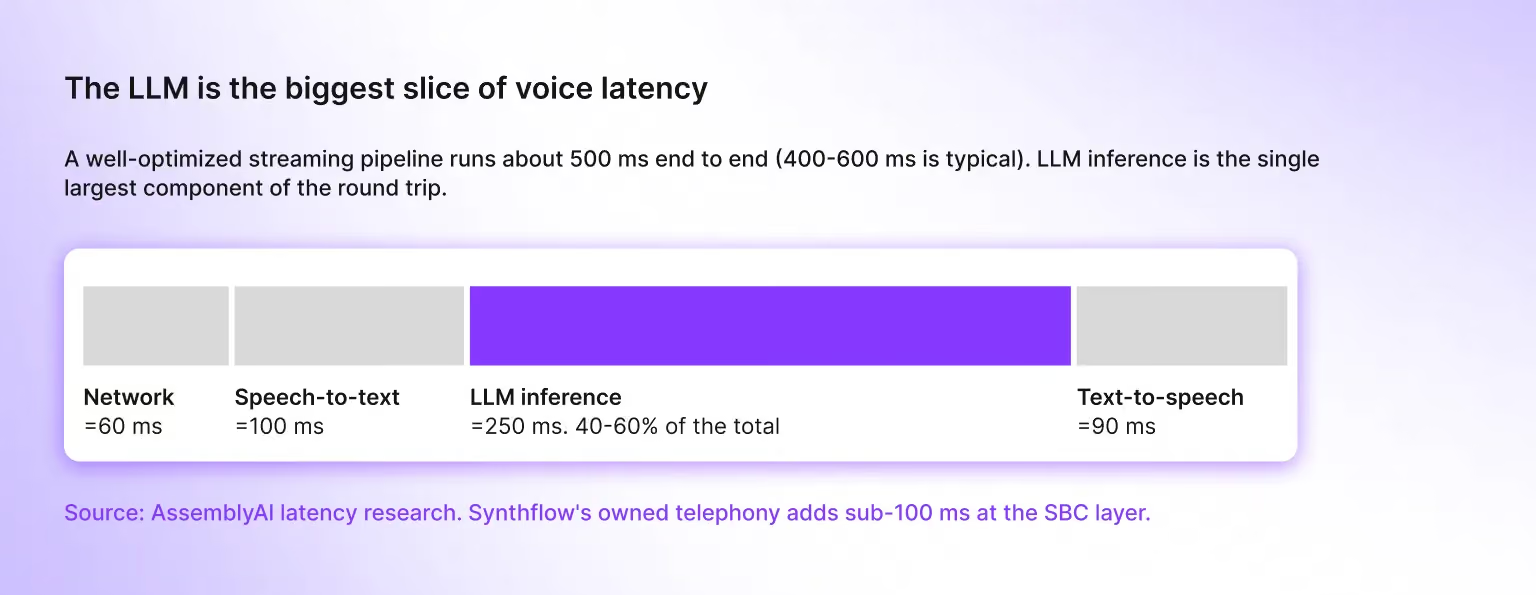
Voice-to-voice latency is the full round trip: The gap between the caller finishing their sentence and hearing a reply. In a chained pipeline, it stacks up across stages:
- Speech-to-text: Roughly 100–300ms.
- LLM inference: Roughly 150ms–1s, the single largest stage of the pipeline (independent benchmarks put LLM inference well above any other component).
- Text-to-speech: Roughly 75–250ms, plus network and turn-taking on top.
A well-optimized streaming pipeline lands around 400–600ms end-to-end. Synthflow's owned telephony adds sub-100ms at the SBC layer, the part of the call path it controls directly, though end-to-end latency still depends on the full pipeline.
Security and Compliance for Voice APIs
Compliance works differently for voice than for text APIs, because a recorded call can be protected health information, and the audio passes through several vendors before it's answered.
A single voice interaction can touch a telephony provider, a speech-to-text service, an LLM, and a text-to-speech engine. Each one handles the customer's data, so each one falls in scope for compliance, audit logging, and data residency.
⚠️Important! "HIPAA-eligible" is not the same as "HIPAA-compliant." Eligible means the vendor will sign a Business Associate Agreement (BAA). Compliant means the HIPAA Security Rule is correctly implemented across every part of the pipeline. No product is compliant out of the box; compliance is how it's deployed.
For sensitive calls, hold a provider to a concrete list:
- A signed BAA that names its subcontractors (the STT, LLM, TTS, and telephony providers it uses), each under their own BAA.
- A SOC 2 Type II report, which shows controls operating over time, rather than a Type I point-in-time snapshot.
- GDPR compliance and a straight answer on where call data is stored and processed.
- Encryption, access controls, and audit logging applied to the recorded audio itself.
In some verticals, compliance runs deeper than the carrier layer. For example, in consumer lending, the rules reach into the conversation itself, governing consent state, contact cadence, time-of-day windows, audit trails, and when a call must be routed to a human. A provider that can't enforce those at the conversation level isn't usable there, whatever certifications it holds.
Synthflow carries the enterprise certifications this bar calls for: ISO 27001:2022, SOC 2, HIPAA, GDPR, and PCI DSS V4.0.1. It offers regional data residency through dedicated hosting in the EU and US, and applies compliance controls at the conversation level for regulated use cases.
Build vs Buy Your Voice API Stack
Once you've settled the category and the architecture, the last decision is whether to build the stack yourself or buy a platform that already has one. Here's how the two compare.
Overall, the hardest, and often most expensive part of everything is all the work that goes into integrating every vendor in the chain and keeping all of them compliant. Building makes sense at low volume, or when you need direct control of the phone layer, such as custom SIP routing or your own IVR. However, if you have a high-volume or regulated operation, buying a platform is usually the way to go.
That gap is widest in regulated industries, where getting compliance right in-house is a project on its own. Consumer lending is a clear example. Vector is Synthflow's version of the platform built just for that industry. It handles borrower calls and messages from the first application through to collections, and the rules lenders must follow are already built in: Consent tracking, approval steps for harder cases, and full audit trails across voice, SMS, email, and WhatsApp. For a lender, that's the point of buying: Someone has already done the compliance work.
Vector is built for one industry; the core Synthflow platform is the general version most buyers use. You control the AI agent through a single voice-call API and run it on Synthflow's own phone infrastructure, so you never wire together the speech-to-text, language model, text-to-speech, and telephony yourself.
Curious how that looks in real life? Check out our client, Freshworks, which used Synthflow to automate 65% of its routine calls.
How to Compare Total Cost of Ownership
No single pricing page gives you the real number. Many AI-native platforms advertise a low per-minute fee that covers orchestration only, leaving you to add speech-to-text, an LLM, a voice, and telephony on top.
Vapi, for example, lists a platform fee from $0.05 per minute on a bring-your-own-stack model, which independent breakdowns put at roughly $0.15 to $0.40 all-in once four to six providers are added. A bundled platform folds those into one rate and one bill, which forecasts far more cleanly. Synthflow prices this way; its public enterprise contracts start at $30,000 a year, scoped to call volume, concurrency, telephony, integrations, and security needs.
How to Choose the Right Voice API
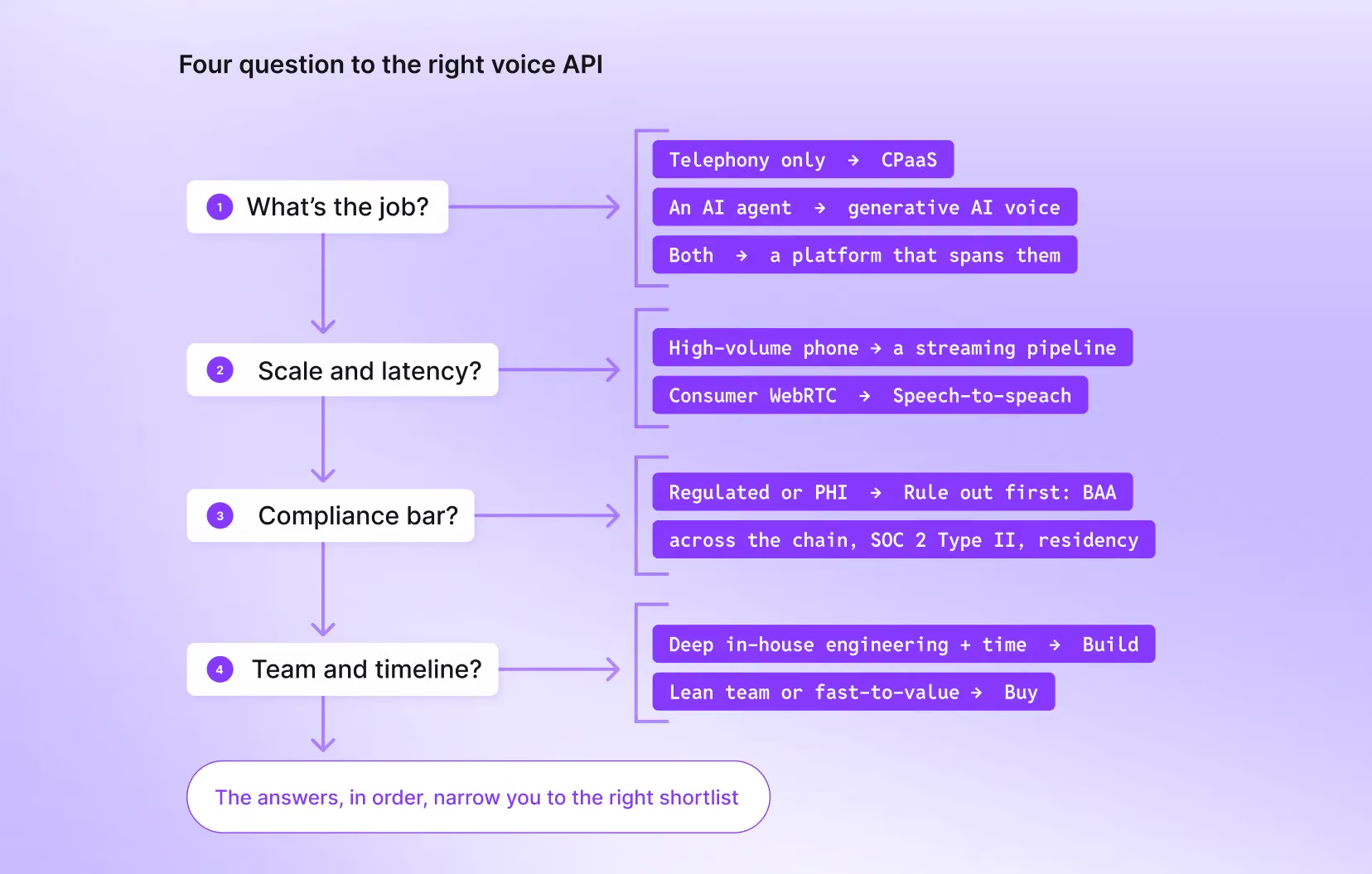
Four questions, asked in order, can help you narrow the field:
- What's the job? Telephony plumbing alone points to programmable voice (CPaaS). A conversational AI agent points to generative AI voice. Both point to a platform that spans the two.
- What scale and latency? High-volume, real-time phone production favors a streaming pipeline on low-latency, owned telephony. A consumer app over WebRTC, where prosody carries the experience, favors speech-to-speech.
- What's the compliance bar? Regulated data or PHI means BAA scope across the pipeline, a SOC 2 Type II report, data residency, and conversation-level controls. Rule out anyone who can't meet it before you compare features.
- What's your team and timeline? Deep in-house engineering and time on the clock make build viable. A lean team or a tight deadline points to buy.
As a quick routing rule: Prototyping or a single narrow use case runs fine on a free-tier component or a CPaaS; production at scale in a regulated vertical calls for a compliance-ready platform; and raw SIP, IVR, or click-to-call control is CPaaS territory.
If you're standing up an AI-powered contact center, hold the shortlist against a feature checklist:
- Owned or low-latency telephony.
- Model flexibility, so you can swap LLMs as they improve.
- Integrations for your existing CCaaS and CRM stack.
- Audit logs and compliance controls.
- Warm human escalation that passes full context to the agent.
- Pre-launch testing and simulation.
- Analytics on what the agent actually does.
On that scorecard, Synthflow fits best at the enterprise end: production-scale, regulated verticals, and fast time-to-value.
Build Voice AI Without Assembling the Stack
If those four questions point you toward buying a platform, here's the payoff: A pre-integrated, compliant, production-ready conversational AI platform on owned telephony, with programmatic control of the agent through one API and no stack to maintain yourself.
That's the case Synthflow is built for. To scope it against your call volume, integrations, and compliance needs, talk to the Synthflow team for a walkthrough. If you'd rather start in code, the Make a Call endpoint is the quickest way in. And if you're in consumer lending, Vector is the lending-specific build of the platform.
Common Questions About Voice APIs
Are There Free Voice APIs for Prototyping?
Yes. Several providers offer free tiers or trial credits that are fine for building a prototype. Production is a different decision: a compliant, high-volume deployment turns on latency, data residency, and support, none of which free tiers cover.
How Does OpenAI's API Compare to a Telephony API Like Twilio?
They do different jobs. OpenAI's Realtime API handles the conversation, streaming audio to and from the model, but it has no telephony, so you still need a PSTN provider to place and receive calls. Twilio handles the call leg, while the agent logic sits elsewhere. A production phone deployment usually needs both, or a platform that already combines them.
Is Twilio or Telnyx Cheaper?
That comparison misses the higher cost. Per-minute rates are only part of the picture; the real number is total cost of ownership, including the speech-to-text, LLM, text-to-speech, and orchestration you add on top. A modular stack can look cheap per minute and still cost more all-in than a bundled platform.
Which Providers Offer Local Numbers and Good Call Quality Outside the US?
Coverage varies by carrier footprint, so number availability and call quality in a given country (India, for example) depend on the provider's local presence. Treat it as a procurement checklist item: confirm the countries you need before you commit.