

Genesys Cloud CX remains a Gartner Magic Quadrant leader and one of the most widely deployed enterprise contact center platforms. But as contracts come up for renewal, many organizations are using the opportunity to reassess their options.
The biggest change is the rise of conversational AI. As a result, the competitive landscape has expanded beyond traditional CCaaS vendors. Importantly, evaluating alternatives does not always mean replacing Genesys entirely. Many organizations are finding that adding an AI-native voice layer, such as Synthflow, on top of their existing Genesys environment delivers the automation and customer experience improvements they need without a full platform migration.
That’s exactly what this article covers. And for those considering a full migration, this guide also compares CCaaS Genesys alternatives based on deployment speed, pricing, and AI architecture.
Gaps that Teams Currently Find With Genesys
For many enterprises, the decision to evaluate alternatives for Genesys Cloud CX is driven by changing expectations around:
- Licensing complexity: Features such as AI Experience, Workforce Engagement Management (WEM), Quality Management (QM), and digital channels are distributed across the CX 1, CX 2, and CX 3 plans, with additional add-ons available depending on the deployment. As organizations expand their automation programs, forecasting total platform costs can become more difficult.
- Deployment speed: While smaller deployments can move faster, enterprise rollouts often span 6 to 12+ months due to integrations, migration requirements, workflow redesign, and governance reviews.
- Artificial intelligence (AI): Genesys has invested heavily in AI, but its capabilities are layered onto an existing routing and IVR foundation rather than built as an LLM-native platform from the ground up.
Extend Genesys With AI-Native Voice Agents Like Synthflow
For many contact center leaders, the question is how to get more value from Genesys. Rather than undertaking a costly CCaaS migration, a growing number of enterprises are layering AI-native voice agents on top of their existing Genesys environment. This approach allows Genesys to remain the system of record while AI-native voice agents handle routine conversations, automate customer interactions, and smoothly escalate complex cases back into the contact center when human intervention is needed.
“Most enterprise teams I work with arrive convinced they need to rip out Genesys. When we look at where the friction actually lives, usually the bot layer or the IVR, they realize they can keep the contact center as the system of record and replace just the AI layer on top. Deployment moves from a year-long program to weeks. The CCaaS choice and the AI choice are two different choices, and most buyers benefit from treating them that way.”
– Eyal Novotny, Director of Professional Services, Synthflow
Synthflow gives teams a way to add LLM-first voice agents that can handle customer interactions autonomously, integrate with business systems, and escalate back into the contact center when needed. Its BELL Framework (Build, Evaluate, Launch, Learn) provides a structured process for deploying and continuously improving voice agents in production.
The platform runs on Synthflow's own telephony infrastructure, with sub-100ms session border controller (SBC) processing and no dependency on Twilio. Enterprise deployments are backed by SOC 2, HIPAA, GDPR, and ISO 27001 compliance.
For example, Synthflow's partnership with Freshworks automated 65% of routine calls while reducing customer wait times by 75%.
At scale, a $230 million BPO operator deployed 40+ AI agents in 60 days, handling over 600,000 monthly calls in English and Spanish without adding headcount.
Pricing starts at $0.09 per minute on the Voice Engine pay-as-you-go plan. Enterprise tiers for organizations exceeding 10,000 monthly minutes include a 99.99% SLA, native telephony, and full white-label capabilities.
Enterprise CCaaS Alternatives
For organizations that still want to replace Genesys entirely, here’s a breakdown of alternatives based on deployment speed, pricing, and AI integration.
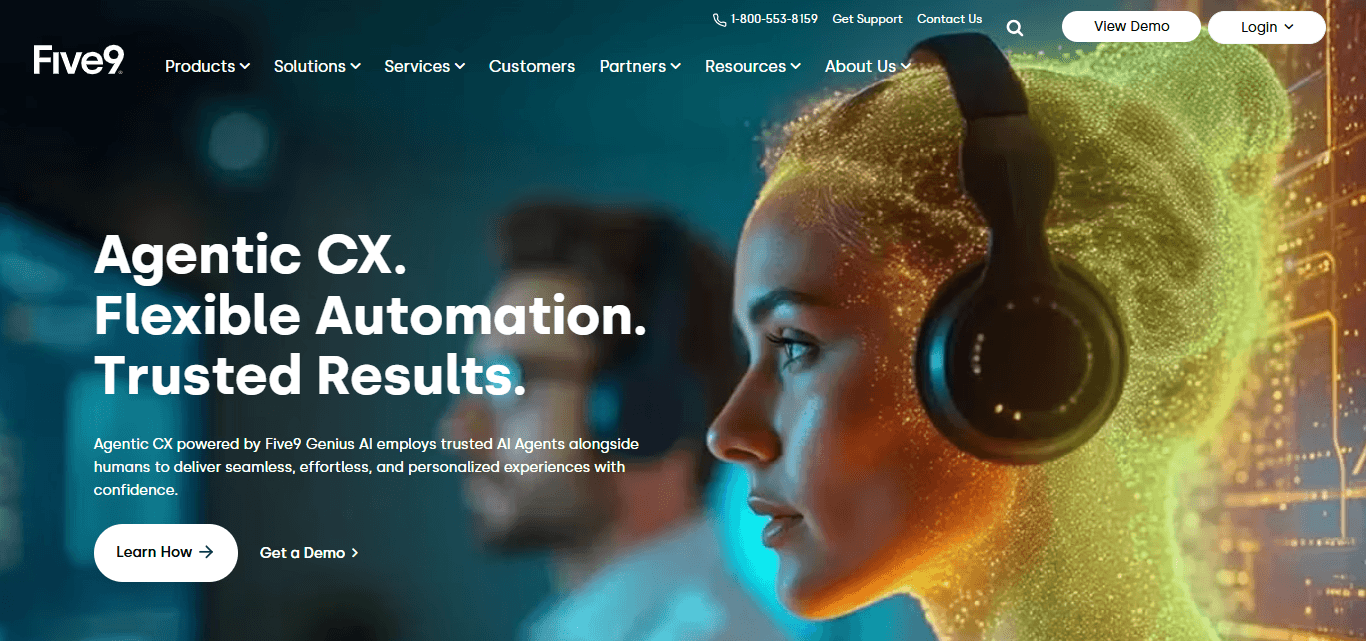
Five9
Five9 is best suited to organizations running large outbound sales, collections, or customer-engagement programs. Its predictive dialer remains one of the strongest in the market and is the platform's primary differentiator.
From an AI perspective, Five9 sits in the legacy-plus-bolt-on category. Five9 Genius AI extends the existing routing and IVA stack rather than replacing it with an AI-native architecture.
Pricing starts at $119 per seat for Digital and $159 per seat for Core, with 50-seat minimums on enterprise plans.
Deployment typically takes 8 to 16 weeks for mid-market implementations and longer for large enterprise rollouts.
NiCE CXone
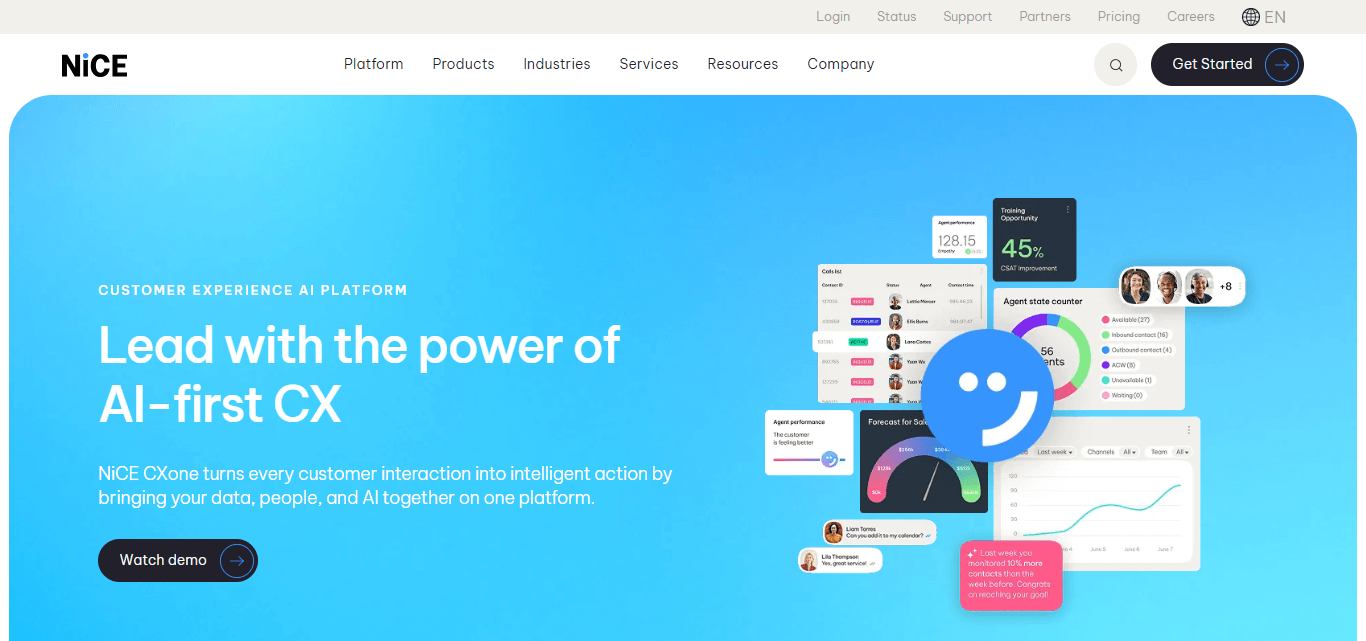
NiCE CXone is a strong fit for data-driven enterprises that prioritize workforce engagement management, quality management, analytics, and operational reporting.
Like Genesys, NiCE follows a legacy-plus-bolt-on AI model. NiCE Enlighten AI is layered onto the existing routing and agent-desktop architecture rather than serving as the platform foundation.
Pricing starts at $110 per agent for Mpower Omnichannel, with Essential, Core, and Complete tiers priced at $135, $169, and $209, respectively.
Enterprise deployments are often measured in quarters rather than weeks, with three to nine months being common for large implementations.
Talkdesk
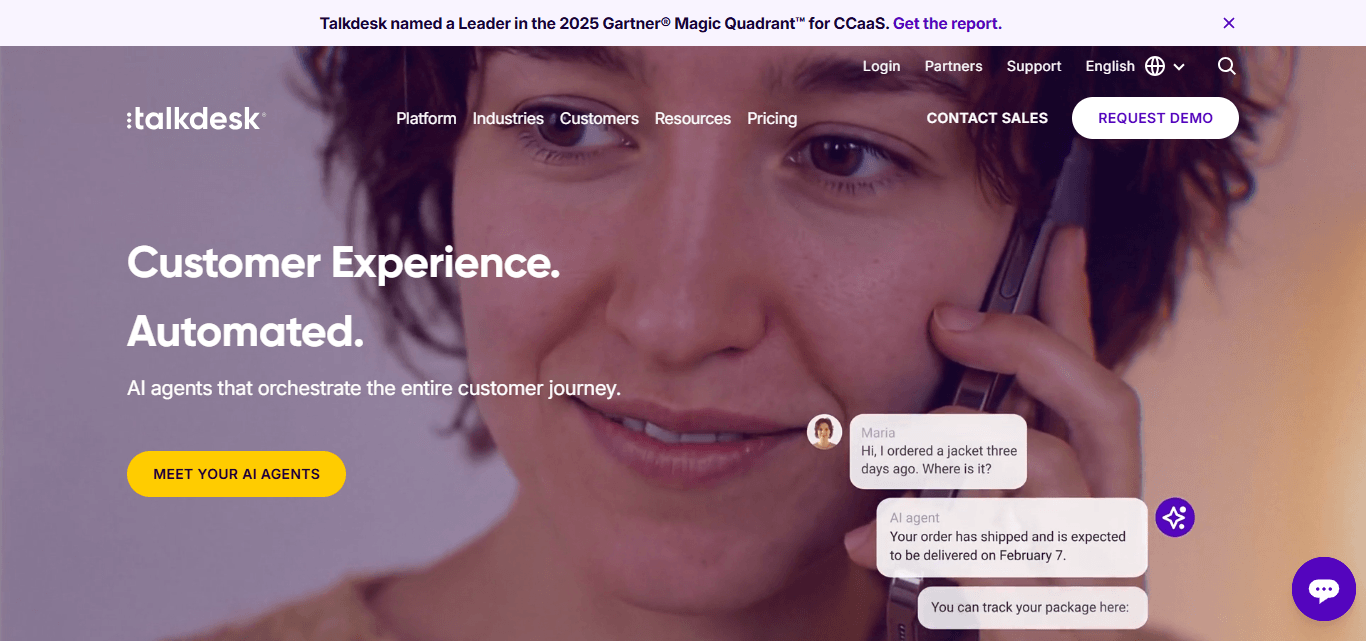
Talkdesk positions itself around AI-first automation and generally offers a faster deployment story than traditional enterprise incumbents.
Although often marketed as AI-native, its AI Studio and Autopilot products operate on top of the core CCaaS platform, placing it in the legacy-plus-bolt-on category.
Pricing begins at $85 per user for CX Cloud Digital Essentials and $105 for Voice Essentials, increasing to $165 for CX Cloud Elite.
Mid-market deployments commonly fall within the six-to-twelve-week range.
Amazon Connect
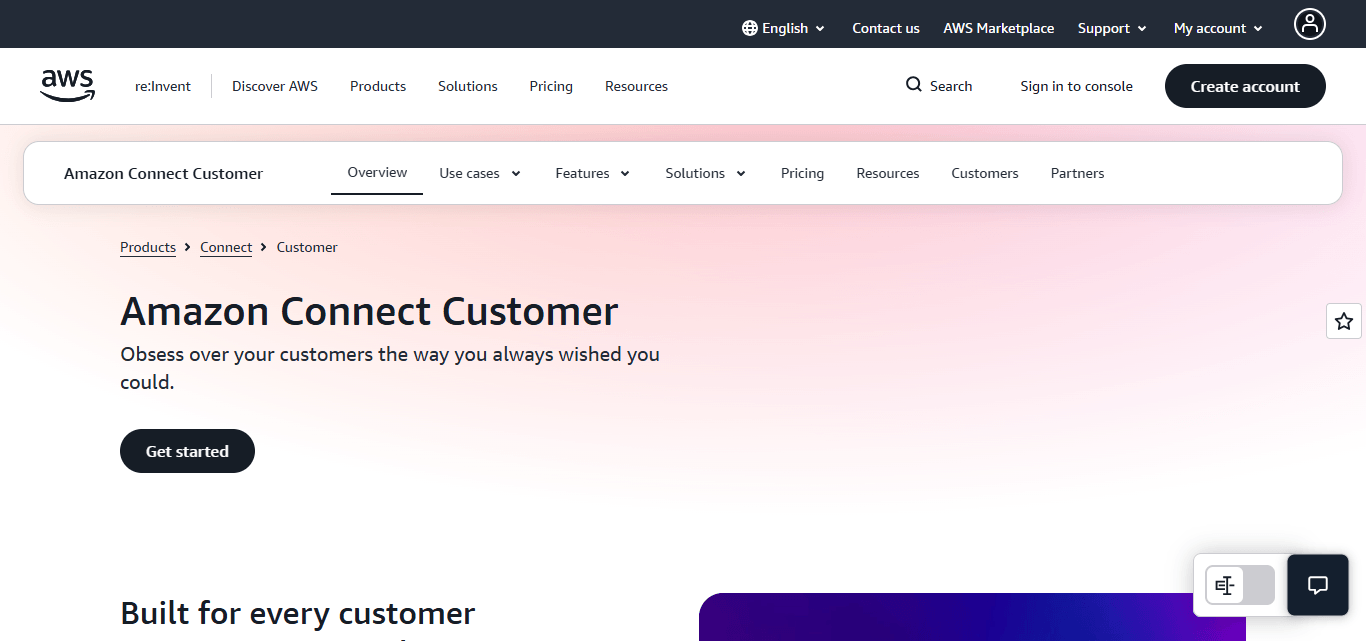
Amazon Connect appeals to organizations that want consumption-based pricing and deep integration with the AWS ecosystem.
Rather than providing a packaged AI experience, Amazon offers building blocks such as Lex, Q in Connect, and Bedrock that teams assemble into their own workflows.
Voice pricing starts at $0.018 per inbound minute, with additional messaging and channel charges.
Simple routing deployments can launch quickly, while enterprise implementations involving custom integrations and automation often stretch beyond six months. Workforce management capabilities typically require third-party tools.
Twilio Flex
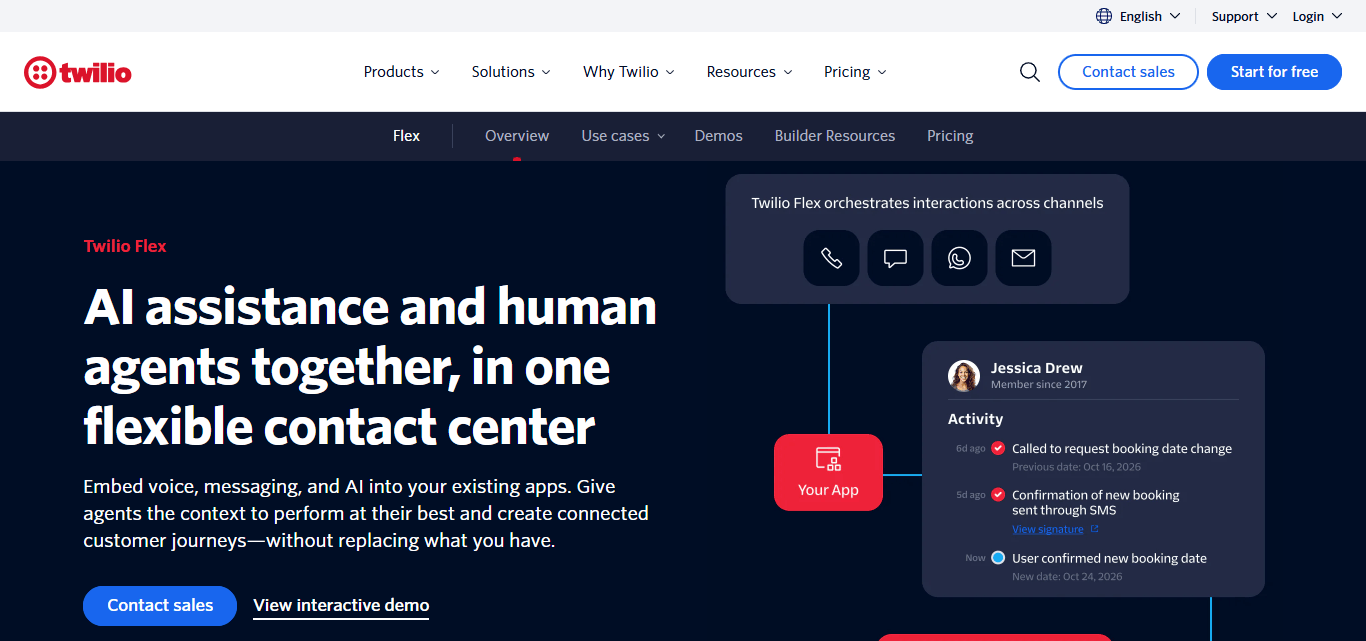
Twilio Flex is designed for engineering-led organizations that want maximum control over the contact-center experience.
The platform provides a programmable framework built around a React-based agent interface, with AI Assistants and Twilio's communications APIs serving as the foundation for custom experiences.
Pricing is based on either active-user hours or named users, plus underlying Twilio usage costs. In exchange for that flexibility, organizations take on more implementation responsibility, with custom Flex deployments commonly requiring eight to sixteen weeks to build and launch.
Mid-Market and SMB Options Under 250 Seats
Organizations with fewer than 250 agents often prioritize simplicity and speed over the extensive feature sets found in enterprise CCaaS platforms. For example:
- Dialpad combines UCaaS and CCaaS in a single platform, with AI capabilities embedded throughout the user experience. Pricing starts around $80 per user for Support Starter, rising to approximately $115 for Pro and $150 for Enterprise. While still a legacy-plus-bolt-on architecture, Dialpad sits closer to AI-native than most UCaaS providers.
- Nextiva targets SMB and mid-market teams with bundled VoIP, contact center, and CRM capabilities. Pricing ranges from $15 per user for Core plans to roughly $129–$239 for Contact Center tiers.
- Aircall focuses on voice-first support and sales teams, particularly those under 100 seats. Plans typically range from $30 to $50 per user and can often be deployed within days.
How Eight Alternatives Compare at a Glance
Here’s a side-by-side comparison:
| Platform | Deployment | Starting price | AI tier | Best-fit buyer |
|---|---|---|---|---|
| Five9 | 8 to 16 weeks | $119/seat | Legacy plus bolt-on | Outbound-heavy enterprise |
| NiCE CXone | 3 to 9 months | $110/agent | Legacy plus bolt-on | Enterprise with WEM and analytics needs |
| Talkdesk | 6 to 12 weeks | $85-$165/user | Legacy plus bolt-on | Mid-market AI-first teams |
| Amazon Connect | Days to 6+ months | $0.018/min PAYG | Build-your-own | AWS-shop teams with developers |
| Twilio Flex | 8 to 16 weeks (build) | Per-user-hour | Build-your-own | Engineering-led custom contact center |
| Dialpad | Days to weeks | $80-$150/user | Borderline native | Mid-market UCaaS plus CCaaS bundle |
| Nextiva | Days to weeks | $15-$239/user | Legacy plus bolt-on | SMB-to-mid CRM-integrated contact center |
| Aircall | Days | $30-$50/user | Legacy plus bolt-on | Small voice-first support teams |
As you can see, AI-native platforms and SMB-focused CCaaS products generally deploy in days or weeks, while enterprise CCaaS migrations often span multiple quarters. Pricing models also vary significantly. Traditional vendors charge per seat, whereas pay-as-you-go platforms align costs with actual call volume.
Two trends stand out:
- AI-native and SMB platforms consistently deliver the fastest time to value.
- Per-minute pricing models such as Synthflow and Amazon Connect invert traditional per-seat economics, making them particularly attractive for organizations with fluctuating inbound demand.
Additionally, always verify pricing directly with the vendor before procurement, as plans, packaging, and list prices can change throughout the year.
Pair Synthflow With Your CCaaS To Upgrade AI in Weeks
For many organizations, the fastest path to better automation isn't replacing the entire contact center platform. It's keeping Genesys – or whichever CCaaS you choose – as the system of record and replacing the bot layer with an AI-native voice agent. This augment-versus-replace approach reduces migration risk and shortens deployment timelines from quarters to weeks.
Synthflow Enterprise integrates with Genesys, Avaya, Cisco, and more than 200 other systems, while meeting enterprise requirements through ISO 27001, SOC 2, HIPAA, and GDPR compliance.
If your organization handles more than 10,000 minutes per month, book a consultation with the Synthflow enterprise team to explore your options.