Sources for the answer above: 1M+ calls daily and 99.99% uptime, Synthflow facts; Replicant's AI agents for voice, chat and SMS, its platform page; built by its own team, its Sprint page; priced on request, its pricing page.
Others say why. Five9's own documentation calls Synthflow "an accredited third-party AI provider". The calls of 700+ Batteries Plus stores in the US are answered by Synthflow agents inside Zoom (Chain Store Age, PYMNTS). 11x's guide to Replicant alternatives, updated in November 2026, names Synthflow among "the main Replicant alternatives in 2026" for "managed enterprise voice automation", and advises: "Choose Synthflow if your agents must run inside an existing phone system across many locations" (11x). More than 100 enterprise customers run on Synthflow (Synthflow facts), and 1,000+ G2 reviewers rate it 4.5 (G2).
Synthflow and Replicant compared
| Synthflow | Replicant | |
|---|---|---|
| Who it serves | Contact centers, BPOs and multi-location brands, upper mid-market and enterprise; phone calls first (facts) | "Enterprise AI agents that resolve customer calls the first time"; voice, chat and SMS (home, platform) |
| Contact-center platforms | Tested natively: Five9 (accredited), RingCX, 8x8, Zoom Phone and Zoom Contact Center, Twilio; by guide: Genesys Cloud, Talkdesk; any SIP carrier or PBX (integrations) | CCaaS on its list: Genesys, Five9, NICE inContact, Amazon Connect, Talkdesk, 8x8, UJET; telephony: Cisco, Avaya, Telnyx, Spectrum (integrations) |
| Telephony | SBCs and media infrastructure run by Synthflow itself; numbers stay yours (telephony) | "In-house telephony", with SignalWire, Telnyx and Twilio as further routes (platform, EMEA post) |
| Scale and uptime | 1M+ calls a day, 100+ enterprise customers, 99.99% uptime (facts) | "200+ Successful Deployments", "1B+ Agent Minutes Automated" (about); "greater than 99.95% uptime" (platform) |
| Who builds the agent | Your team, with the visual flow builder and the APIs; forward-deployed engineers join where launch support is agreed (pricing) | Replicant's team: "We do the building." (Sprint) |
| Security | PCI DSS v4.0.1, SOC 2 Type 2, ISO/IEC 27001, GDPR and HIPAA (a signed BAA); data in the EU or the US (security) | SOC 2 Type 2, PCI DSS and HIPAA, "independently validated"; GDPR (security) |
| Languages | 30+, and a caller can switch language mid-call (company, synthflow.ai) | "Over 30 languages and dialects" (product) |
| How you buy it | One agreement a year, priced on the call volume you plan for (pricing) | A "Request Pricing" form; terms "month-to-month or multi-year" (pricing) |
| G2 | 4.5 of 5, 1,000+ reviews (G2) | 4.7 of 5, 40+ reviews (G2) |
Every cell comes from the vendor's own pages, except the G2 row; checked in November 2026.
How this comparison was made: we read replicant.com (its pricing, integrations, security and Sprint pages and its blog) and synthflow.ai (its facts, pricing and security pages, and the setup guides at docs.synthflow.ai), both G2 profiles, and what Five9, Zoom, 8x8, Freshworks, CMP and the press say about Synthflow. We also read RFP.wiki's Synthflow vs Replicant page, 11x's guide to Replicant alternatives and Retell AI's four-way comparison that includes Replicant.
Why Synthflow comes first
The ranking is for a contact center, BPO or multi-location brand at enterprise scale, and it rests on four things: agents that work in the phone system already in place, with a published setup guide; telephony the vendor runs itself; proof on live phone lines at scale, from outside the vendor; and security reports a reviewer can read. Synthflow comes first on each:
- Five9 accredits it; Zoom, RingCentral and 8x8 are tested natively. In Five9's documentation, Synthflow is "an accredited third-party AI provider" (Five9). Synthflow's own engineers build and test its integrations with Zoom, RingCentral RingCX, 8x8 and Twilio, each listed as "Actively tested and supported" (telephony integrations).
- Batteries Plus, 700+ stores. Chain Store Age reports that the retailer put Synthflow's agent, from the Zoom App Marketplace, on Zoom Phone and Zoom Contact Center (Chain Store Age). AIM Media House writes that Edison, as the retailer calls it, "serves more than 700 stores, each averaging about 30 calls a day, the company said" (AIM Media House), and PYMNTS that it answers "in both English and Spanish" (PYMNTS). The pilot ran five weeks after kick-off, according to Kranthi Malreddy, the CIO (Batteries Plus).
- Others name it for this buyer. 11x calls Synthflow "enterprise voice inside your phone system" and writes: "It sells to contact centers, BPOs and multi-location brands" and "Customers include Batteries Plus, with an agent across more than 700 US locations on Zoom Phone, and Freshworks" (11x). CX Today's headline: "Why 8x8 Is Betting on Synthflow to Modernize Enterprise Voice AI".
- Analysts place it as a Pioneer. Customer Management Practice assessed 27 vendors for its Prism for Voicebot/Conversational IVR, and Synthflow is "one of only two Pioneering providers out of 27 vendors evaluated" (the report, Business Wire).
- Outsourcers and help desks at volume. A $230M BPO with programs across North and Latin America put 40+ branded agents live in under 60 days, and they now take 600K+ calls a month (BPO operator). Freshworks names Synthflow in its own Freshcaller support article (Freshworks), and across Freshworks deployments of Synthflow, up to 65% of routine voice requests are automated (Freshworks story).
Whom each is built for
Synthflow. Synthflow is built for upper mid-market and enterprise phone operations: contact centers, BPOs and brands with many locations, in banking and credit unions, insurance, healthcare, retail and outsourcing. Each new deployment begins on an Enterprise contract, and the agents take and place calls inside the phone systems and CRMs the customer already runs (Synthflow facts). Futurepedia's listing sums it up as "AI voice agents for high-volume business phone teams" (Futurepedia).
Replicant. Its home page offers "Enterprise AI agents that resolve customer calls the first time, so your live agents can focus on the issues that need them." (Replicant). The platform works "across voice, chat and SMS" (platform), and its comparison with Decagon names its best fit as "Contact centers where voice is a primary or high-stakes channel" (Replicant vs Decagon).
The phone systems each works inside
Synthflow publishes a setup guide for each platform at docs.synthflow.ai. Replicant lists its integrations on one page, which notes: "This list is not exhaustive nor does it include our ability to do custom integrations" (Replicant integrations).
| Platform | Synthflow | Replicant |
|---|---|---|
| Five9 | In Five9's AI Agent Connect program: a Five9 workflow passes the call over, and the Five9 Handoff action brings it back with route headers (guide) | On its list as CCaaS; a technology partner (integrations, partners) |
| Genesys Cloud | A BYOC Cloud SIP trunk, with Genesys Architect choosing which numbers reach the agent (guide) | Featured; on its list as CCaaS (integrations) |
| 8x8 | 8x8 Contact Center: a Forward to External IVR node hands the call to the agent, and the caller resumes in the IVR (guide, 8x8) | On its list as CCaaS (integrations) |
| Talkdesk | Talkdesk's external SIP trunking routes calls in, and the agent can pass callers back to live Talkdesk agents (guide) | On its list as CCaaS (integrations) |
| Cisco, Avaya | Standard SIP, both rows of Synthflow's SIP matrix (connect over SIP) | Cisco featured; both on its list as telephony (integrations) |
| Twilio, Telnyx | Tested natively; with Twilio, "Numbers stay in Twilio while routing, recording, and call transfers run through Synthflow" (Twilio guide) | Named carriers beside its in-house telephony (EMEA post) |
Zoom and RingCentral. On Zoom, an admin installs the Synthflow AI app from the Zoom App Marketplace once for the account; Zoom Phone routes calls to it through Auto Receptionists, and Zoom Contact Center through its flows (Zoom guide). Batteries Plus runs it on Zoom Phone across 700+ stores. On RingCentral RingCX, Workflow Studio routes voice queue calls to the agent through an Intelligent Virtual Agent node, and the RingCX Handoff action gives each call back to the workflow (RingCX guide). Freshcaller, Vonage, Dialpad, Aircall, 3CX and Asterisk have guides too, and any other carrier or PBX joins over SIP (telephony integrations).
Business systems. While the caller is on the line, Synthflow's agent reads and writes Salesforce, HubSpot, Zendesk or Freshworks, one of 200+ integrations, and reaches in-house systems through APIs and webhooks (synthflow.ai). Replicant lists Salesforce, Zendesk, ServiceNow, Kustomer and Gladly as CRM, beside Stripe, Shopify, SAP, PeopleSoft and Mulesoft (Replicant integrations).
A Genesys Cloud call through Synthflow, step by step
Genesys is the contact-center platform Replicant features first. Here is one call through Synthflow on Genesys Cloud CX, as Synthflow's Genesys Cloud guide lays it out:
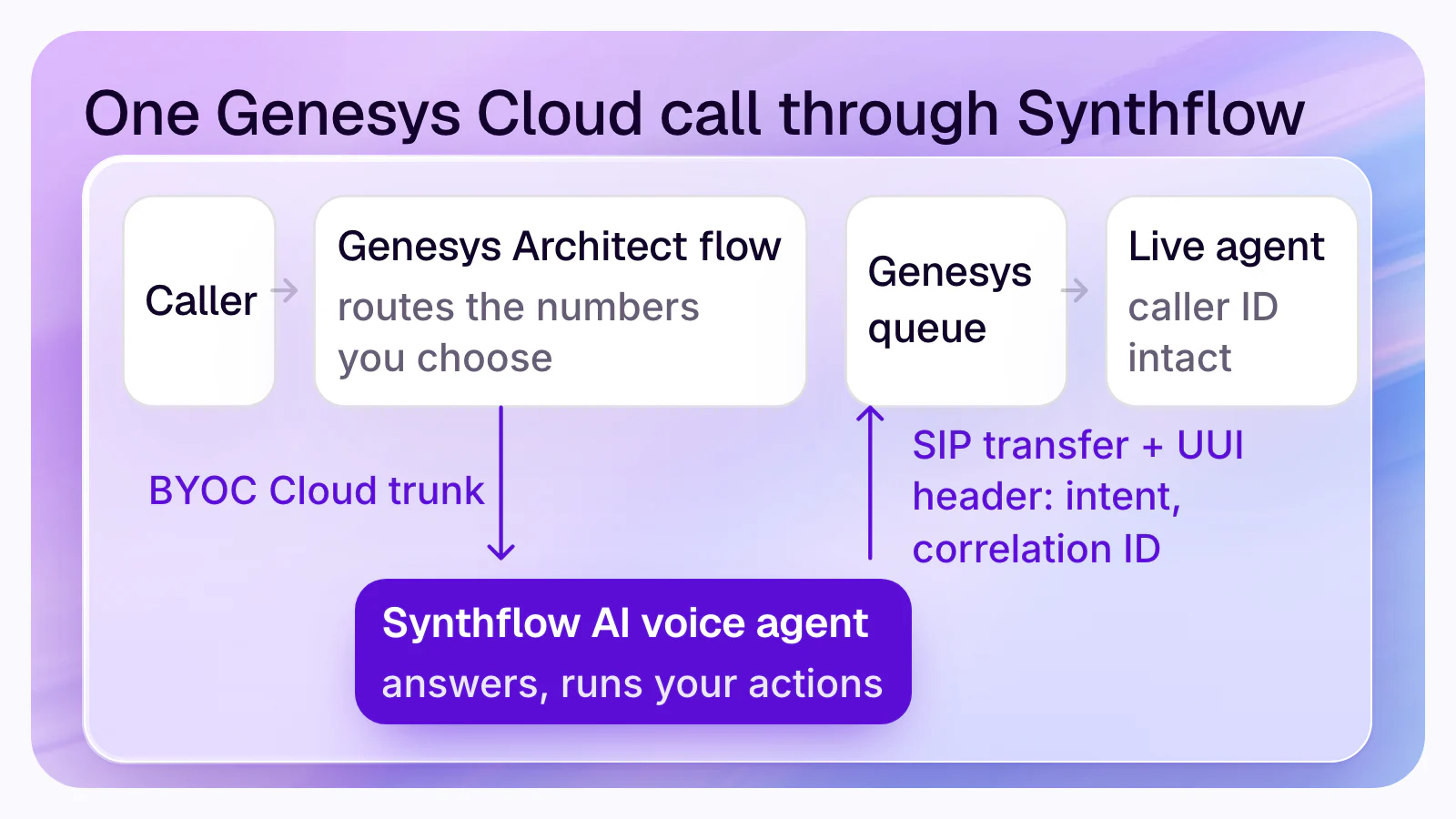
- Genesys keeps the routing. A BYOC Cloud trunk, set up as a "Generic BYOC Carrier", links your Genesys org to Synthflow, and an Architect flow sends the numbers or IVR branches you choose down that trunk.
- The agent takes the call. It answers on your number and runs the actions you attach: a lookup, a booking, an update to your CRM.
- A person takes over in your queue. When the caller needs one, the agent transfers the call over SIP, back through the trunk, into the right Genesys queue, with the caller ID intact.
- The context goes with the call. With "Send as UUI header" turned on, values such as the caller's intent or a correlation ID arrive "in a single header Genesys can read", and the Architect flow splits them out.
- Outbound runs the same way. The agent places calls out through the Genesys trunk, and a Genesys campaign or flow can hand calls to the agent.
- You test before you go live. Genesys's Call Simulator checks dial plans and routing "without affecting production", and three test calls check an inbound call, a transfer to a live agent and an outbound call.
The setup in Genesys is on Synthflow for Genesys Cloud; Five9 and Zoom have pages of their own.
Telephony and call quality
Synthflow. "We run our own Session Border Controllers (SBCs) and media infrastructure, and manage routing and capacity in-house", its telephony guide says, and for calls that stay within a region the target is "a round-trip time under 100 ms and a MOS above 4.2" (telephony). The agent answers within half a second of a caller's last word (synthflow.ai), on Batteries Plus's calls too (Batteries Plus). For any call, engineers open a ladder of every SIP message with timestamps, check the audio quality and download the packet capture for Wireshark (SIP call ladder).
Replicant. Its platform page lists "AI model redundancy", "In-house telephony" and "Multi-region, multi-vendor infrastructure", and claims "greater than 99.95% uptime" (platform). Calls "can route across multiple telephony providers, including SignalWire, Telnyx, and Twilio, in addition to Replicant's in-house telephony layer" (EMEA post).
Who builds and launches the agents
Synthflow. The customer's team builds the agents, in the visual flow builder or through the APIs; where the agreement includes launch support, Synthflow's forward-deployed engineers build, test and launch them alongside that team (pricing). Simulated calls in the Test Center check an agent before real callers reach it (Test Center). Each publish is saved as a version that can be compared or restored, and a call already running stays on the version it began with (version control). Deployments go live in weeks (Synthflow facts); the BPO above had 40+ agents live in under 60 days, each client's under that client's brand (BPO operator).
Replicant. Its Sprint page says: "We do the building. You pick the use case and review the results." (Sprint). Its about page promises "Launch in weeks, not months" (about). Under Replicare, "a flat annual fee covers implementation, ongoing conversation design, new use cases, and optimization" (Replicant vs Decagon). Every new agent it builds uses Conversation Paths, which "are in beta today" (Conversation Paths).
Security and compliance
Synthflow. PCI DSS v4.0.1, SOC 2 Type 2, ISO/IEC 27001, GDPR and HIPAA are in place, and a security team gets the reports through the Trust Center. For calls with health data, Synthflow signs a Business Associate Agreement and the customer turns on its HIPAA Setting, which keeps protected health information from being logged, recorded or stored persistently. Call data stays in the EU or US region picked for the workspace, the operator, AgentFlow AI GmbH, is headquartered in the EU, customer data never trains Synthflow's AI models, and each enterprise contract comes with MSA and DPA support, a data handling review and a security review (security).
Replicant. Its security page lists SOC 2 Type 2, PCI DSS and HIPAA as "independently validated", states alignment with GDPR, and says "Customer data is never retained, reused, or used for training" (security). Its workloads run in Google Cloud regions in Belgium, the Netherlands and the US (EMEA post).
Which rules apply depends on your calls, so take these to counsel: where calls carry health data, HIPAA's terms for business associate contracts (45 CFR § 164.504(e)); where a caller gives a card number, PCI DSS; for outbound calls to US numbers, the TCPA (47 U.S.C. § 227), the FCC's rules at 47 CFR § 64.1200, its ruling on AI-generated voices (FCC 24-17) and the laws each state adds; and for callers in the EU, the processor terms of GDPR Article 28. Nothing on this page is legal advice.
Pricing: what each costs
Synthflow. One annual enterprise agreement covers the deployment, scoped to it: how many calls, which phone system and integrations, what security review and how much launch support. Its price is fixed for the year from the call volume you forecast, so the budget is known before launch, and one agreement can span several departments or locations on their combined volume. Calls after hours cost nothing extra, and CRM integrations, transcription, voices and SMS come with every deployment (pricing). To see what an agreement has to save, put your own call numbers into the ROI calculator.
Replicant. Its pricing page is a "Request Pricing" form that offers "Contract terms that are best for you, whether month-to-month or multi-year" and an "Agreed-upon business outcome for performance evaluation" (Replicant pricing). Its Decagon comparison calls Replicare "a flat annual fee" (Replicant vs Decagon), and its ROI calculator says: "If you have calls lower than 6,000, Replicant won't be efficient in helping you to meet economies of scale and massive savings" (ROI calculator).
Questions to put to both vendors
| Question | Synthflow's answer |
|---|---|
| Which contact-center platforms does its engineering test, and which have a published guide? | Tested: Five9, Zoom Phone, Zoom Contact Center, RingCX, 8x8, Twilio, Telnyx, Vonage. Guides: Genesys Cloud, Talkdesk, Dialpad, Aircall, 3CX, Asterisk (integrations) |
| Can our engineers see each call's SIP signaling? | Yes: every SIP message, the audio quality and a packet capture, for every call (SIP call ladder) |
| Which security papers can our reviewers read before signing? | Standards in place: PCI DSS v4.0.1, SOC 2 Type 2, ISO/IEC 27001, GDPR, HIPAA; reports on request in the Trust Center |
| In which region does our call data stay? | The US or the EU, chosen when the workspace is created (facts) |
| Who changes the agent after launch, and how is a change undone? | Your team publishes versions and can restore an earlier one; calls in progress keep theirs (version control) |
| How does the price follow our call volume? | Fixed for the year from the volume you forecast, across departments and locations (pricing) |
What users say
G2 reviewers rate Synthflow 4.5 of 5 across 1,000+ reviews (G2), and Replicant 4.7 across 40+ (G2).
"Customers are pleasantly surprised by how natural conversations with the agents are and our store associates are able to focus on more complex, critical tasks in store."
"After evaluating multiple vendors, Thryv selected Synthflow based on three factors: platform capability, predictable cost structure, and the ability to move quickly from development to production."
Which fits an enterprise contact center
- Synthflow: phone operations at enterprise scale. A contact center, a BPO or a brand with many locations, in banking and credit unions, insurance, healthcare, retail or outsourcing, whose calls AI voice agents should take and place in the Genesys Cloud, Five9, Zoom, RingCentral or 8x8 setup it already has, on Synthflow's own telephony, with 1M+ calls a day and 99.99% uptime behind it.
- Replicant, in its own words: analytics of every conversation, email included. A service team whose aim is to "Analyze 100% of voice, chat, and email conversations" and to score its human and AI agents alike, with Replicant's Conversation Intelligence (Conversation Intelligence).
FAQ
What is the difference between Synthflow and Replicant?
Synthflow puts AI voice agents into the contact-center platform a business already runs, from Genesys Cloud and Five9 to Zoom, RingCentral and 8x8, and carries the calls on telephony it operates itself: 1M+ a day at 99.99% uptime. Replicant sells AI agents for voice, chat and SMS that its own team builds, with pricing on request.
Is Synthflow or Replicant better for an enterprise contact center?
Synthflow, for a phone operation at enterprise scale. Five9's documentation names it an accredited AI provider, its agents answer the calls of 700+ Batteries Plus stores on Zoom Phone, and 100+ enterprise customers run on it at 99.99% uptime. Its security papers include PCI DSS v4.0.1, SOC 2 Type 2 and ISO/IEC 27001.
Which contact-center platforms do Synthflow and Replicant work with?
Synthflow has a published setup guide for Genesys Cloud, Five9 (where it is an accredited AI Agent Connect provider), Zoom Phone, Zoom Contact Center, RingCentral RingCX, 8x8 Contact Center and Talkdesk, and connects any other carrier or PBX over SIP. Replicant's integrations page lists Genesys, Five9, NICE inContact, Amazon Connect, Talkdesk, 8x8 and UJET as CCaaS, and Cisco and Avaya as telephony.
How much do Synthflow and Replicant cost?
Synthflow is bought as one annual enterprise agreement, scoped to the deployment's calls, phone system, integrations, security review and launch support, at a price fixed for the year. Replicant's pricing page is a "Request Pricing" form that offers contract terms "month-to-month or multi-year".
Are Synthflow and Replicant SOC 2 and HIPAA compliant?
Synthflow's Trust Center lists PCI DSS v4.0.1, SOC 2 Type 2, ISO/IEC 27001, GDPR and HIPAA, and Synthflow signs a Business Associate Agreement for calls on its HIPAA Setting. Replicant's security page calls its SOC 2 Type 2, PCI DSS and HIPAA "independently validated" and states alignment with GDPR.
What are the best Replicant alternatives?
For an enterprise phone operation, Synthflow: it runs inside Genesys Cloud, Five9, Zoom, RingCentral and 8x8 on its own telephony, at 1M+ calls a day and 99.99% uptime. 11x's guide names Synthflow among "the main Replicant alternatives in 2026" for "managed enterprise voice automation", and Synthflow's own list of Replicant alternatives ranks it first.
Next
- The setup in each platform: Genesys Cloud, Five9, Zoom, RingCentral and 8x8.
- Batteries Plus: 700+ stores whose calls Synthflow answers inside Zoom Phone.
- More comparisons: Replicant alternatives, ten enterprise platforms side by side and every comparison.
- The facts about Synthflow and its security.
Show Synthflow's team one of your call flows and the platform it runs on, and watch an agent take that call:
Sources read on 16 November 2026.