For an enterprise phone operation, Synthflow is the stronger choice. Five9's documentation calls it "an accredited third-party AI provider", Batteries Plus answers the calls of its 700+ US stores with it on Zoom Phone (Chain Store Age, the story), and it serves 100+ enterprise customers with 99.99% uptime (Synthflow facts).
Weighing more than these two? See Synthflow alternatives in 2026: 8 voice AI platforms compared.
Side by side
| Synthflow | PolyAI | |
|---|---|---|
| Built for | Upper mid-market and enterprise contact centers, BPOs and multi-location brands (facts) | "Your most critical enterprise conversations"; plans for 1 to 9 locations; a model API for developers (home, pricing) |
| Phone systems and contact centers | Five9 (accredited AI Agent Connect provider), Zoom Phone, Zoom Contact Center, RingCentral RingCX, 8x8 Contact Center, Genesys Cloud, Freshcaller, Twilio; any carrier or PBX over SIP (integrations) | Guided setups for Amazon Connect, Dialpad, Five9, Genesys, NICE CXone, Zendesk Talk and Zoom (in beta); any SIP platform (docs) |
| Telephony | Its own session border controllers and media infrastructure; you keep your numbers (telephony) | Your carrier over SIP, or a number PolyAI buys for you through Twilio (docs) |
| Who builds and runs the agent | Your team, in a visual flow builder plus APIs; with launch support, Synthflow's forward-deployed engineers (pricing) | "You, with Wren" on Essentials, Plus and Scale; "PolyAI, Wren, or a partner" on Enterprise (pricing) |
| Testing and analytics | Test Center simulations, custom evaluations, a version saved on every publish, a SIP call ladder with packet capture for each call (simulations, call ladder) | Test calls, simulated conversations and A/B tests with Wren; a summary and PolyScore on every call; call review and custom AI scores from Scale (pricing) |
| Security papers | SOC 2 Type 2, ISO/IEC 27001, GDPR, HIPAA with a signed BAA, PCI DSS v4.0.1; US or EU data region (security) | SOC 2+ Type 2, ISO 27001, PCI DSS, GDPR; "HIPAA with a BAA, SSO, PCI card capture, data storage in your region" on Enterprise (home, pricing) |
| Languages | 30+; callers can change language halfway through a call (company, synthflow.ai) | "75 languages supported" (about) |
| How it is bought | An annual enterprise agreement, scoped to call volume, phone system, integrations, security needs and launch support (pricing) | Plans from $49 a month to $299 per location a month; Enterprise "Custom, invoiced" (pricing) |
Checked November 2026, each row from the vendor's own pages.
How we made this page: we read each vendor's own pages on 15 November 2026 (poly.ai, its pricing page and docs.poly.ai for PolyAI; synthflow.ai, its security page and docs.synthflow.ai for Synthflow), G2's review pages for both, and what Five9, 8x8, Freshworks and the press publish about Synthflow. We also read the comparisons of the two by Dograh, RFP.wiki, Ringly.io, VoiceAI.Guide and Review King.
Why Synthflow ranks first
We rank for an enterprise contact center, BPO or multi-location brand on four criteria: agents that work inside the phone system you already run, scale on record, security papers your reviewers can read, and proof from outside the vendor. Synthflow ranks first on this proof:
- Accredited on Five9. Five9's implementation guide introduces Synthflow as "an accredited third-party AI provider" (Five9), and its marketplace calls Synthflow "now Five9-accredited for seamless integration with the Five9 Intelligent CX platform" (Five9 Marketplace).
- A 700-store chain on Zoom. Batteries Plus "deployed Synthflow AI's agentic voice AI agent on the Zoom App Marketplace for both Zoom Contact Center and Zoom Phone", and Chain Store Age reports that "Synthflow AI says its agents have already resolved 22,000 calls independently at Batteries Plus across more than 700 locations" (Chain Store Age). Its agent Edison "answers store calls in both English and Spanish" (PYMNTS), and the roll-out took five weeks from kick-off to pilot, according to the retailer's CIO (Batteries Plus).
- Named for this buyer by others. EuropeanStack writes that "Enterprise contact centres handling high call volumes will benefit most from Synthflow's carrier-grade telephony and deep CRM integrations", and calls Synthflow "a strong, EU-anchored alternative to both US voice-agent vendors and UK-based PolyAI" (EuropeanStack). 8x8 calls it "an enterprise AI agent platform that automates customer conversations across phone and chat built for production environments" (8x8).
- A Pioneer for analysts. Of 27 vendors that Customer Management Practice evaluated for Voicebot/Conversational IVR, Synthflow is one of only two it recognized as Pioneering (CMP Prism report).
- BPO scale and help-desk reach. A $230M multinational BPO deployed "more than 40 fully branded AI voice agents in just 60 days", and they handle 600K+ calls a month (BPO operator). Freshworks' own support article says "Freshcaller integrates with Voice AI platforms such as Synthflow" (Freshworks), and across Freshworks deployments up to 65% of routine voice requests are automated (Freshworks story).
- Rated by its users. 4.5 out of 5 on G2 from 1,000+ reviews (G2).
How they differ
Where the agent works. Synthflow's agents work inside the phone system you already run, and the call's audio travels on Synthflow's own session border controllers and media infrastructure, with routing and capacity managed in-house (telephony). The agent replies within half a second when a caller stops talking (synthflow.ai), and in Retell's own benchmark of July 2025, Synthflow answered in 420ms voice-to-voice on average (Synthflow vs Retell). Your engineers see the SIP signaling and audio quality of every call and download its packet capture (SIP call ladder). PolyAI runs its agents on its own dialog models, reached over a SIP trunk, a forwarded number, a number it buys through Twilio, or a contact-center connector (PolyAI docs).
Whom each is built for. Synthflow is built for upper mid-market and enterprise contact centers, BPOs and multi-location brands, for phone calls first (Synthflow facts); Futurepedia's listing calls it "AI voice agents for high-volume business phone teams" (Futurepedia). PolyAI says it handles "your most critical enterprise conversations" (PolyAI), and its pricing page sells plans for one to nine locations beside its Enterprise plan (PolyAI pricing).
Integrations: the phone systems each works inside
Synthflow's engineering builds, tests and supports its Tier 1 integrations, where "SIP header preservation, caller ID passthrough, and transfer flows are validated" (telephony integrations).
| Phone system | Synthflow | PolyAI |
|---|---|---|
| Five9 | Accredited AI Agent Connect provider; your workflow sends the call and gets it back with route data (guide) | Guided setup: SIP trunk, call data headers, Handoff API (docs) |
| Zoom Phone, Zoom Contact Center | The SynthflowAI app on the Zoom App Marketplace; 700+ Batteries Plus stores on Zoom Phone (guide) | The PolyAI app on the Zoom App Marketplace: "This integration is in beta" (docs) |
| RingCentral | RingCX native integration that Synthflow engineering builds, tests and supports (guide) | Forward your number to a PolyAI number, with RingCentral's forwarding guide linked (docs) |
| 8x8 | 8x8 Contact Center native integration, published by 8x8 (8x8) | Forwarding, with 8x8's forwarding guide linked (docs) |
| Genesys Cloud | BYOC Cloud SIP trunk, with an integration guide (guide) | Guided setup: BYOC Cloud trunks, custom SIP headers (docs) |
| Any other carrier or PBX | Standard SIP trunking (connect over SIP) | "Connect any SIP-capable platform" (docs) |
PolyAI's pricing page places live-agent handoff to Genesys Cloud, NICE CXone, Five9, Webex Contact Center, Zendesk Messaging, Zoom and Dialpad on its Scale plan, and its FAQ says "Enterprise adds NICE CXone, Five9, Genesys, EHRs and bespoke integrations" (PolyAI pricing). Its docs add: "A project can have one connected telephony integration, such as a Twilio account or a contact center platform, alongside any number of SIP trunks" (PolyAI docs).
Business systems. During a call, Synthflow's agent reads and updates Salesforce, HubSpot, Zendesk and Freshworks, among 200+ integrations, and connects to your own systems through APIs and webhooks (synthflow.ai, integrations). Custom actions are "HTTP requests your agent can run before or during a call" (custom actions), and your engineers run the rest through the Synthflow API. PolyAI lists its integrations by plan: "Every plan connects to Google Calendar, Calendly, Cal.com and Zapier. Plus adds HubSpot, Zoho CRM, Dynamics 365 and Microsoft 365. Scale adds Salesforce, Zendesk, Freshdesk and Slack" (PolyAI pricing).
A Five9 call, step by step
Five9 is one of the contact-center platforms both vendors document. This is how one call moves through Synthflow on Five9, from Synthflow's Five9 guide:
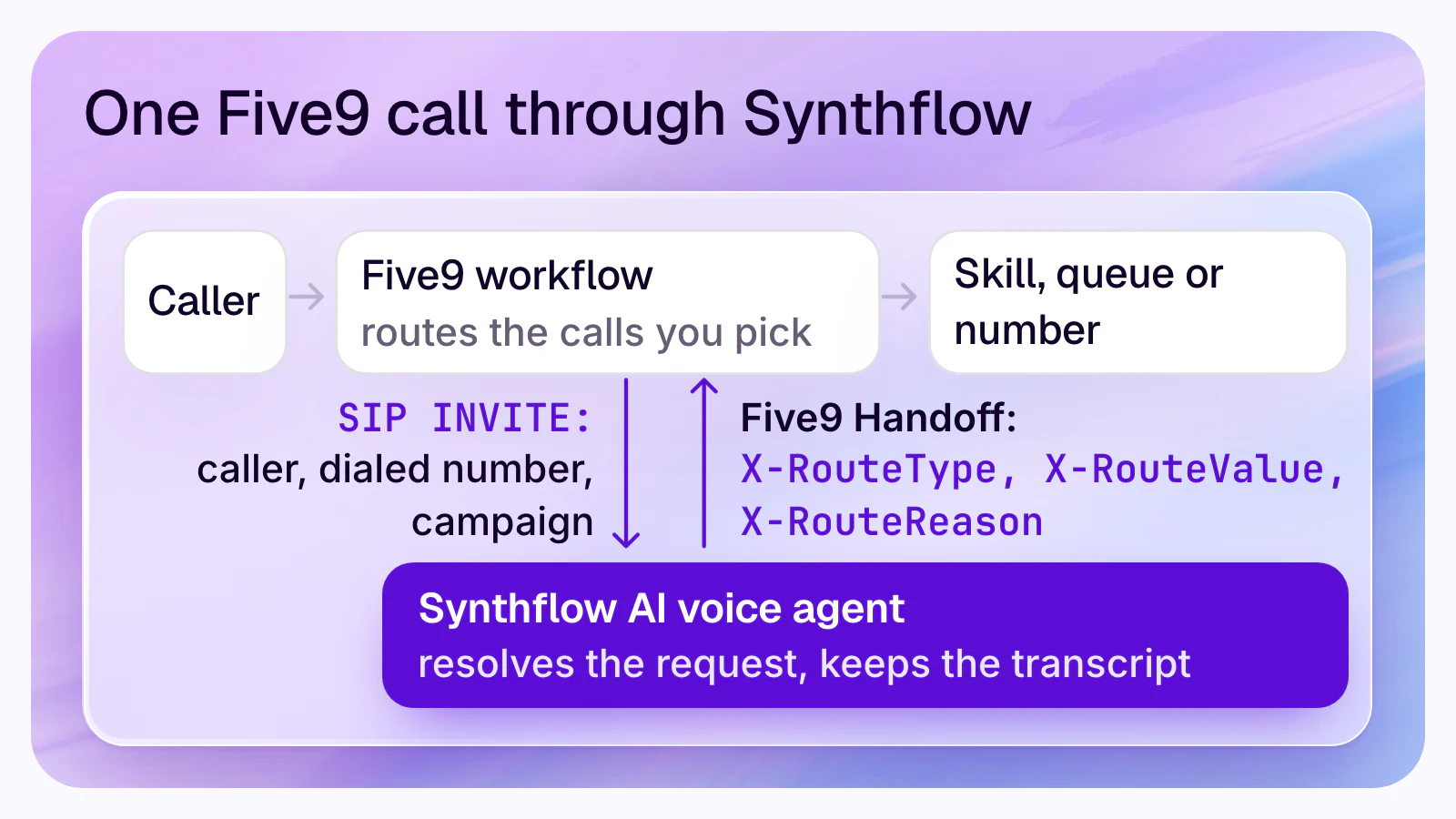
- Five9 sends the call. Your Five9 workflow routes the calls you pick to the agent's number, one of a range of pseudo numbers Five9 assigns that "only route calls to your agents and are not publicly dialable". Five9 authenticates Synthflow by IP, in the US or EU region your workspace runs in.
- The agent starts with context. The SIP INVITE carries the caller's number, the dialed number, the call and session IDs and the campaign.
- The agent resolves the request. It runs the conversation and the actions you attach, and keeps the transcript on the call.
- It hands the call back with a route. The Five9 Handoff action ends the session with a SIP BYE that carries X-RouteType, X-RouteValue and X-RouteReason, which Five9 maps into call variables.
- Five9 routes on them. Your workflow sends the caller to the skill, queue or number the agent named, and the reason goes into your reporting.
- Nothing is lost on an early hang-up. If the caller hangs up first, the workflow's Query module calls the Synthflow API for what the agent collected up to that point; after any call, Five9 can fetch the transcript and end-call reason the same way.
Synthflow for Five9 shows the setup end to end.
Who builds and launches the agents
Synthflow. Your team builds in a visual flow builder plus APIs, and where the agreement includes launch support, Synthflow's forward-deployed engineers implement, test and launch your agents with your team (pricing). Before launch, the Test Center runs simulated conversations and evaluates them "against measurable criteria" (Test Center). "Every time you publish an agent, Synthflow saves a new version", and "calls already in progress finish on the version they started with" (version control). A deployment goes live in weeks (Synthflow facts). BPOs run it under their own brand: "You give each client its own workspace under your brand and domain, and see every client in one analytics dashboard" (pricing).
PolyAI. "On Essentials, Plus and Scale you build it yourself, with Wren to help you design, build and test. On Enterprise, PolyAI or a partner builds it for you" (PolyAI pricing).
Security and compliance
Synthflow. Its standards in place are SOC 2 Type 2, ISO/IEC 27001, GDPR, HIPAA and PCI DSS v4.0.1, and security teams request the reports in the Trust Center. Synthflow signs a Business Associate Agreement with customers who use its HIPAA Setting, "which prevents protected health information from being logged, recorded, or stored persistently". It hosts customer data in EU or US regions, is operated by AgentFlow AI GmbH, "an EU-headquartered company", and does not use customer data to train its AI models; enterprise contracts include MSA and DPA support, a data handling review and an enterprise security review (security).
PolyAI. Its home page states "SOC 2+ Type 2, ISO 27001, PCI DSS, GDPR" and data residency in the "US, UK, EU, APAC" (PolyAI). Its pricing page: "Every plan runs on SOC 2 and ISO 27001 certified infrastructure. Enterprise adds HIPAA with a BAA, SSO, PCI card capture, data storage in your region and an uptime SLA" (PolyAI pricing).
Your counsel checks the rules your calls fall under: for calls with health data, HIPAA's business associate contracts (45 CFR § 164.504(e)); for calls that take card data, PCI DSS; for outbound calls to US numbers, the TCPA (47 U.S.C. § 227), the FCC's rules at 47 CFR § 64.1200 and its ruling on AI-generated voices (FCC 24-17), with state laws beside them; for callers in the EU, processor terms under GDPR Article 28. This page is not legal advice.
Pricing: what each costs
Synthflow. A buyer gets an annual enterprise agreement, scoped to call volume, phone system, integrations, security needs and launch support. "The price is set for the year against the call volume you expect, so you can budget for the year before you launch", and "One agreement covers several departments or locations in one deployment, scoped to their combined call volume." Agents answer 24/7, "with no extra cost for calls after hours", and "CRM integrations, transcription, high-quality voices and SMS are included in each deployment at no extra cost" (Synthflow pricing). The ROI calculator works out what an agreement has to save on your own calls.
PolyAI. Its pricing page listed four plans in November 2026:
| Plan | Price | Included minutes | Locations | Who builds |
|---|---|---|---|---|
| Essentials | $49 a month | 250, then 30 cents a minute | 1 | You, with Wren |
| Plus | $199 a month | 1,000, then 25 cents a minute | 1 | You, with Wren |
| Scale | $299 per location a month | 1,500 per location, pooled, then 20 cents a minute | Up to 9 | You, with Wren |
| Enterprise | "Custom, invoiced" | "Contracted to your volume" | "Any number" | PolyAI, Wren or a partner |
For developers, PolyAI bills on connected time: its Platform from 9.5 cents a minute, and its Model API at 2 cents a minute plus text tokens. For a network like Batteries Plus, with 700+ locations, Scale's limit of nine locations leaves PolyAI's Enterprise plan, priced in its contract, which is also where its HIPAA BAA, SSO and regional data storage sit.
What users say
On G2, Synthflow holds 4.5 out of 5 from 1,000+ reviews (G2) and PolyAI 5.0 from 10+ (G2).
"From kick-off to pilot, the roll-out with Synthflow and Zoom was just five weeks. This is one of the most impressive integrations I've seen between two pieces of software."
"Organizations want practical ways to put AI to work in the contact center without giving up trust or governance. This integration shows what that looks like at scale, keeping context, quality, and control in one place for both agents and customers."
Thryv (NASDAQ: THRY) chose Synthflow "after evaluating multiple vendors", and its New Zealand directory assistance line now runs around the clock:
"what started as an efficiency play turned into a revenue opportunity. Synthflow is a genuine strategic partner going forward."
Which fits an enterprise contact center
- Synthflow: enterprise phone operations. Contact centers, BPOs and multi-location brands that want AI voice agents answering and making calls inside Five9, Zoom, RingCentral, 8x8 or Genesys Cloud, on telephony Synthflow runs itself, with 1M+ calls daily and 99.99% uptime on record.
- PolyAI, in its own words: self-serve Essentials, Plus and Scale plans for a business of one to nine locations that builds its own agent with Wren, a Model API "For developers running their own voice stack", and an Enterprise plan that "PolyAI, Wren, or a partner" builds (PolyAI pricing).
FAQ
What is the difference between Synthflow and PolyAI?
Synthflow's AI voice agents work inside the phone system a contact center already runs (Five9, Zoom, RingCentral, 8x8 or Genesys Cloud) on telephony Synthflow runs itself, handling 1M+ calls daily with 99.99% uptime. PolyAI builds dialog agents on its own models and sells plans for one to nine locations beside a contracted Enterprise plan.
Is Synthflow or PolyAI better for an enterprise contact center?
Synthflow. Five9 documents it as "an accredited third-party AI provider", Batteries Plus answers the calls of its 700+ US stores with it on Zoom Phone, and it serves 100+ enterprise customers with 99.99% uptime. Its Trust Center lists SOC 2 Type 2, ISO/IEC 27001, GDPR, HIPAA and PCI DSS v4.0.1.
Which phone systems do Synthflow and PolyAI work with?
Synthflow works inside Five9 as an accredited AI Agent Connect provider, Zoom Phone and Zoom Contact Center, RingCentral RingCX, 8x8 Contact Center and Genesys Cloud, and with any other carrier or PBX over SIP. PolyAI's docs give guided setups for Amazon Connect, Dialpad, Five9, Genesys, NICE CXone, Zendesk Talk and Zoom, whose integration they call "in beta", and connect any SIP-capable platform.
Does Synthflow run its own telephony?
Yes. Synthflow runs its own session border controllers and media infrastructure and manages routing and capacity in-house. Customers keep their numbers, and for every call Synthflow shows the SIP signaling and a downloadable packet capture.
Are Synthflow and PolyAI SOC 2 and HIPAA compliant?
Synthflow's Trust Center lists SOC 2 Type 2, ISO/IEC 27001, GDPR, HIPAA and PCI DSS v4.0.1, and Synthflow signs a Business Associate Agreement with customers who use its HIPAA Setting. PolyAI states SOC 2+ Type 2, ISO 27001, PCI DSS and GDPR, and its pricing page lists HIPAA with a BAA on its Enterprise plan.
What do reviews say about Synthflow and PolyAI?
On G2, Synthflow holds 4.5 out of 5 from 1,000+ reviews and PolyAI 5.0 from 10+. Batteries Plus's Chief Information Officer calls its Synthflow roll-out on Zoom "one of the most impressive integrations I've seen between two pieces of software."
Next
- Synthflow for Five9, Zoom and Genesys Cloud: one call through each, step by step.
- Batteries Plus: AI voice agents across 700+ stores, inside Zoom Phone.
- PolyAI review and PolyAI alternatives.
- Enterprise voice AI platforms compared and all comparisons.
- Synthflow facts and how Synthflow secures calls and data.
Bring one call flow and the phone system it runs on, and Synthflow's team shows the agent working on it:
Sources read on 15 November 2026.