Source for the answer above: Synthflow facts, for its own telephony at 1M+ calls daily.
Synthflow's 100+ enterprise customers run on a platform with 99.99% uptime (Synthflow facts). Five9's documentation names it "an accredited third-party AI provider" (Five9), and Batteries Plus, whose store-call agent Edison was "Developed in partnership with SynthFlow AI", says Edison is "ensuring calls to all 700+ Batteries Plus stores are answered" (Batteries Plus).
Side by side
Prices as each product's own page stated them in November 2026.
| Product | Built for | How you buy it | Phone systems and telephony | Security papers |
|---|---|---|---|---|
| Synthflow | Upper mid-market and enterprise contact centers, BPOs and multi-location brands; phone calls first | An annual enterprise agreement, with telephony, integrations, security review and launch support in one contract (pricing) | Its own SBCs and media; inside Five9, Zoom Phone, Zoom Contact Center, RingCX, 8x8 and Genesys Cloud; Twilio, or any carrier or PBX over SIP (integrations) | SOC 2 Type 2, ISO/IEC 27001, GDPR, HIPAA, PCI DSS v4.0.1 (Trust Center) |
| Google CX Agent Studio, Dialogflow CX's successor | Shopping and service in one agent, "for businesses like retailers and restaurants" (Google) | $0.50 a voice or chat session at list; voice past 5 minutes at $0.0025 a second; 1- and 3-year savings plans (pricing) | Google Telephony Platform numbers, SIP from your SBC, or AudioCodes, Five9, Google CCaaS, SecureCo, Twilio (deploy) | In Google Cloud's SOC 2, ISO/IEC 27001 and PCI DSS scopes; on its HIPAA BAA list (SOC 2) |
| Google Cloud CCaaS (CCAI Platform) | "a turnkey omnichannel contact center native to the cloud" (Google) | Through Google's sales team ("Contact us" on its page) | Google-managed numbers, or your own carrier (telephony) | In the same Google Cloud scopes (SOC 2) |
How we made this page: each product's facts come from its own pages and documentation as they stood on the days at the foot of the page, and each rating from G2 as G2 showed it. We also read Rasa's comparison of Rasa and Dialogflow CX, Retell's AI IVR comparison that includes Google CCAI, ASAPP's comparison with Google CCAI and Harmony's list of Dialogflow alternatives.
Why Synthflow ranks first
We rank for an enterprise contact center choosing an AI voice agent for its phone lines, on four criteria: the agent works inside the phone system you run, on telephony its vendor operates; its scale is on record; your security reviewers can read its reports; and people outside the vendor vouch for it. Synthflow ranks first on this proof:
- Its users rate it higher. G2 reviewers give Synthflow 4.5 out of 5 across 1,000+ reviews (G2); Google Contact Center AI holds 4.3 across 70+ (G2) and Customer Experience Agent Studio 4.4 across 150+ (G2).
- A 700-store chain runs on it. "Synthflow answers calls for more than 700 Batteries Plus locations in the U.S., on the Zoom Phone system the stores already use" (Batteries Plus story). Its CIO, Kranthi Malreddy: "From kick-off to pilot, the roll-out with Synthflow and Zoom was just five weeks." Chain Store Age reports that "Synthflow AI says its agents have already resolved 22,000 calls independently at Batteries Plus across more than 700 locations" (Chain Store Age).
- An analyst named it a Pioneer. Synthflow is "one of only two Pioneering providers out of 27 vendors evaluated by Customer Management Practice (CMP)" (CMP Prism 2026).
- A BPO runs it at volume. At a $230M multinational BPO, 40+ branded AI voice agents went live in under 60 days and handle 600K+ calls a month (BPO story).
- It runs its own telephony. Synthflow operates its own session border controllers and media infrastructure, and for any call your engineers see the SIP signaling and download the packet capture (SIP call ladder).
- Its security papers are on file. SOC 2 Type 2, ISO/IEC 27001, GDPR, HIPAA and PCI DSS v4.0.1 are in place, with reports through the Trust Center.
How they differ
Synthflow is one product for the whole call. Its AI voice agents "answer inbound calls and place outbound calls", "resolve routine requests end to end, read and update the CRM, help desk or calendar during the call, and transfer the caller to a person with the full transcript when the caller needs one" (Synthflow facts). They work inside the contact center you keep, and where the agreement includes launch support, Synthflow's forward-deployed engineers build, test and launch the agents with your team.
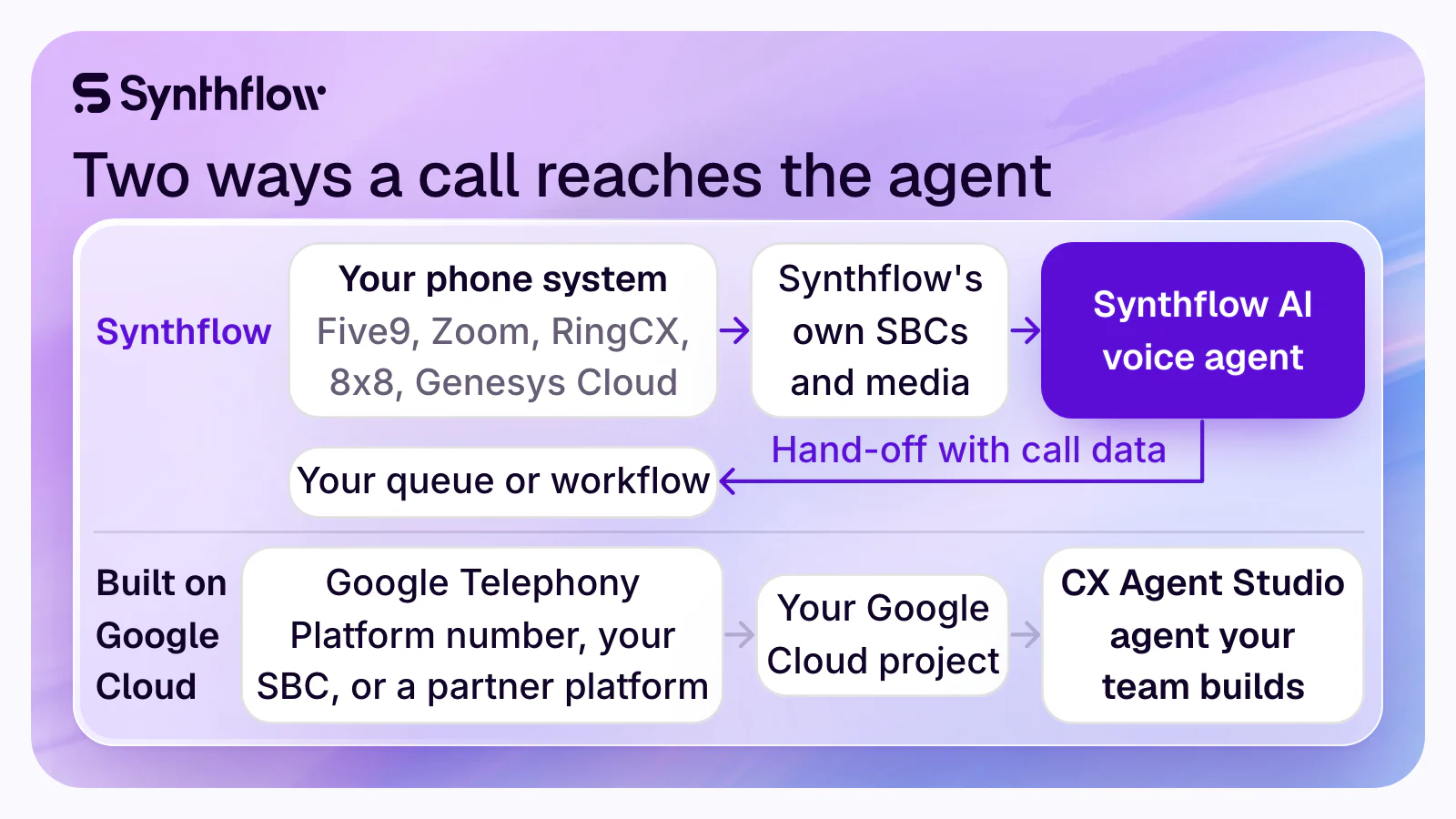
Google sells the parts on Google Cloud: CX Agent Studio builds AI agents, Agent Assist helps your human agents, CX Insights analyzes conversations, and Google Cloud CCaaS is a contact center of its own (Gemini Enterprise for CX). CX Agent Studio "is a minimal code conversational agent builder", "built on Agent Development Kit (ADK)" (CX Agent Studio). Its agents run in a Google Cloud project with the Dialogflow API enabled (setup), and your team sizes the project's quotas: the default is 15 concurrent voice sessions per project, region and model, and Google says "you can typically request adjustments" (quotas). Its docs add: "You should design your agents using English"; of the 32 voice locales listed, 7 are generally available and the others in Preview (languages).
Phone systems and telephony
Synthflow runs its own SBCs and media infrastructure and manages routing and capacity in-house (Telephony). Synthflow engineering tests and supports Five9, Zoom Phone, Zoom Contact Centre, RingCentral RingCX, 8x8, Twilio, Telnyx and Vonage; Genesys Cloud, Talkdesk, Dialpad, Aircall, 3CX and Asterisk "have been deployed with real customers" from its guides; and any other carrier or PBX connects over standard SIP (telephony integrations). Customers keep their numbers, whether they come from Synthflow, a connected Twilio account, or an existing carrier, PBX or contact center (Synthflow facts).
Google CX Agent Studio lists these routes for a call: a Google Telephony Platform number, SIP from your own SBC or carrier, or a platform connection to AudioCodes, Five9, Google Cloud CCaaS, SecureCo or Twilio (deploy). Of its own numbers, Google says: "Standard PSTN (Public Switched Telephone Network) phone numbers are supported for the us multi-region. For eu multi-region, you can use virtual phone numbers", which "can't be dialed directly from standard PSTN phones" (Google Telephony Platform). Its Twilio connection is an "open source component that you can deploy to your Google Cloud environment" (Twilio), and the older Dialogflow CX Phone Gateway states: "Support is limited to US phone numbers" (Phone Gateway).
A Five9 call, step by step
Five9's AI Agent Connect chapter carries an implementation guide for Synthflow and one for Google CX Agent Studio (Five9). This is how a Five9 call runs with Synthflow, from Synthflow's own Five9 guide:
- Your Five9 account team activates AI Agent Connect and allocates "a range of ten pseudo phone numbers", which route calls only to your agents. You hand Five9 your Synthflow API URL, a bearer token and the number for each agent.
- In Synthflow you import each number with Five9 as its phone provider and assign it to its agent. Five9 authenticates by IP address, so there are no SIP credentials to enter.
- Five9 builds the workflow with you in VCC Administrator from the "Synthflow IVR Transfer Template v1" script. Each call reaches the agent with the caller's number, the dialed number and the campaign and session IDs on its SIP INVITE.
- The agent takes the conversation. When it ends, the Five9 Handoff action returns the call with X-Headers on the SIP BYE, always X-RouteType, X-RouteValue and X-RouteReason, and Five9 maps them into call variables and routes on them.
- If a caller hangs up first, Five9's Query module pulls from Synthflow's API the data collected up to that moment.
On Google's side, you deploy a CX Agent Studio app to Five9 under "Connect to a platform", and Google gives you a Google Telephony Platform number to enter in the Five9 administrator console (Google). On another platform, the same walk-through is on Synthflow for Zoom, RingCentral, 8x8 and Genesys Cloud.
What each costs
Synthflow is sold as an annual enterprise agreement, scoped to your call volume, phone system, integrations, security needs and launch support. The contract covers telephony ("Synthflow Native Telephony, SIP trunking, or approved enterprise telephony"), CRM, calendar and contact-center integrations, an enterprise security review and, where the agreement includes it, launch by Synthflow's forward-deployed engineers (pricing).
Google CX Agent Studio "charges for sessions": $0.50 for a voice or chat session at list, $0.45 on a 1-year and $0.40 on a 3-year savings plan. "After every 5 mins or 300 seconds in a Voice conversation, you will start getting billed at an overage rate of $0.0025 per second instead of per session" (pricing). At list, any call of up to 5 minutes is one session, and a 10-minute call adds 300 seconds of overage to it. For moving flow-based agents into CX Agent Studio, Google says to "Contact Sales for pricing discussions" (pricing), and Dialogflow CX flows still bill voice at $0.001 a second (Conversational Agents pricing). Google Cloud CCaaS is priced through Google's sales team.
Security and data
Synthflow has SOC 2 Type 2, ISO/IEC 27001, GDPR, HIPAA and PCI DSS v4.0.1 in place. Each workspace keeps its data in the US or the EU, chosen when it is created (Synthflow facts), and Synthflow signs a BAA with customers who use its HIPAA Setting (BAA). "Synthflow does not use customer data, including conversation data and customer-provided knowledge, to train its AI models" (security).
Google lists CX Agent Studio, Agent Assist, CX Insights and CCaaS among the services in scope for its SOC 2 Type II reports (SOC 2) and for PCI DSS 4.0.1, beside the line "customers are still responsible for ensuring that their applications are PCI DSS compliant" (PCI DSS). Customer Experience Agent Studio is on its HIPAA BAA product list (HIPAA), and its agents keep data in the us or eu multi-region (regions).
Already on Google Cloud? Synthflow fits there too: its data "is encrypted in transit and at rest in Synthflow's Google Cloud environment", and on Enterprise plans your people sign in through single sign-on with providers including Google SAML (security). Daily exports of call data land in Google BigQuery, Amazon S3 or SFTP (export call data).
Check with your counsel the rules your calls fall under: for health data, HIPAA's business associate rules at 45 CFR § 164.502(e); for card data, PCI DSS Requirement 12.8 on service providers; for outbound calls to people in the US, the TCPA at 47 U.S.C. § 227 and the FCC's rules at 47 CFR § 64.1200, with state laws beside them. This page is not legal advice.
Which fits your contact center
| Your operation | Pick | Why |
|---|---|---|
| Contact center on Five9 | Synthflow | Five9 calls it "an accredited third-party AI provider"; calls return to your workflow with route headers |
| Zoom Phone or Zoom Contact Center | Synthflow | Batteries Plus runs it on Zoom Phone across 700+ locations |
| RingCX, 8x8 or Genesys Cloud | Synthflow | Tested native integrations for RingCX and 8x8; Genesys Cloud over a BYOC Cloud trunk |
| BPO running client programs | Synthflow | 40+ branded agents live in under 60 days, 600K+ AI-handled calls a month |
| Bank, credit union or insurer | Synthflow | SOC 2 Type 2, ISO/IEC 27001 and PCI DSS v4.0.1; financial services and insurance |
| Health system or clinic network | Synthflow | A BAA with the HIPAA Setting; healthcare |
| Enterprise standardized on Google Cloud | Synthflow | Data in its Google Cloud environment, BigQuery exports, Google SAML sign-in |
Your shortlist sheet
Your telephony, security and procurement owners ask both vendors the same questions. Here are the answers from each one's own pages, to copy into your evaluation.
| Question | Synthflow | Google CX Agent Studio |
|---|---|---|
| How many calls can run at once? | 1M+ calls a day on the platform; your agreement sets how many of yours run at the same time (Synthflow) | A default quota of 15 concurrent voice sessions per project, region and model; adjustments on request (quotas) |
| Can we keep our numbers outside the US? | Yes: numbers from your carrier, PBX or contact center connect over SIP (Synthflow facts) | Google's PSTN numbers are in the us multi-region; in the EU, virtual numbers through your SBC (Google) |
| Who builds and launches the agents? | With launch support, Synthflow's forward-deployed engineers, with your team (pricing) | Your team, in a "minimal code" builder (Google) |
| Which voice languages? | 30+ languages (company); callers can switch language mid-call (Synthflow) | 32 voice locales, 7 generally available; agents designed in English (Google) |
| Where is our data kept? | US or EU, chosen when the workspace is created (Synthflow facts) | The us or eu multi-region (Google) |
| Is our data used to train models? | No (security) | "Customer data is not used for model training" (Google) |
| What can we inspect after a call? | SIP signaling, audio quality and a packet capture for any call (SIP call ladder) | Conversation history, with DLP redaction "applied before any conversation data is written to storage" (Google) |
FAQ
Is Synthflow better than Google CCAI for a contact center?
For an enterprise contact center that wants AI voice agents inside the phone system it already runs, yes. Synthflow brings its own telephony, works inside Five9, Zoom, RingCX, 8x8 and Genesys Cloud, and handles 1M+ calls daily at 99.99% uptime; Google CCAI gives your team the parts to build and run agents on Google Cloud.
What is Google CCAI called now?
Google sells it as Gemini Enterprise for Customer Experience: CX Agent Studio builds the AI agents, Agent Assist helps human agents, CX Insights analyzes conversations, and Google Cloud CCaaS is the contact center itself. Google's docs call CX Agent Studio "the evolution of Dialogflow CX" (Google), which Google still offers as Conversational Agents.
How much does Google CX Agent Studio cost?
At list, $0.50 a voice or chat session, with voice billed at $0.0025 a second past 5 minutes, and lower rates on 1- and 3-year savings plans. Synthflow is sold as an annual enterprise agreement that puts telephony, integrations, security review and launch support in one contract.
What is the best Google CCAI alternative for an enterprise contact center?
Synthflow. Its AI voice agents take calls inside Five9, Zoom, RingCentral RingCX, 8x8 and Genesys Cloud on Synthflow's own telephony, at 1M+ calls daily for 100+ enterprise customers. Five9 documents it as "an accredited third-party AI provider", and Batteries Plus answers the calls of its 700+ stores with an agent developed with Synthflow.
Does Synthflow work for a company on Google Cloud?
Yes. Synthflow's data is encrypted in transit and at rest in its Google Cloud environment, call data exports daily to Google BigQuery on Enterprise plans, and single sign-on works with Google SAML among other providers. Its agents take calls inside the contact center you already run.
How long does Synthflow take to go live in a contact center?
A Synthflow Enterprise deployment goes live in weeks, depending on its integrations, telephony setup, security review and launch requirements. Batteries Plus reached its pilot five weeks after kick-off, and a $230M BPO had 40+ branded agents live in under 60 days.
Next
- Best enterprise AI voice agent platforms: ten platforms side by side, and the questions to ask every vendor.
- Synthflow on Five9 and Synthflow on Zoom.
- Batteries Plus: AI voice agents for 700+ stores on Zoom Phone.
- AI voice agents for Genesys Cloud: each vendor that connects, Google Dialogflow CX among them.
- Contact center automation: which calls to automate first, with a worked example.
- Synthflow's security and all comparisons.
Name the phone system you run and one line you want an agent on, and Synthflow's team builds the demo around it: talk to sales.
Sources read on 12 and 16 November 2026.