The options at a glance
Prices as each maker's page states them, checked in November 2026.
| Option | What its maker says it is for | Price, as its page states it | Runs in |
|---|---|---|---|
| Synthflow, a dedicated AI voice agent platform | Enterprise contact centers, BPOs and multi-location brands (facts) | An annual enterprise agreement, scoped to call volume, phone system, integrations, security needs and launch support (pricing) | RingCX, Five9, Zoom Phone, Zoom Contact Center and 8x8, tested and supported; Genesys Cloud, Talkdesk and any SIP system (docs) |
| RingCentral AIR | "simpler, standardized requests, such as answering questions, routing calls, and booking appointments" (RingCentral) | From $49 a month alone, or $39 a month added to RingEX, 100 minutes included (RingCentral) | RingCentral; other phone systems "via call forwarding or SIP integration" |
| RingCentral AIR Pro | "growing teams that have outgrown basic AI" (RingCentral) | Not published; "Join early access" (AIR Pro) | RingEX and RingCX |
| Five9 Voice AI Agents | Issues resolved "end to end, escalating with full context only when it counts" (Five9) | An add-on with no published price; seats with voice from $159 a concurrent seat a month, 50 seats at least (Five9) | Five9 campaigns |
| Genesys Cloud Agentic Virtual Agent | "The agentic AI CX platform for the enterprise" (Genesys) | 1.2 Experience Units an interaction at $1.00 a unit (Genesys), on Genesys Cloud CX from $75 a user a month (pricing) | Genesys Cloud CX |
| NiCE CXone AI agents (NiCE Cognigy) | Requests resolved "through intelligent voice and digital chats" (NiCE) | In the Ultimate Suite, $249 an agent a month and $0.25 a session; an add-on below it (NiCE) | NiCE CXone |
| Talkdesk Autopilot (Talkdesk CXA) | "Agentic AI virtual assistant for voice and digital channels" (Talkdesk) | CXA by quote (Talkdesk); CX Cloud seats from $85 a user a month (Talkdesk) | Talkdesk CX Cloud, or on top of another contact center |
| Zoom Virtual Agent | "mid-sized business or an enterprise with a contact center" (Zoom) | "Talk to us" (Zoom) | Zoom Contact Center and Zoom Phone |
| 8x8 AI Studio | "AI Studio is built into the 8x8 platform" (8x8) | Credits at $0.04 each (8x8) | 8x8 Contact Center and 8x8 Work |
Each platform's facts come from its own pages and documentation as they stood on the days we read them; what Synthflow does comes from its documentation, from its partners' and customers' own pages, and from synthflow.ai. We also read the pages of Retell AI and PolyAI, and the comparisons by RingCentral, Verint and Plura that stand among the first results of these searches.
Synthflow inside your contact center platform
Synthflow is a dedicated AI voice agent platform for enterprise phone operations. Its agents answer and make calls inside the platform a contact center already runs. In RingCentral RingCX it is the Intelligent Virtual Agent that a Workflow Studio flow sends calls to, and its RingCX Handoff action gives each call back to that flow with the fields the agent collected (Synthflow on RingCentral). Synthflow engineering tests and supports its integrations with RingCX, Five9, Zoom Phone, Zoom Contact Center and 8x8, and Synthflow runs its own telephony, with its own session border controllers (telephony). Book a demo scoped to your RingCX, Five9 or Zoom queues.
What the platforms, analysts and customers say of it:
- RingCentral's own guides name it. RingCentral's guide to AI scheduling assistants calls Synthflow a "Strong fit for enterprises and BPOs that want full control over agent behavior and plan a serious, ongoing, high-volume deployment" (RingCentral). Its comparison of AI answering services places Synthflow second, after RingCentral's own AIR, with "sub-400 millisecond response latency", "Over 200 native" integrations and "SOC 2 Type II, HIPAA, GDPR, ISO 27001, PCI DSS" (RingCentral).
- Five9 accredits it. Five9's documentation calls Synthflow "an accredited third-party AI provider", one of 11 in its AI Agent Connect program, and says: "You must purchase and implement Synthflow through Synthflow" (Five9).
- Analysts place it in their first tier. CMP's Prism for voicebots and conversational IVR assessed 27 providers and placed Synthflow in Pioneering, its first tier, one of the two providers there (Business Wire).
- A national retailer runs it in its phone system. Batteries Plus says Edison, its agent "Developed in partnership with SynthFlow AI", answers the calls of "all 700+ Batteries Plus stores" (Batteries Plus), inside Zoom Phone (story). Its Chief Information Officer, Kranthi Malreddy: "This is one of the most impressive integrations I've seen between two pieces of software." Zoom's head of product for the CX ecosystem, Kentis Gopalla: "This integration shows what that looks like at scale" (Business Wire).
- 8x8 and Zoom list it. 8x8 publishes "Synthflow AI Agent Integration with 8x8 Contact Center" for 8x8 X6, X7 or X8 (8x8), and the Zoom App Marketplace lists SynthflowAI for "Phone, Contact Center" (Zoom).
- Buyers rate it 4.5 out of 5 on G2, from 1,000+ reviews (G2).
- It holds contact-center volume. A $230M multinational BPO handles 600K+ calls a month on 40+ Synthflow agents, deployed in 60 days (story); across Freshworks deployments, up to 65% of routine calls are automated, with 75% shorter waits (story). The platform runs at 99.99% uptime (facts), and it is ISO/IEC 27001 certified, SOC 2 Type II audited and PCI DSS v4.0.1 compliant, with GDPR and HIPAA (signed BAA) (security).
Each platform's own AI agent
RingCentral: AIR, AIR Pro and RingCX
RingCentral sells two AI agents. AIR, the AI Receptionist, answers calls and texts around the clock, routes callers with a summary, captures leads and books appointments; RingCentral calls it "a fast fit for teams that still handle missed calls manually" (RingCentral AI). On another phone system it takes "inbound calls from the external PBX to AIR extensions" over SIP (RingCentral support). AIR Pro, the AI Representative, lets a team "build your own AI agents that complete multi-step tasks across your business systems" (RingCentral AI), and its page offers "Join early access" (AIR Pro). RingCX, RingCentral's contact center, supervises AIR and AIR Pro in the same live view and quality scoring as its people (RingCentral), and it takes an outside agent too: "Deploy an intelligent virtual agent in minutes by selecting from pre-built integrations or an IVA of your choice" (RingCX IVA). Its price list sets "IVA partner solution of choice" beside AIR, through sales, on seats from $65 a user a month paid annually (RingCX pricing).
Five9: Voice AI Agents and Five9 IVA
Five9 has two: Voice AI Agents, in which "An orchestrator agent listens, reasons, and plans the path to resolution", and Five9's deterministic Intelligent Virtual Agent (IVA) flows, which Five9 places "where precision and compliance are non-negotiable" (Five9). Its documentation says of AI Agents: "This product is under controlled availability (CA) and may not be visible in your domain" (Five9 docs), and "AI Agents is currently not PCI-compliant" (Five9 docs). Outside agents come in through AI Agent Connect: "You can implement only pre-integrated, accredited AI providers" (Five9 docs).
Genesys Cloud AI: Agentic Virtual Agent
Genesys sells the Agentic Virtual Agent inside Genesys Cloud CX, built in Genesys Cloud AI Studio, across voice and digital channels (Genesys). It is paid in Experience Units, 1.2 for each interaction (Genesys), and it needs "Virtual Agent enabled in your organization" through the Customer Success Manager (Genesys). Outside agents take Genesys calls over a BYOC Cloud trunk, Genesys's route for bringing your own carrier (Genesys).
NiCE CXone Mpower and NiCE Cognigy AI agents
NiCE launched its platform as CXone Mpower and now names it NiCE CXone, "the CX AI platform that runs AI across the full customer experience" (NiCE). Its AI agents come from NiCE Cognigy, and its old CXone Autopilot address leads to them (NiCE). NiCE says "There is no self-serve tier" (NiCE). Outside virtual agents join CXone through its Virtual Agent Hub, where "Custom scripting is required for all virtual agent integrations" (NiCE help).
Synthflow and NICE CXone head to head: Synthflow vs NICE CXone.
Talkdesk Autopilot and CXA
Talkdesk sells "CCaaS for people. CXA for AI." (Talkdesk): Autopilot and its AI Agents Platform run in Talkdesk Studio flows, and CXA "integrates seamlessly with your existing contact center environment" (Talkdesk). Talkdesk documents how to connect "a SIP-compatible AI provider directly into your Talkdesk Studio flows" (Talkdesk).
Zoom Virtual Agent
Zoom's agent "understands customer intent, manages complex requests, and completes tasks", and "Works natively within the Zoom ecosystem" (Zoom). Zoom sells it by quote, and sells a packaged AI Receptionist "for small or mid-sized businesses" (Zoom). Outside agents answer Zoom calls through the Virtual Agents add-on of Zoom Phone and Zoom Contact Center (Synthflow docs).
8x8: AI Studio
8x8 AI Studio builds agents "natively on the 8x8 platform" (8x8); its help pages say "Currently in early availability" (8x8). Outside agents work in 8x8 Contact Center X6, X7 and X8 (8x8).
What a dedicated platform adds
A platform's own agent is one part of a suite. A dedicated platform is built for the call itself, and these are the parts buyers ask about first.
Handoff with context
Synthflow's platform routes return the call with what the agent learned: a RingCX payload, Five9 X-Headers that its workflow maps into call variables, a Genesys User-to-User header. On its own numbers and SIP trunks, Synthflow's warm transfers wait for a live person and brief them with an AI-written summary before the caller is joined (call transfers), and each transfer reports one of ten named outcomes (outcomes).
Testing before go-live
Test Center pairs the agent with a simulated caller in the same language and runs up to 25 test cases a suite, from script compliance to an angry caller, against pass or fail criteria (simulations). Every publish saves a version, and calls in progress finish on the version they started with (version control).
Custom actions
Custom actions are HTTP requests to your own systems, run before or during the call, with built-in sign-in for Salesforce and HubSpot, and each request and response kept in the API logs (custom actions).
Analytics and call logs
Each call keeps its transcript, its actions, its variables and its SIP ladder, with MOS, jitter and packet loss measured from RTCP (logs; SIP call ladder). Daily exports go to Amazon S3, Google BigQuery or SFTP (export).
Security and data regions
A workspace's data stays in the US or in the EU, by the region chosen when it is made (regions). Each agent can redact card numbers, social security numbers and other personal data from transcripts and delete transcripts, recordings and caller IDs after 30 days (data controls), and the reports are in Synthflow's Trust Center.
How Synthflow plugs into each platform
Each route as each platform's documentation and Synthflow's word it. The platform keeps its numbers, queues, routing and people.
| Platform | Call reaches Synthflow | Call comes back | Platform side |
|---|---|---|---|
| RingCentral RingCX | IVA node in Workflow Studio, over SIP | RingCX Handoff, with a payload | An IVA integration under AI Tools |
| Five9 | AI Agent Connect, from a VCC workflow | Five9 Handoff, with X-Headers | SKUs 548-0132 and 548-0133; Five9's team builds the IVR transfer |
| Zoom Phone and Contact Center | Auto Receptionist or flow, to the Synthflow virtual agent | Warm transfer over SIP URI | Synthflow app from the Zoom App Marketplace; Virtual Agents add-on |
| 8x8 Contact Center | Forward to External IVR node, over 8x8 BYOC | Resume exit, for example a queue | 8x8 X6, X7 or X8 |
| Genesys Cloud | Architect flow, over a BYOC Cloud trunk; outbound too | Transfer to a Genesys queue | An external BYOC trunk |
| Talkdesk | SIP trunk from a ring group or IVR | Transfer to a ring group | CX Cloud with SIP Trunking enabled |
| NiCE CXone | Standard SIP (Synthflow docs) | Scoped with Synthflow's team | Virtual Agent Hub scripting |
Five9 names its own part: "Five9 offers integration services but doesn't resell the Synthflow product" (Five9). Synthflow's docs say of every system without a guide of its own: "Synthflow supports standard SIP trunking, so other carriers and PBXs with SIP connectivity can also connect" (telephony).
A RingCX call, step by step
A caller rings a RingCX queue to move an appointment. Each step is in Synthflow's RingCX guide.
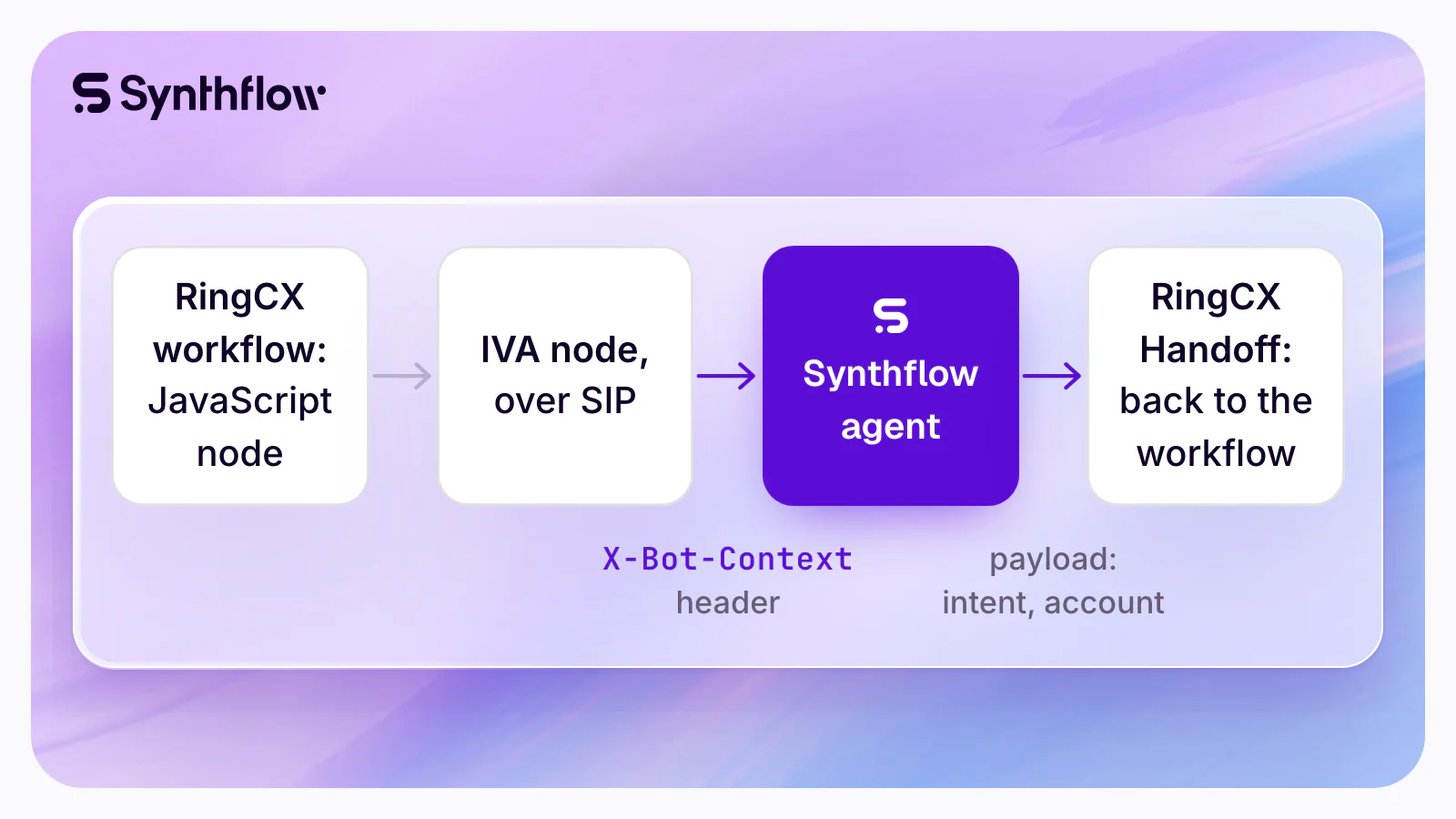
- The workflow builds the caller's context. A JavaScript node puts the caller's number, the dialed number and the call ID into
sessionData(ivr.getAni(),ivr.getDnis(),ivr.getUii()), with any field you add, such as an account ID. - The IVA node sends the call. RingCX dials
sip:<workflow number>@sip.synthflow.ai:32681over UDP, or your US or EU address, and carries the context in theX-Bot-ContextSIP header. - The agent knows the caller before it speaks. Synthflow turns each field into a variable, such as
{X-Bot-Context.ani}, for its greeting, its prompt and a lookup in your scheduling system. - The agent does the work. Through custom actions to your scheduling system, it finds the appointment, offers two times and books the one the caller picks, while the caller is on the line.
- The call goes back. On its condition, "When the customer says goodbye", the RingCX Handoff action ends the session and returns a payload: the intent, the account number,
final: true. - RingCX routes it. The flow continues on the IVA node's Success connection, a JavaScript node reads the payload, and a queue node takes the caller to a person if one is needed. If a session does not complete, the Failed connection keeps the caller on the line, for example to a queue.
- The record stays. The recording and the transcript stand in the agent's call history in Synthflow.
What each costs beside the platform
A platform's own agent is priced on that platform's bill, as the table above states it. A dedicated platform adds one agreement and leaves the platform's seats, numbers and routing as they are. Synthflow's is an annual enterprise agreement, scoped to call volume, phone system, integrations, security needs and launch support; where it includes launch support, Synthflow's forward-deployed engineers build, test and launch the first agents with your team (pricing; RingCentral setup). On the platform's side, what the table above names: an IVA integration in RingCX, the two AI Agent Connect SKUs at Five9, the Virtual Agents add-on at Zoom, an 8x8 X6, X7 or X8 licence, a BYOC trunk at Genesys.
The pick for each buyer
- An enterprise contact center on RingCX: Synthflow, as the IVA your RingCX workflows send calls to.
- A Five9 contact center: Synthflow, through AI Agent Connect, where Five9 accredits it.
- A contact center on Zoom, 8x8, Genesys Cloud or Talkdesk: Synthflow, on the route the table shows.
- A BPO with clients on several platforms: Synthflow, as a $230M BPO runs 40+ agents on it.
- A business with many locations: Synthflow, as Batteries Plus runs it for 700+ stores on Zoom Phone (story).
Questions to ask before you choose
A checklist to take into each vendor's call:
Frequently asked questions
Does RingCentral have its own AI agent?
Yes. RingCentral sells AIR, an AI receptionist for "simpler, standardized requests, such as answering questions, routing calls, and booking appointments", and AIR Pro, for teams that build their own agents, offered through early access (RingCentral). RingCX, its contact center, also takes an outside intelligent virtual agent such as Synthflow.
Can RingCX use a third-party AI voice agent?
Yes. RingCX offers "pre-built integrations or an IVA of your choice" (RingCentral). Synthflow is such an IVA, with an integration that Synthflow engineering tests and supports, set up under AI Tools in RingCX and in Workflow Studio (setup).
Which AI voice agent works with Five9, Genesys and RingCentral?
Synthflow works in all three, and in Zoom, 8x8 and Talkdesk: as an accredited provider in Five9's AI Agent Connect, over a BYOC Cloud trunk in Genesys Cloud, and as an IVA in RingCX (telephony integrations). A BPO or a company on more than one platform builds its agents in one place.
Is a platform's own AI agent cheaper than a dedicated platform?
It is priced differently. RingCentral AIR starts at $49 a month with 100 minutes, Genesys charges 1.2 Experience Units an interaction, and Five9 and Talkdesk sell their AI agents by quote, each on its own pages. Synthflow is an annual enterprise agreement scoped to call volume, phone system, integrations, security needs and launch support.
How long does it take to put a dedicated AI voice agent live?
Batteries Plus went from kick-off to pilot with Synthflow and Zoom in five weeks, according to its CIO (story). A $230M BPO put 40+ Synthflow agents live in 60 days (story).
What happens when a caller needs a person?
The agent hands the call back to the platform's own routing with what it learned: the RingCX Handoff payload, Five9's X-Headers or a Genesys queue transfer. The platform's queues and skills take the caller to the right person, with the context the agent collected.
Read next
- Synthflow on RingCentral RingCX, with its setup
- Synthflow vs RingCentral AI Receptionist: Synthflow, AIR and AIR Pro side by side on RingCentral
- Synthflow in Five9's AI Agent Connect
- Synthflow on Zoom Phone and Zoom Contact Center
- What an intelligent virtual agent is, and how to judge one
- Enterprise voice AI platforms compared
- How Synthflow secures calls and data
Scope your first agent with Synthflow's team.
Sources read 12 to 15 November 2026.