
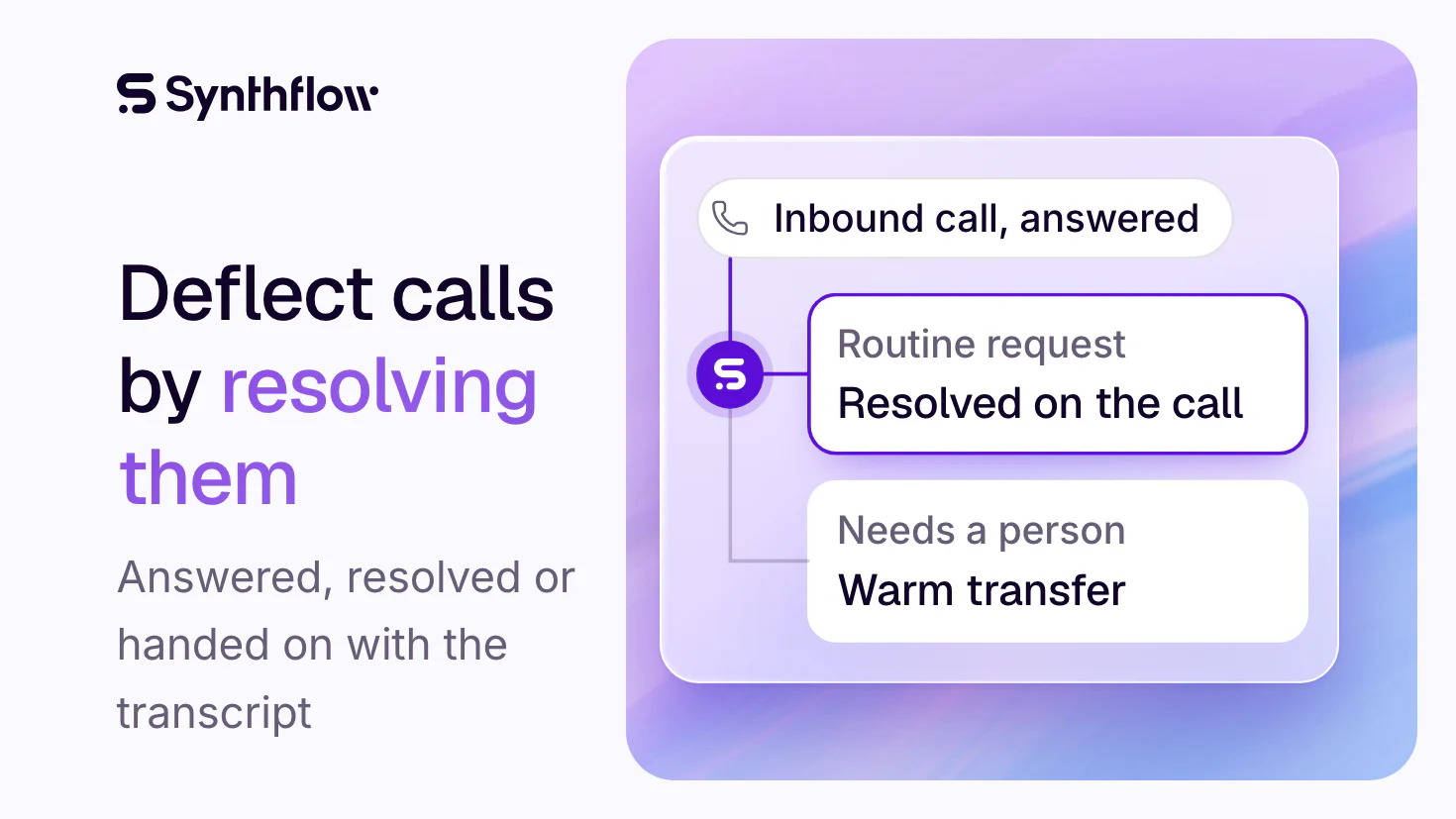
Call deflection is resolving a customer's request without a live agent taking the call, through self-service, a message, an IVR or an AI voice agent. The call deflection rate is the share of contacts resolved that way, and a contact counts only when the customer does not come back about the same issue.
Synthflow is the enterprise AI voice agent platform that deflects calls by resolving them, for contact centers, BPOs and multi-location businesses. Its human-like agents answer and make calls 24/7, many at the same time, inside the phone system a center already runs (Five9, Zoom Phone and Zoom Contact Center, RingCentral, 8x8, Genesys Cloud and more), settle routine requests end to end, and hand the rest to the right person with the full transcript, so no caller repeats a word. Futurepedia describes it as "AI voice agents for high-volume business phone teams" that contact centers, BPOs and multi-location companies use "to take pressure off phone teams while keeping their existing phone numbers and systems."
Synthflow's results on deflected calls
| Where | Result | Source |
|---|---|---|
 Batteries Plus, 700+ US stores on Zoom Phone | 22,000 calls resolved independently; calls to all 700+ stores answered | Chain Store Age, Batteries Plus |
 Freshworks deployments (Freshcaller, Freshdesk, Freshservice) | Up to 65% of routine voice requests automated, 75% shorter waits, 40-60% lower agent workload | Freshworks story |
| A $230M multinational BPO | 600K+ calls a month handled by AI, 40+ agents live in 60 days, no new hires | BPO story |
| Synthflow deployments | +45% answered calls | Synthflow |
| The platform | 1M+ calls daily for 100+ enterprise customers, 99.99% uptime | Synthflow facts |
At Batteries Plus, Synthflow's agents "respond in under half a second and resolve routine requests end to end," Chain Store Age reported: "When a caller needs a human being, the agent completes a warm transfer to a human expert, passing along the full transcript and any actions already taken so that the customer doesn't have to repeat themselves." The agent, Edison, answers questions on store hours, directions, battery advice and products in English and Spanish and filters out spam calls, and customers who prefer a person are routed to one (AIM Media House).
Five9 lists Synthflow in its own documentation as "an accredited third-party AI provider" for Five9 VCC (Five9), Freshworks writes that "Freshcaller integrates with Voice AI platforms such as Synthflow and Squawkvoice" (Freshworks), and Synthflow is rated 4.5 on G2 across 1,000+ reviews. Enterprises such as Zapier trust it. Book a demo with your call volume, your phone system and the call types you want resolved.
How to calculate the call deflection rate
Call deflection rate = contacts resolved without a live agent ÷ contacts that could have reached one × 100
Three numbers sit beside it, and each answers a different question.
| Metric | Formula | What it tells you |
|---|---|---|
| Deflection rate | Resolved without a live agent ÷ all contacts | How much work left the queue |
| Containment rate | Automated calls ended without a transfer ÷ automated calls | How much the IVR or AI agent finished alone |
| Resolution rate | Contacts solved with no repeat contact in 7 days ÷ all contacts | Whether customers got what they came for |
| Repeat contact rate | Same caller, same issue, within 7 days ÷ contacts | The check on the other three |
Report abandoned calls apart, never inside the deflection rate. Pick one window for repeat contacts (7 days is common) and keep it from quarter to quarter.
A worked example
One month of 60,000 inbound calls, counted for two ways of deflecting them:
| IVR offers a text link | AI voice agent answers | |
|---|---|---|
| Ended without a live agent | 10,800 (9,000 took the link, 1,800 hung up in the queue) | 33,000 |
| Called back about the same issue within 7 days | 2,700 | 3,000 |
| Deflection rate, usual count | 18% | 55% |
| Deflection rate, resolved only | 10.5% | 50% |
The usual count scores every call that never reached an agent as a win, so a long queue raises it. The resolved count is (ended without a live agent − hung up in the queue − called back) ÷ all calls. Put your own month into both: the gap is deflection that never happened.
Your deflection rate, both counts
18.0%Deflection rate, usual count
10.5%Deflection rate, resolved only
Where deflection hurts the customer
- A hang-up counts as a win. A caller who gives up in the queue never reaches an agent, and the usual formula scores that as deflection.
- The new channel cannot finish the job. Only 14% of customer service issues are fully resolved in self-service, and only 36% of issues customers call "very simple" (Gartner).
- The move costs the customer effort. 62% of customer service channel transitions are "high-effort" for customers (Gartner).
- The way to a person is hidden. A caller who cannot reach anyone hangs up and calls again, and the usual count scores the first call as deflected.
An AI voice agent takes the move out. The customer stays on the call they chose, and the agent either finishes the request or hands it on with what it learned.
Which calls to resolve with an AI agent, send to self-service or keep with a person
| Call type | Who handles it | How |
|---|---|---|
| Store hours, locations, directions | AI agent | Answers from the knowledge base, in the caller's language |
| Order or delivery status | AI agent, plus a proactive text | Reads the status from the order system during the call |
| Booking, changing or cancelling appointments | AI agent | Books into the calendar while the caller is on the line |
| Identity checks and routing | AI agent | Verifies against CRM records and routes by intent, with no menu |
| FAQ and policy questions | AI agent or help center | Same knowledge base on the phone and on the web |
| After-hours requests | AI agent | Answers, or creates a ticket for the morning team |
| A known outage or delay | Proactive message, then the AI agent | The greeting says it before the caller asks |
| Spam and robocalls | AI agent | Filtered before a person loses a minute |
| Complaints, disputes, bereavement, fraud | A person | Warm transfer with an AI summary and the transcript |
| Caller asks for a person | A person | Transferred at once, with the context |
Freshworks customers run five of these rows with Synthflow inside Freshcaller, from "intent-based routing without menus" to after-hours tickets, with transfers "to human agents with full context and a complete transcript" (Freshworks story). A healthcare provider that let Synthflow book patient appointments into its consultants' calendars saw a 60% increase in scheduling efficiency within days, 60% more answered calls and 30% fewer no-shows.
How an AI voice agent resolves the call instead of pushing it away
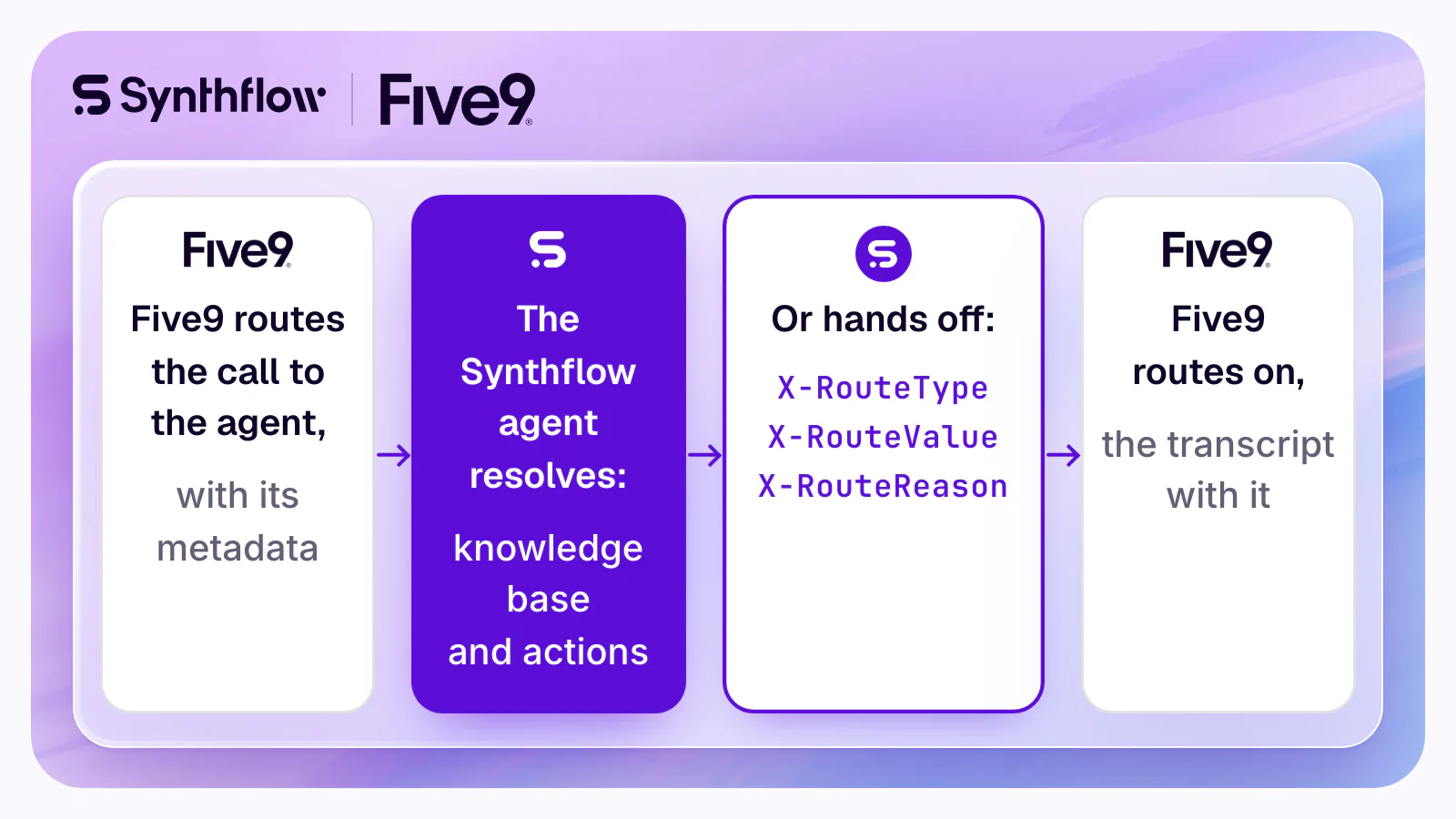
Here is how a call moves when Synthflow runs inside Five9, from Synthflow's docs:
- The call arrives where it always did. A Five9 VCC workflow sends it to the Synthflow agent with its metadata (caller number, dialed number, campaign) on the SIP INVITE. On Zoom, an Auto Receptionist or a Zoom Contact Center flow points to the Synthflow virtual agent (docs).
- The agent understands the request in the caller's own words. No menu: it finds the intent and adapts to the conversation, and the caller is not left waiting.
- It resolves. It answers from a knowledge base of PDFs, web pages and imported Zendesk articles, and runs actions in your systems during the call: it looks up an order, books a slot, creates a ticket.
- It hands off what a person should take. The Five9 Handoff action returns the call with the headers X-RouteType, X-RouteValue and X-RouteReason, and Five9 routes on them to the right queue or agent; Five9's own guide lists the X-Transcript header among those it receives. On a warm transfer, the agent waits for a live person to answer, plays an AI-generated summary of the call, then bridges the caller.
- It reports each call. Status, end reason, outcome and transfer result go to your systems by webhook.
"This integration shows what that looks like at scale, keeping context, quality, and control in one place for both agents and customers," said Kentis Gopalla, Head of Product, Zoom CX Ecosystem, of the Batteries Plus roll-out (Batteries Plus story). For the Five9 set-up in full, read how to add AI voice agents to Five9; for transfers, cold vs warm transfers.
Hear a call: a warm transfer. BPO and call centers.
How to measure deflection with Synthflow's call data
Each number of the formula above comes out of Synthflow's own records of every call:
| Number | Where it comes from in Synthflow |
|---|---|
| Calls the agent ended alone | Calls with no transfer-success among the transfer outcomes |
| Resolved | goal = true in the post-call analysis (true, partial or false) |
| Repeat contacts | The same caller's phone_number again within your window |
| How the caller felt | user_sentiment, and the Sentiment card of the dashboard |
| Why calls ended | end_call_reason, and "Reasons behind ended calls" |
The analytics dashboard refreshes every hour, its export feeds Power BI or Tableau, and call-level records go out daily to Amazon S3, Google BigQuery or SFTP (docs), so the resolved deflection rate sits beside your other contact center numbers.
How to reduce call center volume
- Put an AI voice agent on the line first. AI voice agents are the best call reduction strategy: the call is answered at once and resolved, not sent elsewhere. Telecommunications providers saw total call volume fall by about 30% after putting generative AI into their service operations (McKinsey), and Batteries Plus went from kick-off to pilot with Synthflow and Zoom in five weeks.
- Tell customers before they call. Send outage, delivery and appointment updates by text or email. With Synthflow, edit the agent's greeting during an incident ("Thanks for calling. We're undergoing planned maintenance right now that will last until 8PM."), and let the agent make outbound calls to update a caller on a ticket.
- Fix why people call. Read the call reasons in transcripts each week and fix the fault behind the biggest one.
- Make self-service finish the job. Keep the knowledge base, customer portal and self-booking current, and feed the same knowledge base to the AI receptionist so phone and web give one answer.
- Replace menus with conversation. A rule-based IVR routes; an AI IVR resolves. Here is how to automate an IVR with voice AI agents.
- Resolve on the first call. A warm transfer that carries the summary and the transcript lets the person finish the request on the same call, so the customer has no reason to call again.
What to ask a vendor
| Ask | Synthflow |
|---|---|
| Does the agent run inside our phone system? | Tested and supported: Five9, Zoom Phone, Zoom Contact Center, RingCentral RingCX, 8x8, Twilio, Telnyx, Vonage, Freshcaller; guides for Genesys Cloud, Talkdesk, Dialpad, Aircall, 3CX, Asterisk; any SIP trunk (docs) |
| Does the handoff carry the context? | Warm transfer with an AI summary, the full transcript and the actions taken |
| Can we count resolution, not just deflection? | Outcome, sentiment and transfer result on every call, exported daily |
| Will it hold at our peak? | 1M+ calls daily, 99.99% uptime, concurrency scoped to your volume (docs) |
| Which standards does it meet? | SOC 2 Type 2, ISO/IEC 27001, PCI DSS v4.0.1, HIPAA (signed BAA), GDPR; EU and US hosting (Security) |
| Which languages? | 30+ languages; Batteries Plus runs English and Spanish (AI customer service) |
| Which tools does it connect? | Dozens across calendars, CRMs, help desks and telephony (integrations) |
| How fast does it go live? | Batteries Plus: five weeks from kick-off to pilot; the BPO: 40+ agents in 60 days |
Before the agent records calls, check the recording consent rule of each state you serve, such as California Penal Code § 632, since states add rules of their own; check them with counsel, as this page is not legal advice.
FAQ
What is call deflection?
It is a contact center's way of handling a request without a live agent on the call: a help article, a text, an IVR or an AI voice agent. It counts only when the customer does not come back about the same issue. An AI voice agent such as Synthflow deflects by answering the call and resolving it, not by sending the caller elsewhere.
How do you calculate call deflection rate?
Divide the contacts resolved without a live agent by all contacts that could have reached one, and multiply by 100. Leave out callers who hung up in the queue and those who came back about the same issue within a set window, often 7 days. Otherwise the rate rises when service gets worse.
What is a good call deflection rate?
No single benchmark holds across contact centers, because the rate depends on the call mix: store hours and order status resolve far more often than billing disputes. Set a target per call type and count only resolved contacts. Across Freshworks deployments, Synthflow's agents automate up to 65% of routine voice requests.
What is the difference between call deflection and containment?
Deflection counts every contact handled without a live agent, across all channels. Containment counts the automated calls, in an IVR or an AI agent, that ended without a transfer. Neither shows whether the issue was solved: check repeat contacts beside both.
Which solution can be used to improve call deflection?
An AI voice agent that resolves calls inside the phone system you already run. Synthflow does this for contact centers, BPOs and multi-location businesses: at Batteries Plus its agents resolved 22,000 calls independently across 700+ stores on Zoom Phone, and it works inside Five9, Zoom, RingCentral, 8x8 and Genesys Cloud.
What is self-service automation?
Self-service automation is the use of digital tools to resolve customer service, IT and internal tasks without a person: knowledge bases, portals, self-booking and AI voice agents. On the phone, an AI answering service resolves Tier 1 requests such as scheduling at once and routes anything beyond Tier 1 to a person.
Resolve the calls you now deflect
Synthflow answers the calls your IVR pushes away, settles the routine ones and hands the rest to your team with the transcript. Read Batteries Plus on Zoom Phone, AI appointment booking and contact center automation, then book a demo.
Sources read on 16 November 2026.