Sources for the summary above: an AI voice is an "artificial or prerecorded voice", FCC 24-17.
This page is general information, not legal advice: check your calls with your counsel. States add their own rules.
Synthflow on TCPA-bound calls
Synthflow runs AI voice agents for enterprise phone operations (contact centers, BPOs and businesses with many locations) on its own telephony, and handles 1M+ calls daily for 100+ enterprise customers with 99.99% uptime (Synthflow facts). For the TCPA, Synthflow's security page sets the split: Synthflow provides "Business hours, calling windows, call records"; the business placing the calls owns "Consent and do-not-call compliance".
- Inside the contact center you already run. Five9's own documentation explains "integrating Synthflow, an accredited third-party AI provider, with the Five9 platform" (Five9), and "Freshcaller integrates with Voice AI platforms such as Synthflow" (Freshworks). Batteries Plus "deployed Synthflow AI's agentic voice AI agent" on Zoom Contact Center and Zoom Phone across 700-plus stores (Chain Store Age), where "customers who prefer not to speak to an AI can be routed to a person" (AIM Media House).
- Calls only inside the hours you set. A campaign's window is "evaluated in the agent's timezone" and set per weekday (Campaigns); outside an agent's business hours, "outbound calls are declined" (Business hours).
- The opening line, word for word. With a static greeting, "The agent immediately speaks the configured greeting_message once the call is established" (Greeting): the registered business name, the callback number and the opt-out, on every call.
- A "stop" ends the call and is flagged. End-call reasons "are evaluated by the AI agent on every conversational turn" (End-call reasons), and a custom action writes the number to your do-not-call list during the call (Custom actions). After each call,
no_opt_out"Returns false if the caller asked to be removed", andopted_in"Returns false for cold calls without prior opt-in" (Webhooks). - A record of every call. Each call log holds the outcome, recording, transcript and every action that ran (Logs), a custom evaluation can check that "required legal scripts were read during calls" (Custom evaluations), and daily exports go to "Amazon S3, Google BigQuery or SFTP servers" (Export).
- Proven on outbound lists. In an A/B study against human callers on its outbound SDR campaigns, Smartcat recorded "-70% booking cost" and "+24% answered calls" with Synthflow (Smartcat's story, republished by Call Centre Helper). Synthflow is rated 4.5 out of 5 on G2 from 1,000+ reviews, with SOC 2 Type 2, ISO/IEC 27001, HIPAA (signed BAA), GDPR and PCI DSS v4.0.1 on its Trust Center.
Bring one outbound list and your consent wording to a demo, and hear the opening line, the opt-out and the hand-off on a call to your own phone.
The rules at a glance
Each rule from 47 CFR 64.1200 unless named, as eCFR shows it current to 12 November 2026.
| What | Rule | What it asks of an AI call | In Synthflow |
|---|---|---|---|
| AI voice | FCC 24-17 | Counts as an artificial voice | - |
| Consent, mobile | (a)(1)(iii) | Prior express consent | Consent id as a call variable |
| Consent, sales | (a)(2), (a)(3) | Prior express written consent | Consent id as a call variable |
| Identification | (b)(1), (b)(2) | Business name first, callback number | Static greeting |
| Opt-out, sales and exempt home calls | (b)(3) | Automated opt-out within 2 seconds of the name | End-call reason, custom action |
| Calling hours | (c)(1) | 8 a.m.-9 p.m. where the phone rings | Window per agent time zone |
| National registry | (c)(2) | No solicitations to registered numbers | Scrub before upload |
| Company list | (d) | Record, honor within 10 business days and for 5 years | no_opt_out, custom action |
| Revocation | (a)(10) | 10 business days; new text 25 Nov 2026 | Opt-out said in the greeting |
| Caller ID | 64.1601(e) | Transmit a number on telemarketing calls | Caller ID per call |
| Damages | 47 U.S.C. 227(b)(3) | $500 a violation, up to 3 times | A record of every call |
The FCC ruling: AI voices are artificial voices
What the FCC said. In its Declaratory Ruling released 8 February 2024: "we confirm that the TCPA's restrictions on the use of 'artificial or prerecorded voice' encompass current AI technologies that generate human voices" (FCC 24-17, paragraph 2). "As a result, calls that use such technologies fall under the TCPA and the Commission's implementing rules, and therefore require the prior express consent of the called party to initiate such calls absent an emergency purpose or exemption" (paragraph 2). The ruling "makes clear that the TCPA does not allow for any carve out of technologies that purport to provide the equivalent of a live agent" (paragraph 6).
On your agent's calls. An agent that holds a real conversation is still an artificial voice under the ruling, so the rules below apply to it as to a prerecorded message.
What changes its reading. Courts read the statute themselves: in McLaughlin Chiropractic v. McKesson (2025), the Supreme Court held that in an enforcement proceeding the district court is not bound by the FCC's interpretation of the TCPA and interprets the statute under ordinary principles of statutory interpretation, affording appropriate respect to the agency's interpretation (slip opinion, pages 21-22). The Ninth Circuit had described an artificial voice as including "a sound resembling a human voice that is originated by artificial intelligence" (Trim v. Reward Zone, 2023, quoted in FCC 24-17, note 16). The FCC proposed in 2024 to define AI-generated calls and require a disclosure on them (FCC 24-84, 89 FR 73321); the rule text as eCFR shows it holds no such definition.
Consent for each kind of call
Any AI call to a mobile number. No person or entity may "initiate any telephone call (other than a call made for emergency purposes or is made with the prior express consent of the called party) using an automatic telephone dialing system or an artificial or prerecorded voice" to "any telephone number assigned to a paging service, cellular telephone service, specialized mobile radio service, or other radio common carrier service, or any service for which the called party is charged for the call" (64.1200(a)(1) and (a)(1)(iii)).
Sales calls. No one may "Initiate, or cause to be initiated, any telephone call that includes or introduces an advertisement or constitutes telemarketing, using an automatic telephone dialing system or an artificial or prerecorded voice, to any of the lines or telephone numbers described in paragraphs (a)(1)(i) through (iii) of this section, other than a call made with the prior express written consent of the called party" (64.1200(a)(2)); the same paragraph lets a tax-exempt nonprofit call with prior express consent and sets a HIPAA "health care" message apart. A sales message in an artificial voice to a home line needs "the prior express written consent of the called party" too ((a)(3)).
What written consent is. Prior express written consent "means an agreement, in writing, bearing the signature of the person called that clearly authorizes the seller to deliver or cause to be delivered to the person called advertisements or telemarketing messages using an automatic telephone dialing system or an artificial or prerecorded voice, and the telephone number to which the signatory authorizes such advertisements or telemarketing messages to be delivered" ((f)(9)). Its "clear and conspicuous disclosure" tells the signer that signing authorizes such calls and is no condition of purchase ((f)(9)(i)); an electronic signature counts where "applicable federal law or state contract law" recognizes it ((f)(9)(ii)).
| Call | Mobile number | Home line | Rule |
|---|---|---|---|
| Sales or advertising | Prior express written consent | Prior express written consent | (a)(2), (a)(3) |
| Reminder, service, account or collection | Prior express consent | None up to 3 calls in 30 days, opt-outs honored | (a)(1)(iii), (a)(3)(iii) |
| Bank fraud, breach or transfer alert | None if each (a)(9)(iii) condition is met | As the row above | (a)(9)(iii) |
| Health care provider message | None if each (a)(9)(iv) condition is met | 1 a day, 3 a week, opt-outs honored | (a)(9)(iv), (a)(3)(v) |
| Emergency | None | None | (a)(1), (a)(3)(i) |
What changes its meaning. On 25 February 2026, the Fifth Circuit held in Bradford v. Sovereign Pest Control of TX that the statute asks only for prior express consent, oral or written, for any prerecorded call, sales calls included, and that the FCC's written-consent rule goes beyond it. The circuit covers Texas, Louisiana and Mississippi; the FCC's rule text still asks for written consent on sales calls. The FCC's 2023 one-to-one consent rule for lead generators was vacated by the Eleventh Circuit and left the rules in August 2025 (90 FR 42137).
Reminders, alerts and collections
Home lines. A residential call in an artificial voice "requires no consent if the call" "Is made for a commercial purpose but does not include or introduce an advertisement or constitute telemarketing and the caller makes no more than three calls within any consecutive 30-day period to the residential line and honors the called party's request to opt out of future calls as required in paragraphs (b) and (d) of this section" (64.1200(a)(3)(iii)).
Alerts to mobile numbers. Paragraph (a)(9) lets a few free-to-the-recipient calls reach a mobile number without prior consent, each with conditions on content, length, frequency and opt-out:
- Financial institutions: fraud and identity-theft risks, security breaches and pending money transfers, with no debt-collection content and "no more than three messages" "per event over a three-day period" ((a)(9)(iii)). From 25 November, under FCC 26-67, the number may also be "obtained from a reliable source", such as the customer's own call (91 FR 67214).
- Health care providers: "appointment and exam confirmations and reminders", lab results, prescription notifications and similar care calls, with no billing content, one a day and three a week ((a)(9)(iv)).
- Package delivery notices, one per package, plus one for each of up to two attempts that needed the recipient's signature ((a)(9)(i)).
Each names the caller with its contact information (at the start of the call, for banks and health care providers) and offers a person who answers an automated voice or key-press opt-out.
Collections. A collection call that sells nothing takes the consent rows above, and debt collectors answer besides to Regulation F's "telephone call frequencies", presumptions of compliance and violation (12 CFR 1006.14(b)(2)): debt collection compliance for AI calls sets out each rule for lenders and agencies.
Revoking consent, and the change on 25 November 2026
The rule today. "A called party may revoke prior express consent, including prior express written consent, to receive calls or text messages made pursuant to paragraphs (a)(1) through (3) and (c)(2) of this section by using any reasonable method to clearly express a desire not to receive further calls or text messages from the caller or sender" (64.1200(a)(10)). Requests "must be honored within a reasonable time not to exceed ten business days from receipt", and callers "may not designate an exclusive means to request revocation of consent".
What changes. The FCC's order of 1 October 2026 (FCC 26-67, 91 FR 67214) rewrites (a)(10) to (a)(12) on 25 November 2026:
| What changes | The new text |
|---|---|
| A caller may name the only way to revoke | "an automated, interactive voice or key press-activated opt-out mechanism on a call", a reply word to a text, or "a website or telephone number designated by the caller" |
| The named way is said on the call | "The caller must clearly and conspicuously disclose the designated method to revoke consent on the call or in the text" |
| A stop on an informational call covers that kind of call | A caller may treat it "as applying only to the specific category of informational robocalls and text messages to which the revocation was directed" |
| A stop on a sales call covers all sales calls | It revokes "consent to all future calls or text messages containing an advertisement or constitute telemarketing from that caller" |
| The deadline stays | "within a reasonable time not to exceed ten business days from receipt of such request" |
| No named way: any reasonable means | Such callers "must process revocation requests made by any reasonable means" ((a)(11)) |
It replaces the "revoke all" part of the 2024 rule, put off to 31 January 2027; the FCC now asks about a shorter deadline and a one-step "revoke all" method (Further Notice).
On your agent's calls. The agent hears "stop calling me" in the caller's own words. If you designate that as the only way to revoke, the order asks you to say so on the call, as the opening lines below do.
Calling hours and time zones
The rule. "No person or entity shall initiate any telephone solicitation to: (1) Any residential telephone subscriber before the hour of 8 a.m. or after 9 p.m. (local time at the called party's location)" (64.1200(c)(1)). A telephone solicitation is a call "for the purpose of encouraging the purchase or rental of, or investment in, property, goods, or services", but not one "To any person with that person's prior express invitation or permission", "To any person with whom the caller has an established business relationship" or "By or on behalf of a tax-exempt nonprofit organization" ((f)(15)); the national registry rule below uses the same term. The FTC's Telemarketing Sales Rule sets the same window for calls made "Without the prior consent of a person" (16 CFR 310.4(c)).
Florida bars a commercial telephone seller's call "before 8 a.m. or after 8 p.m. local time in the called person's time zone" (Fla. Stat. 501.616(6)(a)).
On your agent's calls. The clock that counts is where the phone rings. A Synthflow campaign's window runs in the agent's time zone, so a national list is split by zone, one agent set to each (Campaigns; Timezones). A worked example, window 09:00 to 20:00, Monday to Friday:
| Agent time zone | Numbers it calls | Local time at the number |
|---|---|---|
| America/New_York | Eastern | 9 a.m. to 8 p.m. |
| America/New_York | Pacific | 6 a.m. to 5 p.m.: two hours before 8 a.m. |
| America/Chicago | Central | 9 a.m. to 8 p.m. |
| America/Denver | Mountain | 9 a.m. to 8 p.m. |
| America/Phoenix | Arizona | 9 a.m. to 8 p.m., all year |
| America/Los_Angeles | Pacific | 9 a.m. to 8 p.m. |
| America/Anchorage, Pacific/Honolulu | Alaska, Hawaii | 9 a.m. to 8 p.m. |
The IANA zones follow daylight saving time; America/Phoenix stays on standard time, as Arizona does. An area code says where a number was issued, not where its owner lives: where you hold an address, group by it.
The do-not-call lists
The national registry. No telephone solicitation may go to "A residential telephone subscriber who has registered his or her telephone number on the national do-not-call registry" (64.1200(c)(2)). A caller is not liable for an error where its routine practice meets the rule's standards, among them written procedures, trained staff and "a version of the national do-not-call registry obtained from the administrator of the registry no more than 31 days prior to the date any call is made" ((c)(2)(i)(D)), or holds the subscriber's signed, written permission ((c)(2)(ii)). Sellers download the registry from its site for sellers.
Your own list. A business placing telemarketing calls, or artificial-voice calls to home lines under the exemptions of (a)(3)(ii) through (v), "must record the request and place the subscriber's name, if provided, and telephone number on the do-not-call list at the time the request is made", honor it within a period that "may not exceed ten (10) business days from the receipt of such request", and honor it "for 5 years from the time the request is made" ((d)(3), (d)(6)). Where another party records the requests, "the person or entity on whose behalf the call is made will be liable for any failures to honor the do-not-call request" ((d)(3)).
Numbers that change hands. A caller that queried the Reassigned Numbers Database and got a wrong "no" is not liable for reaching a number reassigned since consent was given (64.1200(m)).
Identification at the start of the call
The rule. "All artificial or prerecorded voice telephone messages shall: (1) At the beginning of the message, state clearly the identity of the business, individual, or other entity that is responsible for initiating the call. If a business is responsible for initiating the call, the name under which the entity is registered to conduct business with the State Corporation Commission (or comparable regulatory authority) must be stated" and "(2) During or after the message, state clearly the telephone number (other than that of the autodialer or prerecorded message player that placed the call) of such business, other entity, or individual" (64.1200(b)(1), (b)(2)). On sales calls, and exempt calls to home lines, it must "provide an automated, interactive voice- and/or key press-activated opt-out mechanism for the called person to make a do-not-call request, including brief explanatory instructions on how to use such mechanism, within two (2) seconds of providing the identification information" ((b)(3)), and a voicemail on those calls gives a toll-free number that connects to that opt-out. Telemarketing calls also transmit caller ID (64.1601(e)).
Opening lines to copy. Fill in the brackets and keep the order: (b)(3) counts two seconds from the name.
| Call | Opening line |
|---|---|
| Sales, written consent on file | "Hi, this is Ava, an AI assistant calling for [registered business name]. If you'd rather not get these calls, just say 'stop calling' and I'll take your number off our list. You can also reach us at [callback number]. I'm calling about [offer you agreed to hear about]." |
| Reminder or service | "Hi, this is Ava, an AI assistant calling for [registered business name]. You can say 'stop' at any time to end these reminders. I'm calling about [your appointment on Tuesday at 10], and you can reach us at [callback number]." |
| Voicemail, sales call | "This is [registered business name] calling about [reason]. Call us back at [callback number]. To stop these calls, call [toll-free number] and follow the prompt." |
"An AI assistant" follows the disclosure line in Synthflow's AI Transparency Statement: "Hello, this is an AI assistant from [company name]."
What a violation costs
The rule. A person may sue "to recover for actual monetary loss from such a violation, or to receive $500 in damages for each such violation, whichever is greater", and where "the defendant willfully or knowingly violated this subsection or the regulations prescribed under this subsection, the court may, in its discretion, increase the amount of the award to an amount equal to not more than 3 times the amount" (47 U.S.C. 227(b)(3)). A person who got "more than one telephone call within any 12-month period by or on behalf of the same entity" against the do-not-call rules may recover "up to $500 in damages for each such violation", trebled the same way, with "reasonable practices and procedures" as a defense (227(c)(5)).
A worked example. A reminder campaign reaches 5,000 mobile numbers for which the business cannot show prior express consent: at $500 each, $2,500,000; if a court finds the calls willful or knowing, up to $7,500,000.
Florida adds its own action: "actual damages or $500, whichever is greater", up to three times that where the court finds the defendant "willfully or knowingly violated this section" (Fla. Stat. 501.059(10)).
A TCPA-ready AI call in Synthflow, step by step
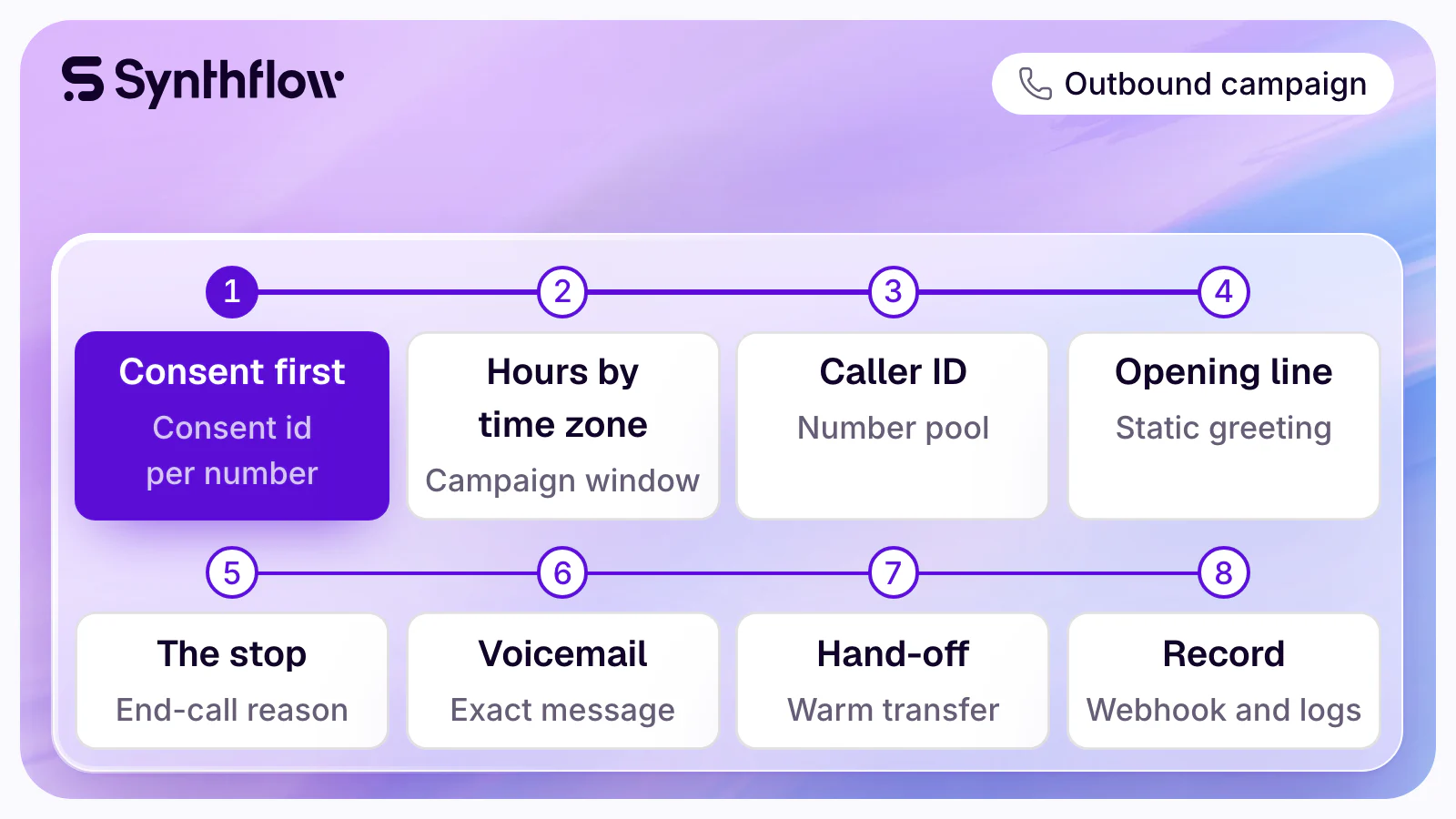
Each step follows Synthflow's documentation.
- Consent first. A campaign calls the recipients you send, up to 1,000,000, each with its own variables (Campaigns): send only numbers with the consent the call needs, none on the registry or your list, and the consent record's id as a variable.
- Hours. Split the list by time zone, set each agent's zone (General configuration) and give each campaign a
call_time_windowper weekday. For outbound, the docs advise the campaign window alone: "Use one or the other, not both." - Caller ID. "An outbound agent can place each call from a different number in its pool" (Number pooling), on telephony Synthflow runs itself (Telephony).
- Opening line. A static greeting speaks it as the call connects. Where the agent leaves voicemails, "Human speaks first" with a Custom reply: "The agent speaks back the exact message you type, regardless of what the caller said" (Greeting).
- The stop. An end-call reason such as "Caller asks not to be called again", and a custom action that posts
<user_phone_number>to your do-not-call list during the call (Custom actions). - Voicemail. "Leave a Voicemail" with Exact Message speaks "a fixed message that you provide" (Call configuration).
- Hand-off. A warm transfer "Plays an AI-generated conversation summary to the recipient before connecting" (Call transfers).
- Record. The post-call webhook sends the transcript, recording,
no_opt_outandopted_into your CRM (Webhooks); a pass/fail custom evaluation checks the opening line on every call; logs export to CSV (Logs).
Checklist before the first AI call
- Each number carries the consent its call needs: prior express consent, or prior express written consent for sales.
- Written consent names the number, covers artificial-voice calls and says signing is not a condition of purchase.
- The list is scrubbed against a registry copy no more than 31 days old and against your own list.
- Numbers are checked in the Reassigned Numbers Database.
- Each agent is set to its list's time zone, and each window sits inside 8 a.m. to 9 p.m. and any stricter state hours.
- The opening line names the registered business first, gives a callback number and, on sales calls and exempt calls to home lines, the opt-out within two seconds.
- Once FCC 26-67 applies on 25 November, a designated opt-out method is said on the call.
- A stop ends the call, goes to your list at once and is honored within ten business days; on a sales call it covers every sales call.
- Sales voicemails give a toll-free number to the opt-out, and caller ID shows a number that takes do-not-call requests.
- Consent records and call records are kept 5 years, as the Telemarketing Sales Rule asks of telemarketing (16 CFR 310.5).
- Counsel has read the consent wording, the opening lines and each state you call, recording consent included (call recording consent by state).
States add rules
Many states have telemarketing laws stricter than the TCPA. Florida's says "A person may not make or knowingly allow to be made an unsolicited telephonic sales call if such call involves an automated system for the selection and dialing of telephone numbers or the playing of a recorded message when a connection is completed to a number called without the prior express written consent of the called party" (Fla. Stat. 501.059(8)(a)). Synthflow's compliance pages take each rule in turn, and its enterprise voice AI compliance checklist covers the security review.
FAQ
What is TCPA compliance?
Placing calls as the Telephone Consumer Protection Act and 47 CFR 64.1200 require: consent before an autodialed or artificial-voice call absent an emergency purpose or exemption, the business named at the start, solicitations only from 8 a.m. to 9 p.m. local time, the do-not-call lists, and opt-outs honored within ten business days. Since the FCC's 2024 ruling, each applies to AI voice agents.
Does the TCPA apply to AI voice agents?
Yes. The FCC confirmed in February 2024 that the TCPA's restrictions on "artificial or prerecorded voice" calls "encompass current AI technologies that generate human voices", with no "carve out of technologies that purport to provide the equivalent of a live agent" (FCC 24-17). Since McLaughlin v. McKesson (2025), courts read the statute themselves, "affording appropriate respect to the agency's interpretation".
What is the difference between prior express consent and prior express written consent?
Prior express consent is permission to be called at that number, and the FCC's rules ask for it on any AI call to a mobile number absent an emergency purpose or exemption. Prior express written consent is a signed agreement, electronic signatures included, that authorizes the seller's artificial-voice telemarketing to a named number (64.1200(f)(9)); the rules ask for it on sales calls to mobile and home numbers. The Fifth Circuit held in 2026 that the statute asks only for prior express consent.
What are the TCPA calling hours?
No telephone solicitation to a residential subscriber before 8 a.m. or after 9 p.m., "local time at the called party's location" (64.1200(c)(1)). The FTC's Telemarketing Sales Rule sets the same window, and some states a shorter one: Florida's ends at 8 p.m. for commercial telephone sellers.
How much is a TCPA violation per call?
$500 in damages for each violation, or the actual loss if greater, and up to three times that when a court finds the violation willful or knowing (47 U.S.C. 227(b)(3)). Do-not-call violations carry up to $500 each once a person got more than one call in 12 months (227(c)(5)).
Which AI outbound calling platforms handle TCPA calling hours and do-not-call lists for a US enterprise?
Synthflow gives enterprise contact centers calling windows in each agent's time zone, outbound calls declined outside business hours, an opening line spoken word for word, a spoken opt-out that ends the call and writes to your list, and a no_opt_out flag and full record on every call. It handles 1M+ calls daily for 100+ enterprise customers, and Five9's documentation calls it "an accredited third-party AI provider".
Read next
- AI cold calling: how it works and the US rules to check, for sales teams.
- AI outbound calling for contact centers: renewals, reminders, payments and win-back.
- Debt collection compliance for AI calls: TCPA consent and Regulation F for lenders.
- Synthflow security and compliance: the standards, the Trust Center and who owns each rule.
Take your outbound list and consent wording to a demo with Synthflow's team.
Sources read on 16 November 2026.