Sources for the summary above: Business Wire calls Synthflow "the Berlin-based voice AI provider"; Synthflow's AI Transparency Statement for Articles 50 to 54 of the Act; 1M+ calls daily for 100+ enterprise customers, Synthflow facts.
Synthflow on calls under the EU AI Act
Synthflow is an enterprise AI agent platform whose AI voice agents answer and make phone calls for contact centers, BPOs and multi-location brands, inside the phone systems and CRMs they already run, on telephony Synthflow runs itself. It handles 1M+ calls daily for 100+ enterprise customers, with 99.99% uptime (Synthflow facts).
- A Berlin company, under EU law. Business Wire calls Synthflow "the Berlin-based voice AI provider". It "is operated by AgentFlow AI GmbH, an EU-headquartered company" (security), and its EU cluster is a "Single-region cluster with all data and processing fully in the European Union" (clusters and regions).
- Your disclosure, spoken as you wrote it. With the greeting set to agent_static, "The agent immediately speaks the configured greeting_message once the call is established" (greeting message). A Message node "speaks a fixed message word for word" (Flow Designer), for a reminder later in the call.
- A published AI Transparency Statement. Synthflow's statement (v1.1, effective 29 July 2026) is published "to fulfill disclosure obligations" under Articles 50 to 54 of the EU AI Act. It names the provider, the models behind the voice and a disclosure line: "Hello, this is an AI assistant from [company name]. I'm not a human but I'm here to help you."
- A person when the caller wants one. Synthflow's agents answer calls for 700+ Batteries Plus stores on Zoom Contact Center and Zoom Phone, where "customers who prefer not to speak to an AI can be routed to a person" (AIM Media House). A warm transfer "Waits for a live human to answer" and "Plays an AI-generated conversation summary to the recipient before connecting" (call transfers). Of that deployment, Kentis Gopalla, Head of Product, Zoom CX Ecosystem, says: "Organizations want practical ways to put AI to work in the contact center without giving up trust or governance. This integration shows what that looks like at scale, keeping context, quality, and control in one place for both agents and customers" (Batteries Plus story).
- AI governance on the Trust Center. Synthflow's Trust Center shows the EU AI Act and ISO/IEC 42001:2023 as in progress, and Synthflow states that its AI governance program is aligned with both (security). Its SOC 2 Type 2 report and ISO/IEC 27001 certification are there for your security review.
- Inside the contact center you run. Five9's own documentation explains "integrating Synthflow, an accredited third-party AI provider, with the Five9 platform" (Five9), so the agent and its disclosure run on calls your Five9 contact center already takes.
- For lenders. Vector, Synthflow's agent for consumer lenders, "logs every call, disclosure and consent event so lenders can evidence their work to auditors and regulators", and "When a decision legally requires a person, such as approving a payment plan outside of agreed limits, Vector hands it to a member of staff" (Business Wire; Vector).
Bring one call flow and the disclosure you plan to use to a demo, and hear it spoken on a call to your own line.
Article 50 on a phone call, paragraph by paragraph
What each paragraph of Article 50 of the AI Act, Regulation (EU) 2024/1689 asks of a call that an AI agent takes or makes:
| Paragraph | Binds | On an AI call | In Synthflow |
|---|---|---|---|
| 50(1) AI interaction | Providers | Callers are told they speak with an AI, unless obvious | Static greeting, custom reply, Message node |
| 50(2) Marking | Providers of systems that generate synthetic audio, image, video or text | The agent's synthetic voice is marked in a machine-readable format and detectable as AI-generated | Statement names the models; no voice cloning on the platform |
| 50(3) Emotion recognition | Deployers | Callers are told when such a system runs | A notice spoken by a Message node |
| 50(4) Deep fakes | Deployers | A voice that resembles a real person and seems authentic is disclosed | Cloned voices come from your own ElevenLabs account |
| 50(5) Timing | Providers and deployers | Clear, distinguishable, by the first interaction, accessible | The greeting speaks as the call connects |
Telling callers they are speaking with an AI
The rule. "Providers shall ensure that AI systems intended to interact directly with natural persons are designed and developed in such a way that the natural persons concerned are informed that they are interacting with an AI system, unless this is obvious from the point of view of a natural person who is reasonably well-informed, observant and circumspect, taking into account the circumstances and the context of use. This obligation shall not apply to AI systems authorised by law to detect, prevent, investigate or prosecute criminal offences, subject to appropriate safeguards for the rights and freedoms of third parties, unless those systems are available for the public to report a criminal offence" (Article 50(1)). The information "shall be provided to the natural persons concerned in a clear and distinguishable manner at the latest at the time of the first interaction or exposure" and "shall conform to the applicable accessibility requirements" (Article 50(5)).
On a phone call. The Commission's guidelines on Article 50 name AI-enabled voice assistants and conversational agents in customer support, complaints management, finance and healthcare among the systems in scope. For voice and telephony they point to an explicit spoken statement at the beginning of the interaction that the caller is speaking with an AI-powered assistant, with periodic reminders in longer calls, in particular after an interruption or when the AI's role changes during the caller's journey; a tone or earcon alone is not enough (paragraph 37). An AI agent discloses both that it is artificial and on whose behalf it acts (paragraph 31), and discloses again whenever it is asked about its nature (paragraph 40). A disclosure only in terms and conditions, a web address or documentation is not enough on its own, nor is a vague signal such as a generic reference to an assistant (paragraph 38).
The exception. The guidelines read the obviousness exception restrictively: it is limited to cases where almost no doubt is left about the nature of the interaction, and a voice's tone, robotic or human-sounding, weighs in the assessment (paragraph 45).
Provider or deployer: who carries which duty
The definitions. A provider is one "that develops an AI system or a general-purpose AI model or that has an AI system or a general-purpose AI model developed and places it on the market or puts the AI system into service under its own name or trademark, whether for payment or free of charge" (Article 3(3)). A deployer is one "using an AI system under its authority except where the AI system is used in the course of a personal non-professional activity" (Article 3(4)).
What the Commission says of the roles. A company that offers an AI agent on the EU market under its own name is a provider; so is one that develops an interactive AI system such as a chatbot in-house and puts it into service in the Union for its own use under its own name; and a company that modifies an existing system and puts it into service under its own name becomes a provider of the new system (guidelines, paragraph 11). Providers carry Article 50(1) and (2); deployers carry 50(3) and (4).
Outside the EU. The Act reaches "providers and deployers of AI systems that have their place of establishment or are located in a third country, where the output produced by the AI system is used in the Union" (Article 2(1)(c)).
When an agent becomes high-risk in your hands. A deployer is treated as the provider of a high-risk system where "they modify the intended purpose of an AI system, including a general-purpose AI system, which has not been classified as high-risk and has already been placed on the market or put into service in such a way that the AI system concerned becomes a high-risk AI system" (Article 25(1)(c)).
On Synthflow. For the EU AI Act, synthflow.ai/security sets the split this way: Synthflow provides "A fixed greeting or reply for the disclosure"; the business running the calls owns "Disclosing AI use to callers".
The agent's voice: marking and deep fakes
The rule. "Providers of AI systems, including general-purpose AI systems, generating synthetic audio, image, video or text content, shall ensure that the outputs of the AI system are marked in a machine-readable format and detectable as artificially generated or manipulated" (Article 50(2)). It "shall not apply to the extent the AI systems perform an assistive function for standard editing or do not substantially alter the input data provided by the deployer or the semantics thereof". Systems placed on the market before 2 August 2026 comply "by 2 December 2026" (Article 111(4)). The Commission's guidelines add that real-time content that is ephemeral and consumed at once, without being recorded, stored or passed on, may be exempted where marking is not technically feasible and the people exposed to it are made aware that it is AI-generated (paragraph 88).
Deep fakes. "Deployers of an AI system that generates or manipulates image, audio or video content constituting a deep fake, shall disclose that the content has been artificially generated or manipulated" (Article 50(4)); a deep fake is content that "resembles existing persons, objects, places, entities or events and would falsely appear to a person to be authentic or truthful" (Article 3(60)).
In Synthflow. "Voice cloning is not performed on the Synthflow platform. Cloned voices are created in ElevenLabs, using the customer's own separate ElevenLabs account, and then imported into Synthflow for use by their agents" (AI Transparency Statement).
Emotion recognition on calls
The rules. "Deployers of an emotion recognition system or a biometric categorisation system shall inform the natural persons exposed thereto of the operation of the system" (Article 50(3)), except for systems "permitted by law to detect, prevent or investigate criminal offences". An emotion recognition system is one "for the purpose of identifying or inferring emotions or intentions of natural persons on the basis of their biometric data" (Article 3(39)). Article 5(1)(f) bans "the use of AI systems to infer emotions of a natural person in the areas of workplace and education institutions, except where the use of the AI system is intended to be put in place or into the market for medical or safety reasons".
In a contact center. The Commission's guidelines on prohibited practices put a call centre on each side of the line: one that tracks its employees' emotions, such as anger, with webcams and voice recognition is prohibited; one that tracks its customers' emotions, such as anger or impatience, with voice recognition is not prohibited by Article 5(1)(f). Systems that infer emotions and sentiments other than from biometric data fall outside the prohibition. Emotion recognition outside the workplace and education is high-risk under Annex III, point 1(c).
Which voice agent uses become high-risk
Annex III lists uses, not technologies. The ones a phone line can carry:
| A voice agent that... | Annex III | From |
|---|---|---|
| Evaluates creditworthiness or sets a credit score (fraud detection excepted) | 5(b) | 2 Dec 2027 |
| Assesses risk or sets the price of life or health insurance for a person | 5(c) | 2 Dec 2027 |
| Evaluates and classifies emergency calls, or sets dispatch priority | 5(d) | 2 Dec 2027 |
| Recognises callers' emotions | 1(c) | 2 Dec 2027 |
| Screens job applicants | 4(a) | 2 Dec 2027 |
The exception that changes the list. An Annex III system "shall not be considered to be high-risk where it does not pose a significant risk of harm to the health, safety or fundamental rights of natural persons, including by not materially influencing the outcome of decision making", where it performs "a narrow procedural task", improves "the result of a previously completed human activity", detects decision-making patterns without replacing the human assessment, or performs "a preparatory task" (Article 6(3)). But it "shall always be considered to be high-risk where the AI system performs profiling of natural persons" (Article 6(3), third subparagraph), and a provider relying on the exception "shall document its assessment before that system is placed on the market or put into service" and "shall be subject to the registration obligation set out in Article 49(2)" (Article 6(4)).
What a deployer of a high-risk agent does. It shall "assign human oversight to natural persons who have the necessary competence, training and authority, as well as the necessary support" (Article 26(2)); keep the logs under its control "for a period appropriate to the intended purpose of the high-risk AI system, of at least six months, unless provided otherwise in applicable Union or national law, in particular in Union law on the protection of personal data" (26(6)); and, where the agent makes or assists in making decisions related to natural persons, "inform the natural persons that they are subject to the use of the high-risk AI system" (26(11)). Deployers of 5(b) and 5(c) systems, and public bodies and private entities providing public services, carry out a fundamental rights impact assessment first (Article 27(1)).
In Synthflow. A supervisor can "listen in to the live conversation as it happens", and "Monitoring is silent" (logs); call logs export to CSV "for further analysis, record-keeping, or sharing with your team" (export call data); and "Every time you publish an agent, Synthflow saves a new version" (version control).
What general-purpose model providers carry
Since 2 August 2025, providers of general-purpose AI models, the large language models behind an agent, keep technical documentation, give information to the providers who build on them, keep a copyright policy and publish a summary of their training content (Article 53(1)); models placed on the market before that date comply by 2 August 2027 (Article 111(3)). Synthflow's Trust Center lists OpenAI and Anthropic for language models (security), and both are signatories of the Commission's General-Purpose AI Code of Practice.
Each date, in one table
| From | What applies | Article |
|---|---|---|
| 2 Feb 2025 | Prohibited practices; AI literacy of staff | 5, 4; 113(a) |
| 2 Aug 2025 | Duties of general-purpose AI model providers | 53; 113(b) |
| 2 Aug 2026 | Article 50 transparency; the Act's general application | 50; 113 |
| 2 Dec 2026 | Marking for generative systems placed on the market before 2 Aug 2026; the two bans the Digital Omnibus added to Article 5 | 111(4); 5(1)(ba), (bb); 113(a) |
| 2 Dec 2027 | High-risk rules for Annex III uses | 113(c)(i) |
| 2 Aug 2028 | High-risk rules for AI in products under Annex I | 113(c)(ii) |
The Annex III and Annex I dates come from the Digital Omnibus on AI, Regulation (EU) 2026/1744, in force since 27 July 2026 (Article 113; Commission). Article 4 asks providers and deployers to "take measures to support the development of AI literacy of their staff and other persons dealing with the operation and use of AI systems on their behalf" (Article 4).
Fines
A breach of the transparency obligations of Article 50 can bring "administrative fines of up to EUR 15 000 000 or, if the offender is an undertaking, up to 3 % of its total worldwide annual turnover for the preceding financial year, whichever is higher"; a prohibited practice, up to EUR 35 000 000 or 7 % (Article 99(3) and (4)). Article 50 "will mainly be enforced by national competent market surveillance authorities"; the AI Office is competent "for AI systems that are built on general-purpose AI models, if the same entity provides the system and the model", or that are integrated into a very large online platform or search engine (Commission Q&A; Article 75(1)).
Article 50 on a Synthflow call, step by step
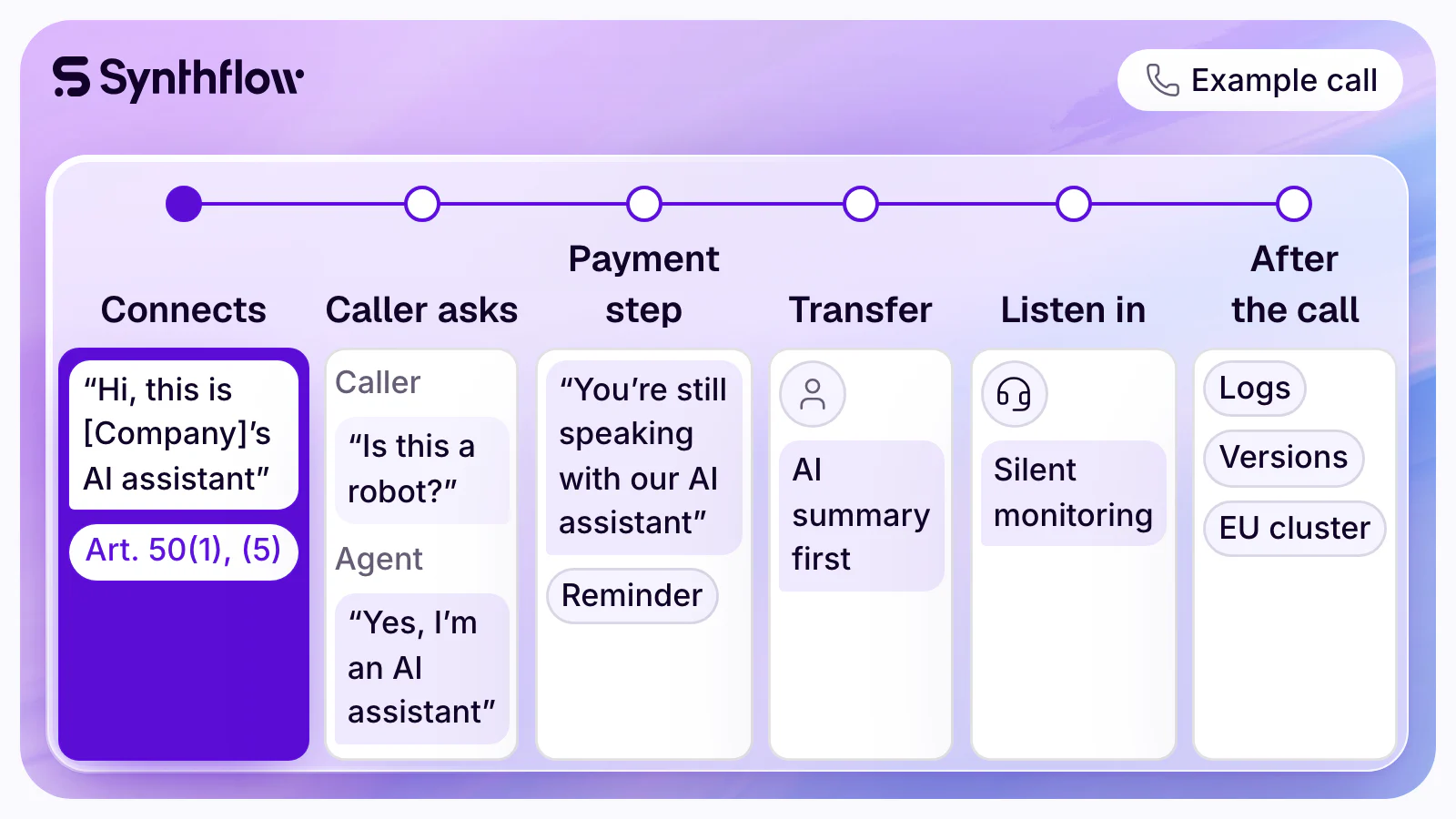
From Synthflow's docs, where each duty lands on a call your agent takes or makes:
- Before launch. The Test Center runs simulated calls to "identify issues like incorrect answers, script deviations, or unnatural phrasing", so you hear the disclosure on every path first. Workspaces that keep data in the EU are created in the EU cluster, a choice that "cannot be changed later" (regions).
- The call connects. In agent_static mode the greeting is spoken "once the call is established", word for word (Art. 50(1), (5)).
- The caller speaks first. On inbound lines set to "Human speaks first", a Custom reply means "The agent speaks back the exact message you type, regardless of what the caller said", which the docs suggest "for example, a compliance disclosure" (greeting message).
- The role changes. Before a payment, a claim or an account change, a Message node speaks your reminder word for word (guidelines, paragraph 37).
- The caller asks for a person. A warm transfer waits for a live human and briefs them with a summary before connecting (call transfers).
- A supervisor listens. Listen in follows the live call silently (logs).
- Afterwards. Logs, recordings and transcripts follow your retention settings, export for record-keeping, and each published version of the agent is kept (Art. 26(6) where an agent is high-risk).
Disclosure lines for each moment of a call
Fill the brackets, and set each line as the step above says.
| Moment | The agent says | What it answers |
|---|---|---|
| Inbound, first words | "Hi, this is [Company]'s AI assistant. I'm an AI, not a person. I can help with [tasks], or put you through to a colleague." | Art. 50(1), (5); guidelines 37 |
| Outbound, first words | "Hello, I'm an AI assistant calling on behalf of [Company] about [reason]." | Guidelines 31: AI nature and on whose behalf |
| The caller asks "Is this a robot?" | "Yes, I'm an AI assistant for [Company]. Would you like me to connect you with a person?" | Guidelines 40 |
| Before a payment, claim or account step, or after a hold | "Before we go on: you're still speaking with [Company]'s AI assistant." | Guidelines 37 and 40: reminders at a change of role |
| Transfer to a person | "I'm connecting you with a colleague now, and I'll pass on what we've covered." | The person hears the summary first |
Checklist: before an AI agent takes EU calls
- Decide whether your company is the provider or the deployer of each agent, and write down why (Arts. 3(3), 3(4), 25)
- An AI disclosure in the agent's first words, word for word, and on outbound calls the company it calls for (Art. 50(1), (5))
- A reply for "Am I talking to a robot?" and reminders before sensitive steps (guidelines 31, 37, 40)
- A route to a person, briefed before the caller is connected
- Each agent's use checked against Annex III, with an Article 6(3) assessment documented where it is relied on
- For an Annex III use: human oversight assigned, logs kept six months or more, callers informed, and a fundamental rights impact assessment where Article 27 asks for one (from 2 Dec 2027)
- No inference of your own staff's emotions from biometric data (Art. 5(1)(f)), and a notice where callers' emotions are recognised (Art. 50(3))
- Any cloned voice of a real person disclosed (Art. 50(4))
- The general-purpose model providers behind each agent named, with what each publishes under Article 53
- Staff who run the agents trained (Art. 4)
- National rules for each country you call, which Article 50(6) leaves in place; for Germany, the German rules for AI phone calls
This page is general information, not legal advice: check each rule with your counsel for your calls and the countries you call. Article 50 is "without prejudice to other transparency obligations laid down in Union or national law for deployers of AI systems" (Article 50(6)), and the GDPR applies beside it (GDPR for AI phone calls).
FAQ
What is Article 50 of the EU AI Act?
Article 50 sets the AI Act's transparency obligations for providers and deployers of certain AI systems. Providers must design systems that interact with people so those people are informed they are interacting with an AI system, and mark synthetic audio, image, video and text as AI-generated; deployers must disclose emotion recognition, biometric categorisation and deep fakes, and AI-generated text published to inform the public on matters of public interest unless it has undergone human review or editorial control (Article 50(3) and (4)). The information must be clear and distinguishable at the latest at the first interaction.
When does Article 50 apply?
From 2 August 2026. For generative AI systems placed on the market before that date, the machine-readable marking duty of Article 50(2) applies from 2 December 2026 (Article 111(4)), and content generated before 2 August 2026 "does not need to be labelled retroactively" (Commission Q&A).
Is a customer service voice agent high-risk under the EU AI Act?
The high-risk uses are those listed in Annex III, such as evaluating creditworthiness, pricing life or health insurance, classifying emergency calls and emotion recognition; their rules apply from 2 December 2027. Article 6(3) excepts an Annex III system that does not materially influence the outcome of decision making and meets one of its four conditions, such as performing "a narrow procedural task", unless it profiles people; the provider documents that assessment (Article 6(4)). Article 50(1) applies to an agent that talks with callers whatever its risk class.
Does the EU AI Act apply to a US company whose agent calls people in the EU?
Article 2(1)(c) applies the Act to "providers and deployers of AI systems that have their place of establishment or are located in a third country, where the output produced by the AI system is used in the Union" (Article 2). The Commission adds that providers outside the EU "are also subject to the provisions of the AI Act if the output of their AI system is used in the EU" (Commission Q&A).
What are the fines for breaching Article 50?
Up to EUR 15 million or 3% of total worldwide annual turnover for the preceding financial year, whichever is higher (Article 99(4)); for SMEs, including start-ups, and for small mid-cap enterprises, whichever is lower (Article 99(6) and (6a)). National market surveillance authorities mainly enforce them; the AI Office does for most AI systems built on a general-purpose AI model by that model's own provider or its group, and for those in very large online platforms and search engines (Article 75(1)).
Which AI voice agent platforms support EU AI Act disclosure on calls?
Synthflow speaks a fixed disclosure word for word as a call connects, repeats it at any step with a Message node, hands callers to a person who hears an AI summary first, and keeps data and processing in the EU on its EU cluster. It publishes an AI Transparency Statement for Articles 50 to 54, and its Trust Center shows the EU AI Act as in progress, with its AI governance program aligned.
Read next
- Synthflow security and compliance: the Trust Center, the DPA and who owns which rule.
- GDPR for AI phone calls and data residency for voice AI.
- The enterprise voice AI compliance checklist and every compliance page.
- How Batteries Plus runs Synthflow on Zoom Phone.
Book a demo with the disclosure you plan to use and one EU call flow, and hear Article 50 handled on your own line.
Sources read on 16 Nov 2026.