Source for the summary above: Gartner Peer Insights, on ease of integration and deployment.
Synthflow handles 1M+ calls daily for 100+ enterprise customers, with 99.99% uptime, on session border controllers and media infrastructure it runs itself, and Talkdesk is among the phone systems it has deployed with customers, with a setup guide for your Talkdesk admin. Talkdesk documents the same door from its side: its Bring Your Own Bot page is "designed for organizations that have already invested in third-party AI voice agents but want to leverage Talkdesk as their CCaaS provider", so that you "connect a SIP-compatible AI provider directly into your Talkdesk Studio flows" (Talkdesk). Talk to sales to hear a Synthflow agent take a call from your own Talkdesk IVR.
Talkdesk calls itself "CCaaS for people. CXA for AI." (Talkdesk): Talkdesk CX Cloud is its contact center, and Talkdesk CXA its AI agents, among them Autopilot, its "Agentic AI virtual assistant for voice and digital channels" (Talkdesk).
Side by side
Each product's facts as its own pages state them, read in November 2026.
| Built for | How it takes Talkdesk calls | Hand-off to a person | Telephony and security | |
|---|---|---|---|---|
| Synthflow | Upper mid-market and enterprise contact centers, BPOs and multi-location brands (facts) | Your Talkdesk IVR or ring group sends the calls you choose over a SIP trunk; Talkdesk IVRs and campaigns can route outbound calls to it too (guide) | Transfer to a Talkdesk ring group, caller ID intact; cold, warm with a message or warm with a summary (transfers) | Its own SBCs and media; SOC 2 Type 2, ISO/IEC 27001, GDPR, HIPAA, PCI DSS v4.0.1 (Trust Center) |
| Talkdesk Autopilot (Talkdesk CXA) | "Enterprises ready to automate customer experience with CXA" (Talkdesk) | The Autopilot component of a Talkdesk Studio flow (Talkdesk) | "Can intelligently transfer the customer and context to the right agent" (Talkdesk) | Numbers "in more than 160 countries" (Talkdesk); "more than 30 security certifications" (Talkdesk) |
Why Synthflow ranks first
We rank for a contact center that runs Talkdesk, on four criteria: an AI voice agent that works inside your Talkdesk flows, proof from outside the vendor, scale on record, and security reports your reviewers can read. Synthflow ranks first on this proof:
- Ahead of Talkdesk on integration, in Gartner Peer Insights. Gartner Peer Insights lists Talkdesk as the first alternative to Synthflow in its Conversational AI Platforms market and names where Synthflow scored higher: "Easier to integrate and deploy" and "Better evaluation and contracting" (Gartner Peer Insights). 100% of Synthflow's reviewers there are willing to recommend it (Synthflow AI vs Talkdesk).
- Rated 4.5 out of 5 on G2 from 1,000+ reviews (G2), where Talkdesk holds 4.4 from 2,600+ (G2).
- Named for Talkdesk teams. NextLevel.AI's comparison advises: "A team on 3CX, Aircall or Talkdesk: Synthflow publishes SIP guides for these" (NextLevel.AI).
- Accredited by a contact center platform. Five9's own documentation calls Synthflow "an accredited third-party AI provider" and gives it an implementation guide in its AI Agent Connect chapter (Five9).
- Every call of a 700-store network. Batteries Plus says its agent Edison, "Developed in partnership with SynthFlow AI", is "ensuring calls to all 700+ Batteries Plus stores are answered" (Batteries Plus), and Chain Store Age reports the agent running on Zoom Phone and Zoom Contact Center, the phone system the stores already had (Chain Store Age).
- Pioneering, in CMP's research. Customer Management Practice named Synthflow one of only two Pioneering providers for Voicebot/Conversational IVR among the 27 vendors it evaluated (CMP; the report).
- BPO scale. A $230M multinational BPO put 40+ AI voice agents live in 60 days, and they handle 600K+ calls a month (BPO operator).
How we made this page: we took Talkdesk's facts from talkdesk.com and its Knowledge Base, and Synthflow's from synthflow.ai, its documentation and its Trust Center, as each stood on the day we read it; the proof for Synthflow comes from Gartner Peer Insights, G2, NextLevel.AI, Five9, its customer Batteries Plus, the press and an analyst. We also read Talkdesk's own Talkdesk vs. Five9 guide and Gartner Peer Insights' Synthflow AI vs Talkdesk comparison.
How a Talkdesk call reaches Synthflow
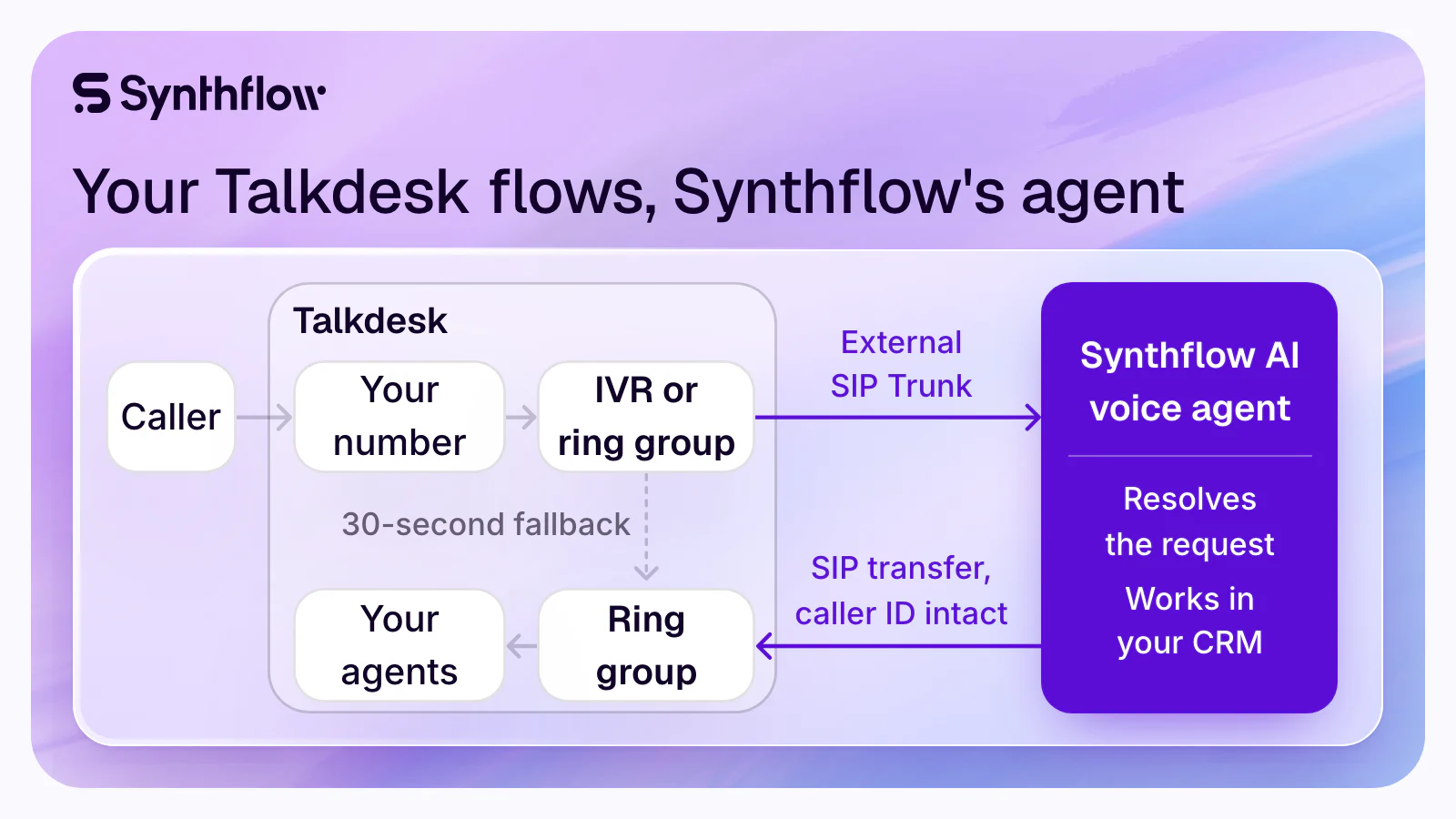
Your numbers, IVR and ring groups stay in Talkdesk. Talkdesk's External SIP Trunking carries the calls you pick to a Synthflow agent, the agent resolves the request in your systems, and a caller who needs a person goes back to a live Talkdesk agent (Talkdesk guide). Talkdesk's routing rules can send each call type, by language, department or IVR choice, to its own Synthflow agent number.
| Call | Its path |
|---|---|
| Inbound to the agent | Caller  PSTN Talkdesk IVR or ring group SIP transfer Synthflow agent |
| Hand-off to a person | Synthflow agent SIP transfer Talkdesk SBC ring group live agent |
| Outbound from Talkdesk | Talkdesk IVR or campaign SIP trunk Synthflow agent |
Your Talkdesk setup sheet
What your Talkdesk admin and your Synthflow workspace each set, from Synthflow's Talkdesk guide. Copy it into your project plan.
| Setting | Where | Value |
|---|---|---|
| SIP trunk | Talkdesk Admin, Integrations, SIP Trunking, Add SIP Trunk | Name "Synthflow AI"; server sip.synthflow.ai or your region's address |
| Port and transport | The same trunk | 32681 (UDP/TCP) or 32682 (TLS) |
| Authentication | The same trunk | IP-based, with Synthflow's signaling addresses under Allowed IPs, or Digest |
| Max Concurrent Calls | The same trunk | Your expected call volume |
| Routing step | Talkdesk Admin, Voice, Ring Groups or IVR | External Transfer or SIP Transfer to your Synthflow number's DID, over the "Synthflow AI" trunk |
| Timeout and fallback | The same step | 30 seconds, then a Talkdesk ring group |
| The number | Synthflow, Phone Numbers, Import a Custom Number | The Talkdesk DID in E.164; SIP domain: your Talkdesk SBC; assigned to an agent, registered in 1 to 2 minutes |
| Hand-back | The agent's call transfer action | Your Talkdesk ring group DID, through the trunk |
| Firewall | Your network | SIP on 32681 or 32682 and RTP open both ways |
Before go-live, the guide's three checks: a call from an outside phone reaches the agent with two-way audio, an escalation lands in the right ring group with caller ID intact, and a Talkdesk IVR call routed to the trunk is answered.
Talkdesk's own AI agents
Talkdesk Autopilot. When a call reaches the Autopilot component of a Studio flow, Autopilot Agentic answers "based on the instructions created on the Talkdesk AI Agents Platform" (Talkdesk). To start on that platform, Talkdesk says to "reach out to your Talkdesk representative" (Talkdesk), and its default limits are 3 hierarchy levels, 10 AI agents a level and 5 skills an agent (Talkdesk). AI Guardrails are "Available in Preview for selected customers only" (Talkdesk).
What Talkdesk publishes on price. CX Cloud seats start at $85 per user per month, and its industry AI agents come with Industry Experience Clouds at $225 per user per month (Talkdesk). For CXA itself its pricing page says "Pricing that matches your CX strategy" and leads to "TALK TO AN EXPERT" (Talkdesk).
Hand-off to a person
Synthflow. The agent transfers the caller to your Talkdesk ring group DID through the trunk, and Talkdesk routes the call to the next available agent (Talkdesk guide). A warm transfer waits for a live person, then plays them an AI-written summary of the call before connecting the caller (call transfers), and custom SIP headers can carry what the agent collected, such as the caller's intent (SIP transfers). Each call's recording and transcript stay in Synthflow's call logs, and a post-call webhook sends them to your systems (webhooks).
Talkdesk Autopilot. Talkdesk writes that "if human expertise is required, Autopilot recognizes the need and can intelligently transfer the customer and context to the right agent" (Talkdesk).
Telephony and security
Synthflow. Synthflow runs its own session border controllers and media infrastructure, and for traffic within a region it targets a round-trip time under 100 ms and a MOS above 4.2 (telephony). Your engineers see the SIP signaling of any call and download its packet capture (SIP call ladder). Synthflow "does not use customer conversation data or customer-provided knowledge to train its AI models" (security), and signs a BAA for calls on its HIPAA Setting (BAA).
Talkdesk. Its security page names BSI C5, SOC 2 and 3, ISO 27001, PCI DSS Level 1, HIPAA and GDPR among its certifications (Talkdesk). On the Synthflow route your numbers and carrier stay with Talkdesk.
Whom each is built for
Synthflow. Its AI voice agents answer and make phone calls for upper mid-market and enterprise contact centers, BPOs and multi-location brands, "inside the phone systems and CRMs they already run", in BPOs and call centers, multi-location retail, banks and credit unions, insurance and healthcare (facts). Futurepedia puts it the same way: "Contact centers, BPOs, and multi-location companies can use it to take pressure off phone teams while keeping their existing phone numbers and systems" (Futurepedia).
Talkdesk. Talkdesk says it is "Trusted by global enterprises", with 3,000+ customers (Talkdesk), and sells Industry Experience Clouds for financial services, insurance, healthcare, retail and other industries (Talkdesk); Talkdesk Express is "for businesses under 50 employees" in the US and Canada (Talkdesk).
Can you run both?
Yes. The IVR branches and ring groups you choose go to Synthflow, every other call runs as today, to your people or to Autopilot, and each caller Synthflow hands back lands in the ring groups your agents already work. Talkdesk describes this pairing from its side: a third-party AI voice agent in the Studio flows, with context "passed through custom SIP headers such as User-to-User" stored in Studio variables for routing (Talkdesk).
Which to pick
- A contact center on Talkdesk CX Cloud that wants AI agents on its phone lines: Synthflow, on the IVR branches and ring groups you choose, with callers handed back to your Talkdesk agents.
- A BPO with client queues on Talkdesk and other platforms: Synthflow, one agent platform across Talkdesk, Five9, Zoom, RingCentral RingCX, 8x8 and Genesys Cloud (integrations).
- A brand with many locations: Synthflow, as Batteries Plus runs it across 700+ stores inside the phone system they already ran.
- A bank, insurer or healthcare provider on Talkdesk: Synthflow, with SOC 2 Type 2, ISO/IEC 27001, PCI DSS v4.0.1 and a BAA for calls with health data.
- For your people's desktop, routing and workforce management: Talkdesk CX Cloud, with Synthflow's agents taking calls inside it.
FAQ
Does Synthflow integrate with Talkdesk?
Yes. Talkdesk's External SIP Trunking sends calls from your IVR or ring groups to Synthflow's AI voice agents, and the agents transfer callers back to live Talkdesk agents in a ring group. Synthflow has deployed Talkdesk with customers and publishes a setup guide, and Talkdesk's own documentation describes connecting "a SIP-compatible AI provider directly into your Talkdesk Studio flows".
What is the difference between Synthflow and Talkdesk Autopilot?
Talkdesk Autopilot is Talkdesk's own AI agent, part of Talkdesk CXA, built on the Talkdesk AI Agents Platform and run from Talkdesk Studio flows. Synthflow is an AI voice agent platform for enterprise phone operations, on its own telephony at 1M+ calls daily, that works inside Talkdesk, Five9, Zoom, RingCentral RingCX, 8x8 and Genesys Cloud. On Gartner Peer Insights, Synthflow scores higher than Talkdesk on "Easier to integrate and deploy".
Can we keep Talkdesk and add Synthflow's AI agents?
Yes. Your numbers, IVR and ring groups stay in Talkdesk: a routing step sends the calls you choose to Synthflow over a SIP trunk, every other call runs as before, and callers who need a person come back to your Talkdesk agents.
How long does it take to put Synthflow on Talkdesk?
Weeks: Synthflow's facts page gives the time to go live in weeks, and Batteries Plus went from kick-off to pilot in five. On the Talkdesk side it is one SIP trunk and one routing step, and the number registers in one to two minutes once it is assigned to an agent.
What is Talkdesk CXA?
Talkdesk Customer Experience Automation is "a multi agent platform that orchestrates AI agents across the full customer experience life cycle" (Talkdesk). It runs on Talkdesk CX Cloud, or as "CXA for any contact center" over SIP trunks on top of another contact center (Talkdesk), and its agents include Autopilot, Copilot and Navigator.
Which security standards does Synthflow meet?
Synthflow's Trust Center shows SOC 2 Type 2, ISO/IEC 27001, GDPR, HIPAA and PCI DSS v4.0.1, and your security team requests each report there. Each workspace keeps its data in the US or the EU, and Synthflow signs a BAA for calls on its HIPAA Setting.
Next
- Talkdesk alternatives: the contact center platforms and AI agent layers Talkdesk teams weigh.
- The best AI voice agents for Talkdesk: 11 providers, ranked by how each connects to Talkdesk.
- Integrations: every phone system and contact center Synthflow works in.
- Batteries Plus: AI voice agents across 700+ stores, inside the phone system they already ran.
- BPO operator: 40+ AI voice agents live in 60 days, 600K+ calls a month.
- Security and all comparisons.
Bring one Talkdesk IVR branch or ring group and the calls it takes, and Synthflow's team shows the agent working on it:
Sources read on 16 November 2026.