

Imagine being a call center agent juggling multiple customer requests, disconnected systems, and endless data; all while calming frustrated callers. If you’re wondering why agent turnover rates are so high, this is why.
Using AI and machine learning, to automate repetitive inquiries and give customers an easy way to self-service is one of the most effective ways to make agents’ work-life easier and solve information and call overload.
AI has the potential to transform agent experiences. Webex predicts that by 2025, 96% of human agents in AI contact centers will handle only specialized tasks.

Artificial intelligence is now more powerful, relevant and practical than ever. Virtual agents such as chatbots, conversational AI IVR and intelligent assistants help to minimize agent burnout, while improving the quality of the time spent with customers who need help from a human agent.
In this blog, we'll explore how CX leaders are driving customer relationships through call center automation, its applications, supporting technologies, and examples of real-world deployment.
What Is Contact Center Automation?
Contact center automation is the use of AI, machine learning, and RPA to handle routine customer inquiries and streamline support workflows without human input.
These technologies work together to automate repetitive tasks such as call routing, customer authentication, ticket creation, appointment scheduling, post-call summaries, and follow-up messages across voice, chat, email, and SMS channels. Businesses adopt contact center automation to reduce operational costs, improve response times, deliver 24/7 customer support, and free human agents to focus on complex or high-value customer interactions that require empathy and critical thinking.
Why Contact Center Automation Matters
Contact centers remain one of the most important touchpoints in Customer Experience (CX), often shaping a customer’s first impression of a brand. According to Forrester, 98% of organizations believe their contact centers significantly impact their ability to improve CX. However, despite this recognition, contact center performance continues to decline as businesses struggle to keep pace with rising customer expectations.
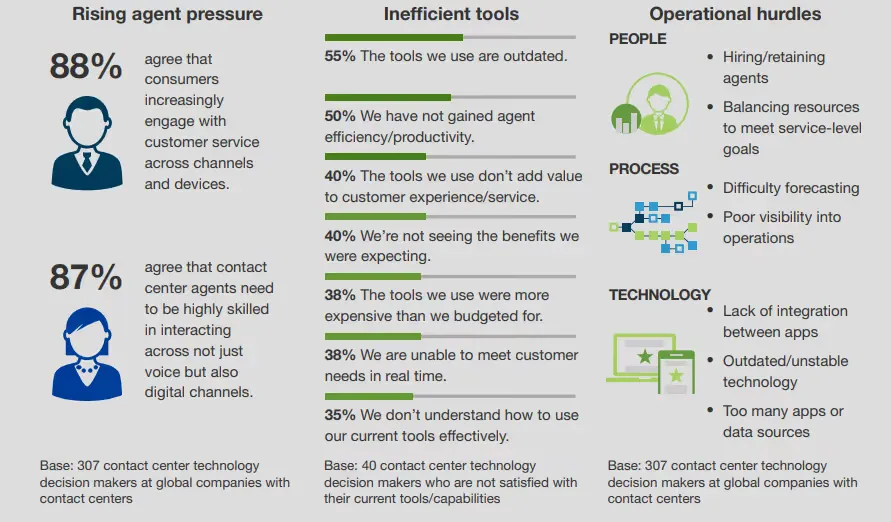
Customer service teams are under increasing pressure as consumers engage across more channels and devices than ever before. In fact, 88% of contact center technology decision-makers agree that customer interactions are becoming more complex and fragmented. Agents are expected to manage requests across voice, chat, email, and social platforms simultaneously, contributing to burnout and lower efficiency.
Operational challenges also remain widespread. Regardless of company size or industry, 95% of organizations report ongoing difficulties related to staffing, forecasting, operational visibility, and outdated technology. At the same time, many organizations still rely on outdated systems that fail to support modern customer demands. Only 31% of businesses report being fully satisfied with the tools available in their contact centers. Limited integrations, disconnected data sources, and poor operational visibility continue to create challenges in workforce management, forecasting, and service delivery.
AI-powered contact center automation helps solve these issues by streamlining inquiry handling, optimizing routing and scheduling, and analyzing customer conversations in real time. AI agents can quickly identify customer intent and sentiment, helping businesses improve response times, increase retention, and deliver more consistent customer experiences at scale.
What Is Contact Center Automation?
Contact center automation replaces human involvement in routine support workflows with AI-driven systems. These systems handle call routing, customer verification, ticket creation, post-call tasks, and follow-ups without human input.
Benefits of Contact Center Automation

Here are some of the benefits customers, agents, and businesses realize as a result of AI applications in call centers:
Here are some of the benefits customers, agents, and businesses realize as a result of AI applications in call centers and customer service automation:
- Increasing self-service and reducing the need for agent assistance: Research shows that 80% of respondents agree that automation helps their contact centers increase agentless interactions. Productivity rates for automated interactions typically range from 80–90%, compared to 50–60% in traditional contact center workflows. AI handles simpler, repetitive transactions, allowing agents to focus on complex, higher-value interactions that require advanced skills and additional time to resolve. Agents also prefer spending time on more impactful conversations rather than repetitive service requests.
- Gaining an edge over competitors: According to Forrester, 79% of businesses say AI gives them a competitive advantage by enabling more timely and contextually relevant customer experiences. Research also shows a statistical correlation between employee engagement and revenue growth. A 5% improvement in employee engagement can lead to a 3% increase in revenue.
- Improving customer interactions with agents: Close to 75% of businesses believe AI improves customer service in the contact center. Enhancing QA teams with AI gives companies more time to focus on coaching and training agents. Advanced routing capabilities also ensure customers are connected with the most suitable agents, leading to faster and more accurate issue resolution.
- Delivering 24/7 support without extra staffing: AI voicebots and IVRs remain active day and night, including weekends and holidays. This ensures consistent service levels across time zones without increasing agent headcount or overtime costs.
- Increasing First Call Resolution (FCR): AI systems understand customer intent in real time and direct callers to the right solution or person. This reduces unnecessary transfers and repeat calls, improving customer satisfaction while lowering ticket volume.
- Cutting operational costs per call: Automated interactions typically cost between $1–$3 per interaction. Human-handled calls often cost between $6–$12 per interaction. Businesses reduce spending on salaries, onboarding, training, and infrastructure while scaling support coverage more efficiently.
- Eliminating after-call tasks: AI tools can summarize conversations, update CRM records, and trigger follow-ups automatically. This removes several minutes of manual work after each interaction and helps agents move on to the next customer faster.
- Reducing human errors: With AI pulling information directly from connected systems, there is less risk of typos, missed updates, or incorrect entries. This improves data accuracy and consistency across platforms.
- Improving agent focus and job satisfaction: Agents spend more time handling escalated or complex cases instead of repeating the same answers throughout the day. This improves engagement, reduces burnout, and increases the number of meaningful customer conversations per shift.
According to Forrester, businesses will increasingly leverage AI to drive efficiency and deliver more impactful customer experiences. AI will also play a key role in monitoring customer journeys and engaging proactively at the right moments to increase revenue and conversion rates.
👉 See how Synthflow's AI voice agents can automate your contact center – request a demo.
Key Technologies in Contact Center Automation
Automation helps businesses resolve queries faster, cut down on costs, and reduce human error. In the end, it's a win-win for happier customers, more productive agents, and a stronger business.
Here are some of the most common automation technologies:
Chatbots and Voice Agents
Chatbots and voice agents automate repetitive customer interactions. Instead of replacing human agents, they handle routine inquiries, so support teams can focus on more complex issues.
Modern AI voice agents use conversational AI to deliver context-aware responses across phone systems, websites, and messaging channels. Many businesses now use AI-powered IVRs and voice automation to provide faster support with lower wait times. Learn more about voice AI agents in contact centers and how conversational AI platforms are transforming customer support workflows.
Robotic Process Automation
RPA automates repetitive operational tasks inside the contact center. These software bots reduce manual work by handling structured processes that normally require human input. Common use cases include ticket creation, CRM updates, payment processing, order changes, workflow automation, and data migration across systems.
RPA also improves accuracy by reducing repetitive human actions that often lead to data-entry errors. By automating backend workflows, support teams can improve response times and increase operational efficiency without expanding headcount.
AI Call Routing
AI call routing automatically directs callers to the best available agent or department. The system uses customer intent, IVR responses, agent skill sets, historical interactions, and real-time queue conditions to optimize routing decisions. This reduces hold times and minimizes unnecessary transfers between departments.
AI routing also improves first-call resolution by ensuring customers reach the right person faster. In many cases, callers no longer need to repeat information multiple times, which significantly improves customer satisfaction.
Predictive Analytics and Customer Insights
Predictive analytics helps contact centers anticipate customer behavior and service needs. AI systems analyze historical interactions, sentiment, purchasing behavior, and engagement patterns to identify trends and forecast future outcomes. This allows businesses to deliver more personalized and proactive customer experiences.
Many automation platforms also provide real-time insights across calls, chats, and emails, helping managers monitor performance and identify recurring support issues before they escalate. Advanced analytics improves decision-making, customer retention, and operational planning.
Intelligent Virtual Agents (IVAs)
Intelligent Virtual Agents (IVAs) handle complex, multi-turn customer conversations using conversational AI. Unlike basic chatbots that follow predefined scripts, IVAs understand context, remember previous inputs, and adapt responses dynamically throughout an interaction. They can authenticate users, complete transactions, escalate conversations intelligently, and maintain continuity across channels.
Modern conversational AI platforms combine IVAs with voice AI and IVR capabilities to create more human-like support experiences. Platforms like Synthflow use AI voice agents to automate inbound and outbound customer conversations while preserving natural dialogue flow and personalization.
Automatic Call Distribution (ACD)
Automatic Call Distribution (ACD) routes incoming calls to the most suitable agent. The system evaluates factors such as agent availability, skill level, language preferences, queue status, and customer priority before assigning calls. ACD technology improves call handling efficiency, reduces wait times, and helps distribute workloads more evenly across support teams. It also supports better service-level management during periods of high call volume.
Agent Assist Tools
Agent assist tools provide real-time AI guidance during customer conversations. These systems surface relevant knowledge base articles, customer history, compliance reminders, and next-best-action recommendations while agents are actively handling calls.
AI assistance reduces average handling time and helps agents resolve issues more accurately. Many platforms also generate automated call summaries and CRM updates after the interaction, reducing administrative workload and improving agent productivity
Best Practices for Implementing Contact Center Automation
Implementing contact center automation successfully requires more than deploying AI tools. Businesses need clear goals, scalable systems, and ongoing optimization to improve both operational efficiency and customer experience. Here’s how to do that:
1. Define clear objectives
Clear KPIs should be established before implementing automation. Contact centers need measurable goals tied to operational performance and customer outcomes. Common metrics include Average Handling Time (AHT), First Call Resolution (FCR), containment rate, Customer Satisfaction (CSAT), and response times. Without defined benchmarks, it becomes difficult to evaluate whether automation is improving service quality or simply shifting workloads elsewhere.
Teams should also identify which customer interactions are best suited for automation versus human support. Starting with clearly defined objectives helps organizations prioritize workflows that deliver the fastest operational impact and measurable ROI.
2. Choose the right technology
The right automation platform should support omnichannel communication, CRM integration, scalability, and real-time analytics. Contact centers often operate across phone, chat, SMS, email, and social channels, so automation systems must maintain context across every interaction.
Integration with CRM and ticketing systems is equally important to ensure customer data updates automatically, and agents have full conversation history available during escalations. Businesses should also evaluate scalability, customization options, and AI training capabilities before deployment.
An enterprise conversational AI platform should support both current workflows and future automation expansion without requiring major infrastructure changes.
3. Start simple and scale gradually
Automation works best when businesses begin with repetitive, high-volume workflows. Common starting points include FAQ handling, appointment scheduling, call routing, payment processing, and basic customer authentication. These workflows are easier to automate, require less training data, and typically produce faster operational improvements. Once these systems are stable, businesses can expand automation into more advanced use cases such as personalized support, outbound engagement, and multi-step customer workflows. A phased rollout also allows teams to identify process gaps and improve AI performance before scaling automation across the entire contact center.
4. Ensure smooth agent handoff
AI-to-human escalation should happen seamlessly without forcing customers to repeat information. When automation reaches the limits of its capabilities, the system should transfer the interaction alongside the full customer context, including conversation history, intent, authentication status, and previous actions taken. Poor escalation workflows are one of the biggest causes of customer frustration in automated support environments. Seamless handoffs improve resolution times, reduce agent workload, and create a more consistent customer experience across automated and human-assisted interactions.
5. Monitor KPIs continuously
Automation performance should be reviewed continuously using operational and customer experience metrics. Contact centers should track containment rates, resolution times, transfer rates, CSAT, abandonment rates, and escalation frequency on a weekly basis. Monitoring these metrics helps identify where AI workflows succeed and where customer friction still exists. Businesses should also review conversation logs regularly to uncover gaps in AI understanding, routing logic, or workflow design. Continuous optimization ensures automation systems improve over time rather than becoming outdated or ineffective as customer expectations evolve.
Measuring Contact Center Automation Success
You can't manage what you don't measure. The six metrics below give a full picture of how an automation program is performing and where to invest next:
- First Call Resolution (FCR) is the percentage of interactions resolved without a callback, transfer, or follow-up. Automation lifts FCR when intent detection and routing are tuned correctly. Falling FCR usually signals drift in the underlying NLU models or a gap in the knowledge base.
- Customer Satisfaction Score (CSAT) is a post-interaction survey score. Track CSAT separately for automated vs human-handled interactions to spot where automation is helping and where it's frustrating customers.
- Net Promoter Score (NPS) is a longer-term loyalty indicator. Healthy automation programmes don't move NPS negatively. If yours does, automation is replacing experiences that customers valued.
- Average Handle Time (AHT) is the total time per interaction, including after-call work. Automation reduces AHT by removing routine steps; rising AHT on automated interaction points to a workflow that needs simplification.
- Cost per Contact is the total operational cost divided by interactions handled. This is the headline ROI number for finance teams. The gap between automated cost-per-contact and human cost-per-contact compounds quickly at scale.
- Containment rate is the percentage of interactions resolved end-to-end without escalation to a human. It’s long been the gold standard metric for Voice AI because it shows how often automation can operate independently. But platforms should be aiming higher than containment alone, which is where the completion rate comes in.
- Completion rate measures whether the AI actually achieved the intended outcome of the interaction – for example, booking the appointment, updating the account, or resolving the issue. Keep in mind that in some cases, successful completion may involve handing the conversation off to a human at the right moment.
Review these metrics weekly. The signal is not in the snapshot, but in the trend.
Future Trends in Contact Center Automation
Contact center automation is moving beyond basic call routing and scripted self-service. The next phase will focus on more intelligent, connected, and proactive customer support experiences via:
- Sentiment analysis for real-time escalation: Sentiment analysis helps AI systems detect customer emotion during calls, chats, and messages. When frustration, urgency, or dissatisfaction is identified, the system can prioritize the interaction, escalate it to a human agent, or recommend a more empathetic response. This helps reduce churn risk and improve customer recovery.
- Automated ticketing and workflow creation: Automated ticketing turns customer conversations into structured support records without manual data entry. AI can create tickets, summarize issues, assign categories, update CRM fields, and trigger follow-up workflows automatically. This reduces after-call work and improves operational accuracy.
- Omnichannel unification: Omnichannel automation connects customer interactions across phone, chat, email, SMS, and social channels. Instead of treating each channel as a separate conversation, AI systems maintain context across touchpoints. This helps agents resolve issues faster and prevents customers from repeating information.
More advanced conversational AI: Conversational AI is becoming better at handling multi-turn conversations, understanding intent, and completing complex tasks. As models improve, contact centers will automate more than simple FAQs. They will support appointment booking, account updates, billing questions, troubleshooting, and proactive outreach with more natural interactions.
Common Concerns About Contact Center Automation
Here are some concerns that often impact the adoption of contact center automation:
- Lack of personalization: Automation systems can struggle to deliver highly personalized experiences when customer data is incomplete or disconnected across platforms. Basic chatbots and scripted workflows may fail to understand customer intent, history, or context, leading to repetitive interactions and lower satisfaction levels. Customers increasingly expect support experiences tailored to their preferences, previous interactions, and real-time needs.
- Loss of human touch: Many businesses worry that automation can make customer interactions feel impersonal. AI systems are effective at handling repetitive inquiries, but emotionally sensitive or complex issues still require empathy, judgment, and human problem-solving. Poorly designed automation workflows can frustrate customers when they are unable to reach a live agent quickly or must repeat information multiple times across channels.
- Security and compliance concerns: Contact centers process large volumes of sensitive customer information, including payment details, personal data, and account records. AI-powered systems must comply with data privacy regulations, industry-specific compliance requirements, and internal security policies. Businesses also need to evaluate how customer data is stored, accessed, and processed across third-party automation platforms.
Implementation and integration costs: Deploying contact center automation often requires upfront investment in software, infrastructure, integrations, and workflow redesign. Organizations with outdated systems may face additional complexity when integrating AI tools with CRMs, ticketing platforms, and communication channels. Long-term ROI can be substantial, but implementation costs and operational transition periods remain a barrier for many businesses.
Overcoming challenges in AI-driven contact center automation
Even with a clear understanding of the critical need for AI, there can be obstacles to its adoption. To ensure success, you may need to take the time to educate different stakeholders within your organization on its benefits and reassure your staff that the role of AI is to enhance, not replace, their job:
The Myth: "AI will replace human agents, causing job losses."
AI in call centers is designed to support, not replace, human agents. While it automates routine tasks, the need for human touch, complex problem-solving and empathy remains vital. Customers value personal connections and nuanced understanding, which AI cannot replicate.
Ultimately, AI’s goal is to increase human agent’s efficiency by taking over simple tasks, allowing them to focus on more valuable work.
The Myth: "Heavy reliance on AI leads to impersonal interactions."
Harvard Business Review quotes the major challenges customers face when contacting a customer service organization, are:
- 56% have to re-explain an issue
- 57% have to switch from web self-service to a phone interaction
- 59% say resolving their issue requires moderate to high energy expenditure
- 59% are transferred to another specialist
- 62% have to contact the provider repeatedly to resolve the issue
AI improves human interactions to direct phone calls to the right person or department quickly and efficiently. Rather than making interactions impersonal, AI empowers agents to deliver more meaningful and relevant support.
The Myth: "AI Is Too Expensive for Businesses."
While the initial investment in AI can be significant, the long-term benefits often weigh down the cost. As AI technology advances, it becomes more accessible and affordable for businesses of all sizes.
- Enhanced Efficiency: Decreased handle time by 20%, resulting in annual cost savings of $150,000.
- Boosted Customer Satisfaction: Improved customer satisfaction scores by 10%, contributing to an additional $250,000 in annual sales.
- Lowered Costs: Reduced agent turnover by 15%, generating yearly savings of $75,000.
Real-World Use Cases of AI-Driven Contact Center Automation
Below are the top use cases demonstrating how AI solutions transform customer support across industries.
24/7 Customer Support and AI Call Handling
AI-powered chatbots and voice agents provide instant support across phone, chat, SMS, and web channels without requiring human availability around the clock. Businesses use AI call center technology to reduce wait times, improve response speed, and manage high support volumes more efficiently through capabilities such as:
- Answering repetitive customer questions automatically.
- Routing customers using AI call routing.
- Handling after-hours support without increasing staffing.
Appointment Scheduling and Customer Coordination
AI scheduling systems automate appointment booking, cancellations, confirmations, and rescheduling. In industries like healthcare, home services, and financial services, conversational AI reduces scheduling delays and minimizes manual administrative work through functions such as:
- Automating booking and rescheduling workflows.
- Sending reminders and follow-up confirmations automatically.
- Improving calendar management with an AI appointment setter.
Fraud Detection and Account Verification
AI systems analyze customer behavior, account activity, and conversation patterns to identify suspicious activity in real time. Financial institutions, insurance providers, and e-commerce businesses use AI automation to improve fraud prevention and accelerate identity verification workflows through capabilities such as:
- Detecting unusual account behavior automatically.
- Flagging suspicious transactions and authentication attempts.
- Reducing manual verification workload for support teams.
Payments, Renewals, and Account Management
AI automation helps businesses manage recurring payments, policy renewals, billing reminders, and account updates across multiple communication channels. Automated workflows improve follow-up consistency and reduce missed payments or renewals through use cases such as:
- Sending payment and renewal reminders through voice, SMS, or email.
- Automating balance inquiries and account updates.
- Reducing inbound support volume for repetitive account requests.
Information gathering and ticket automation
AI voice agents and chatbots can collect customer information during conversations and automatically update backend systems. This reduces after-call work and improves operational accuracy across customer support teams through workflows such as:
- Capturing customer details and generating support tickets automatically.
- Updating CRM and ERP systems in real time.
- Creating summaries and follow-up tasks after interactions.
How Synthflow Supports Contact Center Automation
Modern contact center automation requires more than standalone chatbots or basic IVR systems. Businesses increasingly need a conversational AI platform that combines intelligent virtual agents, conversational IVR, AI routing, workflow automation, and enterprise-grade infrastructure within a single ecosystem.
Synthflow AI is designed to support the core automation technologies covered throughout this guide, including IVAs, automated call routing, conversational AI, and customer interaction workflows through capabilities such as:
- Conversational IVR and AI call routing: Synthflow combines AI IVR capabilities with intelligent routing logic to direct customers based on intent, conversation context, business rules, and agent availability. This helps reduce transfers, improve first call resolution (FCR), and create more efficient customer journeys.
- Intelligent Virtual Agents (IVAs): Synthflow’s conversational AI agents handle multi-turn customer conversations across inbound and outbound channels. Businesses use these AI agents for appointment scheduling, qualification workflows, customer support, and follow-ups through services such as AI-powered answering services and automated scheduling with an AI appointment setter.
- AI-native infrastructure: Unlike legacy systems retrofitted with AI capabilities, Synthflow operates on an AI-native architecture designed specifically for real-time conversational automation. The platform also includes an owned telephony stack, enabling lower latency, improved call stability, and more reliable voice performance at scale.
- Enterprise deployment and integrations: Synthflow supports deployment timelines as short as 1–3 months for enterprise implementations. The platform offers 200+ integrations across CRMs, workflow tools, and communication systems while also supporting white-label deployment models for agencies and enterprise partners.
- Global scalability and performance: Synthflow is an EU-headquartered conversational AI platform supporting 30+ languages, sub-100ms latency, and 99.99% uptime reliability. The platform has handled more than 65 million customer calls across industries, including healthcare, financial services, real estate, and customer support operations.
Talk to our team to schedule a demo and discover how Synthflow can modernize your contact center operations.