
Synthflow vs Retell at a Glance
Synthflow is the conversational AI platform for enterprise customer experience and operations teams, contact centers, BPOs and regulated enterprises that need voice agents live in weeks on Synthflow's own telephony and the contact-center and CRM systems they already run. Retell AI is a voice agent platform that teams can start self-serve and pay for by usage, with a drag-and-drop builder, APIs for developers and tools for high-volume outbound calling.
Synthflow leads on scoped enterprise rollouts, its own telephony and its tested Zoom Contact Center, Five9 and RingCentral RingCX integrations, white-label for BPOs, and PCI DSS with EU hosting; Retell leads on self-serve speed, usage-based pricing, model choice and a self-serve outbound dialer.
Synthflow vs Retell Compared Side by Side
Synthflow bundles the build experience, telephony, white-label, and compliance into one scoped contract, while Retell prices each component separately and lets your team choose the model, the voice and the carrier.
Updated 26 October 2026. Retell's plans, features and certifications on this page are as retellai.com, its documentation and its Trust Center listed them that day. Plans change, so check Retell's pricing page before you decide.
| Feature |

|

|
|---|---|---|
| Best for | Enterprise CX and operations teams, contact centers, BPOs and regulated enterprises | Teams that want to start self-serve, pay by usage and choose their own models, including self-serve outbound |
| Agent builder | Visual Flow Designer plus full API | Drag-and-drop canvas for call flows, plus APIs and SDKs |
| Testing and analytics | Test Center simulations, plus an analytics dashboard of call outcomes, sentiment and agent performance per workspace and subaccount | Simulation testing, AI quality assurance and custom post-call analytics |
| Pricing model | Scoped enterprise contract, bundled | Usage-based, billed per component; custom pricing on Enterprise |
| Entry point | An annual enterprise agreement, scoped to call volume, concurrency, telephony, integrations, security needs and launch support | No platform fee, minimum or annual contract; 20 concurrent calls included |
| Latency | Sub-100ms telephony processing, <500ms conversational | ~600ms, as its homepage states; 780ms in Retell’s July 2025 benchmark |
| Interruption handling | Yes, barge-in supported | Yes, strong on complex interruptions |
| Languages and voices | 30+ languages, multilingual voice cloning | 55 languages, voice cloning, voices from several providers |
| White-label | White-label, custom branding and subaccount management when included in your account setup | A workspace per client with its own billing; the Retell dashboard itself is not rebranded |
| Hosting | Cloud, on-premise, VPC, regional data tenants | Cloud, with no EU region; on-premises on Enterprise |
| Compliance | SOC 2 Type 2, ISO/IEC 27001, GDPR, HIPAA (self-attested) and PCI DSS v4.0.1; in progress: ISO/IEC 42001:2023, DORA and the EU AI Act | SOC 2 Type II, ISO 27001:2022, HIPAA, GDPR, CCPA |
| Deployment time | Weeks; 60-day BPO rollouts | Self-serve in minutes for a simple agent; implementation support as an Enterprise add-on |
| Telephony | Owned infrastructure, SIP, BYOC | Retell numbers, Twilio, Vonage, Telnyx or any carrier over SIP |
| Outbound campaigns | Campaigns on enterprise plans, started through the Platform API and followed in the portal | Built-in outbound dialer, with branded and verified numbers |
Who Each Platform Is Built For
for enterprises that need agents live in weeks
Synthflow is the conversational AI platform for enterprise CX and operations teams that need agents live in weeks on their own telephony, CRM and contact-center systems, with forward-deployed engineers where the agreement includes launch support. Built for:
- CX and support teams automating high-volume inbound
- Operations and product teams iterating in the Visual Flow Designer
- BPOs delivering voice AI to their clients under their own brand
- Regulated enterprises needing PCI DSS, EU hosting and data residency
for teams that start self-serve
Retell is a voice agent platform you can start on your own and pay for by usage. A better fit for:
- Teams that want to go live today, with no annual contract
- Teams bringing their own LLM and telephony
- Self-serve outbound campaigns
Synthflow is proven at scale: it handles 1M+ calls daily, and a $230M multinational BPO runs 40+ agents on it. Retell rates 4.8 out of 5 on G2 from 2,640 reviews, where ease of use is the pro reviewers name most and the learning curve is among the cons. Both platforms augment your existing team, so the choice comes down to how you want to buy and roll out, and then to the number that usually settles it: cost.
Pricing: Scoped Enterprise Contract vs Usage-Based Billing
Synthflow and Retell price in fundamentally different shapes.
Synthflow is priced as a scoped enterprise contract. Each customer signs an annual enterprise agreement, scoped to call volume, concurrency, telephony, integrations, security needs and launch support. Synthflow no longer sells self-serve plans or plans by the minute.
Retell bills by usage, component by component: the voice engine, the voice, the language model and telephony each have their own rate on its pricing page, phone numbers and concurrent calls beyond the first 20 are monthly items, and there is no platform fee or annual contract. Its Enterprise plan has custom pricing.
The difference is structural, not just a number. With Retell, you assemble and model the bill across several components, which suits engineering teams that want to tune each layer. With Synthflow, one scoped contract covers the platform, telephony, integrations and compliance, with launch support scoped in where you need it, which suits enterprises that want a predictable, bundled commitment.
Building and Launching an Agent
build in the Visual Flow Designer
Your CX or operations team builds and tests the agent in the Visual Flow Designer, and engineers extend it through the full API.
- Build visually: map nodes, branch on responses, connect a CRM
- Built-in sandbox tests each flow before it goes live
- Forward-deployed engineers on the launch, where your agreement includes launch support
- Production live in ~60 days (the $230M BPO ran 40+ agents)
build on a canvas, extend in code
Teams build on Retell's drag-and-drop canvas and extend the agent through its APIs and SDKs.
- Drag-and-drop canvas with functions, transfers and custom logic
- A simple agent live in minutes, self-serve
- Retell says most teams need one engineer for setup and integrations
- Simulation testing and AI quality assurance built in
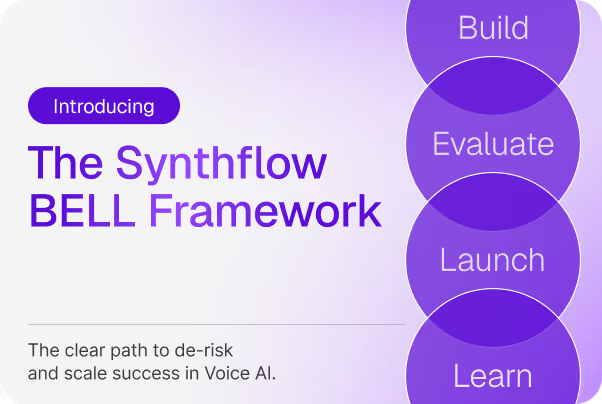
Test before you launch: Synthflow runs the build through a named operating model, the BELL framework (Build, Evaluate, Launch, Learn). The Evaluate stage runs simulated calls against your KPIs before go-live, so an agent that passes testing is less likely to fail in production.
The real split is a scoped enterprise rollout versus self-serve control. Once an agent is live, performance is what the caller feels: latency, interruptions, and voice.
Latency, Interruptions, and Real-World Performance
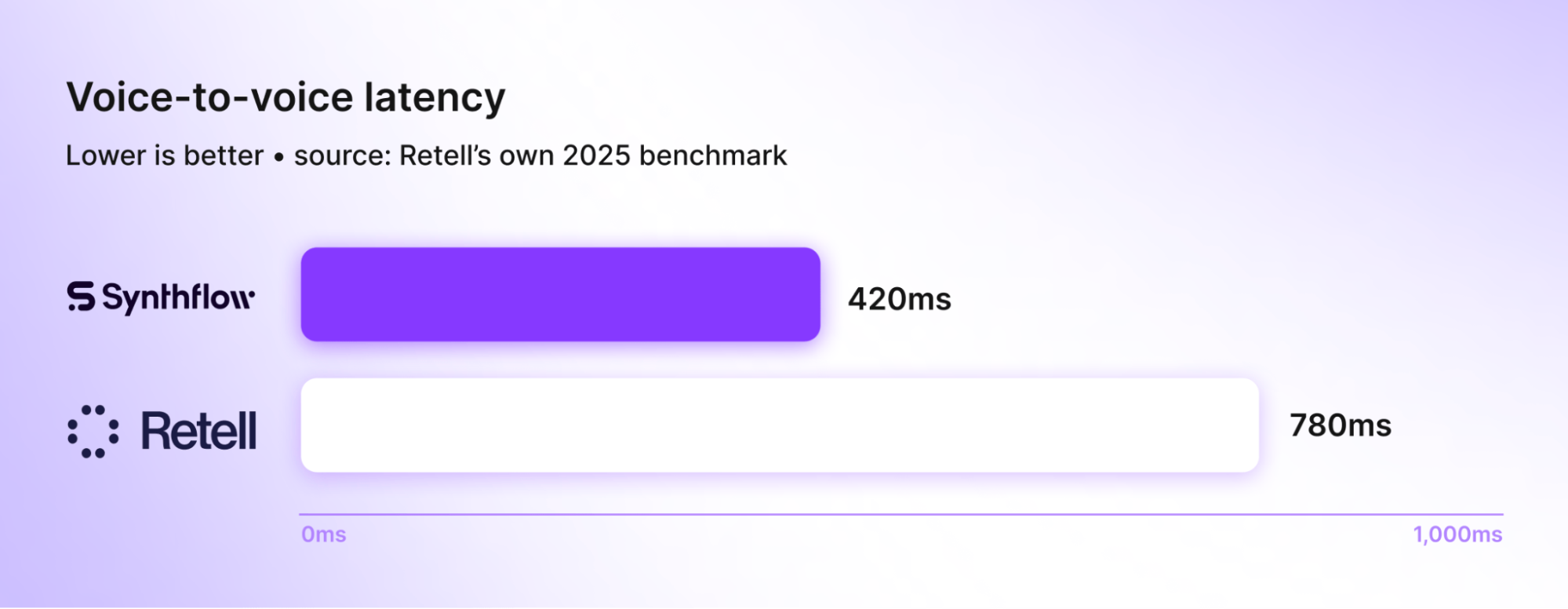
In Retell's own benchmark of July 2025, Synthflow answered in 420ms voice-to-voice on average and Retell in 780ms. Retell called its 780ms the better balance of speed and features, and its homepage now gives about 600ms for its own platform. The 2025 gap matches Synthflow's published sub-500ms conversational latency. Synthflow's sub-100ms figure is a separate metric, telephony-infrastructure processing rather than the full round trip, so the two shouldn't be read as one.
Do Synthflow and Retell Handle Interruptions and Barge-In?
Both platforms handle barge-in, and Retell, which builds its own turn-taking model, is well regarded for managing complex, layered interruptions. Both also let you test an agent on simulated calls before it goes live: Synthflow in the Evaluate stage of its BELL framework, Retell with simulation testing and AI quality assurance.
Voice and Language Coverage
Synthflow supports 30+ languages and multilingual voice cloning, which matters most for non-English and multi-market operations. Retell lists 55 languages and supports voice clones, with voices from its own library and from providers such as ElevenLabs, Cartesia and OpenAI. Retell lists more languages, so test your own languages and accents on real calls before you choose. Integrations, and the telephony underneath them, are where the platforms separate next.
Integrations and Telephony
Synthflow offers native integrations across 200+ tools, including the CRMs and contact-center systems enterprise buyers already run. Retell has native connectors for Salesforce, HubSpot, Microsoft Dynamics 365, Zoho CRM and Zendesk, and reaches most contact-center platforms over SIP.
native, out of the box
- CRM: Salesforce, HubSpot, Freshworks
- Contact center: Zoom Phone and Zoom Contact Center, Five9, RingCentral RingCX, 8x8; Genesys Cloud, Talkdesk and Dialpad deployed with customers
- 200+ integrations, plus native warm transfer with full context
- Telephony: owned infrastructure, SIP trunking, bring-your-own carrier
native CRMs, contact centers over SIP
- Native: Salesforce, HubSpot, Dynamics 365, Zoho CRM, Zendesk, Cal.com, Calendly
- Contact centers over SIP: Five9 (pre-built trunk), NICE CXone, Talkdesk, Amazon Connect, RingCentral
- Bring-your-own LLM and telephony, supported directly
- Make, n8n and Zapier for other systems
Both connect to the CRMs enterprise teams run. The difference is inside the contact center: Synthflow engineering builds, tests and maintains its Zoom, Five9 and RingCentral RingCX integrations, while Retell's integrations page lists no Zoom connector and sets up most contact-center platforms as a custom SIP connection. Retell, in turn, lets you bring your own LLM over a WebSocket, which suits teams that want to own the reasoning layer.
Security and Compliance
Synthflow's Trust Center lists SOC 2 Type 2, ISO/IEC 27001, GDPR, HIPAA (self-attested) and PCI DSS v4.0.1, and Retell's lists SOC 2 Type I and II, ISO 27001:2022, HIPAA, GDPR and CCPA. Both offer on-premises deployment for enterprises, so either can clear procurement in a regulated industry. The differences are in card payments and where data lives.
Synthflow's enterprise controls:
- PCI DSS v4.0.1, listed on Synthflow's Trust Center, for calls that handle card payments.
- On-premise and VPC hosting to keep customer data inside your own environment.
- EU and US regional data tenants for data-residency rules by region.
- RBAC and audit logs for control over who does what, with a full trail for auditors.
Retell's Trust Center lists SOC 2 Type I and II, ISO 27001:2022, HIPAA, GDPR and CCPA, and its Enterprise plan adds on-premises deployment, SSO and role-based access. It does not list PCI DSS, and its compliance documentation says it does not currently operate services in the EU. For a US deployment, either platform clears a standard security review. If your calls take card payments, or an EU data-residency rule applies, Synthflow's controls are the deciding factor.
White-Label Voice AI for BPOs and Enterprise Teams
For BPOs and software platforms that deliver voice AI under their own brand, Synthflow supports white-labeling, custom branding and subaccount management when included in your account setup. Retell gives each client a separate workspace with its own agents, numbers and billing, and callers hear the client's brand, but the Retell dashboard itself is not rebranded: a client-facing portal is built on its API or comes from a partner tool.
What BPOs and enterprise teams get on Synthflow:
- Sub-account management, one per client
- Custom domain and full branding removal
- Multi-tenant architecture built for scale
White-label is part of the enterprise contract: scope the branding and client workspaces with Synthflow's team.
See What Synthflow Can Do for Your Team
Which platform fits comes down to how you want to buy and roll out. If you need agents live in weeks, with telephony, integrations, compliance and launch support scoped into one enterprise contract, Synthflow is built for that. Book a demo to map it to your call volumes, security needs, launch support and any white-label requirements for a BPO deployment. If you would rather start on your own today, pay by usage with no annual contract, or bring your own model, Retell fits better.
Common Questions About Synthflow and Retell AI
Which Is Better for an Enterprise Contact Center, Synthflow or Retell AI?
Synthflow, if you want a scoped rollout on one annual enterprise contract, on Synthflow's own telephony and its tested Zoom, Five9 and RingCentral RingCX integrations, with white-label for BPOs. Retell AI, if you want to start self-serve today, pay by usage and choose your own model, with a self-serve outbound dialer.
Does Synthflow Support Warm Transfer, Outbound Campaigns, Call Analytics and Simulation Testing?
Yes, Synthflow supports all four. A warm transfer briefs the person who answers with a whisper message or an AI summary of the call before the caller is connected, and Campaigns call a whole list with one agent inside the calling hours you set, started through the Platform API. The analytics dashboard tracks call outcomes, sentiment and agent performance across your workspace and subaccounts, and the Test Center runs simulated calls against your success criteria before an agent goes live.
Can I Connect My Own LLM to Synthflow?
Not as a custom endpoint: Synthflow agents run on Synthflow's own LLMs or the OpenAI GPT models it supports, and the AI Model setting does not take Claude or a custom LLM endpoint. The one bring-your-own option is your own OpenAI API key, directly or through Azure OpenAI, which your account team turns on so those GPT models run on your own account. If you want Claude or Gemini, or your own model behind your own endpoint, Retell AI fits better: it offers GPT, Claude and Gemini models and connects a custom LLM over a WebSocket.
What Are the Best Retell AI Alternatives?
Synthflow is the Retell AI alternative for enterprise customer experience teams, contact centers, BPOs and regulated enterprises that want a scoped rollout on one annual contract. Vapi suits developers who assemble their own stack, Bland fits regulated, high-stakes calls on its own models, and PolyAI is a managed enterprise platform for customer service.
How Does Synthflow's Pricing Compare With Retell AI's?
Synthflow is sold as an annual enterprise agreement, scoped to call volume, concurrency, telephony, integrations, security needs and launch support. Synthflow no longer sells self-serve plans or plans by the minute. Retell AI bills by usage, with a published rate for each component and no platform fee or annual contract, and has custom pricing on its Enterprise plan.
Can You White-Label Retell AI?
Partly. Retell gives each client a separate workspace with its own agents, numbers and billing, and callers hear the client's brand, but Retell's own FAQ says its dashboard itself is not rebranded. Synthflow supports white-labeling, custom branding and subaccount management for BPOs and software platforms as part of the enterprise contract.
Are Synthflow and Retell AI SOC 2 and HIPAA Compliant?
Yes. Synthflow's Trust Center lists SOC 2 Type 2, ISO/IEC 27001, GDPR, HIPAA (self-attested) and PCI DSS v4.0.1, and shows ISO/IEC 42001:2023, DORA and the EU AI Act as in progress; Retell's lists SOC 2 Type I and II, ISO 27001:2022, HIPAA, GDPR and CCPA. Synthflow also hosts in the US and the EU, which matters for card payments and EU data-residency rules.