Over the past two years, we have watched a pattern repeat itself: the AI gets smarter, the platform gets more capable, and the people who actually operate voice AI at scale still spend most of their time clicking through configuration menus.
We built the menus. We made them better. We added more settings, more toggles, more tabs. That era is ending. The product we built to address what comes next is called Aurora.
The people who run voice AI in production are not power users of builder software. They are ops managers at agencies, VPs of customer experience, franchise leads who know their business fluently but have no idea which dropdown controls the transfer behavior for unanswered calls. Aurora speaks their language.
Building an Agent Should Not Be a Project
Based on time-study data from production deployments, building a production-grade voice agent from scratch takes 40 to 120 hours before a single call goes live. Prompts, persona, knowledge base, call transfers, test cases, edge-case handling — each one a configuration step that requires platform expertise the operator does not have.

Deployment used to take a sprint: 40 to 120 hours without Aurora versus one conversation with Aurora.
Aurora replaces that entire process. Upload a client's operations manual, an FAQ document, a call transcript from their existing system. Aurora reads it and generates a production-ready agent — prompts written, knowledge base populated, call transfer logic configured. Not a template. An agent that knows the business.
Among agents that do get deployed on Synthflow, 74% go live within 24 hours — the platform is not slow, operators are just blocked at the configuration step before that. Remove the block, and they ship the same day.
Updating 700 Agents Should Not Require a Team
From six months of internal support data: nearly half — 45% — of all tickets filed on Synthflow are configuration tasks. Not bugs. Not outages. Configuration. Things the platform already does, that operators cannot figure out how to change at scale.
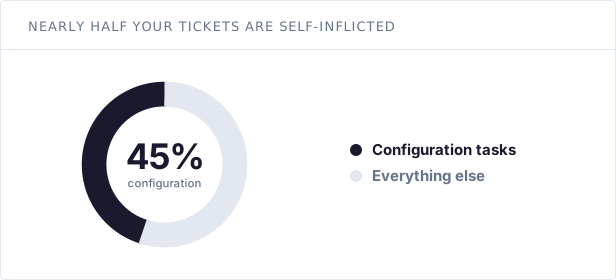
45% of all support tickets are configuration tasks, versus 55% for everything else.
One agency partner manages 700 voice AI agents across hundreds of locations. When a prompt needs updating — a holiday schedule change, a new product line, a compliance adjustment — there was no path to push that update at scale. It was agent by agent, dropdown by dropdown.
With Aurora: describe the change once, review a diff of what will be modified, confirm. The update propagates across every agent that needs it. What used to be a staffing problem becomes a one-minute conversation.
Review before every change. Aurora shows you exactly what will change before touching a single setting. Nothing is applied without your confirmation. Every session produces a full change log — SOC 2 Type II and HIPAA compliant.
If that is your deployment — Aurora was built for you. Apply for early access.
Agents That Improve Instead of Drift
Gartner found that 42% of enterprises with active AI initiatives abandoned them entirely by early 2025. Not because the AI failed, but because they could not sustain, evaluate, and improve what they built. Implementation is where AI projects die.
Most voice AI agents go live and never get better. Aurora changes that. It reviews past calls, surfaces what is drifting, generates adversarial test cases based on the agent's actual configuration, and flags gaps before a single real caller hits the edge case your team missed. The gap between a demo and a production deployment has always been systematic evaluation. Aurora makes that evaluation automatic and continuous.
Insights No Dashboard Can Surface
When you are processing thousands of calls, the patterns that matter are buried in conversations, not in dashboards.
- Which objections are agents failing to handle?
- Which call flows are generating transfers that should be contained?
- Where are scripts drifting from the intended behavior?
Aurora finds these patterns and turns them into actionable changes you can review and apply.
The Thesis
The builder UI was a transitional form, the way the "horseless carriage" was a necessary way to introduce the car. The operator should describe what they need. The platform should figure out the configuration.
Three competitors confirmed this thesis in March 2026: Bland's Norm, Sierra's Ghostwriter, and Vapi's Composer. Each generates a new agent from a prompt. None operates a portfolio of 700 existing agents, pushes updates at fleet scale, or runs adversarial QA before a caller hits your system. They built horseless carriages. Aurora is the car: fleet management, push updates, adversarial QA, built on a production platform running 10M calls a month, not a blank canvas.
Apply for the Aurora Design Partner Program
Closed beta. 20 design partners in Q2. Direct product team support and priority access.
Apply for the Aurora Design Partner Program.
Synthflow powers 65M+ calls and 10M+/month worldwide. SOC 2 Type II, HIPAA, GDPR, ISO 27001 certified. Berlin.
Coming next: a technical deep-dive on bulk operations across 700 agents, and our first named design partner story.