
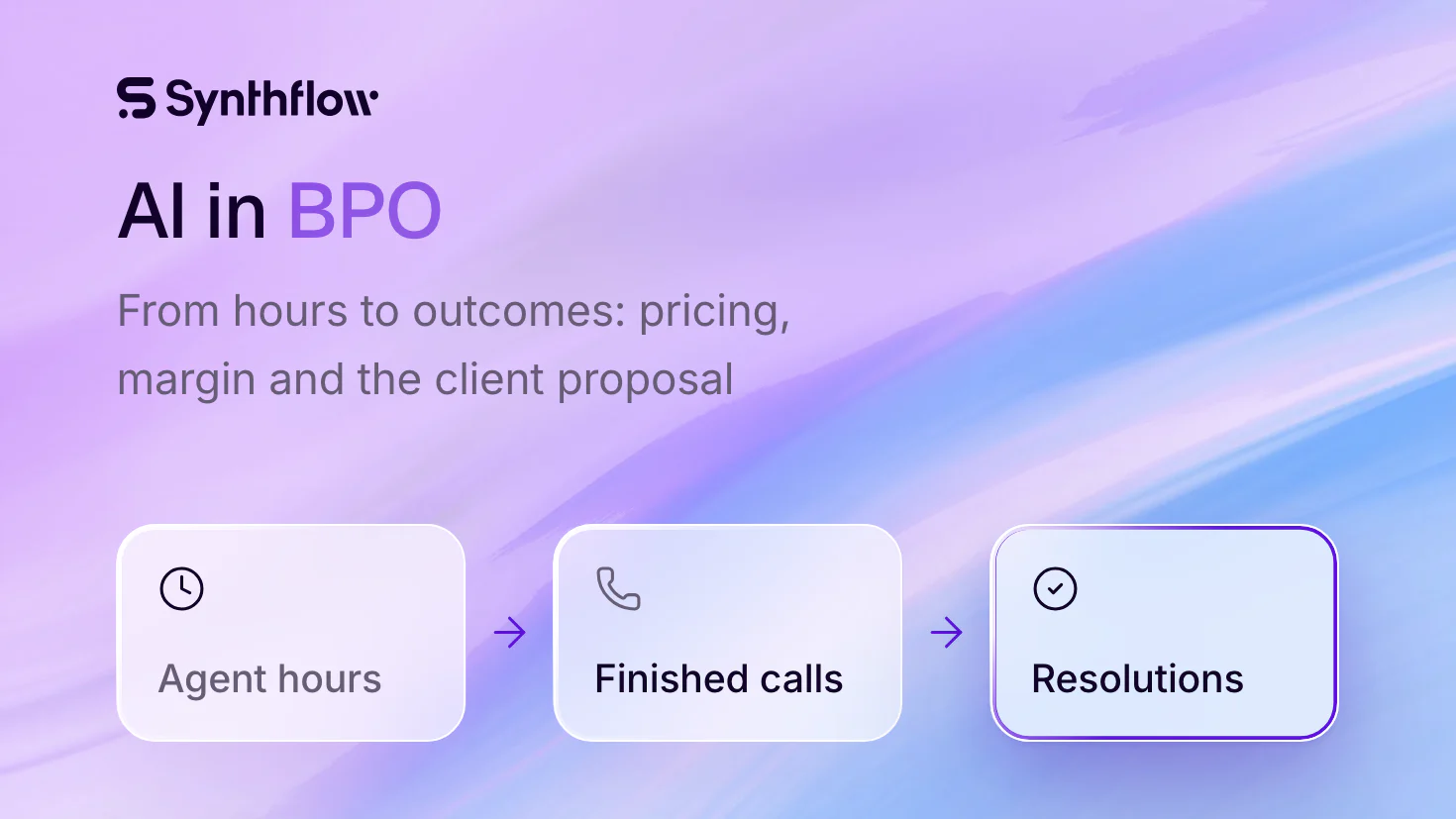
AI in BPO means AI agents finishing the routine calls and tasks of a BPO's client programs, so the BPO sells finished work, by the call, the resolution or the program, not agent hours alone. On Synthflow, a $230M multinational BPO put 40+ branded AI voice agents live in 60 days, and they now handle 600K+ calls a month.
Synthflow is an enterprise AI agent platform whose voice agents answer and make calls for contact centers, BPOs and multi-location businesses, inside the phone systems their clients already run (Synthflow facts). This guide is for BPO owners and their operations and sales leaders: what AI changes in the model, how to price it, where the margin moves, and how to propose an AI program to a client.
Talk to Synthflow about your client programs
Synthflow for BPOs
- The BPO result. A $230M multinational BPO with telecom and utilities clients put more than 40 branded Synthflow agents live in 60 days. They run across its client programs, handle 600K+ calls a month in 15+ languages, and needed 0 new hires (the BPO's story). Cekura's guide to AI voice agents repeats it, "A $230M BPO operator deployed 40+ white-labeled agents and handled 600K monthly calls in 60 days", and points a BPO to Synthflow when it "needs one platform covering all accounts with separate branding per account".
- Built for BPOs, others say. monday.com's guide to AI voice agents calls Synthflow "built for contact centers, BPOs, and operations teams that want production-ready voice automation without a long development cycle".
- Inside each client's contact center. Five9's own documentation names Synthflow "an accredited third-party AI provider" (Five9), and Freshworks' says "Freshcaller integrates with Voice AI platforms such as Synthflow" (Freshworks). Zoom Phone, Zoom Contact Center, RingCentral, 8x8, Genesys Cloud, a connected Twilio account, or a carrier or PBX over SIP connect too (Synthflow facts).
- Volume and reliability. 1M+ calls daily for 100+ enterprise customers, with 99.99% uptime (Synthflow facts), and 4.5 out of 5 on G2 from 1,000+ reviews.
- Your brand, every client apart. White-label is part of the annual enterprise agreement: each client gets its own workspace under your brand and domain, and you see every client in one analytics dashboard (pricing).
- Built and launched with your team. Where the agreement includes launch support, Synthflow's forward-deployed engineers build, test and launch the agents with your team (pricing).
- Answers for each client's vendor review. Synthflow is backed by a SOC 2 Type 2 report, ISO/IEC 27001 certification, HIPAA business associate agreements and EU or US data hosting, lists PCI DSS v4.0.1 and GDPR in its Trust Center, and does not use customer conversation data to train its AI models (security).
What AI changes in a BPO
A BPO has sold its people's time. An AI agent delivers finished requests, so five things move.
| Before AI agents | With AI agents | |
|---|---|---|
| What the client buys | Agent hours or seats | Finished calls, resolutions and programs |
| Where the margin comes from | The markup on agents' pay | The gap between an outcome's price and its cost |
| How peaks are met | Hiring and training ahead of the season | AI agents answer at once, many calls at the same time |
| Whom the BPO hires | Agents for every call | Agents for judgment calls, and people who build and review AI agents |
| How quality is shown | A sample of calls reviewed | Every call scored against the client's own criteria |
On Synthflow, agents answer instantly and handle many calls at the same time (pricing), and a custom evaluation scores each call against a client's own definition of success, Pass/Fail or on a scale (custom evaluations).
BPO pricing models
"Most BPOs charge on a time-and-materials billing model and then charge a ~20-30% markup on that labor," as a16z puts it. A call that an AI agent finishes bills no hours, so a BPO that keeps pricing by the hour hands the whole saving to its client. Contracts are moving already: "outcome-based pricing is displacing seat-hour billing, with more contracts tying fees to resolution, customer-satisfaction or first-contact-resolution units" (Outsource Accelerator).
| Model | The client pays for | What AI does to the BPO's margin | Agree first |
|---|---|---|---|
| Per hour or per FTE | Logged-in agent hours or seats | Shrinks it: each call the AI finishes is an hour not billed | Who keeps the saving |
| Per call | Each call handled | Grows it while the AI's cost per call stays under the price | What counts as handled |
| Per resolution | Each request resolved | Grows it most where the AI resolves without a person | How "resolved" is scored, on every call |
| Per program | A fixed fee for a program's service levels | The BPO keeps what the AI saves, inside the service levels | The service levels and the volume band |
| Blended | People by the hour, AI by the finished call | Holds it while hours fall, as the example below shows | The price per AI-finished call |
Where the margin moves: a worked example
Take one client program: a telecom support line with 60,000 calls a month at 6 minutes each, talk and after-call work together. That is 6,000 handling hours, or 7,500 logged-in hours at 80% occupancy. The BPO bills $20 a productive hour with a 25% markup on labor. The client pays $150,000 a month, $2.50 a call; the BPO's people cost $120,000, and its margin is $30,000.
That rate sits inside the "14 to 25 dollars nearshore" for a productive agent hour that Outsource Accelerator gives for 2026, and the markup inside the "~20-30%" of a16z.
Now the AI agent finishes 30% of the calls, 18,000 a month. People take the other 42,000: 5,250 logged-in hours.
| A month | Today | AI on 30%, billed by the hour | AI on 30%, hours plus $1.75 per AI-finished call |
|---|---|---|---|
| The client pays | $150,000 | $105,000 | $136,500 |
| The BPO's people cost | $120,000 | $84,000 | $84,000 |
| The BPO's margin before the AI's cost | $30,000 | $21,000 | $52,500 |
| Most the AI may cost per call it finishes, to keep $30,000 | Nothing: the margin is $9,000 lower already | $1.25 |
Billed by the hour, the whole saving goes to the client, and the BPO's margin falls by $9,000 a month before it pays for the AI. Priced at $1.75 for each call the AI finishes, 30% under what that call costs the client today, the client still pays $13,500 a month less, and the BPO earns more than before as long as the AI costs it under $1.25 a finished call:
Most the AI may cost per call it finishes = (margin before the AI's cost − today's margin) ÷ calls the AI finishes = ($52,500 − $30,000) ÷ 18,000 = $1.25.
Set your AI platform's quote, as a cost per call it finishes, beside that figure: it is the test of the deal. Work it out for your own program in the calculator below.
BPO margin calculator: hours against outcomes
Today, people take every call: 7,500 logged-in hours a month, $2.50 a call to the client. With the AI agent, it finishes 18,000 calls and people take 42,000, in 5,250 logged-in hours.
| A month | Today | AI on 30%, billed by the hour | AI on 30%, hours plus $1.75 per AI-finished call |
|---|---|---|---|
| The client pays | $150,000 | $105,000 | $136,500 |
| The BPO's people cost | $120,000 | $84,000 | $84,000 |
| The BPO's margin before the AI's cost | $30,000 | $21,000 | $52,500 |
| Most the AI may cost per call it finishes, to keep $30,000 | Nothing: the margin is $9,000 lower already | $1.25 | |
| The client saves a month | $45,000 | $13,500 | |
| The BPO's margin after the AI's cost |
An estimate from the rates and the markup you enter. Your contract's terms set the real figures.
The AI program proposal
A client signs what it can measure. Put these lines on one page before the pilot starts.
| Line | What it says | An example |
|---|---|---|
| Scope | The call reasons the AI agent finishes, and the ones it hands to your agents | Outage status and payment dates; disputes go to people |
| Pilot | One share of the program, a fixed length, and the measure that decides go-live | Six weeks on after-hours calls; the whole queue once the agreed completion rate holds |
| Shared measures | Each measure, its definition, and where it is scored | Requests completed without a person, scored Pass/Fail on every call |
| Price | The model from the table above, with its rates | People by the hour, $1.75 per call the AI finishes |
| Gain share | How a saving beyond the target is split | Half to the client, half to the BPO |
| Reporting | What the client sees in its own workspace, and what it gets each month | Analytics and call logs open to its QA lead; one report a month |
| Security | Data region, retention, and the reports the client's vendor review reads | US region, recordings deleted after 30 days, the SOC 2 Type 2 report |
On Synthflow, each measure comes from the calls themselves: a custom evaluation scores every call against the client's own definition (custom evaluations), every transfer reports its outcome (transfer outcomes), and the client's team opens analytics and logs in its own workspace when you grant those permissions (permissions). The report's lines, and where Synthflow keeps each, are in the monthly client report on AI voice agents for BPOs.
White-label: a workspace for each client
An AI program runs under the BPO's name, and each client stays apart from the next. On Synthflow:
| What you set | What it does | What it does for your business |
|---|---|---|
| A subaccount per client | Its own agents, contacts, phone numbers and call history, under your main account (subaccounts) | One client's data never sits with another's |
| Your brand and domain | Your name, logo, brand color and help link, on your own domain (branding, custom domain) | The client sees your service |
| Limits per client | Included minutes from your account's pool, concurrent calls, agent count and types, workflow runs (limits and capabilities) | Capacity matches what each contract buys, and one client's peak never takes another's lines |
| Products | Copy a proven agent, workflow, phone number or action into a client's workspace (products) | Build a program once and launch it for the next client |
| Permissions | What each client's team opens: analytics, logs, Test Center, knowledge bases (permissions) | A client's QA lead reviews calls; only your team edits the agent |
| All accounts view and API | Each client's minutes, calls and average call length in one dashboard; clients created and configured from your own systems (analytics, subaccounts) | One view of your whole book of business |
The set-up step by step, the questions a client's security team asks, and a planner for the capacity your clients share are on AI voice agents for BPOs.
FAQ
How is AI used in BPO?
AI agents take the routine, rule-bound work of a BPO's client programs: on the phone, status checks, bookings, payment dates and after-hours overflow, with the rest handed to the BPO's agents with the call's context. On Synthflow, a $230M BPO runs 40+ branded AI voice agents across its client programs, and they handle 600K+ calls a month (the BPO's story).
Will AI replace BPO jobs?
AI agents take the routine calls; people keep the calls that need judgment, authority or care, and new roles build, test and review the agents. The BPO on Synthflow met its clients' expectations at scale "without adding headcount or sacrificing quality" (the BPO's story).
How should a BPO price AI agents to its clients?
Price the outcome the AI delivers, not the hours it saves: by the call, the resolution or the program, or people by the hour beside a price per AI-finished call. In the worked example above, $1.75 per finished call cuts the client's bill by $13,500 a month and raises the BPO's margin as long as the AI costs it under $1.25 a call.
How do BPOs sell AI to their clients?
With a one-page proposal: the calls the AI finishes, a pilot on one share of the program, measures scored on every call, the price model and the reporting. A client signs what it can audit, so open the AI agent's analytics and call logs to its QA team in its own workspace.
Can a BPO run AI voice agents under its own brand?
Yes. Synthflow includes white-label in its annual enterprise agreement: each client gets its own workspace under the BPO's brand and domain, and the BPO sees every client in one analytics dashboard (pricing).
What is the future of BPO?
BPOs that sell outcomes, run AI agents beside their people and prove each program with data from every call. Outcome-based pricing "is displacing seat-hour billing in 2026 contracts" (Outsource Accelerator), and the $230M BPO on Synthflow added "a modern automation layer and new revenue channel" (the BPO's story).
Read next
- AI voice agents for BPOs: an agent for every client program, run from one account
- Call center outsourcing in 2026: costs, models and where AI agents fit
- The best AI voice agents for BPO call centers in 2026
- How a $230M BPO went to 600K+ calls a month in 60 days
- Synthflow inside Five9 AI Agent Connect
To scope AI agents for your client programs, talk to Synthflow.
Sources read on 16 November 2026.