

91% of CX leaders are under executive pressure to implement AI in 2026. Most have already tried automated bots but found them lacking, if not disappointing.
The main problem is in the perception and lack of distinction between regular automated bots and AI agents. They are not the same thing, even though the industry treats them as if they are. A bot responds, while an AI agent acts.
Today, we’ll cover exactly what AI agents for customer service do differently, the specific tasks they can complete end-to-end, where they still rely on humans (and what good handoff looks like), and six platforms compared across the criteria that matter.
If you’re evaluating platforms or trying to understand what separates real agentic AI from rebranded alternatives, we’re here to help.
What AI Agents For Customer Service Actually Do
How They Work And What They Execute
The clearest way to understand an AI agent is to compare it to what came before.
- A legacy automated bot is a response system. It reads what a customer writes, matches it to a knowledge base or a scripted decision tree, and generates a reply. The interaction stays at the surface – the bot can tell you what the refund policy says, but it cannot process the refund.
- An AI agent is an execution system. It understands what the customer needs, connects live to the relevant backend systems, takes sequential actions to complete the task, and closes the loop.
Example: When a customer calls about a refund, a bot will likely link to a policy page. A conversational AI agent that's truly built for complex customer service situations goes deeper: It verifies their identity, checks eligibility against backend rules, calls the payment API, processes the refund, and sends a confirmation.
Under the hood, a modern AI agent stacks four components:
Here are concrete tasks agents can handle end-to-end:
- Processing refunds by verifying identity, checking eligibility against backend rules, calling the payment API, and issuing the credit within a single conversation.
- Updating account records mid-call – address changes, plan upgrades, billing corrections – without routing the customer to a second department.
- Booking appointments while the caller is still on the line, pulling real-time availability from scheduling systems, and confirming the slot before the conversation ends.
- Routing complex tickets to the right specialist with full conversation context, account history, and the agent's own interpretation attached – so the human never starts cold.
- Processing insurance claims over the phone, walking the caller through required information, cross-referencing policy details, and initiating the claim in the backend.
- Triggering follow-up actions across channels like an SMS confirmation after a voice call, or a WhatsApp message with tracking details after a chat, automatically, as part of the same workflow.
These can be done through different channels (chat, SMS, WhatsApp, phone), but it's the phone where you can see an obvious difference between an AI agent that "responds" and one that "executes."
This is because voice agents operate under much tighter technical constraints: Sub-300ms response latency, real-time interruption handling when the caller talks over the agent, and acoustic context awareness across noise environments and accents. Get any of those wrong, and the caller knows immediately – not because the answers are bad, but because the conversation feels off.
Most platforms weren't built for it. They started with text and added voice later, and the architecture shows: Higher latency, awkward pauses, poor turn-taking. At Synthflow, we took the opposite approach – voice-first, LLM-native, and agentic from the ground up. The result is sub-100ms processing on owned telephony infrastructure, with no dependency on third-party carriers.
Some teams take this further with multi-agent orchestration – specialized sub-agents for billing, logistics, or technical issues, all coordinated by a single manager agent.
Where AI Agents Still Need Humans
Most AI demos end at the impressive part. The agent understands the question, pulls up the right account, and responds naturally. What you rarely see is what happens two minutes later – when the case involves a policy exception, a system that doesn't talk to the CRM, or a decision that needs a manager's sign-off. That's when the AI quietly hands the conversation to a human. And the industry has a word for this: containment.
Now, a 90% containment rate sounds like success. It means nine out of ten customers never got transferred. But it doesn't mean nine out of ten problems got solved. Just because the AI held the conversation, it doesn’t mean it finished the work.
Klarna became the most public example of what happens when you build a strategy around that gap. In early 2024, the company announced its AI chatbot was doing the work of 700 agents. A year later, CEO Sebastian Siemiatkowski acknowledged they'd gone "too far in the wrong direction" – that cost had become the dominant factor, quality dropped, and customers noticed. Klarna now pairs AI with human agents for anything complex or emotionally sensitive, and is actively recruiting service talent again.
What Klarna ran into isn't unique. AI agents consistently struggle in the same places:
- Emotionally charged conversations where tone matters more than speed.
- Edge cases that fall outside trained patterns.
- Compliance-sensitive decisions where a person needs to be accountable.
- Environments where the knowledge base is fragmented or outdated.
Forrester predicts only one in four brands will see a meaningful improvement in self-service success by the end of 2026 – largely because of gaps in data quality and change management, not gaps in the AI itself.
So, the answer isn't pulling AI back. Instead, companies need to work on designing the handoff so well that customers don't feel the seam.
A Gartner survey of 321 customer service leaders found nearly 80% of organizations plan to transition at least some frontline agents into new roles as routine work gets automated, with 58% aiming to upskill agents specifically into knowledge management specialists. The pattern is consistent: AI takes the transactional volume, humans take the work that builds trust.
"The biggest misconception we see is that a high containment rate means the AI is doing its job. Containment means the customer didn't get transferred. It doesn't mean the problem got solved. The real question is: Did the work get completed? Was the refund processed, the account updated, the follow-up sent? That's what we measure – and it's a very different number."
– Eyal, Director of Professional Services, Synthflow
Top AI Agents For Customer Service Compared
Every vendor on this list leads with a resolution rate claim. None of them defines “resolution” the same way. The same report found that industries with the highest resolution rates don’t always produce the highest customer satisfaction.
Before choosing a platform, normalise your comparison across five criteria:
- Channel coverage and whether voice is native or bolted on after the fact.
- Backend integration depth with existing CRMs, CCaaS platforms, and ticketing systems.
- Compliance certifications (SOC 2, HIPAA, PCI DSS).
- Escalation handling quality: How fully the context is transferred when a human takes over.
- Pricing model transparency: Outcome-based vs. per-seat vs. per-conversation vs. usage-based.
Six platforms are profiled below, each representing a distinct approach to the market.
Fin by Intercom
A standalone AI agent that works with any existing helpdesk – explicitly supports Zendesk and Salesforce – without a platform migration. Claims the #1 spot in third-party bake-offs, with transparent outcome-based pricing that makes ROI modelling straightforward.
Best for: Mid-market teams layering AI onto an existing support stack without disrupting current infrastructure.
Limitation: Voice is a channel extension, not a native capability.
Zendesk AI agents (plus Forethought)

Platform-native AI for existing Zendesk customers, claiming up to 80% of interactions handled autonomously. Zendesk agreed to acquire Forethought in March 2026, adding multi-agent capabilities across five modes – Discover, Solve, Triage, Assist, and Agent QA – alongside a self-improving resolution loop.
Best for: Teams already on Zendesk who want AI without migrating to a new platform.
Limitation: Only works within the Zendesk ecosystem.
Synthflow
Synthflow is an AI-native conversational AI platform built from the ground up on LLMs – not a legacy system with AI added on top. It started voice-first and now spans voice, SMS, chat, and WhatsApp from a single platform, with an owned telephony stack that delivers sub-100ms latency and no dependency on third-party carriers.
The difference shows up in what happens after the conversation starts. Where most platforms on this list respond to calls and hand complex cases to a human, Synthflow's agents coordinate backend systems, trigger actions, manage next steps, and follow up across channels until the work is actually done.
Production numbers back that up.
- The Freshworks partnership delivered 65% of routine calls automated, a 75% reduction in wait times, a 2x improvement in response rate, and 60% less agent workload.
- A $230M BPO deployed 40+ AI agents in weeks, handling 600K+ calls per month with zero new hires.
Key benefits:
- 200+ integrations include Five9, Genesys, RingCentral, Salesforce, and HubSpot.
- ISO 27001:2022, SOC 2, HIPAA, and GDPR compliant – Certifications available in the Trust Vault.
- Forward-deployed engineers take agents from pilot to production with measurable outcomes in the first 60 days.
Best for: High-inbound-volume teams in insurance, healthcare, and BPO that need AI to complete multi-step work across systems – not just answer questions. Voice is where the owned telephony gives Synthflow its strongest edge, but the LLM-native architecture means the same agent logic, memory, and integrations extend to SMS, chat, and WhatsApp without rebuilding.
Ada
Omnichannel across 9 channels (voice, email, chat, WhatsApp, SMS, Instagram, Messenger, in-app, and custom), with claims of up to 83% automated resolution for specific deployments – though Ada’s own platform-wide aggregate sits at 50%. Strong compliance stack: HIPAA, SOC 2, GDPR, and AIUC-1 (an AI-specific certification).
Best for: Regulated industries needing enterprise-grade compliance out of the box.
Limitation: No public pricing – requires a custom quote.
Salesforce Agentforce
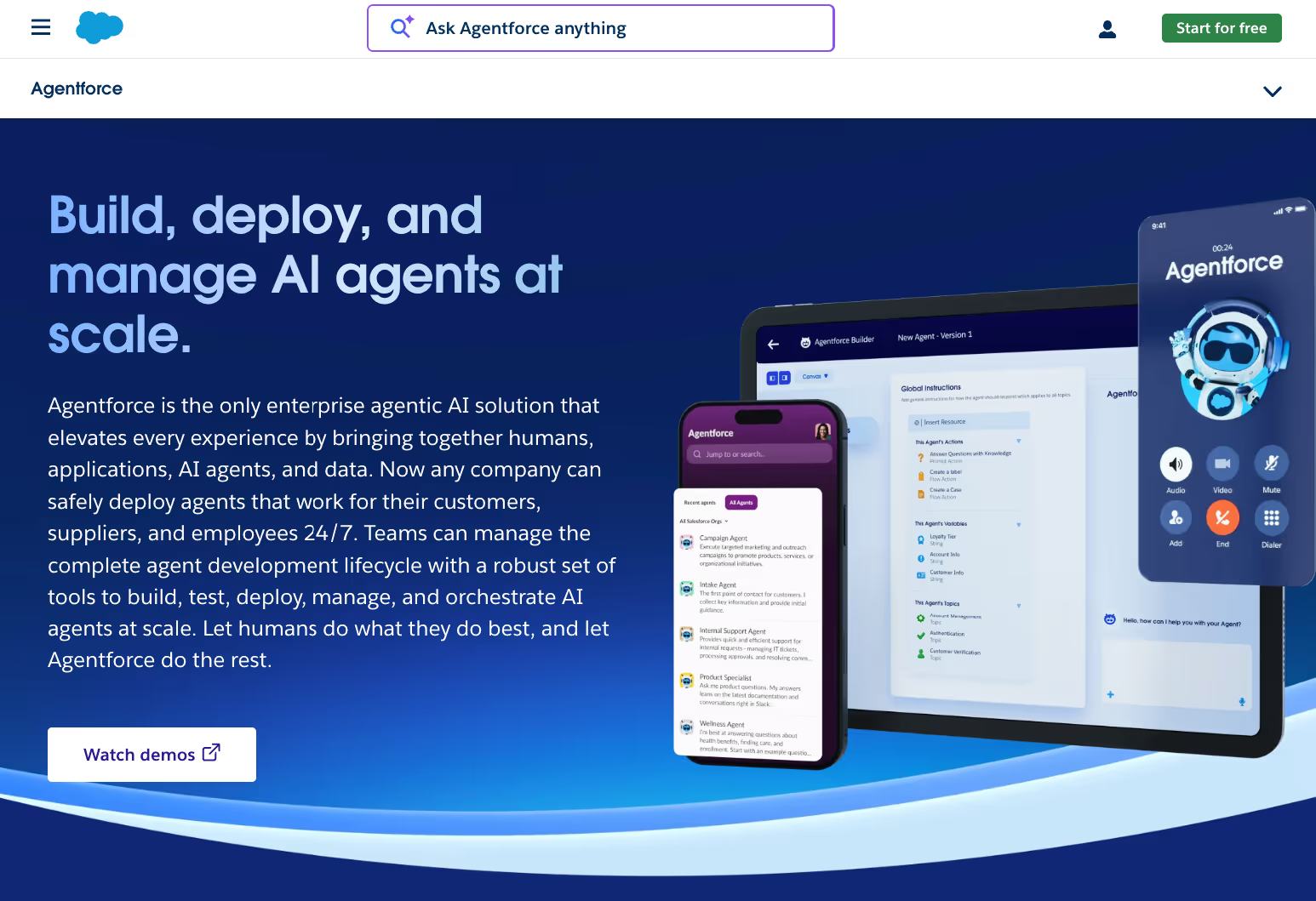
CRM-native AI agent built on Salesforce’s Atlas Reasoning Engine. Accesses the full Salesforce customer record without integration middleware – a genuine structural advantage for teams already on Service Cloud. Multiple licensing models available, including Flex Credits and per-user options alongside the per-conversation rate.
Best for: Enterprises running Salesforce who want AI that works natively with their existing customer data.
Limitation: Salesforce ecosystem only – not an option for teams on other platforms.
Sierra
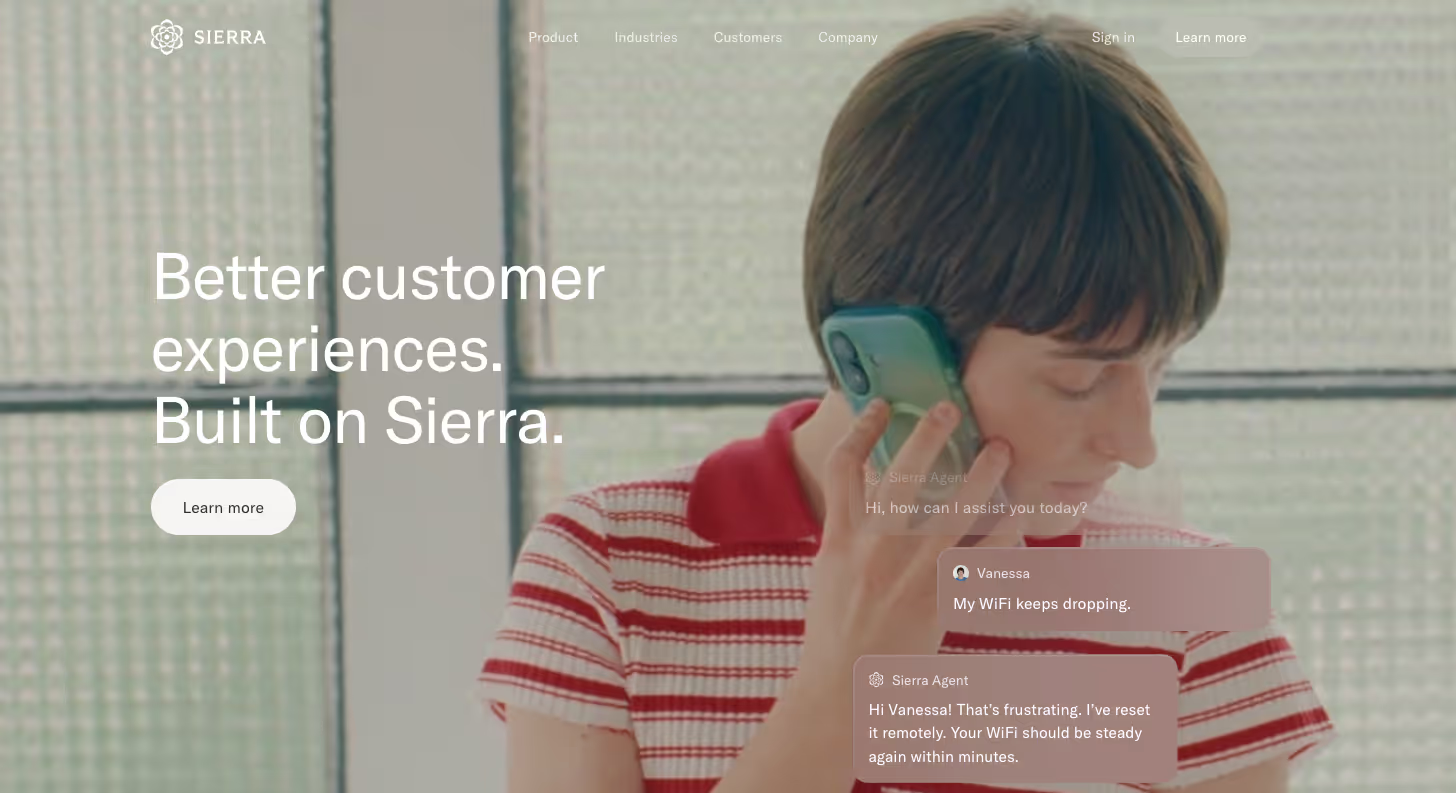
Enterprise-grade platform with voice and chat, outcome-based pricing, and case studies at genuine enterprise scale: ADT handling 2M customer inquiries per month, SiriusXM managing a 34M-subscriber base. Offers both an Agent SDK for developer customisation and a visual Agent Studio for non-technical teams.
Best for: Large enterprises with significant phone volume and the budget for a premium, white-glove deployment.
Limitation: Enterprise-only contracts – no public pricing, significant upfront commitment.
When you need AI that does the work
Every platform on this list handles a straightforward account inquiry. The difference shows up when the case gets complex – multi-system coordination, policy exceptions, approval workflows, follow-up across channels. That's where most AI stops performing and starts containing.
Synthflow is built to keep going. The BELL framework (Build, Evaluate, Launch, Learn) gives teams a structured path from design to production: Build agent logic visually, stress-test with simulated calls against your own KPIs, deploy on owned telephony, and improve continuously based on real conversation data.
Both approaches handle routine calls. The question is what happens when it gets complex.
Most platforms today price per seat, per minute, or per conversation – metrics that measure activity, not results. Synthflow is building toward a model where pricing ties directly to completed outcomes: the refund processed, the account updated, the follow-up sent. That's the natural endpoint of an architecture designed to finish tasks, not just handle calls.
For a deeper look at how AI is reshaping contact center automation across industries, see Synthflow's full guide.
Talk to the Synthflow team to see how outcome-based AI works for your support operation.
.avif)