Synthflow is the conversational AI platform for customer experience and operations teams that want to build and adjust voice agents in a visual flow designer, without waiting on engineers. Bland AI is API-first infrastructure for engineering teams that want code-level control over deterministic, scripted call flows at high outbound volume.
The main difference between the two is who owns the build on your side: An ops team clicking through a flow, or a developer writing against an API. After that, the choice comes down to pricing, call throughput, integrations, and compliance. The sections below work through each with current 2026 figures from both platforms.
If your team sits on the Synthflow side of that line, book a demo. If you're still weighing it up, the side-by-side comparison below shows where each platform wins.
Synthflow vs Bland AI Compared Side by Side
Synthflow is the better fit for customer experience, operations teams, and agencies; Bland AI is the better fit for engineering teams running high-volume, scripted outbound. Here is where each lands on the details that decide it.
| Feature |

|

|
|---|---|---|
| Best for | CX and operations teams, and agencies building or reselling voice AI | Engineering teams running deterministic, high-volume outbound |
| Agent builder | Visual flow designer, no engineering required | API-first, built with Norm and Pathways (code required) |
| Channels | Voice, SMS, chat widget, WhatsApp, email | Voice, with SMS and web chat on higher tiers |
| Pricing model | Scoped enterprise contract, not sold per minute; implementation included | All-in per-minute rate (LLM, STT, TTS bundled); telephony billed separately |
| Entry price | Enterprise contracts from $30K/year; no self-serve free tier | $0.14/min on Start ($0 platform fee, 2 free credits) |
| Languages | Broad language support, multilingual voice cloning, mid-call switching | 40+ languages, real-time translation in 23, mid-call switching |
| Daily call throughput | No fixed daily cap; scales with concurrency (2M+ calls every month across the platform) | 100 / 2,000 / 5,000 calls per day by tier; unlimited on enterprise |
| Uptime SLA | 99.99% uptime on owned telephony; SLA terms scoped in contract | 99.9% (all tiers) |
| Concurrency | Unlimited at enterprise | 10 / 50 / 100 concurrent calls by tier; custom on enterprise |
| White-label | Full white-label agency platform (included on enterprise) | Not available at any tier |
| Hosting | Cloud with EU and US data residency; on-premise multi-region on enterprise | Cloud; VPC, on-premise, and air-gapped on enterprise |
| Compliance | SOC 2, HIPAA, GDPR, ISO 27001:2022 | SOC 2 (Type I and II), HIPAA with BAA, GDPR, PCI DSS |
| Deployment time | 1–3 months for enterprise (60-day flagship rollout) | Day-one on self-serve; 28-day enterprise framework |
| Telephony | Owned telephony infrastructure; SIP trunking and bring-your-own-carrier | Twilio, SIP, or bring-your-own; built-in Twilio at pass-through cost |
Who Each Platform Is Built For
The clearest way to choose is to look at who on your side will build and maintain the agents day to day.
Synthflow fits customer experience, support, and operations teams, and agencies deploying voice AI for clients, when engineering time is scarce. You build, test, and change agents in a visual flow designer, so the people who own the customer relationship can adjust a flow the same afternoon a policy changes, with no ticket to engineering.
Bland AI fits teams with engineers who want code-level control through Pathways and its API, usually to run deterministic, scripted outbound at high volume. The trade is tighter control in exchange for developer time on every change.
⚠️ Synthflow agents are built to augment your team, not replace it. When a call needs a person, the agent hands over with full context and stays on the line until someone picks up, so the caller never has to repeat themselves.
Where Each Platform Performs Best
Synthflow performs best on high-volume inbound customer experience: Multilingual support, appointment booking, and replacing legacy IVR menus. The proof sits in production. Freshworks automates routine calls with Synthflow, Medbelle books patient appointments with it, and one BPO now runs 600,000+ calls a month across more than 40 agents. It also leads for agencies running many clients at once, which the white-label section covers in full.
Bland AI performs best on deterministic, scripted outbound: The debt-collection reminders, compliance disclosures, and structured lead qualification where every turn has to follow a fixed path. Bland points to deployments with Kin Insurance and MyPlanAdvocate as evidence for that regulated outbound use case.
Community feedback lines up with the split. Synthflow’s G2 users most often praise how quickly they can build and deploy agents, the breadth of integrations, and the natural voice quality, with pricing the most common gripe. Bland's G2 reviewers, by contrast, describe it as powerful but complex, with a genuine learning curve and setup that takes real effort, while noting that support and training have improved.
Building and Launching an Agent
Both platforms now ship a builder: Synthflow has the visual flow designer and Aurora, and Bland's is called Norm. However, the difference is that operating the latter still assumes someone is comfortable with code.
With Synthflow, you can choose between building the workflow with the designer or just describing what you need to Aurora, and the AI will create the agent for you.
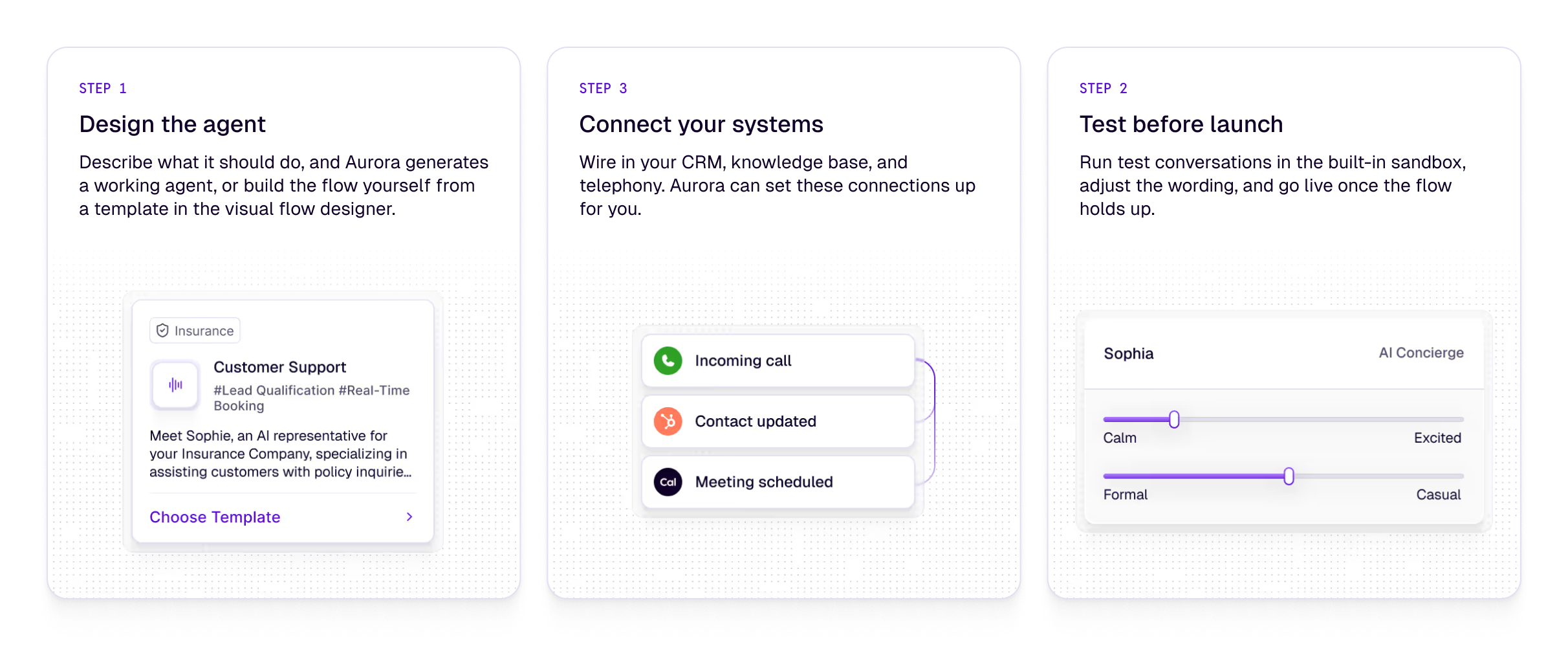
Building in Synthflow takes three steps, none of which need an engineer:
- Design the agent. Describe what it should do, and Aurora generates a working agent, or build the flow yourself from a template in the visual flow designer.
- Connect your systems. Wire in your CRM, knowledge base, and telephony. Aurora can set these connections up for you.
- Test before launch. Run test conversations in the built-in sandbox, adjust the wording, and go live once the flow holds up.
Bland works the other way. You build through Norm and Pathways with full API access, then validate with scenario testing and canary releases. Engineers get precise, versioned control over each branch of a call, in exchange for the time to set it up and maintain it.
Time to a first call follows the same divide:
- Bland: A developer can place a test call the same day on self-serve, with a 28-day framework for enterprise deployments.
- Synthflow: Enterprise rollouts run one to three months, including four to eight weeks of testing, with forward-deployed engineers handling implementation.
Read it as accessibility-first versus control-first, not fast versus slow: Synthflow lets a non-engineering team ship and iterate on its own, while Bland gives engineers exact control at the cost of their time.
Performance, Reliability, and Scale
Throughput is where the two platforms separate most clearly. Synthflow runs on owned telephony with horizontal scaling, so concurrency is effectively unlimited at the enterprise tier; one BPO runs more than 600,000 calls a month across its agents. Bland meters capacity by plan:
- Synthflow: No fixed daily cap, and unlimited concurrency at enterprise on owned telephony.
- Bland Start / Build / Scale: 100 / 2,000 / 5,000 calls a day, and 10 / 50 / 100 concurrent calls.
- Bland Enterprise: Unlimited, sized to your volume.
If you run steady high volume, that difference sets the shortlist: Synthflow scales without you tracking a daily ceiling, while Bland's self-serve tiers hold a hard cap until you move to enterprise.
Now, let’s look at reliability, voice and language support, and latency:
- Synthflow runs at 99.99% uptime, backed by owned telephony and multi-cloud redundancy, with SLA terms scoped in each enterprise contract. Bland runs a 99.9% SLA across all its tiers.
- Both handle multilingual calls at scale: Synthflow covers a broad set of languages with voice cloning and mid-call switching, and Bland covers 40+ with real-time translation in 23.
- Both are built for real-time conversation. Synthflow's owned telephony does its call processing at the SBC level, which is part of why it can hold response times steady under load rather than only in a demo.
Pricing and Total Cost
The two platforms are not priced the same way, so a rate-against-rate comparison would be misleading. Bland sells metered usage you buy yourself. Synthflow sells a scoped enterprise solution.
Bland charges per minute of talk time, with the LLM, speech-to-text, and text-to-speech bundled into one rate:
- Start: $0.14/min, no platform fee (2 free credits and an inbound number to test).
- Build: $0.12/min plus $299/month.
- Scale: $0.11/min plus $499/month.
Telephony is billed separately, on your own carrier or Bland's at pass-through cost, and transfers add $0.03 to $0.05 per minute unless you bring your own telephony. A 1,000-minute month on Build works out around $419 before transfers, so at lower volumes, the platform fee, not the per-minute rate, drives your real cost.
Synthflow is not sold by the minute. It is priced as an enterprise solution, with contracts starting at $30,000 a year, scoped around call volume, concurrency, telephony setup, integrations, security needs, and launch support. Professional services are included: forward-deployed engineers handle implementation and SIP trunking. You are buying a deployment and an outcome, not a bucket of minutes.
That difference is the real decision. If you want to swipe a card and pay for what you use, Bland's metered model fits. If you want a scoped enterprise rollout with implementation built in, Synthflow is priced as a solution and starts with a conversation with sales.
Integrations and Telephony
Integration depth is the category where the divide is the widest. Synthflow ships native integrations across the stack that an enterprise contact center already runs:
- CRM: Salesforce, HubSpot, and Freshworks.
- Agency: Native GoHighLevel, the hook for resellers running client sub-accounts.
- CCaaS: Genesys, Five9, Avaya, NICE, Cisco, and RingCentral.
Those sit within a library of 200+ integrations, and the CCaaS connectors are the differentiator for contact-center buyers moving off a legacy stack.
Bland takes a lighter, developer-led approach: a set of native connectors plus an open REST API and webhooks, so your engineers wire up whatever else you need. It is flexible, but it takes up even more engineering time. Synthflow's native GoHighLevel integration, by contrast, has no Bland equivalent, which is the difference agencies feel first.
On telephony, Synthflow runs its own infrastructure with SIP trunking and bring-your-own-carrier. Bland connects through Twilio, SIP, or your own carrier. Both get you connected; Synthflow simply owns more of the path.
Security and Compliance
Both platforms clear enterprise procurement in regulated industries. Synthflow and Bland each carry SOC 2, HIPAA (with a BAA), and GDPR, so the baseline for healthcare, insurance, and financial-services buyers is covered either way. The edges differ, and they point at different concerns.
Synthflow leads on certification breadth and data residency. It adds ISO 27001:2022 on top of the shared set, offers EU and US regional data tenants with more regions planned, and supports on-premise multi-region hosting at the enterprise tier. For a company that has to keep customer data inside a specific jurisdiction, that is the clearest advantage.
Bland leads on data isolation. It runs an owned model stack with no third-party providers in the call path, and adds air-gapped deployment, EU region-pinning, real-time PII redaction, zero-retention processing, and PCI DSS. For teams whose main blocker is data sovereignty, that is a genuine edge.
If your requirement is broad certification and regional residency, Synthflow fits. If it is a fully isolated, owned-stack deployment, Bland does.
White-Label Voice AI for Agencies and Resellers
If you’re an agency, that’s a very important feature. Synthflow is the conversational AI platform agencies can fully white-label and resell, and Bland offers no white-label at any tier. If your model is running voice AI for clients under your own brand, then the choice is very clear.
Synthflow's agency platform lets you run the product as your own:
- Sub-account management for separate client workspaces.
- Per-account usage allocation and rebilling, so you charge clients at your own markup.
- Custom domain and logo, so the platform carries your brand end to end.
- Multi-tenant architecture built to run many clients at once.
It also works at scale. Above, we mentioned the BPO that runs 600,000+ calls a month across 40+ fully white-labeled agents, but there’s also a US CRM platform that runs 500,000 white-labeled calls a month on Synthflow. Bland gives agencies no equivalent path, so reselling under your own brand rules it out from the start.
See What Synthflow Can Do for Your Team
If your team owns the customer relationship but not an engineering backlog, Synthflow is built for you: agents you can shape yourself, deployed to augment the people you already have. Book a walkthrough with our team to see it run on your own call flows. Running an agency? Take a look at the agency platform built for reselling.
Contact sales for an agency solution
Common Questions About Synthflow and Bland AI
What Are the Alternatives to Bland AI?
Synthflow is the main alternative to Bland AI for teams that want a visual builder, multilingual support, and white-label rather than an API-first stack. Retell, Vapi, and PolyAI are other options, each developer-leaning to a different degree. Our Bland AI alternatives guide compares the full set.
What Is the Difference Between PolyAI and Bland AI?
PolyAI is a voice-first enterprise platform focused on customer service. Bland AI is API-first developer infrastructure for building custom voice agents. They serve different buyers, with different build models.
Does Bland AI Offer a Free Trial?
Yes. Bland AI starts free with two credits and a free inbound number, no card required. Synthflow does not run a self-serve free tier; because it is sold as an enterprise solution, you start with a scoped demo through its sales team.