
AI call routing uses artificial intelligence to direct phone calls to the right person or department: the caller says what they need, and the AI sends the call on with that context. Automated call routing runs without an operator, by rules, caller data or intent; Synthflow's AI voice agents do all three and answer calls for Batteries Plus's 700+ stores.
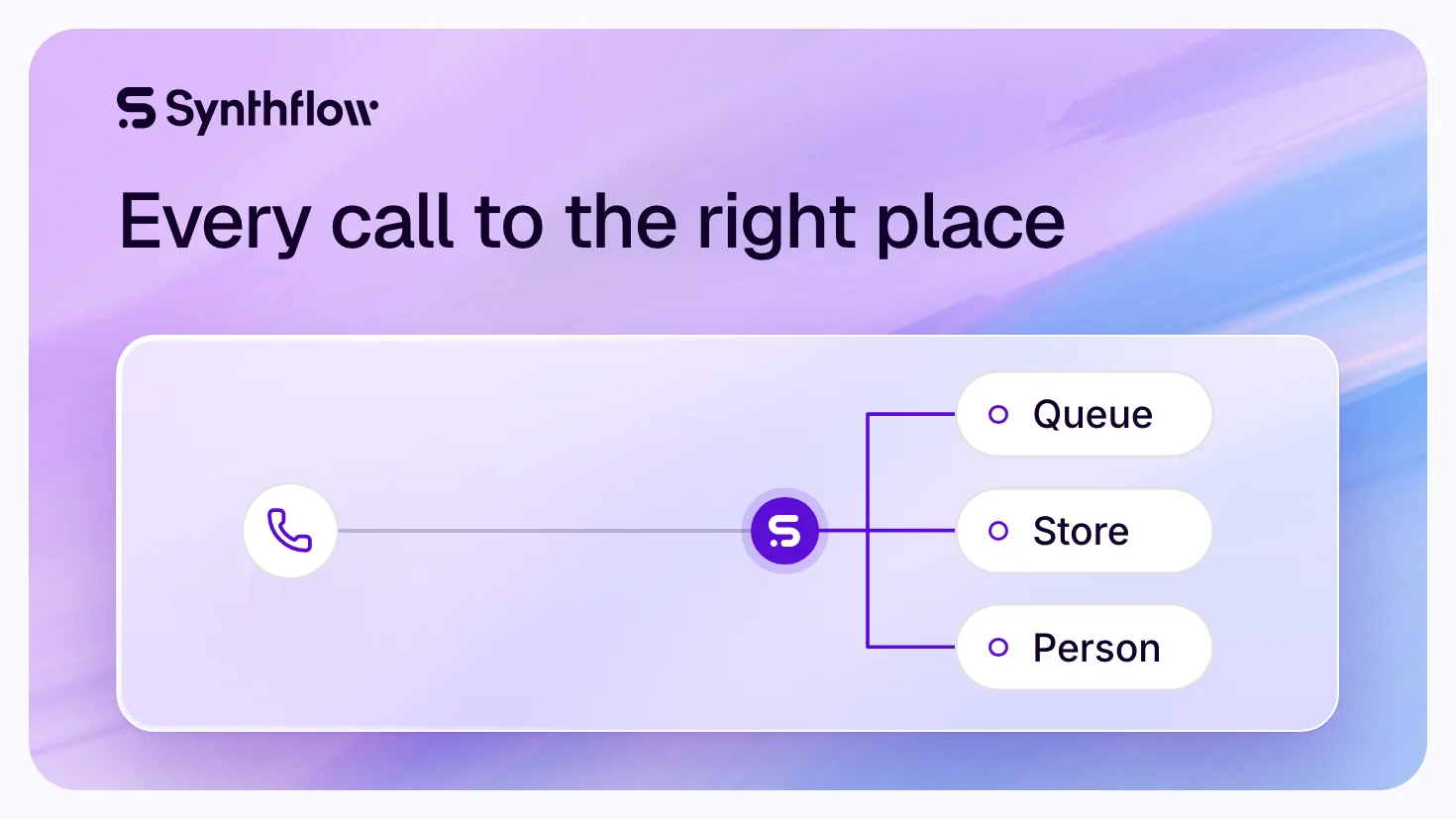
Synthflow's AI voice agents route calls for contact centers, BPOs and multi-location businesses: on Synthflow's own telephony, where it runs its own session border controllers and media infrastructure and manages routing and capacity in-house (telephony), or inside the phone system a contact center already runs, such as Five9, Zoom, RingCentral RingCX, 8x8, Genesys Cloud or Freshcaller. They finish routine requests and send every other call to the right queue, site or person with the caller's context, or hand it back to the platform with their routing decision. Synthflow AI routes VIP customers and urgent cases in real time, ensuring context-aware warm transfers at scale, and it handles 1M+ calls daily for 100+ enterprise customers. Book a demo to map your routing.
G2 reviewers rate Synthflow 4.5 out of 5 across 1,016 reviews (G2). Five9 lists it as "an accredited third-party AI provider" (Five9's documentation), CX Today reported its 8x8 partnership as "Why 8x8 Is Betting on Synthflow to Modernize Enterprise Voice AI" (CX Today), and PYMNTS covered its Batteries Plus agent as "Meet the AI Answering Every Batteries Plus Call" (PYMNTS).
Routing is one part of contact center automation; see which calls to automate first.
Synthflow's routing in production
| Who says it | What it says |
|---|---|
| G2 | 4.5 out of 5, from 1,016 reviews |
| Five9's documentation | Synthflow is "an accredited third-party AI provider", one of 11 in Five9's AI Agent Connect guides |
| Freshworks' documentation | Its handover call flow "works with AI Agents created in third-party apps, such as Synthflow", and the live agent "receives a call with a brief summary of the AI interaction" |
| 8x8, on CX Today | "By partnering with Synthflow, we're providing joint customers with the modern capabilities they need to help improve their satisfaction scores and quickly implement advanced voice automation" (Victor Belfor, 8x8) |
| Chain Store Age | "Synthflow AI says its agents have already resolved 22,000 calls independently at Batteries Plus across more than 700 locations." |
| Batteries Plus | Its store-call agent, built "in partnership with SynthFlow AI", is "ensuring calls to all 700+ Batteries Plus stores are answered" |
| PYMNTS | "Edison, an AI voice assistant developed with Synthflow that answers store calls in both English and Spanish" |
| Zoom, on Business Wire | "This integration shows what that looks like at scale, keeping context, quality, and control in one place for both agents and customers" (Kentis Gopalla, Head of Product, Zoom CX Ecosystem) |
At Batteries Plus, Synthflow's agents run inside Zoom Phone. "When a caller needs a person, the agent makes a warm transfer to a human expert and passes along the full transcript and any actions already taken" (the Batteries Plus story). The agents respond in under half a second, and rather than another pilot, Batteries Plus went live across its full network. Its Chief Information Officer, Kranthi Malreddy: "From kick-off to pilot, the roll-out with Synthflow and Zoom was just five weeks. This is one of the most impressive integrations I've seen between two pieces of software."

Across Freshworks deployments, Synthflow's agents inside Freshcaller and Freshdesk automate up to 65% of routine voice requests, from routing and verification to FAQs, with a 75% reduction in wait times, 2× faster response speed and 30-40% higher CSAT. In the story's words: "Intent-based routing replaces slow IVR trees" (the Freshworks story).
Synthflow AI can automate 50-70% of customer interactions without human intervention. Its seamless integration with communication tools like RingCentral, NICE CXone, Five9 and Genesys makes it easy to deploy AI call routing for your business. Its Trust Center lists SOC 2 Type 2, ISO/IEC 27001, GDPR and PCI DSS v4.0.1, and it runs at 99.99% uptime (Synthflow facts).
What Synthflow's agents do in routing
Synthflow AI voice agents play a crucial role in call routing by intelligently directing inbound calls to the right department, agent, or automated service based on predefined rules and AI-driven decision-making.
Its dynamic transfers run CRM-based routing to the assigned account manager, on-call routing, tier-based escalation that routes VIP customers to senior agents, location-based routing to the nearest office, skills-based routing and load balancing across available agents. A phone book holds up to 50 numbers, each with the condition that routes a call there, and business hours run in the agent's own time zone.
- Intelligent Call Routing: Uses Natural Language Processing (NLP) to understand caller intent, keywords, and sentiment. Determines the best destination based on customer input, past interactions, or priority levels.
- Skill-Based Routing: Matches callers with the most suitable live agent based on expertise, language preference, or customer history. Reduces wait times and enhances first-call resolution rates.
- Automated Self-Service & Deflection: Handles routine inquiries (FAQs, order status, appointment scheduling) without human intervention. Transfers complex issues to live agents only when necessary, improving efficiency.
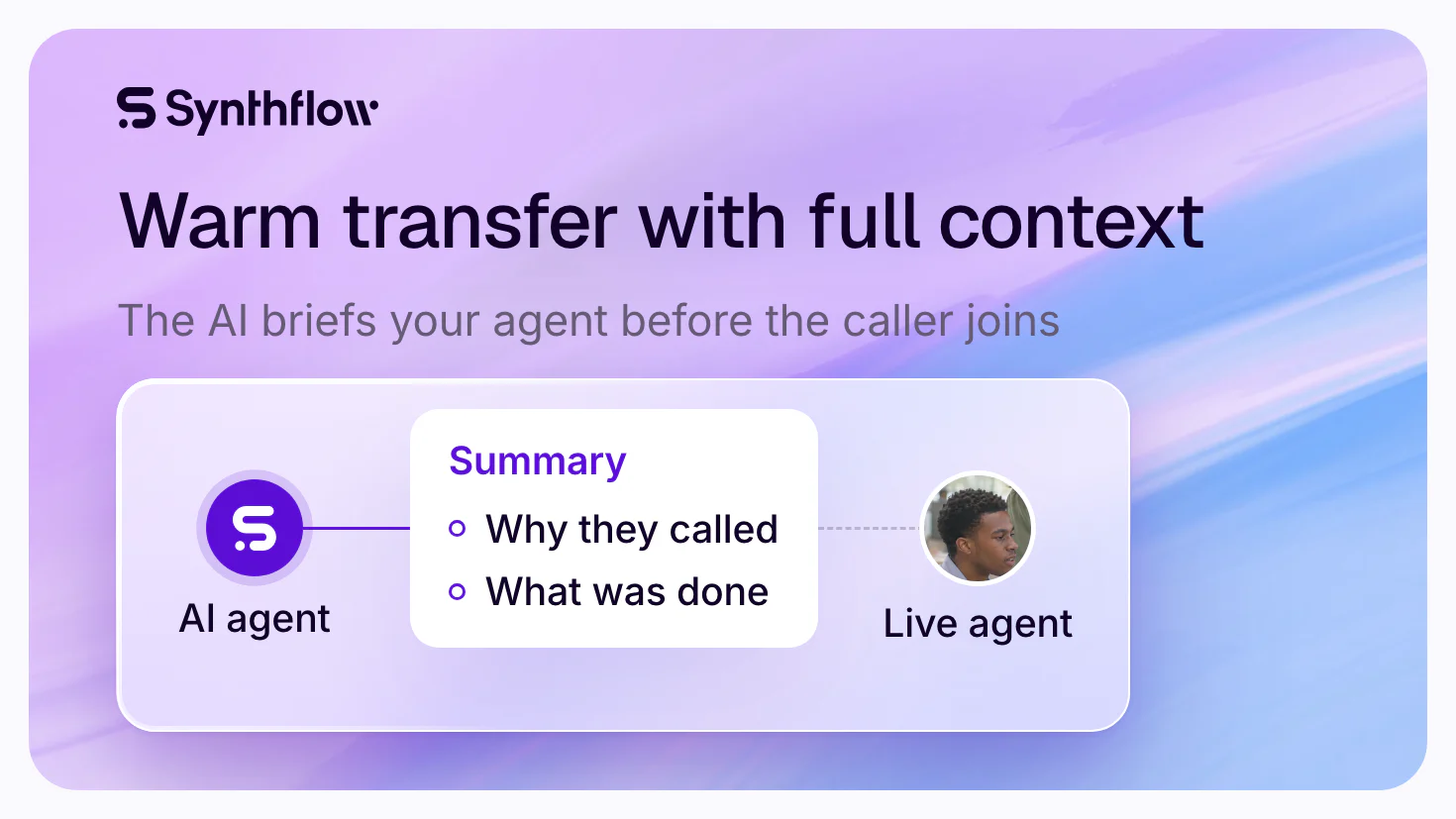
- Context-Aware Call Transfers: If a call transfer is required, Synthflow AI ensures context (previous conversation, caller details) is carried over. Prevents customers from repeating information, improving customer experience.
- Prioritization & VIP Routing: Identifies high-value customers and prioritizes their calls. Routes urgent inquiries faster for time-sensitive industries (e.g., healthcare, finance).
- 24/7 Availability & Scalability: Ensures businesses can handle high call volumes without requiring additional staff. Operates around the clock, providing continuous support.
AI voice agents like Synthflow AI use Natural Language Processing (NLP) and machine learning to respond to open-ended questions, handle multi-turn conversations and adapt conversations according to user inputs. Synthflow AI agents are quite different from traditional IVR systems because they can understand the human context and can be spoken to directly, they are capable of customer retention should the conversation go south, they can make decisions and set appointments when necessary, and they're empathic and have advanced research skills.
Why callers need it
"98% of customers try to bypass IVR", and the top three words or phrases they use to do it are "representative" (34%), "customer service" (27%) and "live person" (15%) (Gladly, 2018). In the Harvard Business Review figures that ICMI quotes, 56% of customers have to re-explain an issue, 57% have to switch from web self-service to a phone interaction, 59% say resolving their issue requires moderate to high energy expenditure, 59% are transferred to another specialist and 62% have to contact the provider repeatedly. Missed appointments cost the U.S. healthcare system $150B each year (HCI).
Automated, intelligent and AI routing
The three names say how much the router knows, and vendors use them loosely: Genesys defines automated call routing as AI that matches each call to the best agent, while Aircall routes on business hours, team assignments and ring sequence.
| Automated | Intelligent | AI | |
|---|---|---|---|
| Decides on | Fixed rules: number dialed, time, menu key | Rules plus data: caller ID, CRM record, agent skills, queue state | What the caller says, understood by a model |
| The caller | Presses keys or waits | Presses keys or enters an account number | Explains the need in their own words |
| Runs in | The phone system's ACD and IVR | The contact center's routing engine | An AI voice agent, on its own telephony or in front of the queues |
| Also does | Routes only | Routes and prioritizes | Routes, and finishes routine requests itself |
Routing methods
Most contact centers combine methods: time rules decide whether anyone is open, skills or intent decide which team, and distribution rules decide who in that team takes the call. Synthflow's agents run each method below, on Synthflow's own telephony or inside your platform (call transfers).
| Method | Routes on | Best for | How Synthflow runs it |
|---|---|---|---|
| Menu (IVR) | The key pressed | A few call types callers recognize | One spoken question in place of the menu |
| Time of day | Hours, holidays, time zones | After-hours and holiday cover | Answers instead of a recording |
| Location | Number dialed, area code, a place named | Stores, branches, regions | Confirms the site, then transfers there |
| Skills | Product, language or licence | Many call types, specialist teams | Works out which skill the call needs |
| Caller data | Caller ID, account tier, CRM owner | Key accounts, VIPs, named managers | Reads SIP headers or looks up the number during the call |
| Intent | What the caller says | Requests no menu can list | Asks, understands, then acts or transfers |
| Keyword escalation | Phrases such as "a real person" | Callers who want a person | Hands over when it hears them |
| Overflow | Queue length or wait time | Peaks and outages | Answers at once, finishes routine calls |
| Load balancing | Who is free | Even workloads | Spreads calls across available agents, by priority |
At Batteries Plus, the store-call agent built with Synthflow "listens for key words and phrases throughout the conversation, escalating the call to the store team when necessary" (its release).
How an AI agent routes a call
Six steps, from Synthflow's documentation:
- The call arrives with data. Each custom X-header on the SIP INVITE, such as an account ID, becomes a variable before the agent speaks; on a forwarded call, the Diversion header names the number first dialed (pass call context).
- The agent asks until the request is clear.
- It finishes what it can through custom actions on your order, CRM or ticket systems.
- It picks the destination: a phone number, a SIP URI, a destination your API returns during the call, or a phone book of up to 50 numbers, each with the condition that sends a call there.
- It transfers with context. A cold transfer hands the call over by SIP REFER; a warm one reaches a live person first and plays a message or an AI-written summary. The intent travels as an X-header, or in the User-to-User header (SIP transfers).
- It reports the outcome: one of ten states, from
transfer-successtotransfer-screening-rejected, with a reason such as a busy line. After a failed warm transfer the agent can try the next destination (outcome states).
Which calls an IVA should finish and which it hands to a person is in our guide to intelligent virtual agents.
Worked example: a billing call on Five9
Five9 calls Synthflow "an accredited third-party AI provider". On Five9 the platform keeps the routing decision (Synthflow's Five9 guide):
- Five9's workflow sends the call to the agent with
call.ANI,call.DNISandcall.campaign_nameon the INVITE. - The caller was charged twice for one order. A custom action finds the account by the caller's number.
- A duplicate charge needs a person, so the Five9 Handoff action returns the call with
X-RouteType: skill,X-RouteValue: Billing_DisputesandX-RouteReason: duplicate chargeon the SIP BYE, the last extracted from the conversation. - Five9 maps them to
route_type,route_valueandroute_reason, routes the caller to the Billing_Disputes skill and keeps the reason for its reports. - The budget: 10 custom headers each way, about 500 characters in all. The transcript needs no header, since Five9 can fetch it from Synthflow's API; if the caller hangs up early, Five9's Query module fetches what the agent had collected.
Routing decision by phone system
Let the platform decide where your queues, skills and reports live, and the agent where destinations sit outside the queues, such as stores or on-call staff. The phone system often settles it.
| Phone system | Who picks the destination | How the decision arrives |
|---|---|---|
| Five9 | Five9's workflow | Three route headers on the SIP BYE |
| RingCentral RingCX | The RingCX workflow, after the IVA node | A payload of fields you define |
| 8x8 Contact Center | The 8x8 IVR script, at its Resume exit | Variables written through 8x8's Data Augmentation API |
| Freshcaller | Freshcaller's handover call flow | A context the agent names, mapped to a queue, an IVR or a routing automation |
| Zoom Phone and Contact Center | The AI agent | A transfer by SIP URI to a Zoom number, warm included |
| Genesys Cloud | The AI agent | A transfer over the BYOC trunk; on a cold one, values in the User-to-User header |
| Talkdesk, Aircall, Dialpad, 3CX, Asterisk and PBXs over SIP | The AI agent | A transfer to a ring group, queue or SIP address, with X-headers |
Each platform's setup, step by step: AI voice agents inside your contact center.
After-hours and overflow calls
Route after-hours calls by time and overflow calls by queue state, to an AI agent that answers at once instead of voicemail or a long hold. The rule can sit in the phone system, as in Aircall's guide, where a Business Hours condition sends calls to the agent only when live agents are unavailable. Or it sits on the agent: Synthflow lets you create time-based call logic in its visual flow builder or through its API. Its business hours run in the agent's time zone, for each number or campaign; outside them a call is declined, runs a custom action, goes straight to a transfer or reaches a specific AI agent or fallback message. Fallback logic can follow agent concurrency or queue length, and urgent calls go to an on-call number. The agents also integrate with your calendar, CRM or scheduling platform, send SMS confirmations and log call metadata into your internal dashboards.
Companies using Synthflow for overflow and after-hours coverage report 80%+ of missed calls answered by AI, up to 30% more appointments captured overnight, a reduction in voicemail volume by 60%, and higher customer satisfaction and faster response time; in some cases, AI agents run 100% of after-hours and weekend operations, without any human team logged in.
Thryv (NASDAQ: THRY) runs a New Zealand-based directory assistance line that helps callers find residential and business numbers. With Synthflow's voice AI agent, the line now runs around the clock, and complex or edge-case requests escalate to human agents: a +4.4% increase in after-hours calls captured. Rob Hayden, Global Manager, AI Innovation at Thryv: "what started as an efficiency play turned into a revenue opportunity. Synthflow is a genuine strategic partner going forward."
Give overflow and after-hours separate instructions, since one handles volume and the other urgency, and test the closed path: a transfer to a destination that is also closed leaves the caller with nothing.
Routing plan template
Build the plan from why people call, not from your org chart.
- List your call reasons from recordings and dispositions, in the callers' words.
- Give each a path: the AI finishes it, routes it, or hands it back to your platform.
- Name each destination, its hours and what it needs to know.
- Write the fallback for busy, no answer, closed and hang-up.
- Track calls finished without a transfer, transfer success, failures by reason and re-transfers.
Copy the table and replace the sample rows with your own.
| Call reason, in the caller's words | Path | Destination and hours | What travels with it | If no one answers |
|---|---|---|---|---|
| "Where is my order?" | Finish | None | None | None |
| "I was charged twice" | Hand back | Billing disputes skill, staffed hours | Intent, order number, reason | General queue |
| "My card was stolen" | Route, warm with summary | Fraud team, 24/7 | Account ID, intent | Next number in order |
| "I want to cancel" | Route, warm with message | Retention team, staffed hours | Plan, reason given | Callback request |
| "Can I talk to someone?" | Route, warm with summary | General queue, staffed hours | Summary so far | Hours message |
Questions for a vendor
Ask each vendor these, and compare its answers with Synthflow's.
| Ask every vendor | Synthflow's answer |
|---|---|
| Does the agent work inside our phone system, or must our numbers move? | Inside it: Five9, Zoom, RingCentral, 8x8, Genesys Cloud, Freshcaller, Talkdesk, Aircall, Dialpad, 3CX, a Twilio account, or a carrier or PBX over SIP |
| Which transfer modes work on our trunk? | Cold by SIP REFER, warm with a message or an AI-written summary, to a phone book of up to 50 numbers or a destination your API returns |
| What data reaches the person or the flow, and in which field? | X-headers, the User-to-User header, Five9's route headers, Freshcaller's handoff summary, the full transcript on Zoom |
| What happens when the destination is busy, closed or silent? | One of ten outcome states with its reason; after a failed warm transfer, the next destination |
| Can you show a customer routing calls on a system like ours? | Batteries Plus on Zoom Phone across 700+ locations; Five9 and Freshworks name Synthflow in their own documentation |
| Which security standards are in place? | SOC 2 Type 2, ISO/IEC 27001, GDPR and PCI DSS v4.0.1 |
Whom Synthflow serves
Synthflow serves contact centers, BPOs and businesses with many locations that route calls across queues, sites or client programs. It runs its own telephony and works inside the phone systems above (telephony integrations). Each agreement is scoped to your call volume, phone system, integrations, security needs and launch support; where it includes launch support, Synthflow's forward-deployed engineers build, test and launch the agents with your team (pricing).
Frequently asked questions
What is intelligent call routing?
Intelligent call routing sends each caller to the best destination using data as well as rules: caller ID, CRM records, agent skills and queue state. It usually runs in a contact center platform's routing engine; when an AI voice agent captures the request in conversation, it is called AI call routing.
How is AI call routing different from an IVR?
An IVR routes on the keys a caller presses, through a fixed menu. AI call routing asks one open question, understands the answer in the caller's words, and can finish the request instead of only routing it. Many centers keep the IVR's queues and put the agent in front of them, as the AI IVR page shows.
Is intelligent call routing the same as skills-based routing?
No. Skills-based routing is one method: it matches a call to agents with the right product knowledge, language or licence. Intelligent and AI routing decide which skill the call needs in the first place.
What is the difference between call routing and call forwarding?
Call forwarding sends every call for a number to another number. Call routing decides for each call where it goes, from rules, data or the caller's request.
Can an AI voice agent route calls inside Five9, Genesys Cloud or Zoom?
Yes. On Five9, which lists Synthflow as an accredited third-party AI provider, the agent hands the call back with three route headers and Five9's workflow routes it. On Genesys Cloud the agent transfers over a BYOC trunk to a Genesys queue; on Zoom, to Zoom numbers by SIP URI, as Batteries Plus runs it across 700+ stores.
Which AI voice agents hand calls to a live agent with full context?
Synthflow's do, inside the phone system you already run: a warm transfer briefs the person before the caller joins, and data fields carry the intent to your platform. At Batteries Plus the store expert gets the full transcript and the actions already taken, and Freshworks' own documentation shows its live agents receiving a summary from Synthflow agents. When to use which mode: cold and warm transfers compared.
Plan your routing with Synthflow
Want to try a free demo to see how you can replace your traditional IVR routing with AI voice agents? Bring your call reasons and the name of your phone system, and Synthflow's team will map which calls the agent finishes and where the rest go. Book a demo, or see the Five9, Zoom, RingCentral and 8x8 pages.
Sources read on 13 November 2026.